Four days before one of the most consequential diplomatic meetings of the year, Wall Street is already positioning around a deal that has not been signed.
Trump and Xi are scheduled to meet in Washington on 24 September 2026, and markets have begun pricing in a tariff extension, Boeing order confirmations, and a ceasefire in the chip war. That positioning is either prescient or premature, and the gap between those two outcomes matters enormously for portfolios exposed to industrials, semiconductors, energy, and consumer goods.
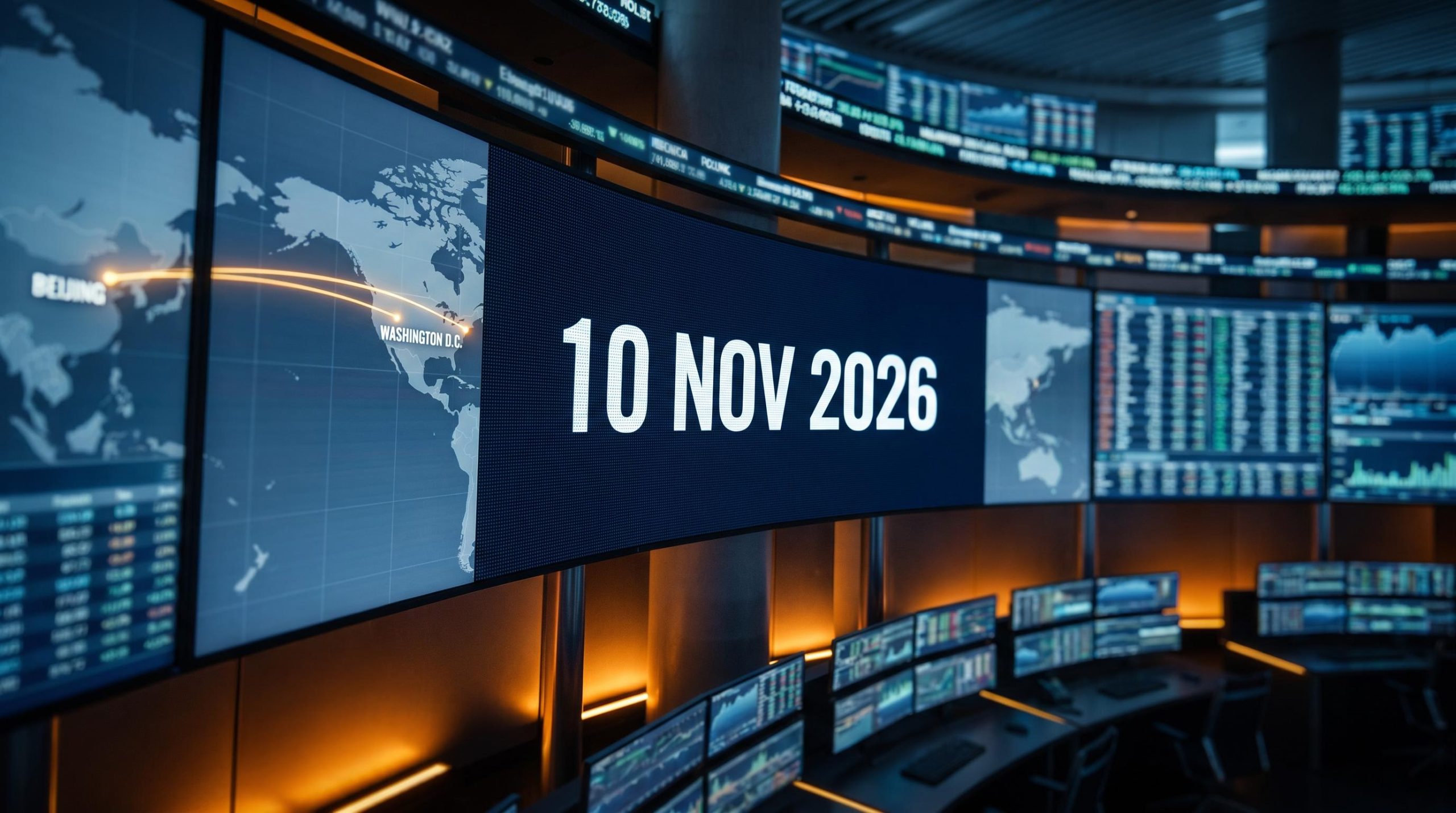
The summit arrives with an unusual clock running. The existing U.S.-China tariff truce expires on 10 November 2026, the two leaders last met in Beijing in May, and the Washington meeting is widely expected to set the direction of U.S.-China economic relations through at least mid-2027.
The agenda spans trade volumes, technology access, rare earth supply chains, Taiwan rhetoric, and secondary issues including the Iran conflict and fentanyl precursor chemicals. Each thread carries distinct market implications, and not all of them point the same way.
This is a section-by-section breakdown of the four agenda items most likely to move markets, what each realistic outcome looks like, and where the analytical consensus may be getting ahead of the evidence. It is not a prediction. It is a framework for weighing the probabilities before the meeting happens.
Why the November 10 tariff deadline is the only number that matters right now
The current tariff architecture is a ceasefire, not a settlement. Before the truce, proposed duties on both sides had been driven beyond 100%, a level severe enough to threaten international supply chains outright. The ceasefire halted that escalation rather than reversing the underlying dispute.
Under the truce as it stands, the U.S. levies tariffs on covered Chinese imports at roughly 30%, while Chinese tariffs on covered U.S. goods sit at approximately 10%, according to figures compiled by Perplexity that have not been independently confirmed. Average U.S. customs duties on Chinese imports had reached 41% before being trimmed to 31%. The suspension of the steeper rates was formalised through a May 2025 Geneva agreement and a follow-up arrangement in Kuala Lumpur in November 2025.
The White House joint statement on the Geneva trade meeting formalised the suspension of 24 percentage points of the additional ad valorem duty, retaining a baseline 10% rate, establishing the specific tariff floor that both governments have since been negotiating around.
Both sides are now negotiating a reciprocal reduction covering roughly $30 billion in goods, with China’s tariffs on U.S. liquefied natural gas (LNG) a named target. U.S. officials have reportedly held back any finalised rate announcement until after the summit, with the Trump administration said to prefer a settled level near 20% to keep rates broadly in line with the truce.
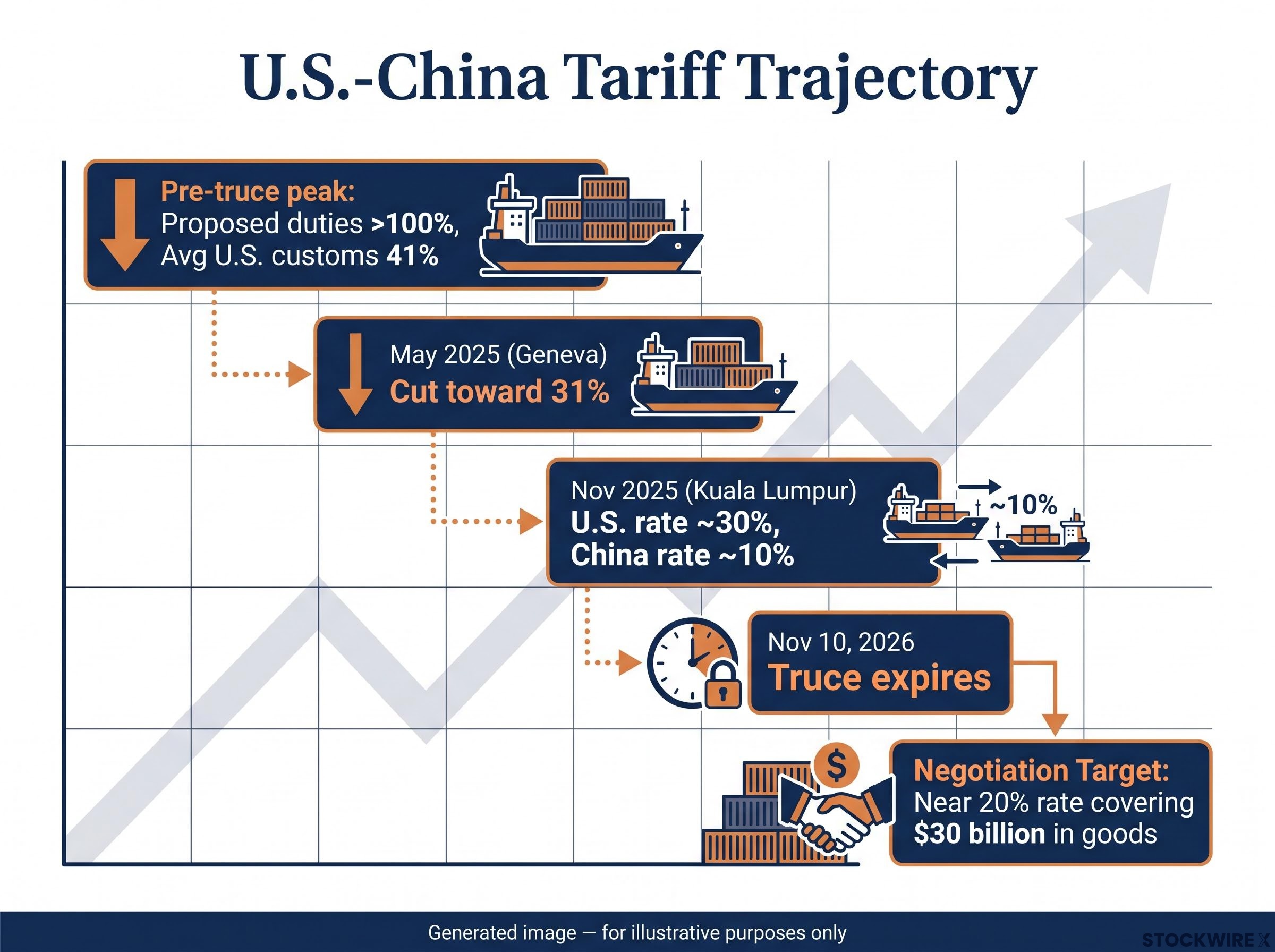
| Point in the timeline | Tariff environment |
|---|---|
| Pre-truce peak | Proposed duties driven beyond 100%; average U.S. customs duties reached 41% |
| Geneva agreement, May 2025 | Steeper tariffs suspended; rates cut toward 31% |
| Kuala Lumpur arrangement, November 2025 | Truce framework formalised; current U.S. rate approximately 30%, Chinese rate approximately 10% |
| Truce expiry, 10 November 2026 | Reversion risk to pre-truce escalation path unless extended or replaced |
What this tells you is that the truce is not a background condition. It is an active countdown with a fixed end date, and the summit’s primary commercial job is to reset that clock or replace it with something more durable. The tariff level is the single variable most directly wired to earnings guidance for multinationals with China exposure, consumer goods pricing, and inflation expectations.
Tariff pass-through costs fall unevenly across the supply chain, with estimates attributing an additional $1,830-$2,600 in annual household expenses to the 2025-2026 escalation, a dynamic that gives the November deadline political weight beyond the corporate earnings channel.
What actually reverts if the truce lapses on November 10
If the ceasefire is allowed to expire, the pressure returns to the categories the truce currently caps. Covered Chinese imports would face reversion toward the pre-truce ceiling, dragging the average customs rate back up from the low thirties toward the peak levels that prompted the ceasefire in the first place.
The most exposed U.S. import categories are the high-volume consumer and industrial goods that sit at the centre of the covered list, where a jump from a 30% rate toward the pre-truce trajectory feeds directly into landed costs. For investors, the point is concrete: the downside is not a vague deterioration in sentiment but a mechanical increase in duties on named goods, and that increase would land within weeks of the deadline if no extension is agreed.
When big ASX news breaks, our subscribers know first
The Boeing deal and the agriculture promise: headline numbers versus delivery reality
The commercial centrepiece is aircraft. Following the May 2026 Beijing meeting, China formally committed to purchasing 200 Boeing aircraft, valued by aviation advisory firms at roughly $17-19 billion on the assumption that about 80% of the mix is 737 MAX narrow-bodies.
The scale gets murkier above that baseline. Reporting on the maximum scope of the negotiations conflicts: the original source described long-term talks potentially reaching 500 737 MAX jets plus wide-bodies, while subsequent research indicates Trump publicly cited a possible expansion up to 750 aircraft, a figure that has not been independently confirmed.
Here is where the headline and the order book diverge. Boeing’s CEO has clarified that delivery timelines remain undetermined and that firm orders are expected to arrive incrementally through individual Chinese airlines rather than as one finalised mega-contract. That is a material distinction, because Boeing’s order book recognises firm contracts, not political commitments.
The path from announcement to revenue runs through three distinct stages:
- Political commitment. A leader-level pledge to buy, which sets intent but binds no one to a specific contract or delivery date.
- Individual airline sign-off. Each Chinese carrier negotiates and signs its own order, converting the pledge into firm backlog.
- Regulatory and financing clearances. Export approvals, financing arrangements, and delivery scheduling turn a signed order into aircraft that actually change hands.
The current deal sits at stage one, with the “initial tranche” framing making that explicit.
History gives that framing weight. The 2019-2020 Phase One deal is the precedent investors should keep in front of them.
The pattern runs directly to the May 2026 Beijing summit, where Beijing’s confirmed commitments covered tariffs, agricultural purchases, and aircraft procurement, but no formal agreement, tariff schedule, or implementation timeline was published by either government.
Under Phase One, China ultimately met only around 10% of its $200 billion in extra purchase commitments, according to figures that have not been independently confirmed. Structural disputes over subsidies and intellectual property were left unresolved.
The agricultural and LNG side of the agenda runs on the same logic: political pledges to buy farm products and cut tariffs on U.S. gas make headlines, but the follow-through depends on commercial orders materialising over time.
For investors holding Boeing or watching the industrial sector, the distinction between a political commitment and a firm order with delivery dates is the difference between a catalyst and a headline. Boeing’s equity has historically reacted sharply to China aircraft news and then given the move back when the orders lacked contract backing. On the current evidence, this deal is closer to the headline end of that spectrum than the catalyst end.
The chip war and the rare earth standoff: two pressure points, one negotiating table
The technology and critical minerals tracks are best understood as a single reciprocal arms race rather than two separate disputes. Each side has spent months building leverage against the other, and each holds a chokepoint the other cannot easily route around.
On the U.S. side, semiconductor export controls have been layered rather than imposed in one stroke. The Commerce Department added roughly 140 China-linked semiconductor entities to its blacklist in December 2024, followed by 42 entities in March 2025 and 23 more in September 2025 (figures unconfirmed independently). A “50% affiliates rule” introduced in September 2025 automatically extends restrictions to foreign firms majority-owned by listed companies, while an August 2025 move revoked Validated End-User (VEU) status for certain foreign-owned fabs in China, forcing them onto case-by-case licensing. Guidance issued in May-June 2026 extended AI-chip licensing restrictions to Chinese-headquartered entities operating abroad.
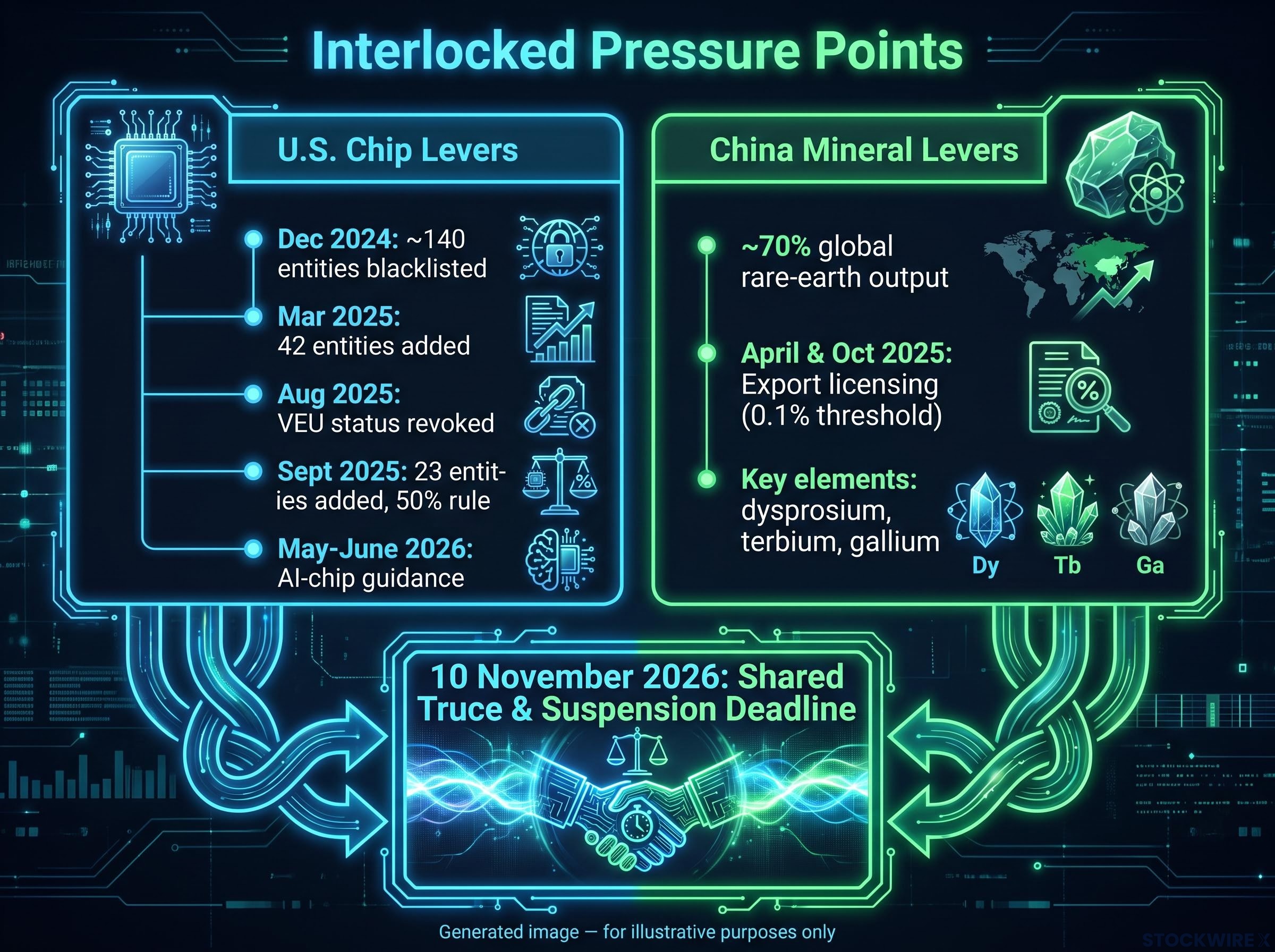
China’s counter runs through the critical minerals it dominates. Beijing controls roughly 70% of global rare-earth output and nearly all heavy rare-earth production, according to unconfirmed estimates, giving its export controls real bite.
| Pressure point | U.S. lever | China lever |
|---|---|---|
| Advanced chip access | Entity List expansion; 50% affiliates rule | Heavy rare-earth export licensing (dysprosium, terbium, gallium) |
| Manufacturing chokepoints | VEU status revocation for China-based fabs | Permanent magnet and processing technology controls |
| Offshore workarounds | Overseas AI-chip guidance on Chinese entities abroad | 0.1% Chinese-origin threshold triggering approval requirements |
The critical detail is the calendar. In April and October 2025, China imposed export licensing on heavy rare earths, magnets, and processing technology, with current rules reportedly requiring approval for products containing as little as 0.1% Chinese-origin rare earths by value. Portions of those controls have been suspended through 10 November 2026, the exact same date the tariff truce expires.
That convergence changes how you should read the summit. It is not defusing two separate disputes on independent timelines. It is defusing two interlocked pressure points that share a deadline, which means a failure on either track likely reactivates both. Investors in semiconductor equipment, defence contractors, EV manufacturers, and clean energy supply chains all sit downstream of this single negotiating table.
Why China’s rare earth dominance is not an unlimited weapon
Beijing’s leverage here has a shelf life. Rare earth mining and processing diversification is already underway in multiple countries, which reduces, though it does not yet eliminate, China’s grip. That tension is part of why the controls have been suspended rather than tightened, and it is a reason to treat any summit-era escalation on this track as a shorter-term risk than the raw dominance figures suggest.
The Taiwan language problem and what a single word could signal to markets
The most sensitive item on the agenda may hinge on the difference between two verbs. Beijing wants Trump to shift the U.S. formulation on Taiwan from “does not support” independence to “opposes” independence.
That looks like a linguistic nicety. It is not. The current U.S. One-China policy pairs “does not support” Taiwanese independence with opposition to any unilateral change to the status quo by either side, a posture of restraint that keeps options open. “Opposes” is a policy commitment that forecloses them.
The distinction that matters Current U.S. formulation: the United States “does not support” Taiwanese independence. Beijing’s requested formulation: the United States “opposes” Taiwanese independence. The first is a stance of restraint. The second aligns U.S. language with Beijing’s own legal framing and pre-judges Taiwan’s future.
U.S. officials have already declined this request once, at an Xi meeting on 29 April 2026, seeing “oppose” as too close to Beijing’s position and as pre-judging an outcome Washington has long kept deliberately open.
The market mechanism runs through Taiwan’s semiconductor cluster. Foreign policy analysts warn that a shift to “oppose independence” could be read in Beijing as a green light to intensify coercive pressure short of invasion, meaning economic sanctions or cyber operations. That kind of pressure directly threatens the island’s chip production, anchored by TSMC, which sits at the centre of the global semiconductor supply chain.
If Trump makes the language shift at this summit, the market implication is not a treaty or a tariff. It is a changed risk premium on every supply chain that depends on TSMC. This is one of the rare diplomatic variables with a direct, traceable path to equity risk in a named sector, which means the right response is to watch the press conference transcript word by word.
Taiwan semiconductor risk extends well beyond the diplomatic language debate: TSMC produces approximately 90% of the world’s leading-edge chips and Taiwan holds only around 11-12 days of LNG reserves, meaning coercive pressure short of invasion could force fab shutdowns within weeks.
What history says about summit deals: the implementation gap investors keep forgetting
Structural scepticism here is not pessimism. It is pattern recognition.
The clearest evidence is Phase One. China met only around 10% of its $200 billion in extra purchase commitments, and the structural disputes that mattered most, state subsidies and intellectual property enforcement, were left essentially untouched. The deal delivered headlines and a temporary truce, not a resolution.
The current negotiation is built on the same foundation. Like the December 2018 G20 truce before it, the 24 September summit is structured around a ceasefire and headline commitments rather than a settlement of the underlying disputes. Analysts caution that high-profile Washington summits frequently produce exactly this shape: a headline ceasefire followed by a long implementation gap.
That does not mean every outcome is equally fragile. Some categories of deal hold better than others.
Higher durability outcomes:
- Tariff rate formulas with defined review mechanisms and dates
- Procedural frameworks with named implementation channels
Higher slippage risk outcomes:
- Volumetric purchase commitments (the Boeing and agriculture pledges sit here)
- Vague technology dialogue pledges with no enforcement mechanism
The reader value here is a sorting tool. Announcements in the first group deserve to influence portfolio positioning; announcements in the second deserve a wait-and-see posture until implementation evidence accumulates.
A framework for reading the post-summit announcement
When the joint statement or press conference lands, three or four specific signals separate structural durability from headline weight:
- A named review mechanism with dates. A tariff formula that specifies when and how rates will be reassessed is far more durable than a one-off rate cut.
- Binding enforcement language. An arbitration clause or defined penalty for non-compliance signals both sides expect the deal to be tested.
- Named agency-level implementation contacts. Publicly identified officials responsible for follow-through indicate a process, not just a photo opportunity.
- Specificity on the next negotiating cycle. A stated date for the next review or meeting turns goodwill into a schedule.
Deals carrying those markers deserve more weight. Deals that are all headline and no mechanism have historically given their gains back.
What the summit will not resolve, and why that is the baseline to hold
No single meeting can close the disputes that actually define this relationship. State subsidy architecture, intellectual property enforcement, the trajectory of technology decoupling, and Taiwan’s long-term political status all sit outside the realistic scope of a one-day summit.
For investors, geopolitical fragmentation is the structural backdrop against which every summit outcome should be assessed: the IMF warns severe fragmentation could reduce global GDP by up to 7-8% long term, meaning the November deadline is not a bilateral trade event but a node in a much larger divergence.
What a successful summit can deliver is narrower and worth naming precisely: a runway extension on the truce, a set of headline commitments that give both governments domestic credibility, and a framework for the next negotiating cycle. That is a reset, not a resolution.
The five stated agenda items, trade, tariffs, Taiwan, the Iran conflict, and AI and fentanyl, split cleanly along that line. Trade and tariffs are near-term tractable. Taiwan and technology decoupling are long-cycle structural questions that will outlast this meeting and the next.
For investors, the useful posture is to watch dates, not handshakes:
- 10 November 2026. The truce expiry and rare earth suspension deadline, the nearest hard constraint on the whole relationship.
- The mid-2027 tariff review window. The point at which any rate formula agreed at the summit would be tested for durability.
- The next scheduled U.S.-China diplomatic meeting. Whether one is named at all, and with what agenda, signals how much process the two sides intend to build.
The right question after this summit is not whether Trump and Xi shook hands. It is whether the mechanism for the next tariff review has a named date, because that date is the actual market catalyst, not the meeting itself.
This article is for informational purposes only and should not be considered financial advice. Investors should conduct their own research and consult with financial professionals before making investment decisions.
Past performance does not guarantee future results. Financial projections and any forward-looking statements are speculative, subject to change based on market developments, and dependent on various risk factors.