Most investors chasing the semiconductor boom start with the same question: where is the next Nvidia? The instinct is to hunt for another pure graphics-processor monopoly and ride it. That instinct may be the wrong one.
The capital flooding into AI infrastructure is not pouring into a single lane. It is splitting into highly specific channels, with the largest cloud operators funding two distinct bets at once: general-purpose compute that challenges the market leader, and bespoke custom silicon designed for their own workloads.
AMD and Marvell sit on opposite sides of that split. One wants to become the second great AI compute platform. The other wants to be the indispensable engineer behind chips that will never carry its logo.
Understanding AI infrastructure stocks now means understanding those two very different business models, and the very different risks attached to each. This analysis gives you a fundamentally driven framework for spotting genuine earnings acceleration in hardware suppliers, so your allocation decisions rest on verifiable enterprise adoption rather than a replay of returns that have already happened.
The 2023 inflection point and the new infrastructure playbook
The template for reading this cycle was set in May 2023, when Nvidia reported its fiscal first-quarter results and changed how the market thinks about data centre demand.
Nvidia posted total revenue of $7.2 billion that quarter, with $4.3 billion coming from its data centre segment. The number that reset expectations was not the actual result but the guidance: management projected roughly $11 billion for the following quarter. The quarter that followed delivered $13.5 billion in total revenue, up 101% year-on-year, with data centre revenue of $10.3 billion, up 171%. Recent quarterly revenues have since reached approximately $96 billion.
That single guide became the reference point for identifying a structural shift rather than a passing surge in orders.
The distinction that matters is structural versus cyclical. A cyclical spike is demand pulling forward; a structural shift is demand arriving because the underlying architecture of computing has changed. The 2023 inflection was the market conceding the latter.
This matters because semiconductors move in cycles, and cycles have shapes. Demand runs ahead of supply, supply lags, capacity expands, and eventually supply catches up and normalises. Analysts commonly measure these windows at roughly four years from peak to peak.
The current AI buildout is widely described as an early-to-mid supercycle. Growth projections point to strong but modulating expansion, with estimates in the region of 20% in 2024, 23% in 2025, and 26% in 2026. Earlier booms in personal computers and the internet saw semiconductor growth stretch across extended phases before flattening out.
So here is the read you should take into the rest of this piece. The infrastructure buildout is not an infinite straight line. It is a defined multi-year cycle, and the only reliable way to separate durable winners from cyclical traps is to look for genuine enterprise adoption: rapid data centre revenue acceleration, upward estimate revisions, expanding addressable markets, and customer deployments you can actually verify.
Most capital flowing into AI infrastructure is concentrated in just one or two of the AI supply chain layers, and the distinction between a GPU designer, a custom ASIC partner, a networking infrastructure provider, and a foundry equipment name is not cosmetic: each layer carries a different moat type, a different binding constraint, and a different risk profile as the cycle matures.
When big ASX news breaks, our subscribers know first
AMD and the ambition of general purpose compute scale
AMD has spent the past two years transforming itself from a challenger with promising parts into a company where data centre is the main event.
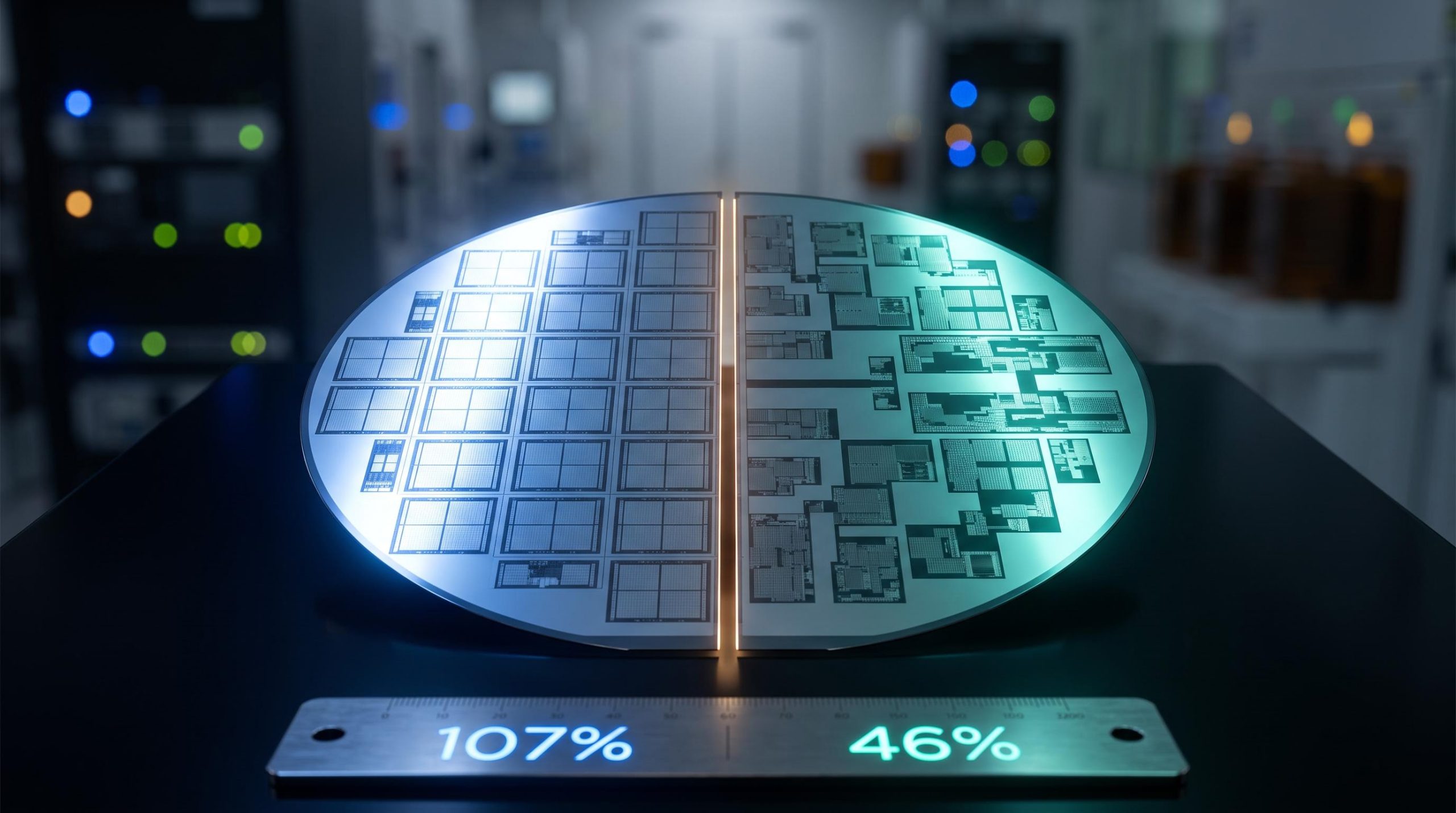
In its most recent quarter, Q2 FY 2026 (ended 27 June 2026), AMD reported total revenue of $11.5 billion, a company record and a 50% year-on-year increase. The data centre segment generated $6.7 billion, up 107% year-on-year, and now accounts for 58% of total revenue. That growth was driven by EPYC server processors and the Instinct AI GPUs, including the MI350 series.
Profitability told the more important story. The data centre segment produced operating income of $2.1 billion, a 31% operating margin, a sharp reversal from an operating loss in the prior-year period (a comparison distorted by an $800 million export-control charge that year).
The strategic centrepiece is Helios, AMD’s rack-scale system that bundles Instinct MI450/MI455X GPUs, CPUs, networking, and software into a single integrated product. It is a direct answer to the market leader’s bundled approach, and it is winning attention from serious buyers. Anthropic has agreed to deploy 2 gigawatts of Instinct MI450 GPUs on the Helios architecture, and Microsoft has expanded its partnership to run Helios systems and sixth-generation EPYC processors across Azure. Active deployments also span Amazon, Meta, Oracle, and Alphabet.
On raw capability, AMD is competing hard on memory and bandwidth. According to company claims, Helios racks deliver 10-15% more performance at fixed rack power and up to 30% more tokens per dollar than the competing architecture.
| Company | Segment Focus | Q2 Data Centre Revenue Growth | Core Hardware Type |
|---|---|---|---|
| AMD | General-purpose AI compute and rack-scale systems | 107% YoY (to $6.7B) | EPYC CPUs and Instinct GPUs |
| Marvell | Custom silicon, networking and electro-optics | 46% YoY (to $2.17B) | Custom ASICs and connectivity infrastructure |
Navigating the developer ecosystem deficit
Hardware is only half the fight. The harder half is software, and here AMD faces its steepest climb.
Nvidia’s CUDA platform is supported by an estimated 5.9 million developers and nearly two decades of optimised libraries. AMD’s developer base, built around its open-source ROCm stack, is far smaller, often cited at 100,000 or fewer, though it is growing.
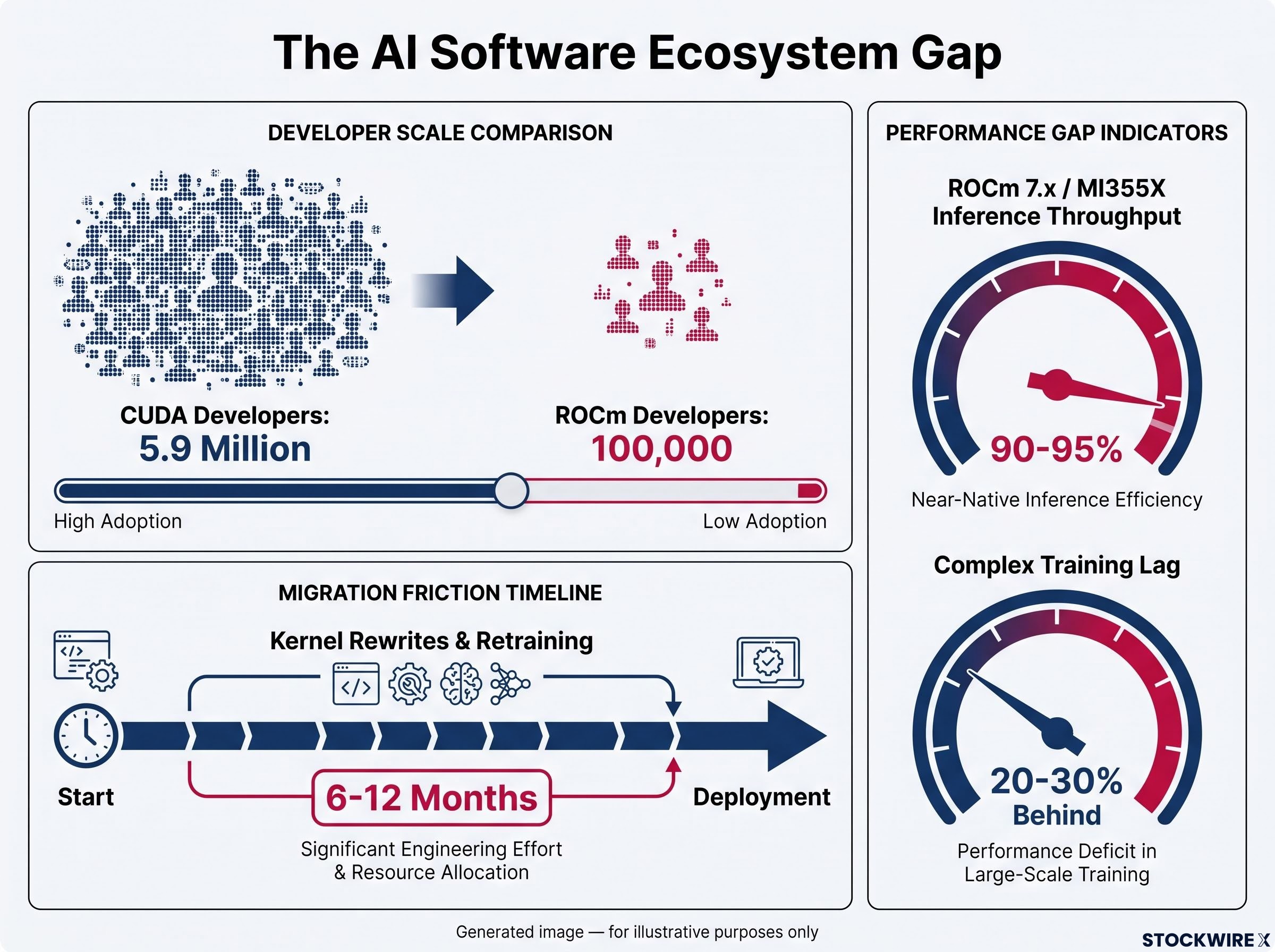
That gap creates real migration friction. Moving large deployments off CUDA can require 6-12 months of kernel rewrites and retraining, and performance often regresses during that transition. AMD’s ROCm 7.x has narrowed the gap on inference, with the MI355X reported to reach 90-95% of the competing chip’s throughput on some inference tasks, but it still trails by 20-30% in complex training workloads.
When you look at AMD’s margin profile, read it as a deliberate trade. Breaking an entrenched software monopoly means sacrificing near-term pricing power to buy long-term ecosystem footprint. Software adoption, not benchmark charts, is the metric to watch on future earnings calls.
Ecosystem switching costs, not raw benchmark performance, are the metric that will determine whether AMD’s ROCm developer base compounds into a durable competitive position or remains a second-choice migration option for workloads that general-purpose GPU infrastructure already handles adequately.
Marvell and the economics of custom hyperscaler silicon
Now step away from graphics processors entirely, because the other major AI infrastructure story barely involves selling a chip under your own name.
Marvell does not compete head-on with AMD or the market leader. It operates as the engineering co-pilot to the largest cloud operators, helping them design proprietary, workload-specific chips they can call their own.
The financials show how fast that role is scaling. In Q2 FY 2027 (ended 1 August 2026), Marvell reported record total revenue of $2.739 billion, up 36.5% year-on-year. Data centre revenue reached $2.17 billion, up 46% year-on-year, and now represents 79% of the total business. Adjusted earnings came in at $0.94 per share against a $0.93 consensus, with operating cash flow above $600 million.
Why are the giants building their own chips rather than buying off the shelf? The motivations are specific and financial.
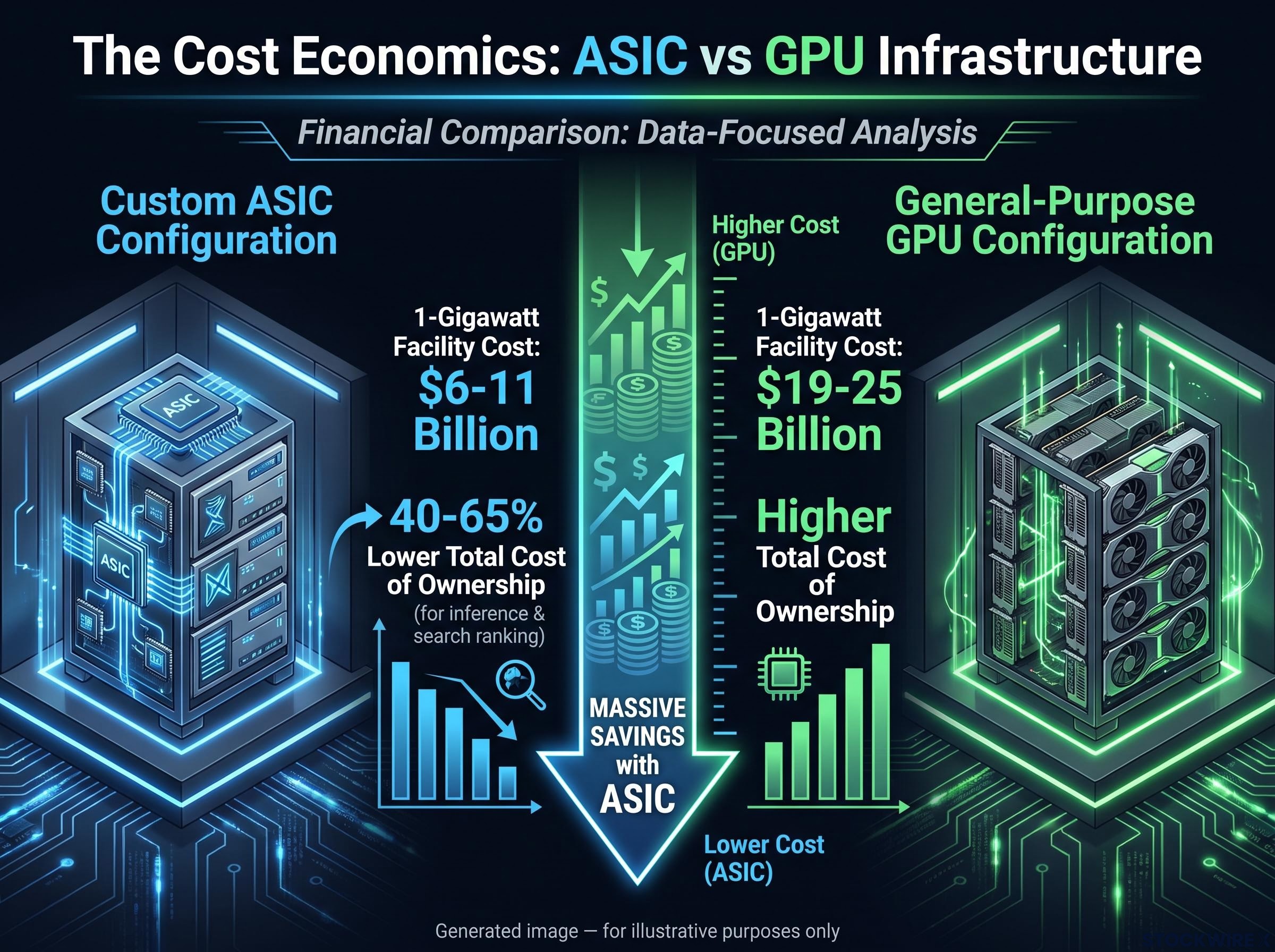
- Total cost of ownership and power efficiency. Custom application-specific integrated circuits (ASICs), which are chips built for one narrow task rather than general use, are estimated to deliver 40-65% lower total cost of ownership than general-purpose GPUs on predictable, high-volume workloads like inference and search ranking.
- Strategic control. Designing in-house lets a cloud operator set its own hardware roadmap, free of a single supplier’s release cadence and pricing.
- Supply chain diversification. Owning the design reduces the concentration risk of depending on one GPU vendor.
The cost gap at scale is striking. A 1-gigawatt AI facility built on ASIC racks is estimated to cost $6-11 billion, against roughly $19-25 billion for a comparable GPU-based configuration.
Marvell’s reach extends well beyond custom compute. Its portfolio covers electro-optics, networking, storage controllers, and memory-interface infrastructure, the connective tissue of a modern data centre. A recently expanded relationship with Alphabet spans custom products tied to Google’s TPU ecosystem, with Alphabet even issuing commercial incentives through a warrant structure, a signal of how deep the co-development runs. Marvell is also a lead ASIC partner for Amazon’s Trainium and Inferentia chips.
Here is the way to hold this in your head. Marvell is a pure play on the biggest tech companies wanting to control their own destiny. That means your success as a shareholder is tied directly to the capital-expenditure budgets of just three or four cloud operators. It is a different narrative from the general-compute plays, and it protects you from the binary trap of assuming only GPU sellers count as infrastructure investments.
Execution realities and customer concentration risks
Both growth stories are genuine. Both also carry structural vulnerabilities sharp enough to reverse a quarter, and you need to weigh them coldly before committing capital.
Marvell’s central weakness is concentration. Recent filings indicate its top-10 customers historically account for over 80% of total revenue. When a business depends that heavily on a handful of buyers, a single delayed or cancelled custom programme can trigger severe downside, and Marvell’s stock has swung close to 18% on weaker data centre outlooks tied to custom programmes. There is also the longer-term risk that Amazon, Microsoft, or Meta eventually pull more design work in-house or dual-source with a rival such as Broadcom.
AMD carries a different exposure: regulation and geopolitics. The company previously booked up to $800 million in charges tied to US export restrictions on its MI308 GPUs bound for China. Certain AI products are cleared for sale to China only under terms where a reported 15% of proceeds go to the US government, which adds direct pressure to margins. Layer on the execution demands of ramping the MI450 and deploying Helios at scale, and the margin for error is thin.
For both, margin sensitivity is the number analysts watch. Custom ASIC work carries high non-recurring engineering costs, and Marvell’s margin is tracked closely around the 57-59% range. Any slippage there directly threatens the thesis.
Then there are the risks they share:
- TSMC foundry dependence. Both rely on TSMC for advanced nodes and advanced packaging, exposing them to Taiwan-related geopolitical risk and potential capacity bottlenecks.
- Advanced packaging constraints. Techniques like CoWoS and high-bandwidth memory assembly are supply-limited across the industry.
- Capex durability. If the cloud operators overbuild, or if AI model economics shift unfavourably, a pullback in infrastructure spending would hit both companies’ data centre trajectories at once.
The practical point is simple. Track Marvell’s customer retention and AMD’s execution cadence as active positions, not background noise, because a miss in either is where the severe corrections start.
Hyperscaler capex dynamics complicate both theses at once: the same $700 billion-plus infrastructure wave funding AMD’s Instinct GPU pipeline and Marvell’s custom ASIC engagements is simultaneously bankrolling the in-house silicon programmes at Alphabet, Amazon, and Microsoft that represent the most credible long-run competitive pressure on general-purpose compute.
This article is for informational purposes only and should not be considered financial advice. Investors should conduct their own research and consult with financial professionals before making investment decisions. Past performance does not guarantee future results, and financial projections are subject to market conditions and various risk factors.
Weighing the dual paths of semiconductor allocation
The core difference between these two cases is structural. AMD is fighting a high-profile, high-stakes battle for general platform dominance, spending pricing power to buy ecosystem share. Marvell is running a quieter, more concentrated model, embedding itself in the custom silicon of a few enormous customers.
The coming earnings cycles will test both. Watch whether AMD’s software adoption and Helios ramp justify the aggressive price targets analysts have set, and whether Marvell’s custom programmes convert into the durable revenue its valuation now assumes.
For portfolio construction, the choice comes down to conviction. If you believe open-ecosystem adoption eventually cracks the software moat, AMD fits that view. If you believe the largest clouds will keep building proprietary architecture, Marvell is the more direct expression. Both statements are speculative and subject to change as the cycle develops.
The supplier profitability advantage is becoming structurally measurable: Goldman Sachs projects that combined hyperscaler return on equity will fall by an average of seven percentage points from mid-2026 as depreciation climbs, while semiconductor suppliers retain pricing power precisely because the buyers are compelled to keep spending regardless of their own margin compression.