
Most people believe you need a lump sum, a mortgage-sized commitment, or a wealth manager on speed dial before you can start building real wealth in the share market. Hayden McLean started with spare change and a roundup app.
The Sydney Swans player is 27, an age when a professional footballer is thinking hard about a truth that applies to almost every high-earner on a short clock: the money comes in a narrow window, the career ends young, and in Australia your superannuation stays locked away until you are well into your sixties. McLean’s response was not a financial plan drawn up by an adviser. It was a $500 monthly commitment and a habit.
Here is how he built it, in the order he built it, with the numbers that shaped each decision. You will leave with a clear picture of which platforms suit which balance levels, which ETFs he chose and why, and how to layer technology exposure on top of a diversified core without betting the whole thing on one thesis.
From spare change to skin in the game: how Hayden McLean got started
The entry point was social, not structured. A senior Swans teammate pointed McLean toward Raiz, a micro-investing app that rounds up your everyday card purchases to the nearest dollar and invests the difference. No lump sum, no broker, no paperwork marathon.
You can start on Raiz with as little as $5. That low bar is the entire point: the roundup mechanism removes the behavioural friction that stops most people from ever placing a first trade.
Even as a beginner, McLean made an active choice. He selected a higher-growth, higher-risk allocation, one that at the time included an emerging cryptocurrency option, rather than defaulting to the most conservative setting.
Then something shifted in his head. Watching his invested funds grow reframed investing from a risky, gated activity into something practical, proof that money could work for him without leverage or a large upfront cheque.
The catch arrives quietly, in the fee math. Here are the key Raiz tiers, which are flat monthly charges rather than a percentage of what you hold:
- Lite plan: $2.50 per month for balances up to $1,500 (figure not independently confirmed).
- Regular plan: $5.50 per month for balances under $26,000; over that, no monthly fee but a 0.275% annual account fee (figure not independently confirmed).
A flat fee feels cheap on a small balance and expensive on a growing one. That is the signal. A $5.50 monthly charge on a few hundred dollars is a meaningful drag; on a portfolio building toward five figures, you want a structure that scales with you, not against you.
That is what pushed McLean to CommSec Pocket, where he began putting roughly $500 a month into selected ETFs including Australian technology, sustainability, and ASX top 200 options.
| Platform | Minimum | Fee structure | Ownership model | Best-suited balance |
|---|---|---|---|---|
| Raiz | $5 | Flat monthly ($2.50-$5.50) | Units in a managed fund | Getting started, under ~$10,000 |
| CommSec Pocket | $50 per trade | $2 per trade to $1,000; 0.20% above | Beneficial ETF ownership | Building an ETF habit |
| Pearler | $5 (Micro) | $6.50 flat per trade (main) | CHESS-sponsored, your own HIN | Long-term index investing |
The lesson worth carrying: micro-investing apps are training wheels by design, not permanent homes for a growing portfolio. The right time to graduate is usually sooner than you think.
When big ASX news breaks, our subscribers know first
The five-ETF portfolio McLean built, and the logic behind each pick
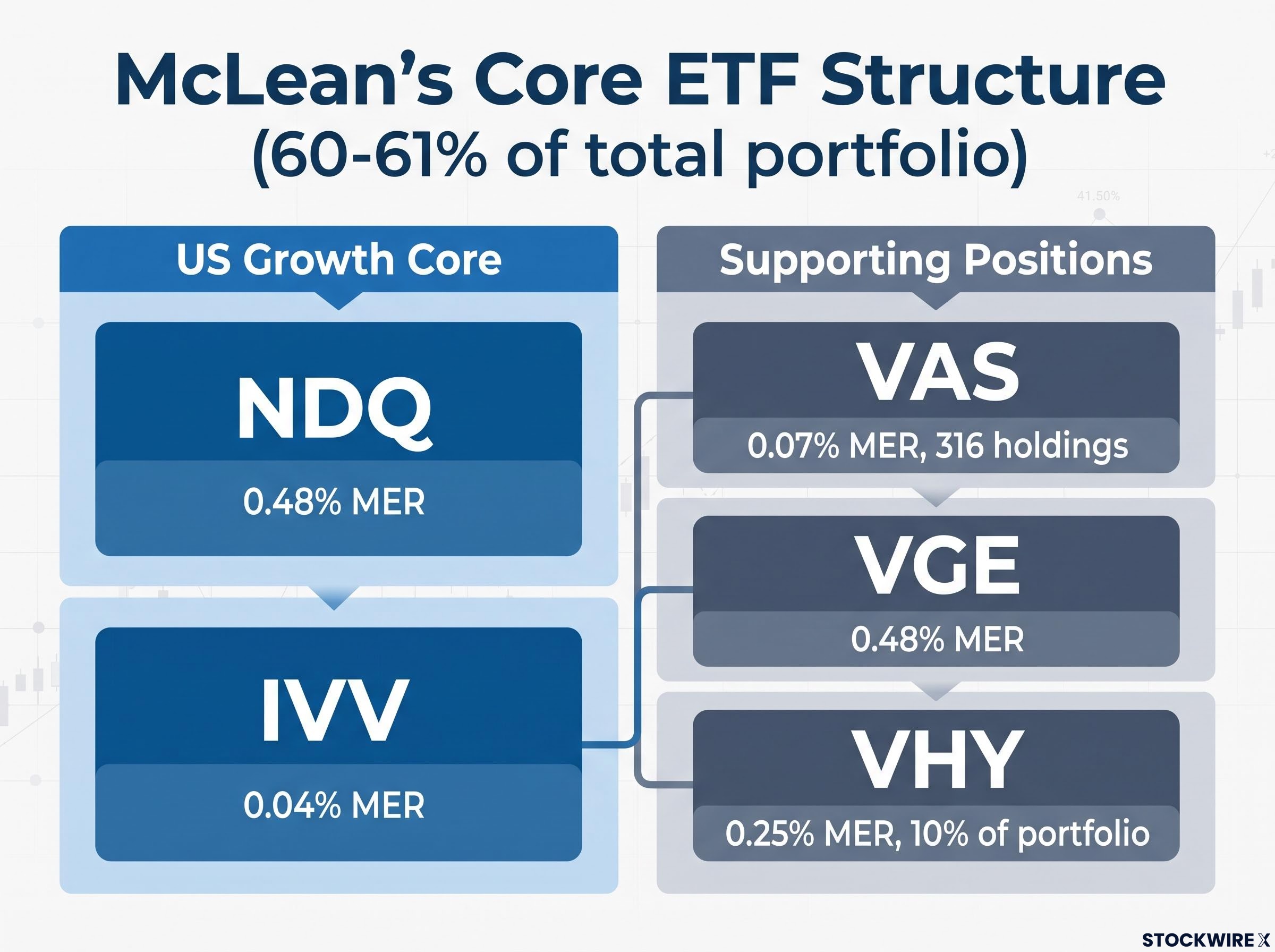
McLean’s current core is a five-ETF structure, and none of the picks are random. Read together, they form a deliberate shape: a US growth engine, geographic spread, a domestic anchor, and an income position now under review. ETFs make up roughly 60-61% of his total portfolio.
The two largest holdings sit at the centre, not the edge: NDQ and IVV. That placement tells you the US-heavy technology bias is the strategy’s core conviction, not a garnish.
The US growth core
NDQ (BetaShares NASDAQ 100 ETF) tracks the Nasdaq-100, the 100 largest non-financial companies on the Nasdaq, with holdings including Nvidia, Apple, Microsoft, Amazon and Alphabet. It carries a management expense ratio (MER, the annual percentage the fund charges you) of 0.48% and gives unhedged US dollar exposure. Reported returns to Q2 2026 showed a 1-year figure of 24.9% and a 3-year annualised 24.2% per year in AUD (figures not independently confirmed).
IVV (iShares S&P 500 ETF) tracks the S&P 500 of large US companies at an MER of just 0.04%, with an approximate 1-year return around 15% and a 3-year annualised figure near 17% in AUD.
Notice the gap between them. NDQ costs twelve times what IVV does. That is not a rounding error you should absorb without thinking, because a higher fee means the underlying holdings have to outperform proportionally just to justify the cost. Paying up for concentrated tech exposure can make sense, but it should be a decision you make on purpose, not one that happens to you.
The supporting positions: VAS, VGE, and VHY
VAS (Vanguard Australian Shares Index ETF) tracks the S&P/ASX 300 across roughly 316 holdings at an MER of 0.07%, paying quarterly income with franking credits attached. It is the domestic anchor that keeps the portfolio from being entirely offshore.
VGE (Vanguard FTSE Emerging Markets Shares ETF) provides exposure to markets like China, India and Brazil through the underlying VWO fund, at an MER of 0.48%. It is the geographic diversifier that offsets the US concentration.
VHY (Vanguard Australian Shares High Yield ETF) holds higher-dividend ASX companies at an MER of 0.25% and makes up about 10% of McLean’s portfolio. He is weighing whether to replace it with something more growth-oriented, and the logic is timeline: targeting financial independence before age 34 means a yield-focused holding matters less than one built for long-run capital growth.
The execution method tying all five together is dollar-cost averaging (DCA): investing a fixed dollar amount every month regardless of where the market sits.
The DCA principle Because you invest the same dollar amount every month, a downturn automatically buys you more units at lower prices, without you needing to make any active call or time the market.
Why McLean is betting on technology, and what the critics say
Beyond the ETFs, McLean runs a 40% individual stock allocation, and it leans hard into technology. These are high-conviction satellite positions, not lottery tickets:
- Amazon
- Microsoft
- Nvidia
- Palantir
- AMD
- Rocket Lab
- IonQ (quantum computing)
His thesis is built from observable corporate behaviour rather than hype. When the largest technology companies pour capital into data centre infrastructure, McLean reads that spending as validation that genuine value is coming, even if it takes 10 to 15 years to fully materialise. When Amazon’s share price fell roughly 30% on concerns about heavy AI infrastructure spending, he treated it as short-term noise around a long-term signal.
Several major institutions share the optimism. T. Rowe Price, UBS, Goldman Sachs and Allianz Global Investors have held positive views on the sector, citing accelerating earnings and margin expansion. Goldman Sachs points to data centre and semiconductor capex as evidence of structural demand, implying long-term earnings growth of around 11% per year for leading infrastructure beneficiaries (figure not independently confirmed).
The bull case, quantified UBS forecasts that global AI revenues will rise roughly fifteenfold between 2022 and 2027, reaching US$420 billion (figure not independently confirmed).
The bear case deserves equal weight before you copy any of this. The risks are specific:
- Valuation stretch: many AI names already embed aggressive growth assumptions in their price.
- Monetisation delay: heavy spending disappoints if revenue takes longer than expected.
- Regulatory exposure: antitrust action, data privacy rules and national security compliance could compress margins.
- Semiconductor cyclicality: chip demand swings hard through cycles.
- Currency drag: unhedged US holdings expose your AUD returns to exchange-rate moves.
That last point compounds the others. NDQ and the individual US stocks are unhedged, so your returns in Australian dollars ride on two variables at once: how the shares perform, and where the AUD/USD rate goes. Both can move against you at the same time, which is worth acknowledging explicitly before you tilt a portfolio this heavily toward technology.
For investors wanting to stress-test NDQ or evaluate alternatives within the AI and technology space, our dedicated guide to comparing AI ETFs applies a five-criteria screening framework across concentration, value-chain position, cost, liquidity, and currency risk.
What the educational ramp looked like, and why starting late still works
McLean began at 27 and admits mild regret at not starting four or five years sooner. It is a reasonable feeling, but the arithmetic argues the other way: beginning at 27 is earlier than most Australians build any structured investment portfolio outside their super.
His education was informal by design. Podcasts did part of the work, and a WhatsApp group of five to eight Swans teammates swapping investment research did the rest. That peer network, not a formal adviser, was the architecture of his learning.
The peer-network model McLean used, a WhatsApp group swapping research rather than a formal adviser, reflects a broader pattern: the investing habits that compound wealth are built through repeated small decisions, not one-off advice sessions.
The platform path itself followed a clear sequence:
- Raiz for entry, using roundups.
- CommSec Pocket for structured, themed ETF investing.
- Pearler for automated monthly investing on your own HIN.
- Individual stock brokerage for direct equity positions.
There is a counterweight to peer-led learning worth naming. ASIC has specifically warned Gen Z investors that online trends can push them toward riskier decisions in fast-moving sectors, exactly the kind of environment McLean’s tech tilt sits inside.
ASIC’s warning to Gen Z investors, published in March 2026, specifically identifies social media and finfluencer content as drivers of riskier financial decisions, a dynamic that applies directly when your investment research comes from a WhatsApp group and a podcast feed rather than a licensed adviser.
The Australian superannuation gap and why it changes the calculation
Here is the structural reason this all matters. Australian superannuation only becomes accessible at age 67, the position as it stands in 2026.
McLean is targeting lifestyle freedom around age 34, with immediate post-career plans including a year of travel visiting family in Hong Kong and Europe. The gap between 34 and 67 is the entire case for an external portfolio: super cannot bridge it. He also intends to open investment accounts for his future children, treating compound growth as a multi-generational tool rather than a personal one.
Combining a superannuation and ETF portfolio, rather than treating them as separate accounts, is the structural response to the access gap McLean identifies: super accumulates tax-efficiently for retirement while the external portfolio provides liquidity during the years in between.
Building your own version of McLean’s portfolio
Enough observation. Here is the handoff, the part you can act on regardless of which specific ETFs or stocks you eventually choose.
Start by locating yourself on the same four-stage platform ladder McLean climbed:
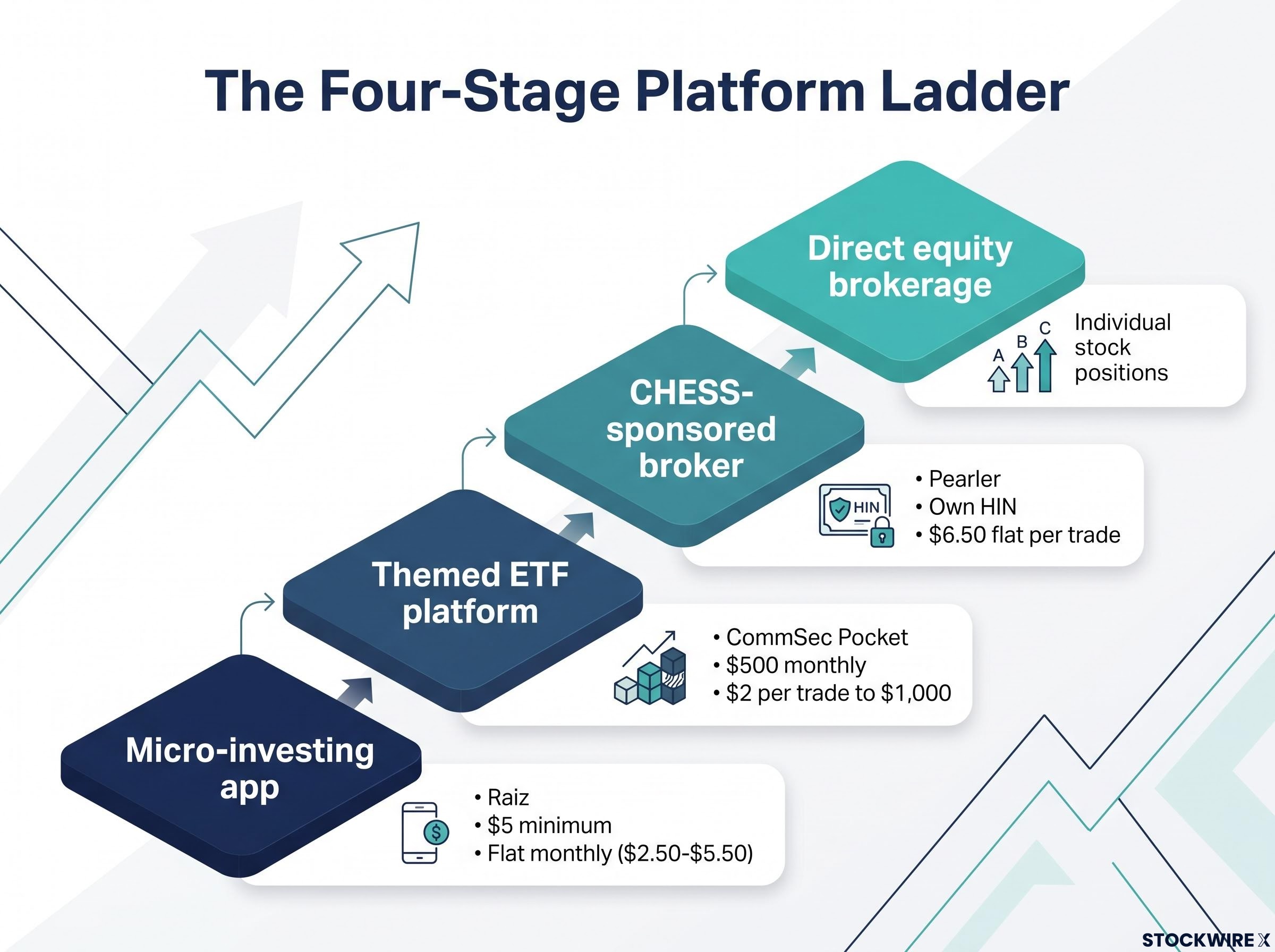
- Micro-investing app (like Raiz) to build the habit with roundups and tiny contributions.
- Themed ETF platform (like CommSec Pocket) once you can commit a fixed monthly amount.
- CHESS-sponsored broker (like Pearler) for direct ownership on your own HIN.
- Direct equity brokerage for individual stock positions, if and when you want them.
The trigger for each move is simple: watch for the point where a flat monthly fee becomes a drag relative to your balance. For most people, somewhere around $10,000 to $20,000 is where a micro-app stops making sense and a low-cost broker starts.
Then structure what you hold using the core-satellite approach:
- Core: broad-market ETFs such as VAS and IVV, the diversified foundation that carries most of your money.
- Satellite: sector-specific ETFs like NDQ and individual stocks, the higher-risk, higher-upside positions.
- Weighting: keep satellites to a minority of total holdings, especially when you are young.
That split is not just tidy theory. It is the mechanism that lets you hold speculative positions without a wrong thesis threatening the whole portfolio.
The core-satellite framework formalises this split by prescribing that the broadly diversified, low-cost foundation should hold 70-90% of a portfolio, with deliberate thesis-driven satellites occupying the remaining 10-30%, a structure that lets speculative conviction coexist with downside protection.
Your monthly routine Invest the same dollar amount, on the same date, every month, regardless of what the market is doing. Autoinvest features on platforms like Pearler automate exactly this, removing the temptation to time the market.
What McLean’s portfolio tells you about building wealth on a finite timeline
Strip away the football and the transferable parts of this story are clear. The platform ladder, the DCA discipline, and the core-satellite split are the replicable variables. The AFL salary and the short career are just the context that made those choices urgent enough to act on.
His portfolio is not a finished showcase, and that is what makes it useful. Several questions remain genuinely open:
- The VHY position is under review for a more growth-oriented replacement.
- The 40% individual stock allocation is one he plans to trim over time.
- The unhedged US currency exposure is a live risk, not a solved one.
A portfolio still being refined teaches you more than a polished one, because it shows that ongoing adjustment is the practice, not a sign something went wrong.
So place yourself honestly. Which rung of the platform ladder are you on right now, how does your current mix map to the core-satellite principle, and what is the one deliberate next move from where you stand? That question, answered specifically, is worth more than copying anyone’s exact holdings.
This article is for informational purposes only and should not be considered financial advice. Investors should conduct their own research and consult with financial professionals before making investment decisions.
Past performance does not guarantee future results. Financial projections are subject to market conditions and various risk factors, and forward-looking statements are speculative and may change based on market developments.