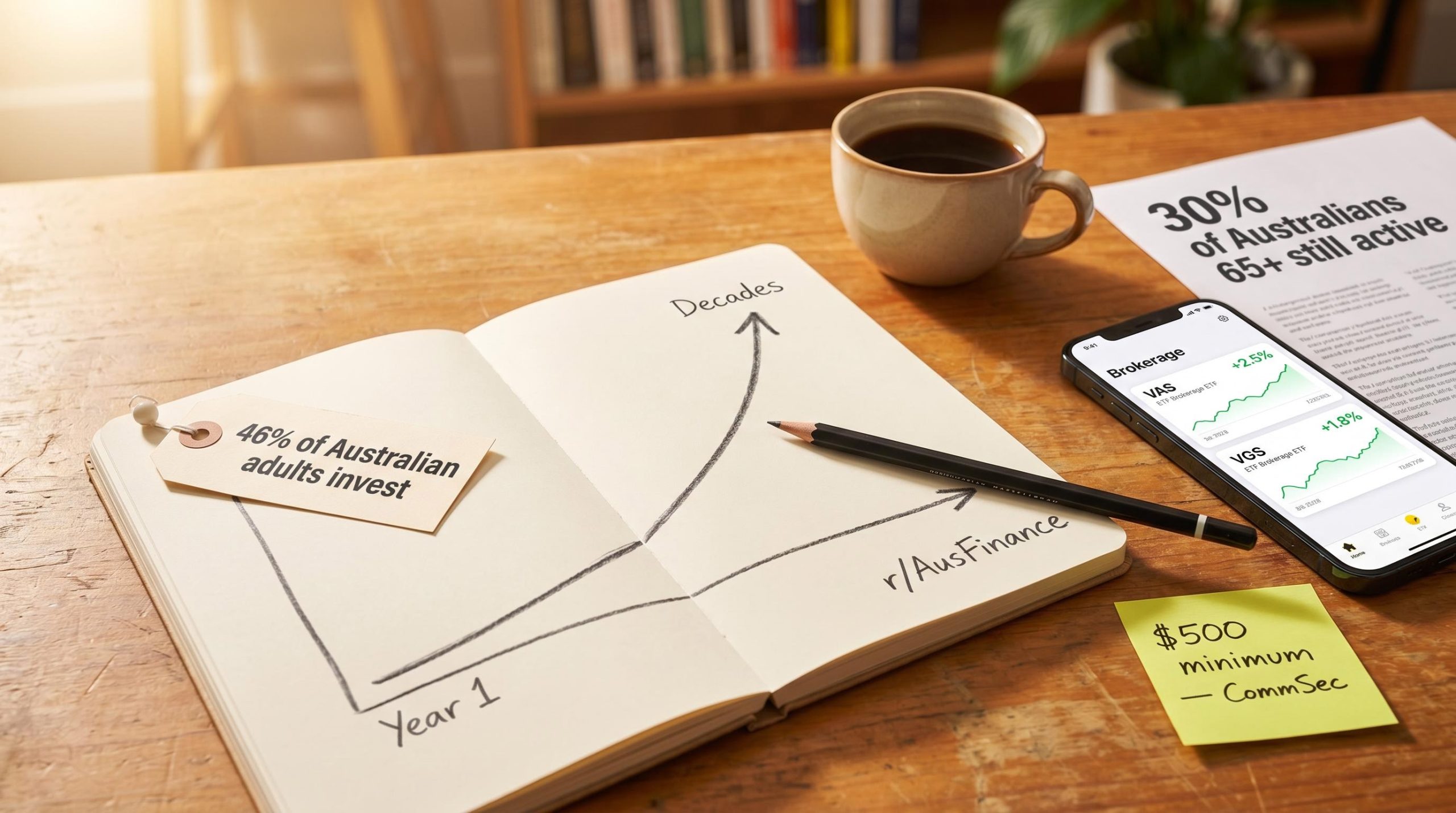
Most people approach investing by asking how much they can make. The more useful question is how long they are willing to stay engaged. According to the ASX Australian Investor Study 2023, 46% of Australian adults now invest in shares or funds, up from 43% the previous year. That is not a niche pursuit. It is a mainstream activity, and its growth suggests something beyond financial obligation is drawing people in.
This is not a guide about getting rich quickly, and it is not about protecting capital from inflation. It speaks to a specific reader: someone weighing whether committing to investing as a long-term, ongoing pursuit is worth the effort, and what that commitment should look like from day one. What follows covers why investing rewards patience and sustained engagement more than short sprints, what realistic first-year expectations look like, and how to build the habits, tools, and community that sustain decades of participation.
Why investing rewards commitment more than capital
The question most beginners fixate on is “how much money do I need to start?” It is the wrong question. The primary input that separates successful investors from unsuccessful ones is not starting capital. It is time and sustained attention.
Investing’s core advantage over most other intellectually engaging pursuits is compounding, and compounding operates on two levels. Financial returns compound with time in the market. Knowledge compounds alongside them. Each earnings season, each policy shift, each sector rotation adds to a growing base of pattern recognition that no course or book can deliver in isolation.
The mathematics of compounding over decades is more counterintuitive than most beginners expect: the final ten years of a thirty-year investment horizon generate more dollar growth than the preceding twenty years combined, which is precisely why early entry and sustained participation matter more than the size of the initial contribution.
The learning curve is measured in years, not weeks. Expecting competence after a single quarter is like expecting fluency in a language after one semester. According to the ASX Australian Investor Study 2023, 25% of under-40s entering the market are beginners, which means the participant base is constantly refreshing. A 2026 Mediaweek report noted that Australians increasingly treat investing as a lifestyle pursuit rather than a financial obligation, a shift in framing that aligns with the multi-year commitment the activity actually demands.
What keeps this pursuit intellectually fresh is that financial markets never repeat exactly. Geopolitical developments, central bank policy changes, and sector rotations ensure there is always something new to understand. That non-repetitive quality distinguishes investing from hobbies that plateau.
Sprint mindset versus long-game mindset:
- Checking portfolio prices multiple times per day versus reviewing holdings weekly
- Chasing a stock after a single news headline versus researching a sector over several weeks
- Measuring success by monthly returns versus measuring success by what was learned each quarter
- Abandoning a strategy after one bad month versus refining a strategy across market cycles
When big ASX news breaks, our subscribers know first
What investing does for your brain, especially later in life
The financial case for investing is well documented. The cognitive case is less discussed, and arguably more interesting for anyone thinking about this as a lifelong activity.
Research published in 2023 linked financial decision-making activities, including active investing, to approximately 12% slower cognitive decline in older adults. Broader ageing research suggests that problem-solving activities of this kind may reduce dementia risk by approximately 10%. No single definitive Australian longitudinal study has confirmed these figures in a local context, but the international evidence base is consistent: sustained cognitive engagement through strategic, decision-rich activities slows decline.
Research from 2023 links financial decision-making activities to approximately 12% slower cognitive decline in older adults, placing active investing alongside pursuits like chess and language learning as cognitively protective activities.
The parallel to chess or learning a new language is instructive. All three require pattern recognition, risk assessment under uncertainty, and continuous adaptation to new information. Investing adds a real-world feedback loop (the portfolio’s performance) that keeps the stakes tangible without requiring physical exertion.
According to the ASX Australian Investor Study 2023, 30% of Australians aged 65+ participate in investing, with notable growth in trading app usage among this cohort. That statistic alone suggests something beyond financial motivation is at work.
The social dimension that most investors overlook
Cognitive engagement is only part of the picture. PubMed research published in 2024 on retirement and loneliness highlights that social connection is a significant factor in post-retirement cognitive health. Investing communities provide exactly this kind of connection.
Reddit’s r/AusFinance has grown to approximately 450,000-493,000 members as of 2026, making it one of Australia’s most active personal finance communities. HotCopper remains one of the country’s oldest stock discussion forums. Groups such as Women Investing Australia on Facebook reflect the broadening demographic of engaged investors, with notable participation from retirees discussing market engagement for mental stimulation as much as financial returns.
These communities are not incidental. They are social infrastructure that keeps participants connected, challenged, and accountable across decades of engagement.
The psychology of starting: what your brain will do to you in year one
Knowing the theory behind investing and actually living through the first year are two different experiences. The gap between them is almost entirely psychological, and being honest about that gap upfront is more useful than any stock-picking framework.
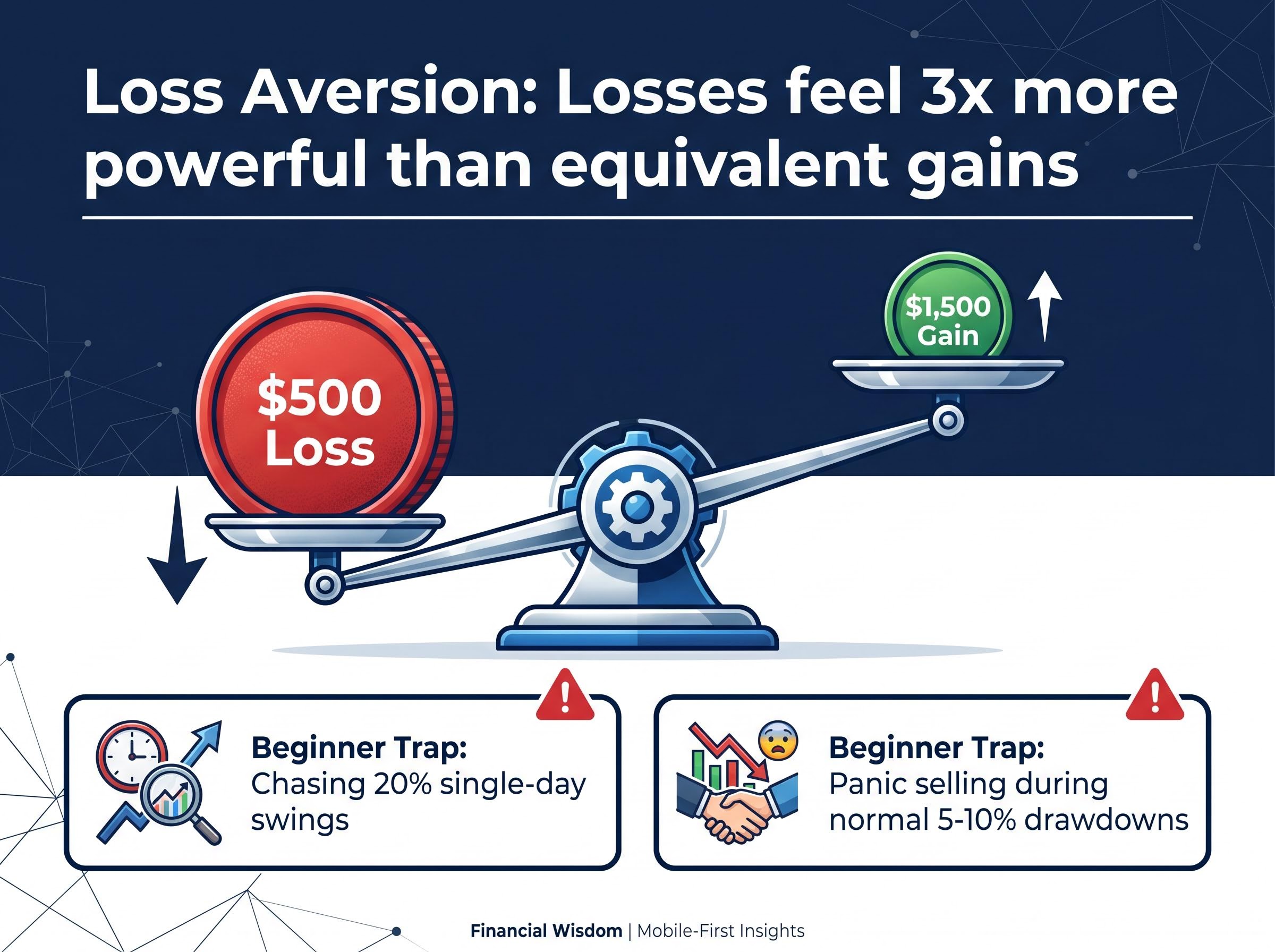
The primary reason beginners make poor decisions is not lack of knowledge. It is loss aversion. Behavioural finance research consistently shows that the psychological impact of losses is roughly three times greater than the positive impact of equivalent gains. A $500 loss feels approximately as painful as a $1,500 gain feels good. That asymmetry distorts decision-making in predictable ways, and year one is when it hits hardest.
Behavioural biases at market extremes do not operate independently; loss aversion, overconfidence, recency bias, and herd behaviour form an interlocking feedback loop that intensifies precisely when clear thinking matters most, which is why year one, with its inevitable small losses and unexpected volatility, is the period that reveals whether an investor’s process can override their instincts.
Loss aversion does not operate in isolation. It compounds with a specific set of beginner traps:
- Chasing volatile stocks after single-day swings. Stocks experiencing price movements of 20% or more in a single day are high-risk purchases for new investors. The move has usually already happened by the time a beginner notices it.
- Acting on informal tips from friends or colleagues. By the time a tip reaches a social conversation, prices have typically already adjusted. A London-based broker with 50 years of experience estimated he would have been approximately $1 million wealthier had he never received insider information throughout his career.
- FOMO-driven trades. Fear of missing out leads to purchases at inflated prices, which then triggers loss aversion when the position declines.
- Panic selling during normal drawdowns. A 5-10% portfolio decline is a routine occurrence in any given year. Selling during one locks in losses that a patient investor would have recovered from.
- Overtrading to “make back” losses. Attempting to recover quickly leads to higher transaction costs and worse decision-making under emotional pressure.
A London broker with 50 years of market experience estimated he would have been roughly $1 million wealthier had he never acted on a single piece of insider information in his career. The best tips, it turns out, are often the most expensive ones.
The year-one benchmark worth internalising is straightforward: finishing with approximately the same capital is a success, not a failure. It means psychology did not override process. The returns come later, once the emotional architecture is in place.
How to actually start: the practical setup for an Australian beginner
The first step is not opening a brokerage account. It is simulating trades without risking real money.
Paper trading, using a demo account or a simple spreadsheet to track hypothetical purchases, builds mechanical familiarity and reveals emotional patterns before capital is at stake. CommSec offers demo capabilities through its learn hub. Even a basic spreadsheet tracking “bought” and “sold” prices over four to six weeks achieves the same purpose.
Once the simulation phase feels comfortable, the Australian platform options suit different starting points:
| Platform | Best for | Minimum investment | Key beginner feature |
|---|---|---|---|
| Pearler | ETF-focused, long-term investors | No set minimum | Beginner education content and auto-invest |
| CommSec | Broadest range, largest retail broker | $500 for most trades | Demo account and CommSec Learn hub |
| Sharesies | Micro-investing, small starting amounts | As little as $5 | Fractional shares and community features |
A note on paid courses: any paid education product or subscription service that provides personal financial advice must be operated by an Australian Financial Services Licence (AFSL) holder. This is verifiable through ASIC’s register. ASIC prohibits performance guarantees and misleading claims in investment education products. Before paying $49.99 per month (or any amount) for a course promising specific outcomes, check the free alternatives first. ASIC’s Moneysmart platform (moneysmart.gov.au) and ASX Education resources cover the same foundational ground at no cost.
For the first real purchase, index funds and ASX-listed ETFs such as VAS (tracking the ASX 300) and VGS (tracking global developed markets) are the consistent recommendation across Australian beginner investing communities. They provide diversification from day one and remove the pressure of individual stock selection during the learning phase.
The practical sequence:
- Paper trade for four to six weeks using a demo account or spreadsheet
- Open a brokerage account on the platform that matches starting capital and goals
- Fund the account with a modest amount (only money not needed in the short term)
- Buy a first ETF position
- Set a weekly or fortnightly review schedule and stick to it
Building the habits that turn a hobby into a lifelong practice
The first trade is not the interesting part. The compounding effect of consistent, curious engagement over years is where the value accumulates, both financially and intellectually.
Year one’s real output is not returns. It is the establishment of a reliable process. The habits that sustain long-term investors are specific and repeatable:
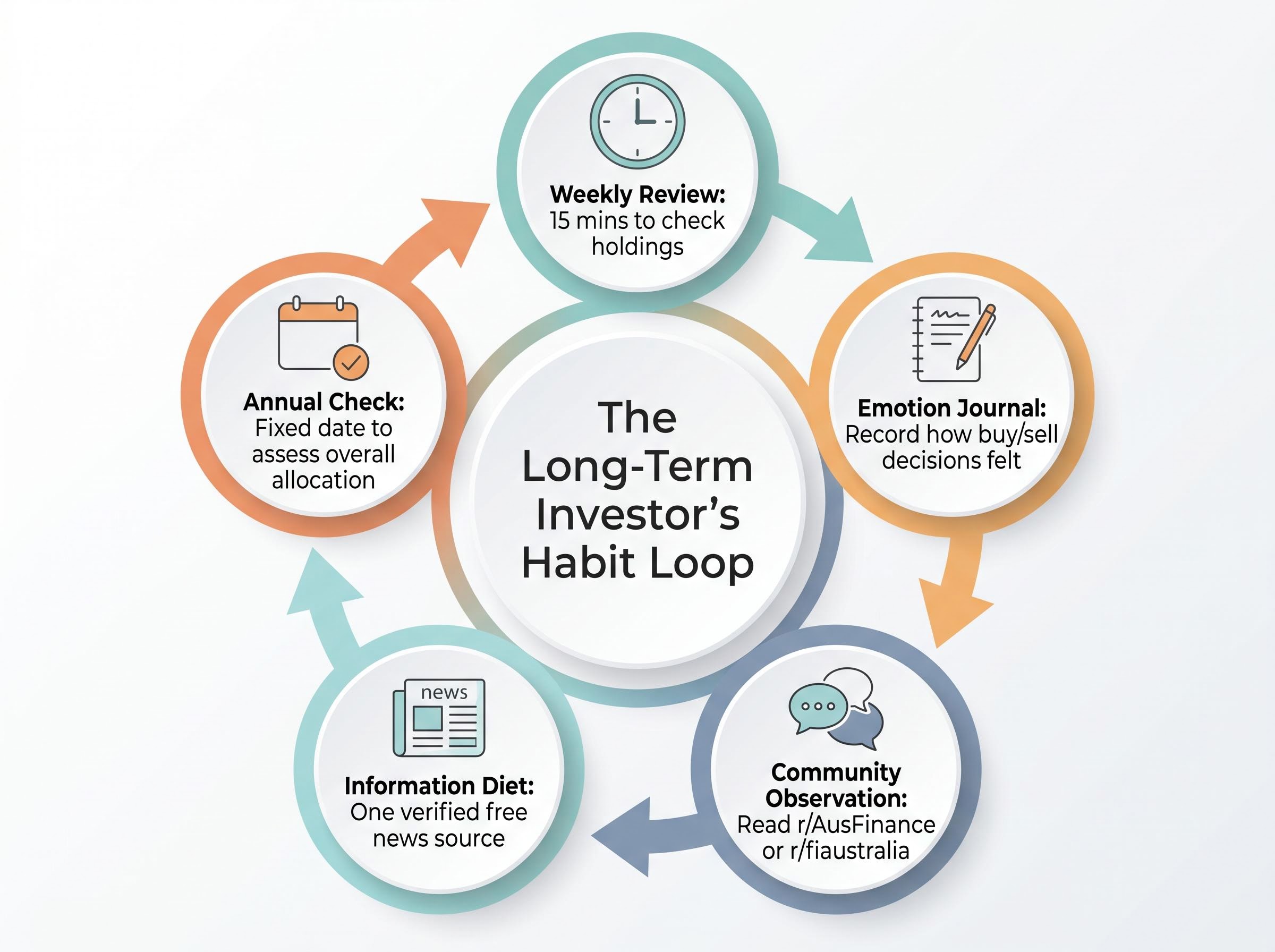
- Weekly portfolio review. Fifteen minutes once a week to check holdings, read one market update, and note any changes in conviction.
- Emotion journal. A brief record of how each buy or sell decision felt, what triggered it, and whether the trigger was analytical or emotional. Patterns become visible within months.
- Community observation before participation. Spend time reading threads on r/AusFinance (approximately 450,000-493,000 members as of 2026) or r/fiaustralia before posting. Observing how experienced investors reason through decisions is more instructive than asking for tips.
- One verified free news source. Subscribe to a single reliable market summary rather than scrolling multiple sources. This reduces noise and builds a consistent information baseline.
- Annual portfolio review date. Choose a fixed date each year to assess overall allocation, rebalance if needed, and revisit original investment goals.
- Distinguish community opinion from financial advice. Online forums are valuable for perspective and discussion. They are not a substitute for verified financial guidance from an AFSL holder.
Rules-based rebalancing, where an investor commits in advance to restoring target allocations at fixed intervals regardless of recent market performance, has documented advantages over discretionary approaches: Vanguard Australia data shows a 4.2% annualised outperformance for pre-committed strategies, a gap that widens meaningfully during the volatile periods that test every investor’s resolve.
The Financial Planning Association of Australia (FPA) recommends what it describes as a “hobby mindset” approach: starting modest, simulating before going live, and tracking psychological biases as part of the learning process. That framing aligns with the community consensus across Australian investor forums, where emotional discipline, paper trading, and avoiding overpriced courses are recurring discussion themes.
Markets themselves reinforce engagement. New sectors emerge, policy settings shift, and global events reshape the investment environment continuously. There is no point at which the learning is “complete,” which is precisely what makes this an activity with no ceiling on depth.
Investing is not a phase. Here is what the long game actually looks like.
The investors who sustain participation across decades share a common trait: they treat the activity as an ongoing intellectual hobby rather than a means to a specific financial endpoint. The evidence from Australian investor communities and participation data supports this framing consistently.
Long-term wealth accumulation through diversified equities has delivered approximately 7% real annual returns since 1802, a consistency across wars, recessions, and technological upheavals that underpins the case for treating investing as a permanent intellectual engagement rather than a task to be completed before a specific financial goal is reached.
There will be years of poor returns. There will be individual positions that lose money. There will be market events that test conviction and make the entire exercise feel pointless. That is part of the experience, not a signal to quit. The emotional resilience built through those periods is what separates investors who compound wealth over decades from those who abandon the activity after a single difficult year.
The participation statistics tell a story of sustained engagement. 46% of Australian adults now invest, and 30% of Australians aged 65+ remain active participants. This is not a pre-retirement task to be completed. It is an activity that people carry into their later decades because it continues to provide intellectual stimulation, social connection, and financial engagement simultaneously.
The next step is small and specific. Identify one action from the practical setup section and commit to it this week: open a demo account on CommSec, join r/AusFinance and read five threads, or spend twenty minutes on Moneysmart. The long game does not start with a large sum of money. It starts with a single decision to stay engaged.
This article is for informational purposes only and should not be considered financial advice. Investors should conduct their own research and consult with financial professionals before making investment decisions.