Investing $500 per month at 8% annual returns for 30 years grows to approximately $745,000, yet most Australians aged 30-34 hold superannuation balances below $50,000. A large proportion of self-directed investors abandon their contributions before year seven. The gap between what compound growth can deliver and what most people actually capture is not a knowledge problem. It is a behaviour problem, layered on top of a vehicle-selection problem. Australians building wealth before retirement have three primary pathways: salary sacrificing into superannuation, investing in ETFs through a brokerage account, or running both simultaneously. Each involves different tax rules, access restrictions, and behavioural demands, and the right mix depends on income, timeline, and how much financial flexibility a person needs before age 60. This guide walks through how each vehicle works in the Australian context, explains the real tax numbers behind the super versus ETF decision, and makes the case for automation as the single most important habit for long-term investment consistency.
How compound growth actually works over 30 years in Australia
Compound growth is a curve, not a straight line. The first decade feels slow. The final decade does most of the work.
Consider $500 per month invested at 8% annual returns. After 10 years, the balance reaches approximately $91,500, against $60,000 in personal contributions. The compounding premium is modest: roughly $31,500 in earned returns. After 20 years, the balance climbs to approximately $294,500 on $120,000 contributed. The returns have now generated more than the investor put in. After 30 years, the balance reaches approximately $745,000 on just $180,000 in contributions. The final decade alone roughly doubles the balance.
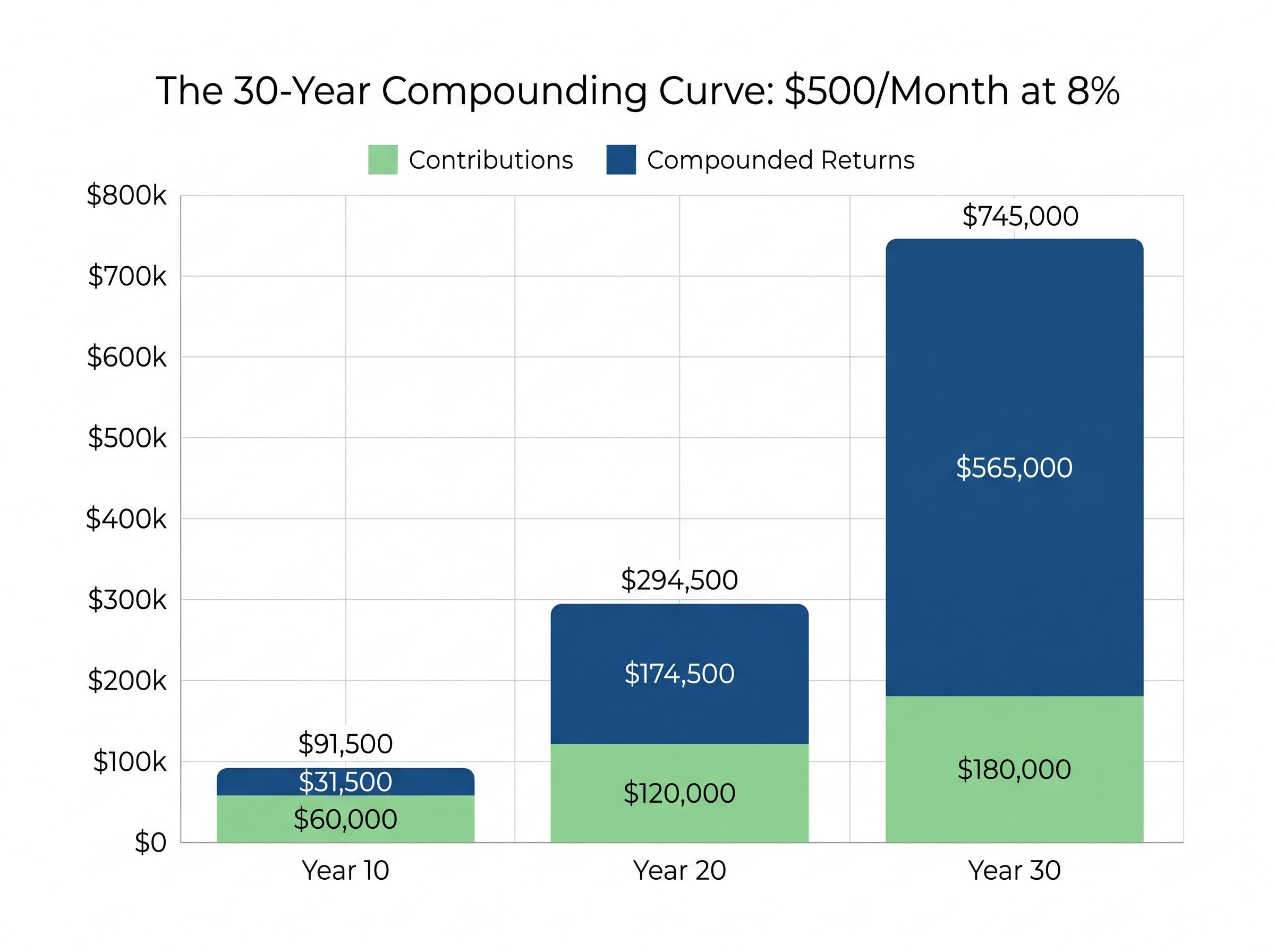
| Years invested | Total contributions | Balance at 8% | Balance at 10% |
|---|---|---|---|
| 10 | $60,000 | $91,500 | $103,000 |
| 20 | $120,000 | $294,500 | $379,700 |
| 30 | $180,000 | $745,000 | $1,130,000+ |
At the ASX historical average of approximately 9-10% annually (including dividends over the past 30 years), the same $500 per month exceeds $1.1 million. Balanced superannuation funds have averaged roughly 8% per year over the most recent decade, placing them squarely in this range.
“At 8% annual returns, $180,000 in contributions grows to approximately $745,000. The final decade alone roughly doubles the balance.”
The implication is direct: withdrawing early does not just cost the withdrawn amount. It permanently removes all the future compounding that capital would have generated. The curve accelerates precisely when most investors are tempted to interrupt it.
For investors wanting to understand where they currently stand relative to where they need to be, our dedicated guide to superannuation balance benchmarks by age breaks down average and target balances at each decade of life, the compounding shortfall that accumulates for those who delay, and the contribution strategies most likely to close the gap before retirement.
When big ASX news breaks, our subscribers know first
What superannuation salary sacrifice actually does to your tax bill
The tax advantage of salary sacrifice is not abstract. It shows up on every payslip.
An Australian earning $80,000 per year faces a marginal tax rate of 34.5% (including the Medicare levy) on each additional dollar earned. When that same dollar is salary sacrificed into super, it is taxed at 15%, the flat contributions tax rate. That is a difference of 19.5 percentage points per dollar contributed. On $500 per month ($6,000 per year) in salary sacrifice, the tax saving is meaningful enough to materially alter the 30-year compounding outcome.
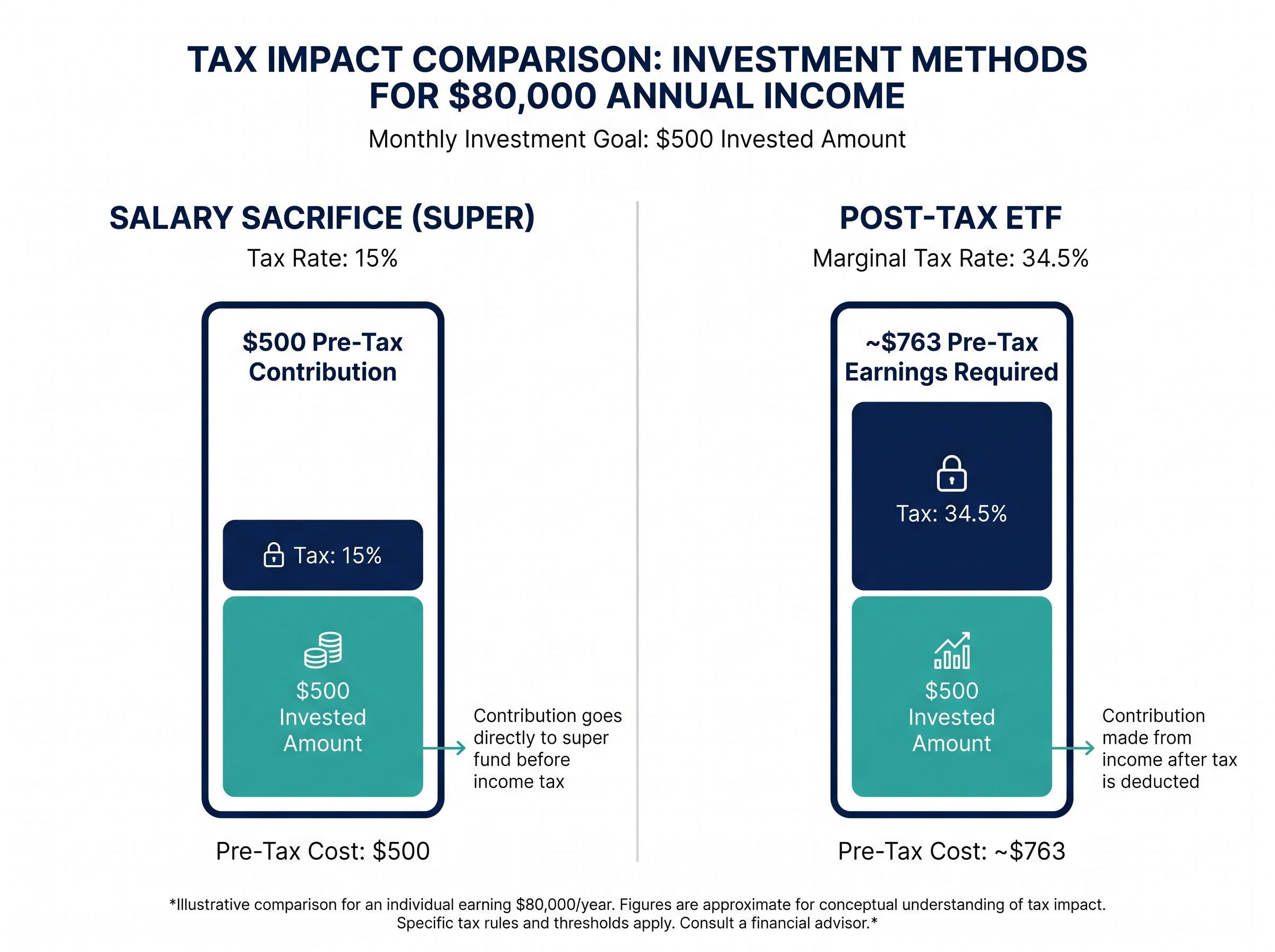
| Contribution method | Monthly contribution | Tax rate applied | Effective cost to investor |
|---|---|---|---|
| Salary sacrifice (super) | $500 | 15% | $500 (pre-tax; reduces take-home by less than $500) |
| Post-tax ETF investment | $500 | 34.5% (at $80,000 income) | $500 (from after-tax pay; requires earning ~$763 pre-tax) |
The concessional contributions cap for FY 2025-26 is $30,000 (up from $27,500), and it rises to $32,500 from 1 July 2026. This cap includes employer Superannuation Guarantee contributions, so the amount available for salary sacrifice depends on how much the employer is already contributing. Investors with total super balances below $500,000 can also access carry-forward rules, using unused cap amounts from prior years to make catch-up contributions.
For those with very high incomes, the advantage narrows. Division 293 tax applies an additional 15% contributions tax for individuals earning above $250,000, effectively doubling the super contributions tax rate to 30%. From 1 July 2025, earnings tax on super balances above $3 million also rises to 30%. Both provisions reduce the relative appeal of super for ultra-high earners, though the advantage remains for most working Australians. Current caps and preservation rules are available at ato.gov.au.
The preservation age trade-off
Super’s tax efficiency comes with a hard constraint. Funds are inaccessible until preservation age, which is 60 for anyone born after 30 June 1964. For a 35-year-old, that means 25 years of locked capital.
This is appropriate for retirement savings. It is a real constraint for anyone who needs financial flexibility before 60, whether for a career change, a business venture, or an unplanned expense. The lock-in is not a hidden cost; it is the price of the tax concession.
ETFs outside super: what they give you and what they cost you
ETFs are not the tax-inefficient alternative to superannuation. They are a different tool solving a different problem.
The Australian ETF market exceeded $200 billion in total funds under management in early 2025, with annual inflows for 2024 reaching approximately $22-24 billion at record levels. Growth has been driven by low costs and accessibility: broad index ETFs consistently carry management expense ratios (MERs) below 0.20%. VAS (Vanguard Australian Shares Index ETF) tracks the ASX 300 at an MER of approximately 0.10%. VGS (Vanguard MSCI Index International Shares ETF) provides global equities exposure at approximately 0.18%. A200 (BetaShares Australia 200 ETF) competes directly with VAS on fees.
The most recent Betashares ETF industry review reported total funds under management of $330.6 billion by end of 2025, with record net flows of $53 billion for the year, reflecting a retail investor base that has moved decisively toward low-cost index investing as a core wealth-building vehicle.
The genuine advantages of holding ETFs outside super are substantial:
- Full liquidity: sell on any ASX trading day, no preservation age restriction
- No contribution cap: invest as much as income allows, unlike super’s $30,000 concessional limit
- 50% CGT discount: assets held for more than 12 months receive a 50% capital gains tax discount
- Full control: complete visibility over individual holdings and allocation
- Franking credits: Australian equity ETFs carry franking credits on dividends, representing corporate tax already paid, which can reduce or offset personal tax obligations
The cost is tax drag. ETF distributions (dividends, interest, capital gains) are taxed at the investor’s marginal rate each year, regardless of whether distributions are reinvested. For a middle-to-high income earner, this creates a higher ongoing tax burden compared to super’s 15% earnings rate.
“ETF investors holding for more than 12 months receive a 50% CGT discount; super funds receive only 33%, partially offsetting super’s earnings tax advantage for long-term investors.”
That CGT discount comparison matters. It means the gap between super and ETFs is not as wide as the headline contribution tax rates suggest, particularly for investors who buy and hold over decades. For anyone who needs access to wealth before 60, ETFs are not a compromise. They are the only vehicle that actually solves the accessibility problem.
The tax wrapper advantage does not require a performance edge to generate a meaningful wealth gap: two identical portfolios, one inside super and one held directly, with identical asset allocations and identical gross returns, are projected to diverge by approximately $230,000 over 25 years purely because of the difference in earnings tax rates and the compounding effect of retaining more of each year’s return.
The hybrid approach: how to run super and ETFs together
The dominant recommendation from Australian financial professionals is not a forced choice between super and ETFs. It is a practical split that captures the best of each vehicle.
The hybrid allocation follows three steps:
- Receive the employer Superannuation Guarantee contribution as a baseline. This is currently 11.5% of ordinary time earnings, rising to 12% from 1 July 2025. It requires no action from the employee.
- Salary sacrifice to top up to the concessional cap. For FY 2025-26, the cap is $30,000 total (including employer contributions). Each dollar salary sacrificed captures the tax differential described above.
- Direct surplus savings capacity to an automated ETF portfolio. Any amount beyond the concessional cap that would otherwise sit in a savings account or be spent can be invested in low-cost index ETFs for liquidity and pre-retirement access.
This sequence ensures that every additional dollar goes to the vehicle best suited to its purpose: tax-efficient compounding for retirement capital inside super, and accessible growth for pre-retirement flexibility outside it.
Geographic diversification strengthens the ETF component. Australian equities represent approximately 2% of global market capitalisation. Holding only Australian shares creates concentration risk that a blended portfolio (such as VAS alongside VGS) can reduce meaningfully. APRA’s YourSuper comparison tool provides fund-level performance data for the super component.
Home bias in Australian portfolios creates a structural concentration problem that many investors underestimate: with financials and materials making up approximately 50-60% of the ASX index, a domestic-heavy allocation is effectively a leveraged bet on Australian banks and commodity cycles rather than on the technology-led sectors that drove global equity outperformance over the past decade.
Adjusting the split by life stage
Investors in their 30s with medium-term financial goals, such as a home renovation, a career change, or building an emergency buffer, may allocate a larger share of surplus savings to ETFs. The accessibility matters more when preservation age is 25-plus years away.
Investors in their 40s and 50s approaching preservation age tilt more heavily toward super. The tax advantage compounds over a shorter remaining period, but the lock-in costs less in practical terms. Sequence-of-returns risk also becomes relevant near retirement: a gradual shift toward defensive assets is standard practice as preservation age approaches.
Why automation is the single decision that determines whether any of this actually works
The mathematics of compounding are well understood. The behavioural challenge is where most wealth-building plans fail.
Treating investment contributions as a discretionary monthly decision exposes them to constant competition from consumption. Research consistently shows that a meaningful proportion of self-directed investors reduce or pause contributions during market downturns. The 4-7 year period appears to be a common abandonment window: investors who start in a rising market encounter their first significant correction and disengage, often permanently.
Morningstar’s Mind the Gap research quantifies this behaviour gap precisely, finding that investors in most fund categories earn meaningfully less than the funds themselves return, because poorly timed contributions and withdrawals erode the compounding benefit that consistent, automated investing preserves.
Super’s structural advantage here is behavioural, not financial. Salary sacrifice deductions occur before pay hits the account. The investor never sees the money, never decides to redirect it, never weighs it against a holiday or a car repair. Automatic super contributions show substantially higher continuation rates than self-directed ETF investments, directionally supporting the case that systems outperform willpower.
“$500 per month is $16.50 per day, approximately the cost of a single food delivery order. The question is not whether the money exists; it is whether it is being directed toward compound growth.”
Market downturns are also worth reframing. During the accumulation phase, when prices fall by 20-30%, each fixed monthly contribution buys more units. Investors who continued contributing through downturns have historically achieved better outcomes than those who paused. Automation removes the temptation to time the market by removing the decision entirely.
Automated periodic investing mathematically smooths average entry costs over time by buying more units when prices fall and fewer when prices rise, a structural property that reframes market downturns from a threat into a mechanical advantage for investors who have removed the monthly decision from their control.
Three automation levers are available to Australian investors:
- Salary sacrifice via payroll for super contributions
- Regular investment plan via a brokerage platform for ETF contributions (platforms such as Pearler and SelfWealth offer automated purchasing)
- Automatic dividend reinvestment where the platform offers it, keeping compounding uninterrupted
The system, not the willpower, is what produces outcomes over 30 years.
What building wealth before retirement actually requires Australians to do next
The super-ETF hybrid is not a complex strategy. It is a systematic allocation of each additional dollar to the vehicle best suited to its purpose: tax efficiency for retirement capital, liquidity for pre-retirement flexibility. The compounding mathematics reward starting now over optimising later. A delayed perfect strategy consistently underperforms an imperfect strategy started today.
Practical next steps:
- Check current super fund via ATO MyGov to understand existing balance and employer contributions
- Compare funds via APRA’s YourSuper comparison tool for fees, performance, and insurance
- Set up salary sacrifice via employer payroll to capture the concessional contribution tax advantage
- Open a low-cost brokerage account (options include CommSec, SelfWealth, Stake, and Pearler)
- Automate a regular ETF contribution to replicate super’s behavioural structure outside the super system
- Verify adviser credentials via ASIC’s Financial Advisers Register for anyone with complex tax situations, Division 293 exposure, or approaching retirement
For current contribution caps and super rules, the ATO (ato.gov.au) is the authoritative source. ASIC’s MoneySmart (moneysmart.gov.au) provides unbiased guides and calculators. A licensed financial adviser is recommended for anyone managing sequence-of-returns risk or navigating high-income contribution strategy.
This article is for informational purposes only and should not be considered financial advice. Investors should conduct their own research and consult with financial professionals before making investment decisions. Past performance does not guarantee future results. Financial projections are subject to market conditions and various risk factors.