Most retail investors believe successful trading comes down to reading the next headline correctly. Guess the inflation print, position ahead of the central bank, pick the stock that runs. Miss the call, lose the trade.
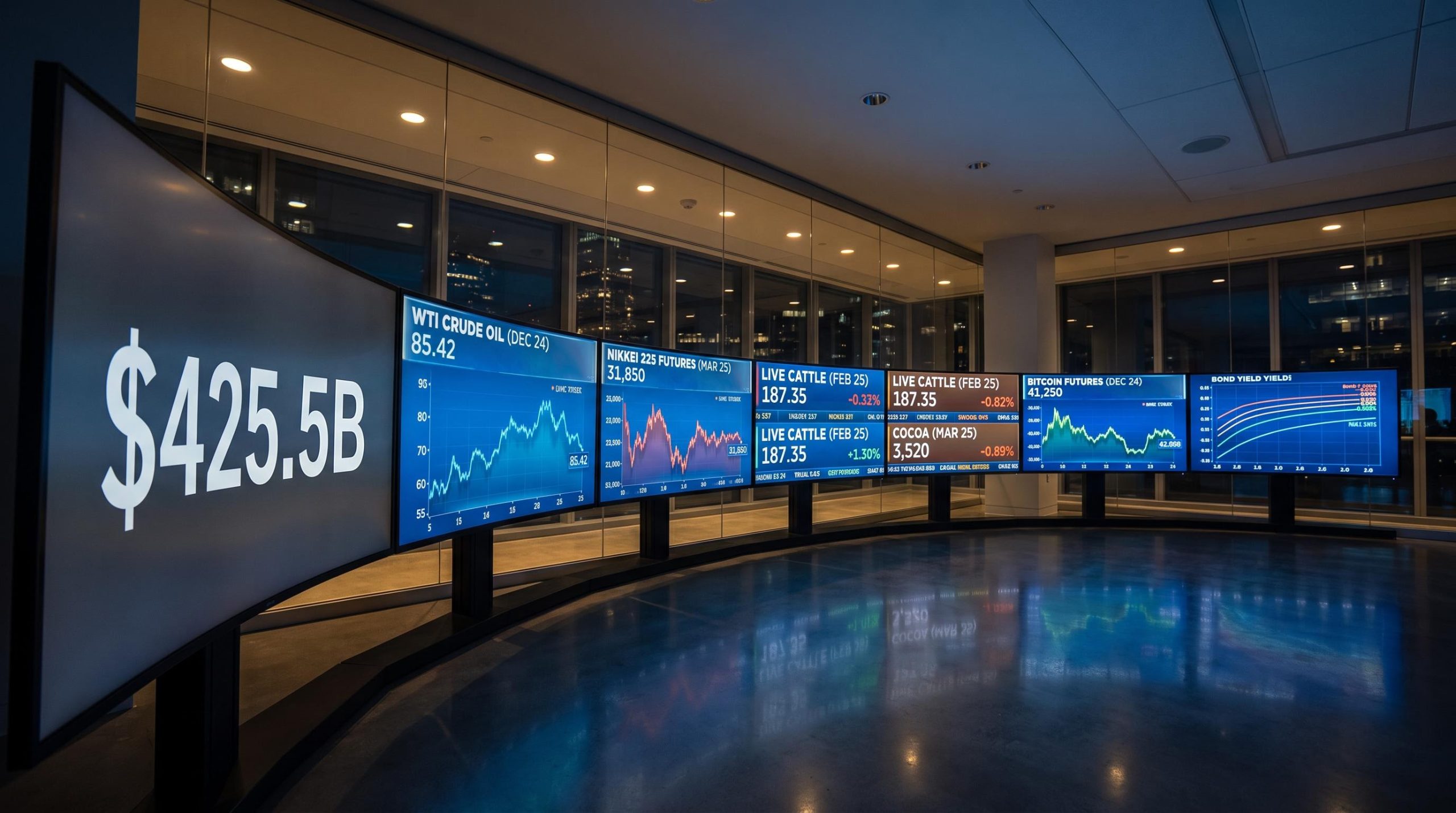
That assumption is exactly backwards, and a growing corner of the market has the numbers to prove it. Systematic trend following, the discipline of following price signals rather than forecasts, has swelled into a $425.5 billion industry as of Q1 2026, according to BarclayHedge data. Systematic strategies alone account for roughly $392.39 billion of that total.
The appeal is mathematical rather than intuitive. These strategies capture movement across dozens of global markets without needing anyone to correctly predict a single economic outcome.
This guide gives you a clear framework for building a rules-based allocation across global markets, drawn from decades of institutional practice, so your capital can protect and grow itself in any environment. You will see how the philosophy works, how the diversification is engineered, how risk gets mathematically capped, and where do-it-yourself replication becomes genuinely dangerous.
How process systematically beats prediction
Veteran trader Tom Basso has spent roughly 45 years in the markets, and his central conclusion sits uncomfortably with how most people trade: you cannot know where the market is going, so stop trying.
Basso founded and ran Trendstat Capital Management until it closed in 2003, managing up to around $600 million at its peak. His operating view is that markets move as they choose, and your job is not to argue with them but to respond through systematic signals.
That single idea reshapes everything downstream. If you accept that forecasting is unreliable, you stop building your portfolio around a macro thesis and start building it around rules that fire automatically in either direction.
Basso’s core philosophy Markets will move as they choose. Rather than predicting direction from economic headlines, a trader prepares to respond to whichever way price actually breaks, using systematic triggers instead of forecasts.
This is where a fully systematic strategy parts ways with opportunistic trading. Buying a single stock because it looks cheap after a fall is a discretionary bet. Basso does make those occasionally, holding Tesla after a price decline he personally judged attractive, but he is explicit that this is not the system.
The system is something else entirely. Basso runs roughly 50 total positions across about 10 simultaneous strategies, and he does it without leaning on the daily economic news cycle at all.
The reason this matters to you is psychological as much as financial. When your positions are governed by pre-set signals, you no longer carry the burden of being right about the next central bank meeting or supply shock.
That burden is what usually destroys retail accounts. A trader convinced the market must fall holds a losing short far too long. A trader certain a rally will continue ignores every exit signal. Prediction breeds attachment, and attachment breeds ruin.
The mindset shift is the foundational move in professional portfolio management. You stop guessing the next macro event and instead prepare your portfolio to automatically capture whichever direction the market actually takes.
When Basso recently assessed the S&P 500, he did not issue a forecast. He described it as still in a longer-term uptrend but approaching greater downside risk, the kind of neutral, evidence-based read a systematic trader makes rather than a confident call. That restraint is the point.
When big ASX news breaks, our subscribers know first
The mechanics of extreme diversification across global markets
The engine that makes this reactive approach work is what Basso calls extreme diversification: a fixed, pre-selected universe of liquid futures contracts spread across markets that do not move together.
This is worth slowing down on, because it is the core of the entire method. Rather than continuously screening for fresh ideas, you commit in advance to a set list of markets and let your rules trade that list. Basso’s futures portfolio spans roughly 30 to 40 individual contracts across uncorrelated global markets.
The word that matters there is uncorrelated. Correlation measures how closely two assets move together, on a scale from 1.0 (identical movement) to -1.0 (perfect opposites), with 0.0 meaning no relationship at all. Genuine diversification requires holding things that sit near zero to one another.
Dalio’s Holy Grail framework demonstrates that 15-20 genuinely uncorrelated return streams can reduce portfolio volatility by roughly 80% without sacrificing expected returns, a finding that arrives at the same structural conclusion Basso reaches through futures diversification: independence between positions is worth more than any individual return.
Basso builds that non-correlation deliberately across several asset classes:
- Bond futures, which respond to interest rate shifts rather than corporate earnings
- Global equity indices, including the Nikkei, spreading exposure beyond any single national market
- Agricultural softs such as lumber, cocoa, live cattle, hogs, and grains, driven by weather and supply
- Energy contracts, moving on geopolitics and inventory rather than equity sentiment
- Cryptocurrency futures in Bitcoin and Ethereum, a newer and largely independent return stream
The payoff from this structure is measurable. An iMGP July 2024 whitepaper reports that the SG CTA Index has shown roughly 0.01 correlation to global stocks since 2000, and negative correlation to global bonds. Simplify Asset Management found a similarly close-to-zero long-term relationship to the S&P 500.
Simplify Asset Management’s CTA portfolio analysis, covering performance through February 2026, documents the negative correlation to both stocks and bonds that managed futures have delivered across multiple market cycles, including the simultaneous equity and bond selloff that defined 2022.
Crypto adds another layer of independence. Research from Bloomberg, WisdomTree, and FTSE Russell confirms Bitcoin’s correlation to traditional equities frequently sits in the neutral 0.0 to 0.2 range.
| Asset category | Example contracts | Correlation to traditional equities |
|---|---|---|
| Managed futures (overall) | Diversified CTA basket | ~0.01 (near zero) |
| Bonds | Government bond futures | Negative |
| Agricultural softs | Lumber, cocoa, live cattle | Low |
| Energy | Crude oil, natural gas | Low |
| Cryptocurrency | Bitcoin, Ethereum futures | ~0.0 to 0.2 |
But low correlation alone is not enough to earn a spot in the universe. Liquidity has to govern inclusion just as strictly, because a market you cannot exit cleanly is a liability no matter how uncorrelated it looks.
The concentration here is stark. Quantica Capital’s Q1 2025 research shows that the 10 most liquid commodity markets account for roughly 70% of total commodity futures liquidity, with energy alone making up between 55% and 65%. Beyond that core, transaction costs and capacity constraints escalate quickly.
By fixing your universe to liquid, uncorrelated markets, you protect yourself from the behavioural trap of chasing recent winners and ensure your capital is always positioned where real trends can emerge.
Core benefits of a pre-committed universe
A fixed list also does quiet work on your costs. Because you trade the same liquid markets repeatedly, you avoid the wider bid-ask spreads and heavier slippage that come from wandering into thin, exotic contracts.
There is a discipline benefit too. A 2026 summary of Graham Capital’s analysis notes that incremental risk-adjusted gains flatten out beyond roughly 70 to 80 markets, so endless expansion adds little.
AQR builds its strategies on a fixed universe of around 67 markets specifically to avoid data-mining bias, the tendency to keep tweaking your inputs until past results look flattering. A committed list removes that temptation entirely.
Using technical indicators for strict position sizing
If diversification is the offence, position sizing is the defence, and this is where Basso’s method becomes genuinely mathematical.
The first thing to understand is what the indicators are for. Basso treats technical indicators as risk-management and hedging tools, not crystal balls. He is candid that no single indicator is reliable, since breakouts reverse and signals fail, but that several indicator families tend to converge near meaningful turning points.
The families he leans on are worth knowing:
- Volatility-adjusted indicators, which scale exposure to how much a market is currently moving
- Moving average systems, which track the direction of the underlying trend
- Channel-based models, which define price boundaries and breakout points
- Swing-low breakout methods, which trigger entries when price clears a recent low
The real protection, though, comes from the maths applied on top of those signals. Basso limits any single futures position to about 0.5% of total equity risk. One trade going catastrophically wrong simply cannot take the account with it.
Volatility then refines the sizing further. Using a 21-day Average True Range, a measure of how far a market typically moves over that period, Basso caps initial volatility exposure at roughly 0.2% of equity. The more violently a market swings, the smaller the position it earns.
At the portfolio level, total risk is capped at around 17% of equity. That ceiling holds regardless of how many attractive signals fire at once.
Volatility targeting, the practice of scaling total risky exposure mechanically against a chosen volatility ceiling, is the same principle Basso applies when he caps initial volatility exposure at roughly 0.2% of equity per position, and it can be implemented by individual investors using realised portfolio volatility measured against a conservative, moderate, or aggressive target band.
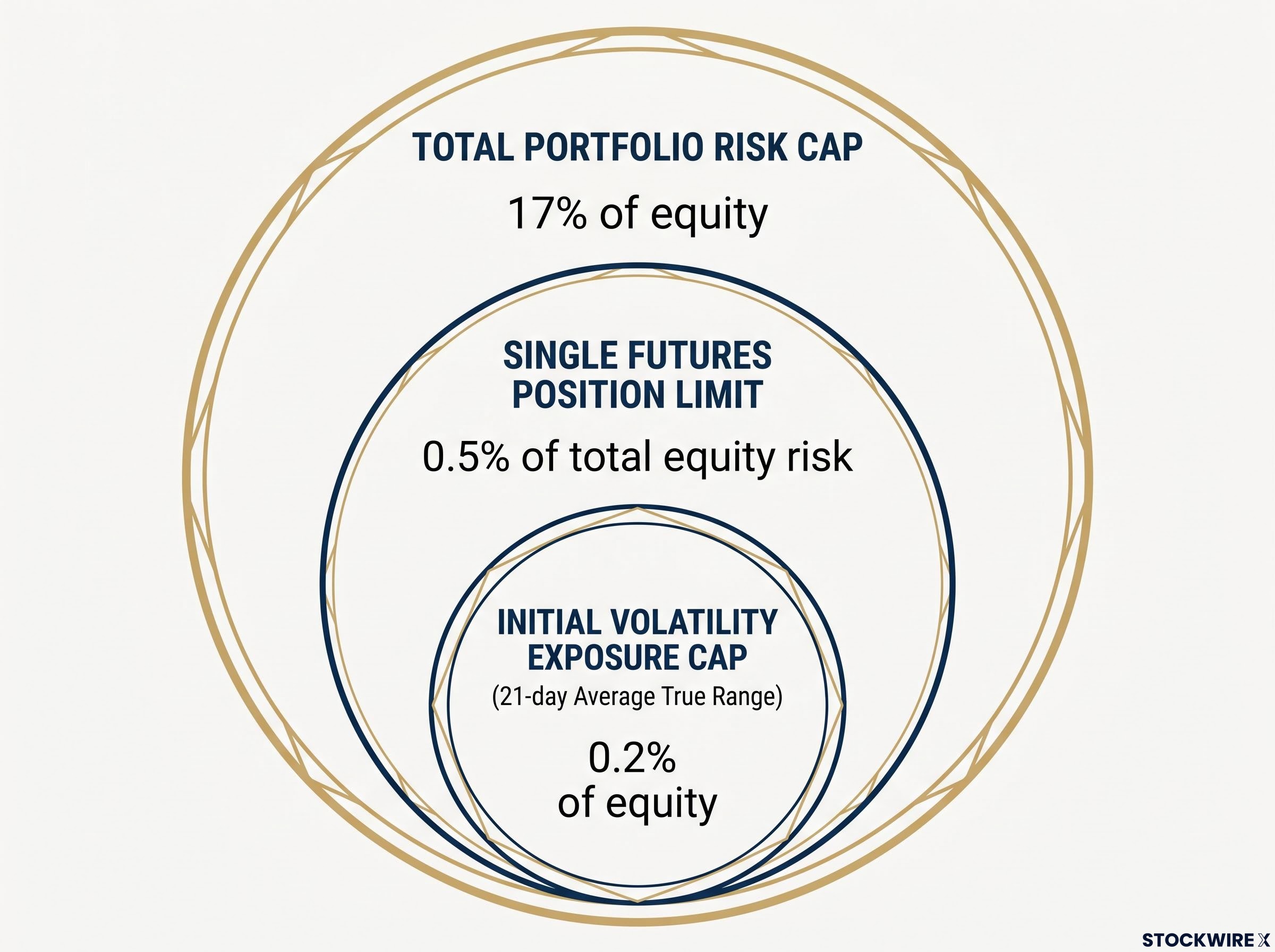
By capping your initial volatility exposure with these metrics, you ensure that no single catastrophic trade or sudden market shock can wipe out your entire account. That is the whole purpose of the framework.
Position sizing is what keeps traders solvent through losing streaks, and losing streaks are inevitable in trend following. What you have here is a quantifiable, professional risk structure you can study and adapt to your own capital, rather than trading on gut feel about how much to stake.
Real-world stress tests and the dangers of retail replication
The theory is elegant, but the record is where you should form your judgement, and the record is genuinely mixed.
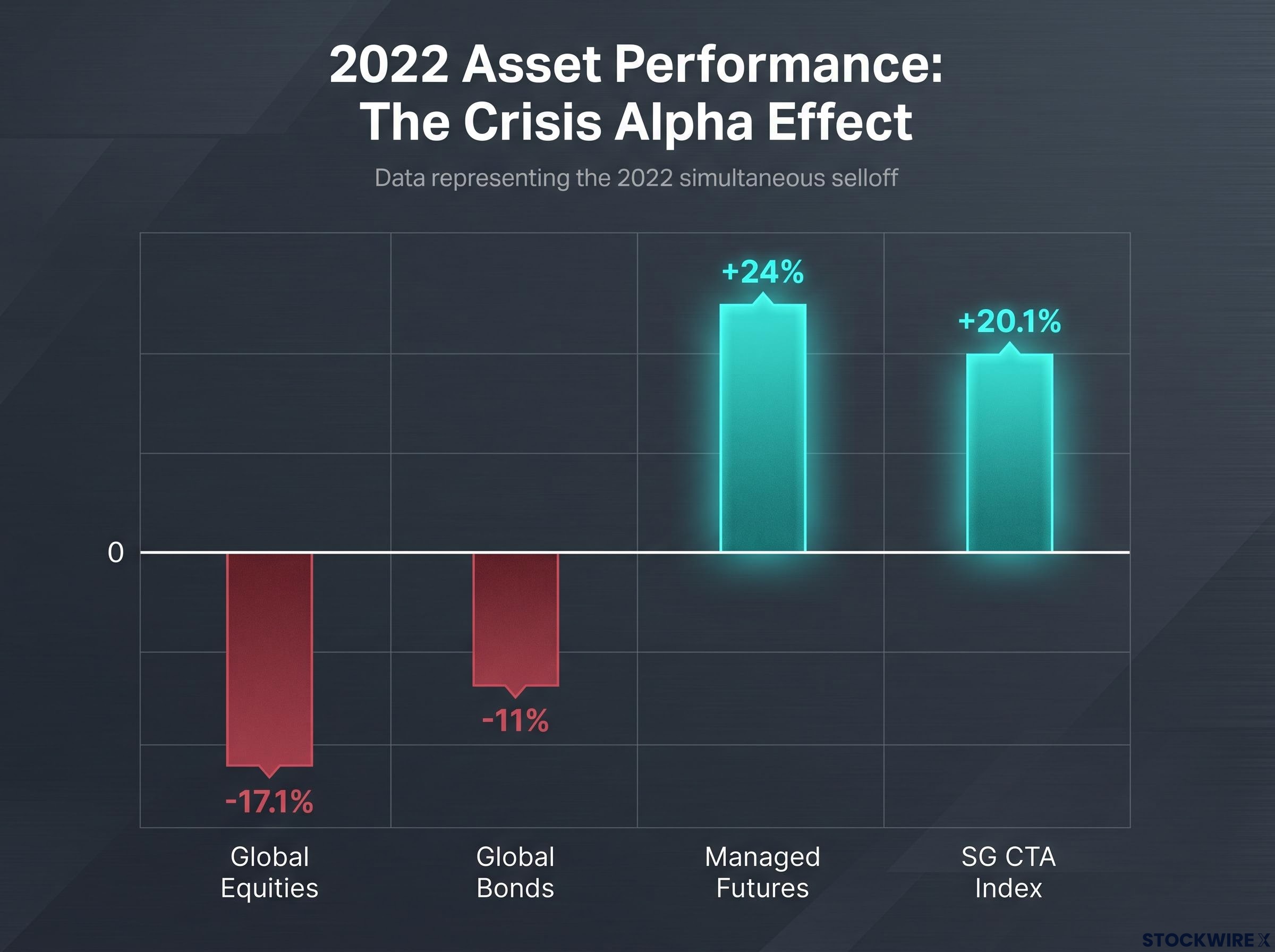
Start with the case for the defence. In 2022, as global equities fell around 17.1% and global bonds dropped roughly 11% in a rare simultaneous selloff, managed futures gained approximately 24%. The SG CTA Index finished the year up 20.1%, achieving negative correlation to the S&P 500 exactly when investors needed it most.
A 10% allocation to managed futures that year would have cut a global 60/40 portfolio’s calendar loss by more than a fifth. This is what practitioners mean by crisis alpha: a return stream that shows up precisely when everything else breaks.
Then comes the sobering half. Trends that persist in a crisis dissolve in choppy, range-bound markets, and the years since 2022 have been unkind. Morningstar reported that over the three years through 31 August 2025, the median fund in its Systematic Trend category delivered an annualised -2.3% return.
That gap between a 24% windfall and years of grinding losses is the honest shape of this strategy. It does not pay you smoothly, and marketing that sells it as guaranteed protection ignores the lean years, including the flat stretch trend followers endured across the 2010s.
Recency bias is the mechanism that drives investors to abandon systematic rules precisely after a strategy’s lean years, treating a short run of poor returns as evidence the strategy is broken rather than evidence they are observing a normal drawdown period in a long-term cycle.
For a retail investor tempted to copy an institutional manager directly, the structural risks are sharper still.
- Leverage and margin risk. Futures run on margin, and regulators including the CFTC and NFA warn continuously that adverse moves can trigger margin calls, forced liquidations, and losses exceeding your original deposit.
- Liquidity constraints. With around 70% of commodity liquidity locked in the top 10 contracts, expanding your universe to mimic an institution quickly pushes you into thin markets you cannot exit under stress.
- Tracking error. A 2024 SSRN paper, “In Pursuit of Trend-Following Beta,” showed that copying diversified CTA exposure with a handful of proxies introduces heavy tracking error and skill leakage.
- Behavioural over-trading. Baird noted in 2025 that managed futures are volatile on their own and hard to time, which drives individuals to abandon their rules mid-drawdown, the exact moment discipline matters most.
You need to hold both truths at once. The crisis protection is real, but the leverage and liquidity constraints make an unsupported do-it-yourself replication genuinely hazardous without proper infrastructure and capital behind it.
The false diversification trap
Even institutions get diversification wrong, and the trap is subtler than it looks. Loading up on correlated contracts, several grain futures, say, feels like diversifying but adds operational complexity without meaningfully reducing portfolio variance.
The same illusion appears at the manager level. A 2026 Markov Processes analysis found the 20 largest institutional trend followers carried an average pairwise correlation of about 0.78 in 2024.
CTA selling pressure is not a theoretical tail risk: Bank of America’s trigger-map analysis shows a 3% S&P 500 decline from spot would unleash roughly $100 billion in programmatic global equity selling by trend-following funds, with gold and international indices facing cascading systematic flows that could accelerate once initial thresholds break.
That figure should stop you. Spreading capital across several large CTAs looks prudent, but if they all trade near-identical signals in the same markets, you have bought one bet dressed as many.
Building portfolio resilience beyond traditional allocations
The thread running through all of this is a single reversal: you win not by predicting the next crisis, but by having a structure already built to catch the momentum it releases.
That structure has a clear order to it. You start with the philosophical foundation that forecasting is unreliable, then engineer extreme diversification across a fixed, liquid, uncorrelated universe, then impose strict mathematical limits so no single position or shock can break you.
True diversification, the kind that held up in 2022, means owning assets that move independently of the stock market rather than versions of the same bet. The near-zero correlation to equities is the entire point.
None of this promises smooth returns, and the choppy years since 2022 make that plain. What it offers instead is discipline: a pre-committed system that removes emotion from the moments emotion is most expensive.
Use this framework to interrogate your own portfolio. If your holdings would all fall together in the next crisis, you hold less diversification than you think, and that is the gap worth closing before the next shock arrives.
This article is for informational purposes only and should not be considered financial advice. Investors should conduct their own research and consult with financial professionals before making investment decisions. Past performance does not guarantee future results. Financial projections are subject to market conditions and various risk factors.