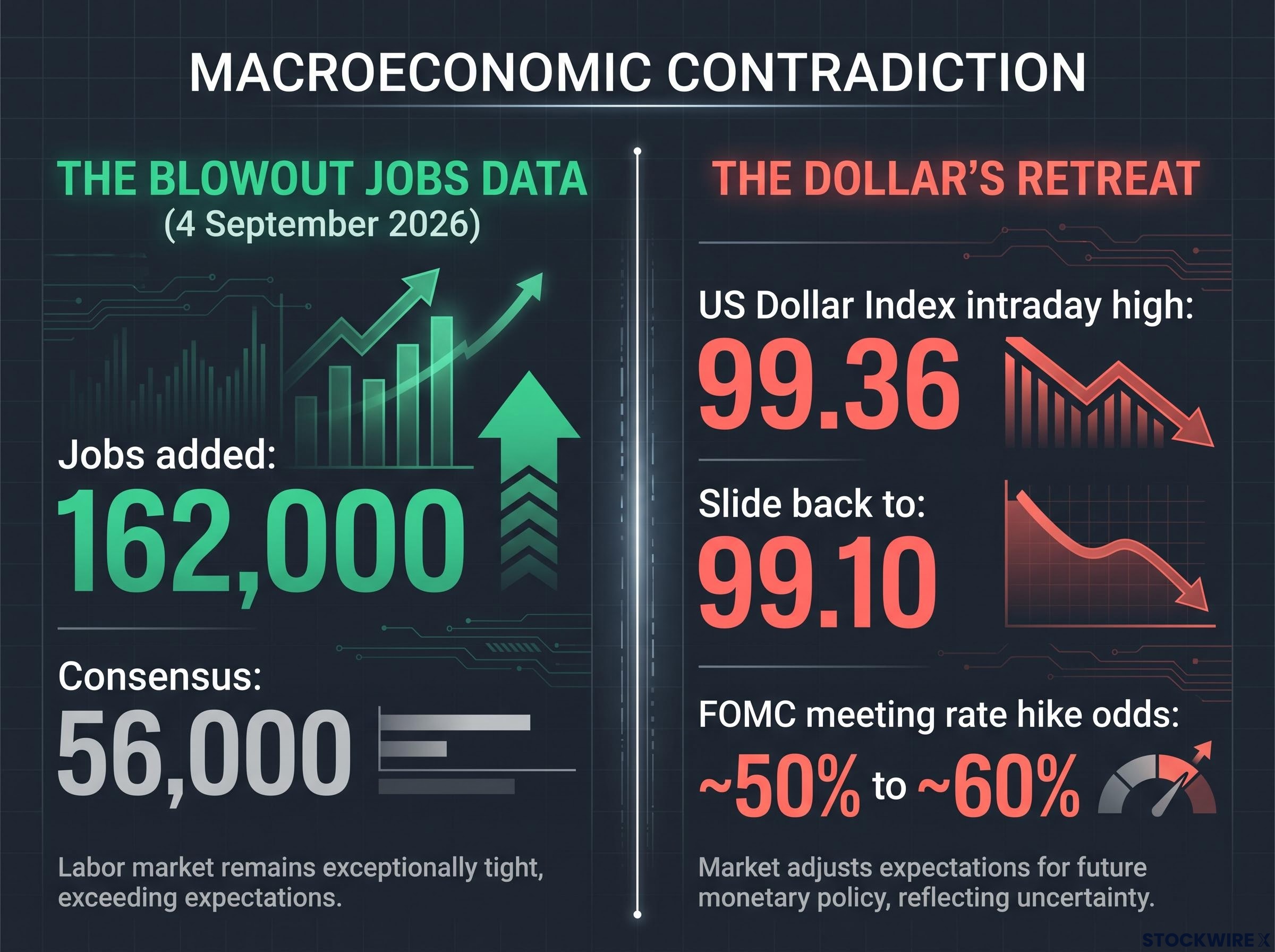
On 4 September 2026, US employers added 162,000 jobs against a consensus of just 56,000, nearly triple the expected figure. Within hours, the dollar was retreating. The US Dollar Index touched an intraday high of 99.36, then slid back toward 99.10.
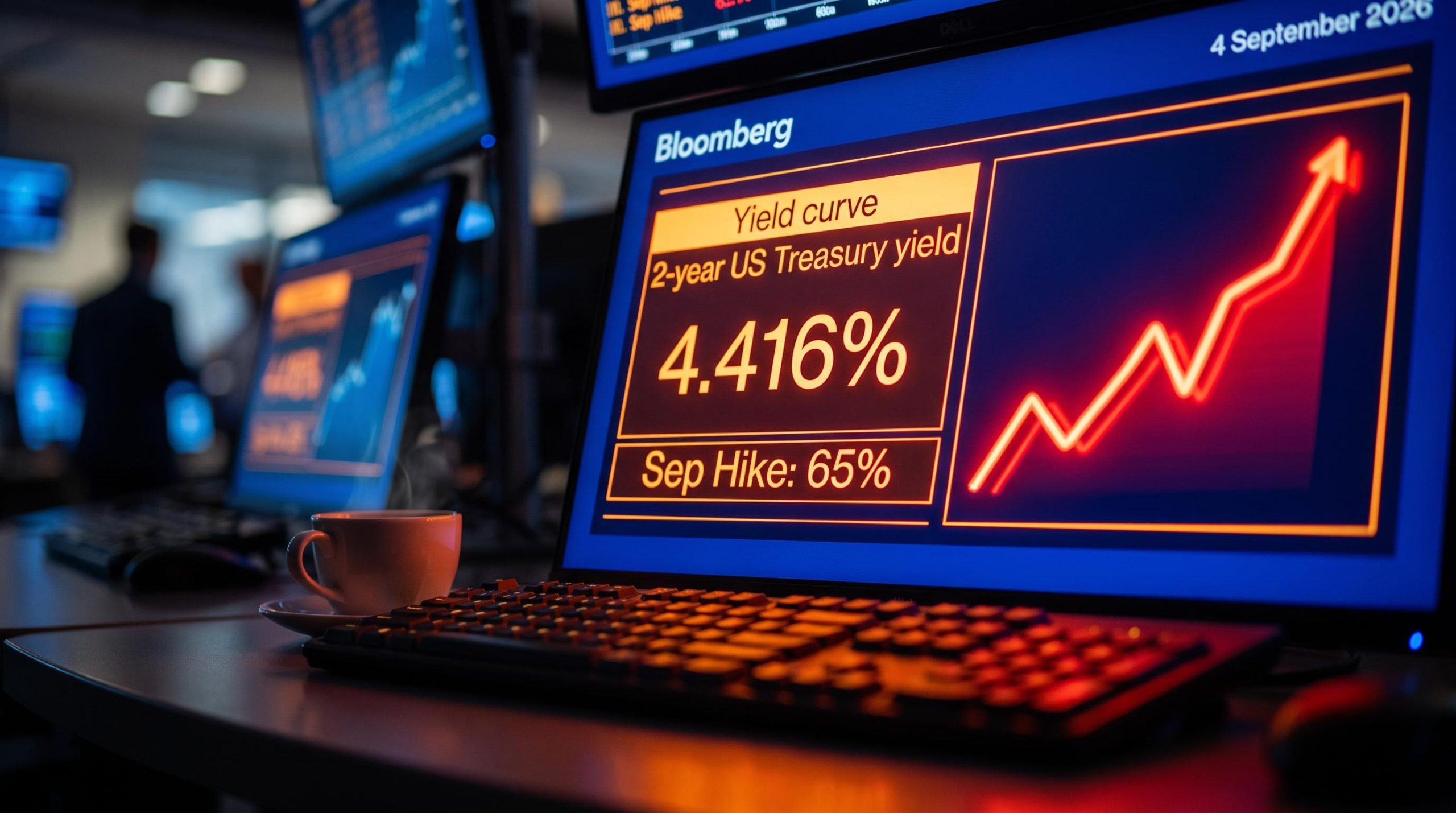
A blowout jobs number should power the dollar higher, not knock it back. Odds of a rate hike at the 15-16 September FOMC meeting climbed from roughly 50% before the release to about 60% afterwards on the CME FedWatch Tool, according to FXStreet. Higher hike odds usually mean a stronger currency. This time, the greenback gave back its gains anyway.
That contradiction is the subject of this piece. What follows is not a description of one Friday’s trading; it is a working guide to reading the next CPI or jobs print the way a macro trader would, understanding what genuinely shifts currencies and rate expectations, and what merely fills headlines.
The dollar’s post-NFP failure: what the intraday chart is actually telling you
The price action looks like a malfunction. A jobs print nearly three times consensus lands, hike odds rise, and the dollar tops out at 99.36 before drifting back to around 99.10 within the same session. Soft US bond yields added to the pressure, compounding the retreat.
It was not a malfunction. It was positioning.
By early August, the market had already leaned hard into the hawkish case. Longbridge data put the probability of a 25-basis-point hike at 73.6% on 2 August 2026, described at the time as a hawkish shift. Through late August, FedWatch readings sat in the 57-66% range. Much of the bullish dollar story was priced in well before the August payrolls hit the tape.
That is the setup for a “buy the rumour, sell the fact” reversal. Traders who were long dollars in anticipation of a strong number took profits the moment it confirmed what they had already positioned for. A print that validates an existing expectation triggers unwinding, not fresh buying.
The Meese-Rogoff puzzle provides the academic foundation for why short-run dollar drivers like Fed policy repricing and yield differentials consistently dominate macro fundamentals such as debt levels and trade balances, which helps explain why a blowout jobs print can validate existing rate expectations and still leave the currency weaker by session end.
The reason is structural. Currency markets trade the change in the expected policy path, not the data headline in isolation. Four forces sit behind these reversals on strong data:
- Crowded positioning: When hike odds are already sitting at 60-70%, dollar-bullish trades become crowded. A strong print that only confirms the consensus prompts profit-taking rather than new positions.
- Risk-on shifts: Strong US data can lift global risk appetite, pulling flows into higher-yielding assets outside the US and diluting demand for the dollar even as Treasury yields tick up.
- Terminal rate versus timing: If the market believes the Fed is near the peak of the cycle, a strong print that merely brings one hike forward does not lift the terminal rate, so it offers little medium-term support.
- Structural deficits and relative growth: US fiscal deficits and converging growth differentials encourage investors to fade short-term dollar spikes rather than chase them.
The dollar follows shifts in Fed odds, not just payroll headlines.
Here is what the reversal tells you. When a strong number simply confirms what traders already expected, the position that anticipated it gets unwound, and chasing the spike is usually the wrong call. The headline beat is rarely the full story. The relevant question is always how far expectations had already moved before the data arrived.
When big ASX news breaks, our subscribers know first
How FedWatch probabilities actually moved: why the arc matters more than the snapshot
A single FedWatch reading is a photograph. The arc across the summer is the film, and the film is far more revealing.
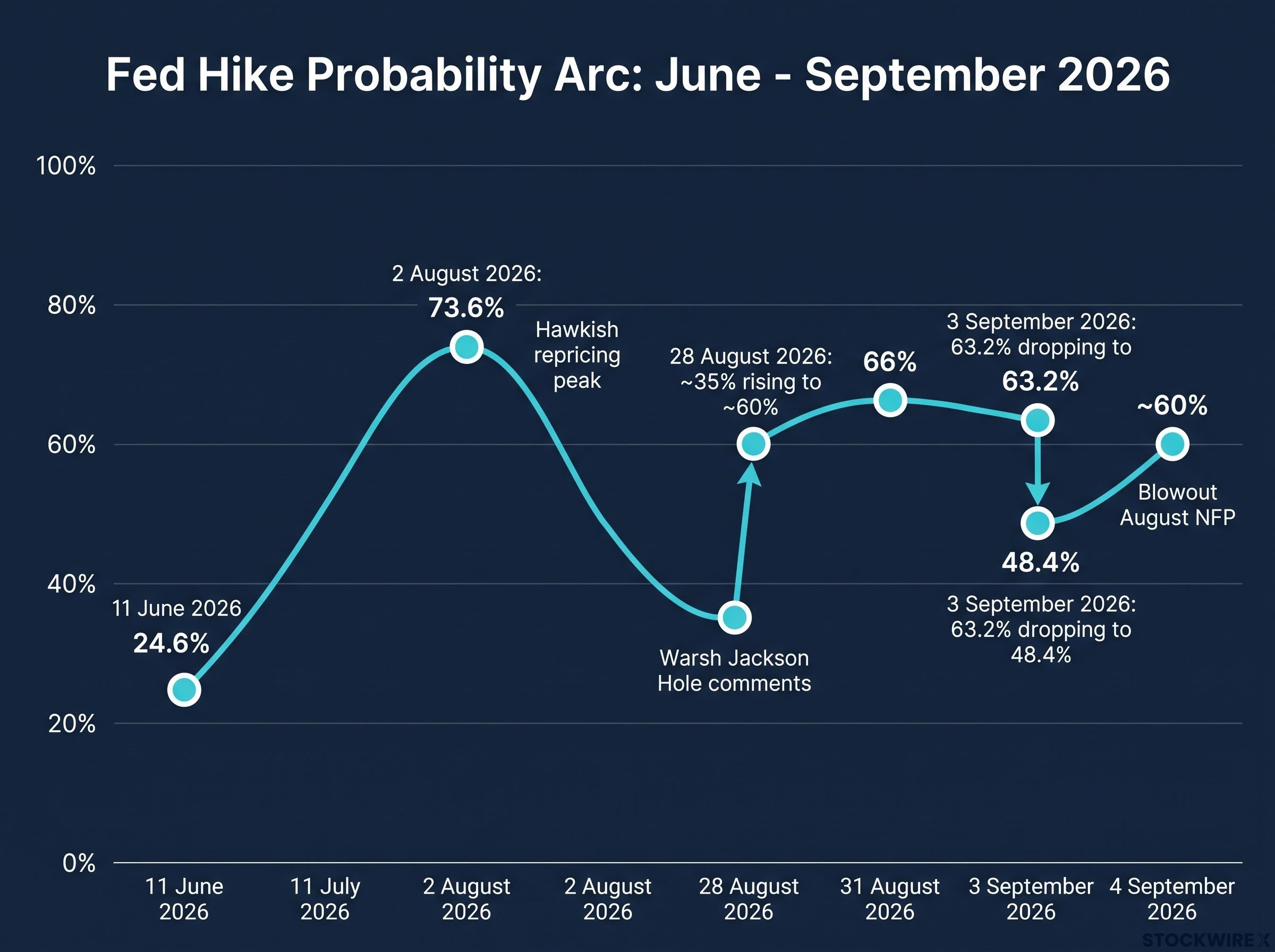
Hike odds for the September meeting started low and unloved. On 11 June 2026, Yahoo Finance-cited FedWatch data implied just 24.6% probability the rate would be higher than the current 3.50%-3.75% range by September. Markets were treating further tightening as a tail risk.
Then the direction turned. By 2 August, Longbridge had the odds at 73.6% for a quarter-point hike, a near-tripling in under two months. Something had convinced the market that the Fed was not done.
| Date | Hike Probability | Key Catalyst |
|---|---|---|
| 11 June 2026 | 24.6% | Further hikes viewed as a tail risk |
| 2 August 2026 | 73.6% | Hawkish repricing peak |
| 28 August 2026 | ~35% rising to ~60% | Warsh Jackson Hole comments |
| 31 August 2026 | 66% | Target range 3.75%-4.00% cited |
| 3 September 2026 | 48.4% | Pullback from 63.2% prior day |
| 4 September 2026 | ~60% | Blowout August NFP |
By 3 September, MarketWatch had the odds back down to 48.4% for a hike against 51.6% for a hold, a fall from 63.2% the previous day. Then the August payrolls reset the clock again, pushing odds back toward 60%.
A market that swings roughly 50 percentage points in three months is not reading a clean policy signal. It is reacting to noise, which is precisely why every remaining data point before 15 September carries outsized weight.
The probability arc from June to September tells a story of market sentiment running ahead of softening macro data, with ISM manufacturing sub-components decelerating and three-month annualised PCE already falling before Warsh’s hawkish pivot, a divergence that raises the question of whether the 60% hike consensus on 4 September reflected genuine economic evidence or narrative momentum.
When a former governor’s words move markets more than data
The sharpest single move in the arc did not come from data at all. It came from a speech.
On or around 28 August 2026, Kevin Warsh made hawkish comments at Jackson Hole that caused September hike odds to nearly double, jumping from about 35% to roughly 60%, according to Yahoo Finance and CNBC coverage. A near-doubling of the implied path from one appearance is a striking demonstration of how thin conviction was.
Here is the attribution that matters. Warsh is a former Fed governor, not a sitting FOMC voter. His words carry weight as a prominent voice, but they do not set policy.
That distinction helps explain the 3 September pullback from 63.2% to 48.4% in a single day. Part of that move looks like the market correcting an overreaction to a non-voting voice, which tells you how fragile a probability reading built on commentary rather than hard data can be.
What strong payrolls alone cannot tell the Fed
Start with the Fed’s own rulebook. The dual mandate commits it to maximum employment and price stability, and its inflation-targeting framework anchors the second half of that to a specific number. A strong jobs print speaks to the first half. It says very little, on its own, about the second.
That is why 162,000 jobs against a 56,000 consensus, with the July figure revised up to a 21,000 gain from a previously reported decline of 23,000 and unemployment holding at 4.1%, is necessary but not sufficient for a hike. The relevant question is not whether the labour market is strong. It is whether that strength is generating or sustaining above-target inflation.
Cleveland Fed President Beth Hammack has made the live version of that concern explicit. Communicating via LinkedIn, she has indicated that current policy is not restrictive and warned about the difficulty of reversing inflation once it stays high.
Beth Hammack, Cleveland Fed President: Prolonged above-target inflation becomes increasingly difficult to reduce over time, and current policy settings are not restrictive.
The energy dimension complicates the picture further. Elevated oil prices tied to Middle East conflict feed into headline CPI and PPI and, more importantly, into medium-term inflation expectations through transport and production costs. Supply-side shocks are the hardest kind for a central bank to answer, because hiking into a supply shock risks slowing growth without fully curbing prices.
The hike probability repricing in late July offered an early blueprint for the September arc: odds jumped from roughly 10% to 36% in two weeks as Middle East tensions lifted oil prices against an above-target core PCE backdrop, the same oil-inflation-expectations channel that continues to complicate the Fed’s read of supply-side shocks.
For a hike delivered with genuine conviction, the Fed would want three conditions lining up together:
- A strong labour market, which the August print supplies.
- Sticky core inflation, meaning underlying price pressures that persist once volatile food and energy are stripped out.
- Anchored or rising inflation expectations, so that households and businesses do not start assuming higher prices are permanent.
Only the first of those is confirmed. That is the takeaway you should carry into any late-cycle jobs report. Labour market resilience is bullish for rates only when paired with sticky or rising inflation, and that verdict sits with the CPI and PPI, not the payrolls.
Why the CPI and PPI releases, not Friday’s jobs report, are the September decision
The August jobs report has already done its work. The decisive inputs are still ahead.
CPI and PPI are both due the week of 8 September 2026, the last substantive data the Fed will see before the 15-16 September meeting. That timing makes Friday’s payrolls effectively preliminary. It narrowed the range of outcomes without resolving it.
Three camps currently divide analyst and market opinion, and every one of them resolves on the inflation data rather than the labour data.
The hawkish camp, represented by Forbes, puts the odds around 66% and expects a hike to the 3.75%-4.00% range. The hold-leaning camp, drawing on CNBC coverage after the July jobs miss, saw hold odds rise toward 60%. The coin-flip camp, captured by MarketWatch’s 3 September reading of 48.4% hike against 51.6% hold, treats the outcome as genuinely open.
What history says about jobs prints in late tightening cycles
Prior cycles reinforce the point. Through the 2016-2018 tightening, strong payrolls were often followed by range-bound or weaker dollar trading, because the hike path was already priced and attention had moved to terminal-rate expectations.
The 2021-2023 period tells a similar story. Robust jobs numbers raised near-term hike odds but did not shift the medium-term rate path, and dollar reactions faded quickly as focus returned to inflation and financial conditions.
The recurring lesson is that labour data alone rarely forces the Fed’s hand. What matters is how jobs, inflation, and financial conditions together reshape the whole expected policy path.
| Data Outcome | Fed Action (Most Likely) | Dollar Implication |
|---|---|---|
| Strong CPI, sticky core services | Hike to 3.75%-4.00% | Cleaner path higher; terminal rate repricing |
| Softer CPI, easing energy costs | Hold, hawkish language retained | Continued softness; odds drift toward 50% |
| Mixed reading | Coin-flip preserved into meeting | Range-bound, headline-driven volatility |
For anyone positioning ahead of the meeting, the actionable read is this. The jobs report narrowed the outcomes but did not settle them, and the CPI print on its own now carries more binary decision weight than any payrolls report in this cycle.
What the dollar needs to stage a sustained recovery before the FOMC
A single spike is not a trend. For the 4 September move to become one, the specific conditions would have to align, and the four headwinds identified earlier still stand in the way.
Crowded positioning, risk-on flows, a terminal rate the market believes is near its peak, and lingering fiscal and growth concerns all argue for fading dollar spikes rather than chasing them. A hot CPI print would need to overwhelm all four at once.
The DXY technical picture heading into September reinforces the structural case for fading spikes rather than chasing them: price was already trading below both the nine-period and 50-period EMAs near 99.00 in late August, with RSI recovering from oversold toward neutral rather than confirming a directional reversal.
The bull case is legitimate, though. If CPI shows sticky core services inflation and the Fed delivers a 25-basis-point hike with a hawkish statement, FedWatch odds could push above 70% and reopen the terminal-rate debate. That would be new information rather than confirmation of existing pricing, and the dollar would have a cleaner path higher from its current base near 99.10.
The softer scenario runs the other way. A CPI reading that eases, particularly in energy-sensitive components, would confirm the hold camp and push probabilities back toward 50% or below, keeping the greenback under pressure.
Here is the sequence to watch, in order:
- CPI and PPI, week of 8 September 2026: the decisive inputs, with core services the number that matters most.
- Pre-blackout FOMC communications: any remarks from sitting voters before officials go quiet.
- The 15-16 September statement language: especially any guidance on hikes beyond September.
Watch those three, know the thresholds, and you can read each release as it lands rather than waiting for the Fed to tell you what it meant.
This article is for informational purposes only and should not be considered financial advice. Investors should conduct their own research and consult with financial professionals before making investment decisions. Past performance does not guarantee future results, and financial projections are subject to market conditions and various risk factors. Forward-looking scenarios are speculative and subject to change based on market developments.