If you trade anything linked to the VIX, you have almost certainly stared at two numbers that should be the same and are not. The VIX quote on your screen says one thing. The VIX future you are about to buy says another. And the gap between them is not a lag, a glitch, or a rounding error.
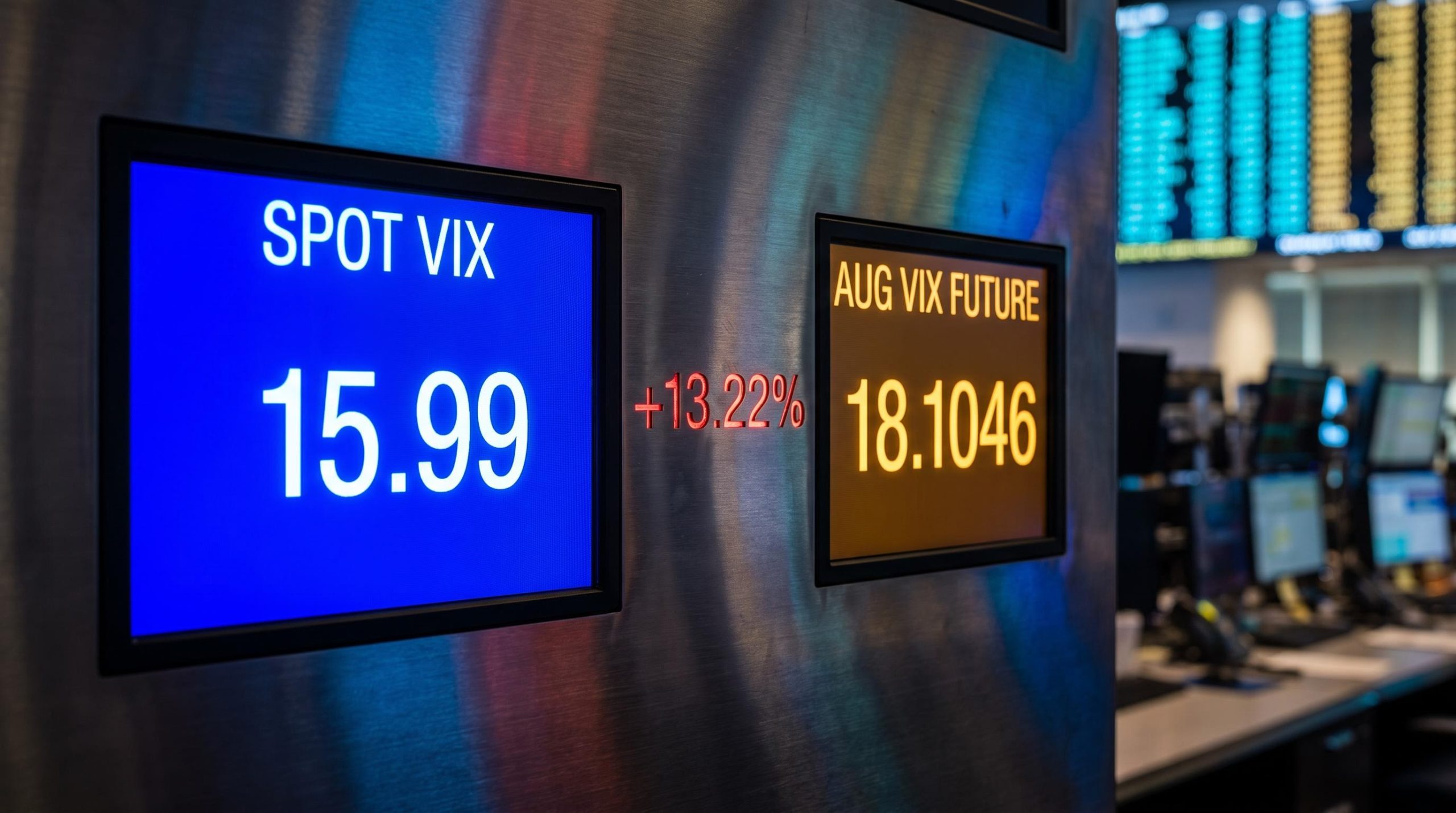
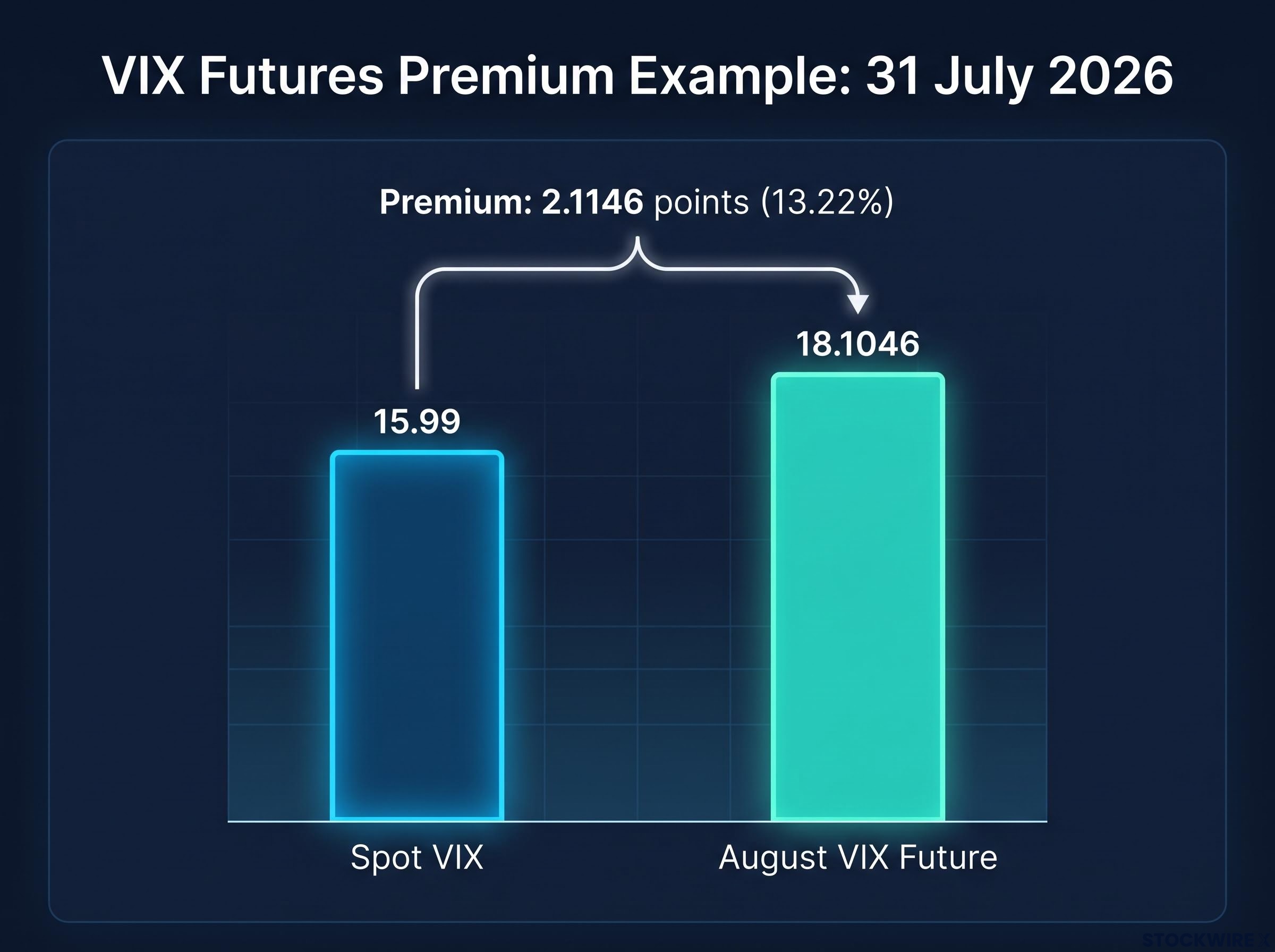
It is a structural feature, and it is often large. On 31 July 2026, spot VIX closed at 15.99 while the August VIX future settled at 18.1046, according to Cboe daily settlement prices. That is a premium of 2.1146 index points, or 13.22% above the spot level. If you had bought that future expecting exposure to a VIX of roughly 16, you were actually paying for something priced closer to 18.
This article explains the specific reason futures cannot converge to spot, how VIX settlement actually works on expiration morning, and why manipulating that settlement is prohibitively expensive. By the time you finish, you will understand the mechanics that govern every dollar of VIX-linked exposure, before you ever put on the trade.
Why you cannot buy the VIX you see on your screen
Here is the assumption almost every new volatility trader makes: the VIX is a price, and a price is something you can buy. It is not.
Spot VIX is a calculated index. It is derived in real time from the mid-quotes of S&P 500 Index (SPX) options across a range of strikes and expirations. There is no asset behind the number, no share, no contract, nothing you can hold. It is a measurement, the way a temperature reading is a measurement, and you can no more buy the VIX than you can buy 72 degrees.
Spot VIX is itself a measure of implied volatility extracted from live SPX option prices, and grasping how implied volatility is priced into any options chain is the foundation for understanding why the gap between spot and futures is not arbitrary but reflects collective market expectations about future movement magnitude.
That distinction is the entire reason the futures premium exists. If you could buy spot VIX and sell a future against it, any gap between the two would be an arbitrage, and traders would collapse it in seconds. But you cannot, so the gap persists.
Could you replicate spot VIX synthetically instead? In theory, yes. In practice, according to Russell Rhoads, former CBOE Options Institute instructor and volatility specialist, it is operationally impractical and prohibitively expensive. Rhoads notes that major Chicago trading firms have explored whether it can be done and have come up empty.
Replicating the index would require you to hold and continuously manage a live portfolio of SPX options. Specifically, it would demand three things at once:
- Continuous management of an SPX options position, adjusted in real time as the index recalculates
- Dynamic rebalancing across strikes as the market moves and the set of relevant options shifts
- Simultaneous management across multiple expirations, because the VIX formula blends options from more than one expiry
Get any one of those wrong and your replica drifts away from the index it is meant to track.
The anchor number On 31 July 2026, spot VIX closed at 15.99 while the August VIX future settled at 18.1046. That is a premium of 13.22% above spot, and no arbitrage exists to close it.
This is not a one-off. Rhoads has documented similar spreads: with spot VIX near 14.04 to 14.10, the September future traded around 16.00 (roughly a $1.90 premium) and the November future sat near 18.70. The premium is the rule, not the exception.
What this means for you is simple and slightly unsettling. Every VIX futures position you take is inherently different from what the headline VIX number implies. Grasp that, and the rest of the machinery finally makes sense.
The VIX structural limitations that prevent it from capturing individual stock moves are a direct extension of the same non-replicability problem: because the index is built from SPX aggregate options flow, dealer gamma hedging and low cross-stock correlations can suppress the headline number even while single stocks are swinging violently.
When big ASX news breaks, our subscribers know first
The three structural forces that hold the premium in place
Non-replicability explains why the premium can exist. It does not, by itself, explain why the premium is so consistently positive. For that, three separate forces are at work, and each one would push the future above spot even if the other two disappeared.
The first is the volatility risk premium (VRP). Over long stretches, index options price in more uncertainty than the market actually goes on to realise. A 2019 paper in the Review of Financial Studies, “The VIX Premium,” defines this gap precisely: it is the difference between the risk-neutral expectation of future VIX and the physical, real-world expectation. In plain terms, buyers of volatility protection overpay on average, and that overpayment is compensation to the speculators willing to sell them insurance.
The VIX Premium, published in the Review of Financial Studies in 2019, defines this gap as the difference between the risk-neutral and physical expectations of future volatility, providing the formal theoretical grounding for why buyers of protection systematically overpay relative to realised outcomes.
Interestingly, this premium is not constant. Cboe and academic research on the VRP find that ex-ante premiums fall or stay flat precisely when risk is rising, and falling premiums tend to predict increasing market risk after the fact.
Contango and hedging demand
The second force is the shape of the futures curve. Under normal conditions, the VIX futures curve slopes upward, a state called contango, roughly 80% of the time according to Cboe documentation. Longer-dated contracts price in more uncertainty over longer horizons, so each further-out contract tends to sit above the one before it. In the Rhoads examples, the September and October futures showed a bid-to-bid spread of around $2.00, a visible slope you pay to climb.
VIX seasonality adds a temporal layer to the contango dynamic: the late-August to early-October window has historically coincided with the largest average monthly VIX increases across three decades of data, meaning the upward-sloping futures curve tends to steepen precisely when seasonal volatility risk is highest.
The third force is hedging demand. Institutions want volatility insurance more or less permanently, and the supply of speculators willing to sell it is finite. That structural imbalance keeps demand-side pressure on the premium persistent rather than episodic.
| Driver | Mechanism | Effect on futures price |
|---|---|---|
| Volatility risk premium | Options price in more uncertainty than markets realise; buyers overpay on average | Lifts futures above spot as compensation to volatility sellers |
| Term structure (contango) | Curve slopes upward around 80% of the time; longer horizons carry more uncertainty | Pushes each later-dated contract above the one before it |
| Hedging demand | Persistent institutional demand for insurance exceeds speculator supply | Applies constant upward pressure on the premium |
The takeaway for you is that these forces are structural, not circumstantial. If you hold a long-volatility product, you are paying a persistent cost that compounds, not a temporary inefficiency waiting to close.
How VIX futures actually settle: the SOQ and the zero-bid rule
Ask most traders how a VIX future settles and they will tell you it settles to whatever the VIX reads on expiration morning. That is wrong, and the real answer is more precise and more interesting.
VIX derivatives settle to a Special Opening Quotation (SOQ), a value calculated from the opening auction prices of SPX options on the morning of expiration. The process is patterned after the way A.M.-settled SPX options themselves settle.
The critical difference from intraday spot VIX is the input. Spot VIX runs on mid-quotes throughout the trading day. The SOQ uses actual opening trade prices from a special opening auction, and it only falls back to mid-quotes when no opening trade occurs at a given strike. Cboe determines in advance which strikes are included.
The Cboe VIX methodology whitepaper details exactly which strikes are included in the SOQ calculation and how the fallback to mid-quotes operates when no opening trade occurs, giving you the precise formula behind every settlement value you receive.
Here is how the SOQ comes together, in order:
- Cboe announces the strike range of SPX puts and calls to be included in the calculation
- The special opening auction in SPX options begins on expiration morning
- Opening trade prices are collected across the announced strikes
- Where no opening trade occurs at a strike, the mid-quote is used as a fallback
- The VIX SOQ is calculated from the collected prices, and that value settles the derivatives
Because the SOQ leans on real opening trades rather than quotes, it is anchored to genuine liquidity. The data shows how tight that anchor is. A CFTC filing covering August 2023 to August 2024 found the average absolute difference between a monthly VX future’s settlement price the day before expiration and its final SOQ value was just 0.422 index points.
What the settlement data shows Over the August 2023 to August 2024 period, the average absolute settlement deviation was 0.422 index points, equal to $422.37 per contract. In typical conditions, the SOQ and the pre-expiration futures price sit remarkably close together.
There is one scheduling wrinkle worth knowing. When SPXW options are closed on a Friday, Good Friday, for example, a 2024 Cboe product update clarifies that VIX weekly options and the corresponding futures settle on Tuesday rather than Wednesday. If you hold through such a week, your settlement date moves.
What this means for you is twofold. Settlement is usually orderly because it is tethered to real auction trades, but the value you receive is set during a brief window on expiration morning that you cannot watch in real time.
The two-consecutive-zero-bid rule as a liquidity filter
The intraday spot VIX calculation has a built-in filter that stops thinly traded strikes from distorting the index. Moving down the put chain and up the call chain, once two options at consecutive strikes show zero bids, no options further out at those extremes are included.
The asymmetry matters. A put with even a one-cent bid still counts, provided the two-consecutive-zero threshold has not been crossed. It takes two zeros in a row, not one, to stop the chain.
The purpose is to prevent anyone from nudging the index by placing tiny trades in deeply out-of-the-money strikes that almost never trade. The SOQ sidesteps this issue entirely by using Cboe’s pre-announced strike range, which removes the ambiguity the zero-bid rule is designed to manage in the first place.
Why manipulating VIX settlement costs tens of millions of dollars
Now the stress test. Because VIX relies on quotes rather than executed trades, there is a genuine theoretical vulnerability: widen the bid-ask spreads on illiquid out-of-the-money puts, and you can move the index without any real change in market volatility.
This is not hypothetical. The Bank for International Settlements, in Bulletin No. 95 dated 29 October 2024, analysed the sharp VIX spike on 5 August 2024 and found it was strongly influenced by the asymmetric widening of bid-ask spreads, particularly in less liquid OTM SPX puts. The quote-driven weakness is real and documented.
BIS Bulletin No. 95 attributes the August 2024 VIX spike primarily to the asymmetric widening of bid-ask spreads in less liquid out-of-the-money SPX puts, concluding that quote-driven index construction amplified the move well beyond what underlying equity market stress alone would have produced.
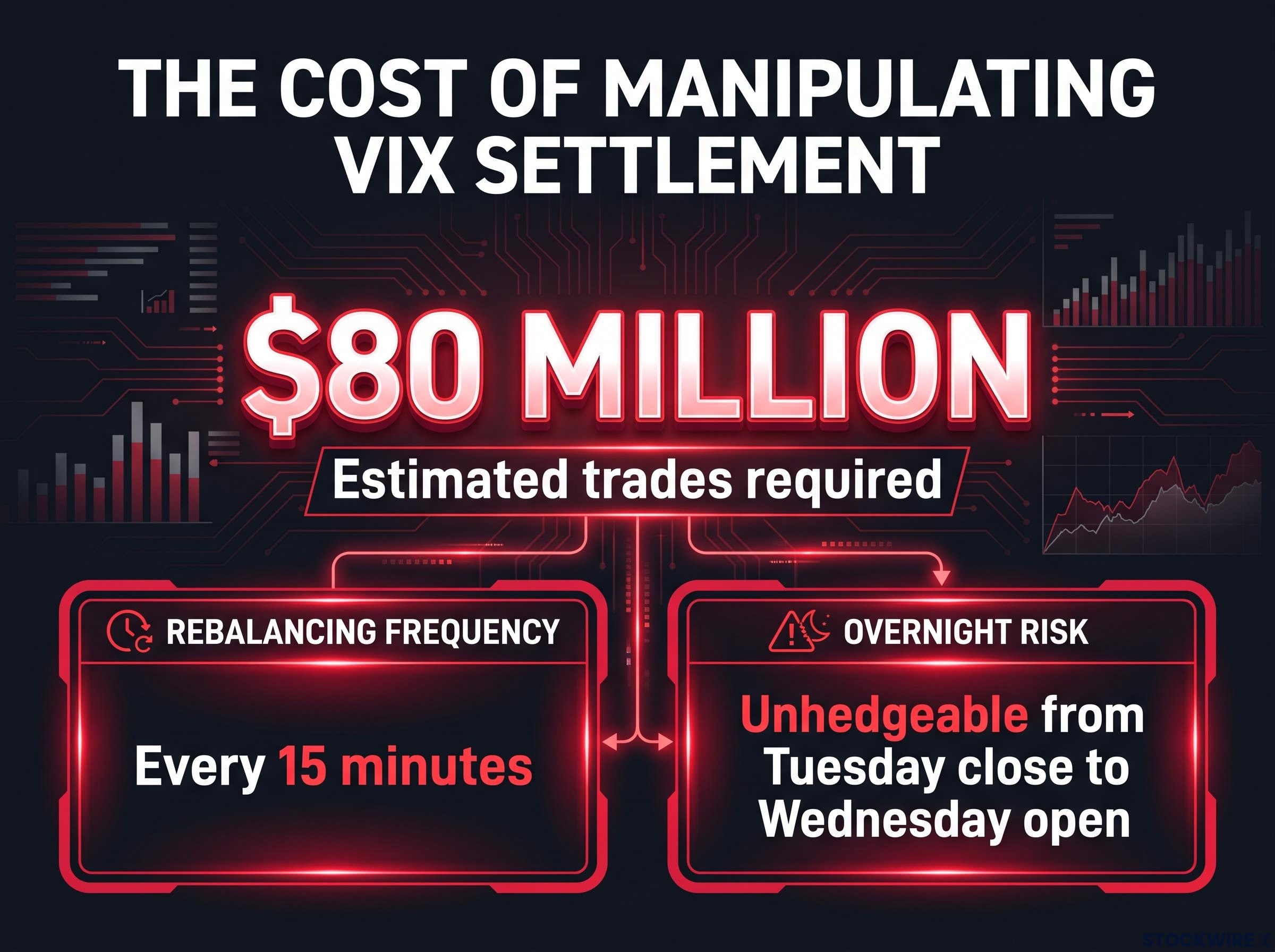
So why does it not get exploited constantly? Because the economics are brutal. According to Rhoads, a meaningful attempt to move the SOQ auction would require roughly $80 million in trades, with positions rebalanced about every 15 minutes, and it would carry unhedgeable overnight risk between Tuesday’s close and Wednesday’s opening.
The cost of a manipulation attempt Rhoads estimates a serious effort to move VIX settlement would need approximately $80 million in trades, rebalanced roughly every 15 minutes, on top of overnight risk that cannot be hedged away.
The deterrents stack up quickly:
- Financial cost: an estimated $80 million threshold just to move the number meaningfully
- Rebalancing frequency: positions must be adjusted roughly every 15 minutes
- Overnight risk: unpredictable moves between Tuesday’s close and Wednesday’s open cannot be hedged
- Regulatory monitoring: Cboe actively watches for abuse
Rhoads cites a telling regulatory case: an individual placed bids on far OTM puts during VIX settlement and, when questioned, said the minimum permitted bid was a dime and they would have gone to a penny if allowed. Even a dime bid on deeply OTM SPX puts carries a large notional cost, which is exactly the point.
The legal record is mixed rather than settled. Class-action complaints filed in 2018, including Bueno v. Cboe and Mussov v. John Does, alleged that quote-based flaws let firms create artificial settlement prices. A 2019 Analysis Group report rebutted them, arguing that moving the SOQ would demand enormous, costly positions and that observed settlements reflect normal market dynamics.
The debate has not closed. A 2024 University of Tilburg master’s thesis concluded that evidence of manipulation anomalies persists despite a decade of scrutiny, documenting abnormal volumes in OTM options around settlement. Separate academic analysis has estimated the distortionary cost to holders of VIX derivatives at around $1.81 billion, though that figure is unverified and should be treated with caution. Notably, no SEC or CFTC enforcement action targeting VIX settlement manipulation occurred between 2024 and 2026.
Where you should focus is the gap between theory and practice. The system is not manipulation-proof, quotes can be gamed, but the cost structure makes opportunistic manipulation economically irrational in most conditions. That is a far more useful read than either dismissing the risk or treating every settlement as rigged.
What this means before you put on a volatility trade
Four layers of mechanics now converge into one practical point. The VIX number on your screen is not the price of anything you can buy, and every VIX-linked product, futures, options, and exchange-traded products (ETPs), exposes you to the premium, the roll cost, and the SOQ settlement dynamic all at once.
The roll cost deserves particular attention if you hold long-volatility ETPs. Because these products roll expiring futures into more expensive longer-dated contracts while the curve is in contango, they systematically absorb negative roll yield. FINRA Regulatory Notice 17-32 warns specifically about this decay, and many volatility ETPs have lost more than 90% of their value since launch.
Inverse volatility products magnify the same contango drag through leverage, because their daily reset mechanic forces compounding losses as futures roll from cheaper near-term contracts into more expensive ones, accelerating the decay that FINRA Regulatory Notice 17-32 warns about in standard long-volatility ETPs.
The creator’s verdict Robert Whaley, widely credited as the creator of the VIX, has reportedly described volatility ETPs as “guaranteed losers” over the long run because of this contango trap.
The extreme illustration is “Volmageddon” on 5 February 2018, when the VIX more than doubled. Inverse VIX ETPs were forced by their own rebalancing rules to buy futures into the spike, accelerating their own collapse. The VelocityShares Daily Inverse VIX Short-Term ETN (XIV) lost 96.3% of its value in a single session, and Credit Suisse subsequently terminated it.
Four questions to answer before any VIX-linked trade
Before you enter any VIX-linked position, you should be able to answer these:
- What is the current futures premium over spot? If you do not know the gap, you do not know what you are actually buying
- Where does the curve sit, contango or backwardation? The slope tells you whether roll yield is working for or against you
- What is the roll schedule for any ETP involved? This determines how much decay you absorb over time
- On what date and by what process does the position settle? The SOQ, and any scheduling shift, decides the value you receive
If you cannot answer all four, you are taking on risks you have not priced.
This article is for informational purposes only and should not be considered financial advice. Investors should conduct their own research and consult with financial professionals before making investment decisions. Past performance does not guarantee future results.
The premium is a feature, not a flaw
What looks like a market inefficiency to the uninitiated is actually a coherent structure. The VIX futures premium is not a sign of dysfunction. It is a direct consequence of the fact that spot VIX cannot be traded, which makes the premium structurally inevitable rather than something the market will eventually correct.
Understanding the premium, the SOQ, and the roll dynamics will not make volatility trading easy. Nothing makes volatility trading easy. But it removes the single most expensive source of confusion for anyone entering these products: the belief that the future should equal the spot.
Volatility products reward structural literacy more than almost any other asset class, because the mechanics here are more consequential than in equities or fixed income. Learn the machinery first. Then decide whether the trade is worth it.