
Currency markets can feel like they move on their own logic, spiking and sliding for reasons that never quite make the headlines. But the value of the Pound Sterling is not set by some invisible hand. A single committee in London, meeting eight times a year, effectively sets the floor beneath your currency.
That committee is the Bank of England’s Monetary Policy Committee, and its decisions on the Bank Rate, quantitative easing, and quantitative tightening ripple straight through to the value of the Pound in your pocket.
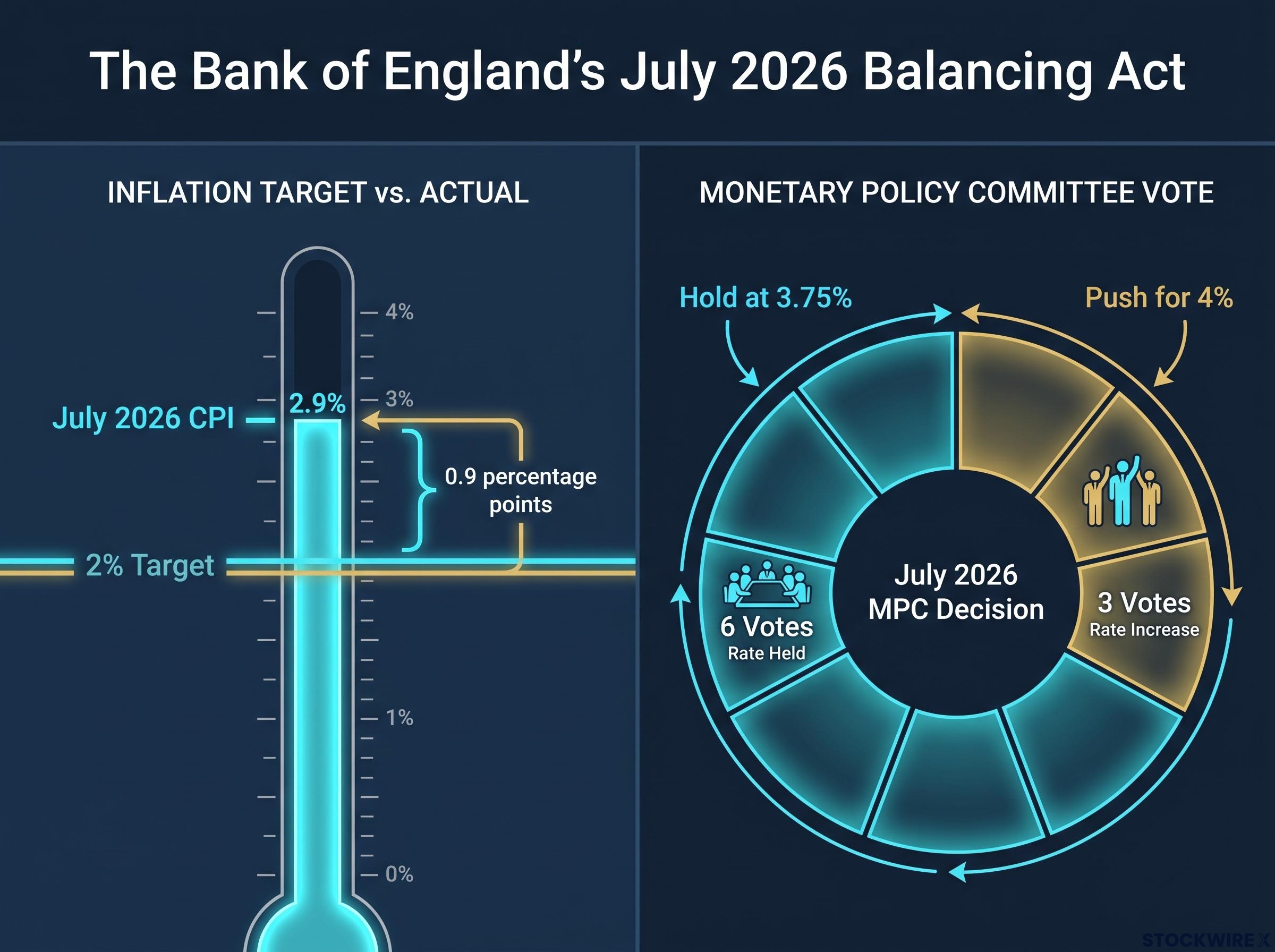
Right now, this is playing out in real time. UK inflation ran at 2.9% in July 2026, according to the Office for National Statistics, while the Bank Rate has held steady at 3.75%. The gap between those two numbers is exactly what keeps the committee busy, and what keeps Sterling moving.
Understanding Bank of England monetary policy is not just an academic exercise. When the Pound weakens, your holiday abroad costs more and imported goods get pricier at home.
This gives you a clear framework for interpreting central bank announcements and understanding exactly why your domestic currency shifts when policy does.
The mandate that drives the decisions
Everything the Bank of England does traces back to one number: 2%. That is the official inflation target, and the Bank’s primary job is keeping the Consumer Price Index (CPI), the standard measure of how fast prices rise across the economy, anchored there.
Miss that target, and the committee is obligated to act. This is not discretionary. Price stability is the mandate, and every rate decision flows from it.
The Bank of England inflation mandate formally sets the 2% CPI target as the primary objective, with the committee required to write an open letter to the Chancellor whenever inflation deviates by more than one percentage point in either direction.
That July 2026 reading of 2.9% sits 0.9 percentage points above where the Bank wants it. To you, that gap is not a statistic. It is the reason the committee keeps policy restrictive, and the reason your money buys slightly less each month than it did before.
The distinction between headline and core inflation matters here: the July 2026 UK inflation data shows a 2.9% headline driven almost entirely by a 13% energy price cap rise, while core CPI fell to 2.5%, the very divergence that explains why the MPC majority read the same number as the hawks did and reached the opposite conclusion on rates.
The Monetary Policy Committee is not simply chasing low inflation, though. It is constantly weighing two competing dangers, a balancing act that has defined its reports throughout 2025 and 2026.
- The risk of greater inflation persistence: if prices keep climbing, the committee must tighten policy, raising rates to cool demand.
- The risk of weaker demand and output: if the economy stalls, tightening too hard risks damaging growth and employment.
Every decision is a judgement call between these two. Lean too far toward fighting inflation, and you choke off the economy. Lean too far toward protecting growth, and inflation runs loose.
To manage this balance, the committee has three main levers. Base rate adjustments handle day-to-day steering. Quantitative easing is the emergency stimulus tool. Quantitative tightening is the reverse gear, used to unwind that stimulus.
Here is the practical takeaway for you: read every inflation headline through the lens of this mandate. When CPI drifts away from 2%, that is the specific trigger forcing the committee to change policy, and with it, the value of your currency. Get the mandate, and you can start anticipating moves rather than scrambling to react to them.
When big ASX news breaks, our subscribers know first
How base rate adjustments steer Sterling
The Bank Rate is the most direct tool the committee has, and its effect on the Pound follows a fairly clear chain. When the Bank raises the rate it charges commercial banks, borrowing across the economy gets more expensive, and UK assets start paying more attractive returns.
Higher returns pull in global capital. Investors chasing yield move money into Sterling to earn those better rates, and that demand pushes the Pound up.
But here is the part most people miss: currency markets do not react to the headline rate itself. They react to where they expect rates to go next.
This is the concept of interest rate differentials, the gap between UK rates and those in the United States and the Euro area. Sterling strengthens when the UK offers a better rate path than its peers, and weakens when it falls behind.
A 2025 analysis from Allianz captured the Bank’s reputation neatly, describing it as “first to hike, last to pause and pivot.” A higher projected peak in the Bank Rate supports the Pound by preserving that yield advantage over rivals.
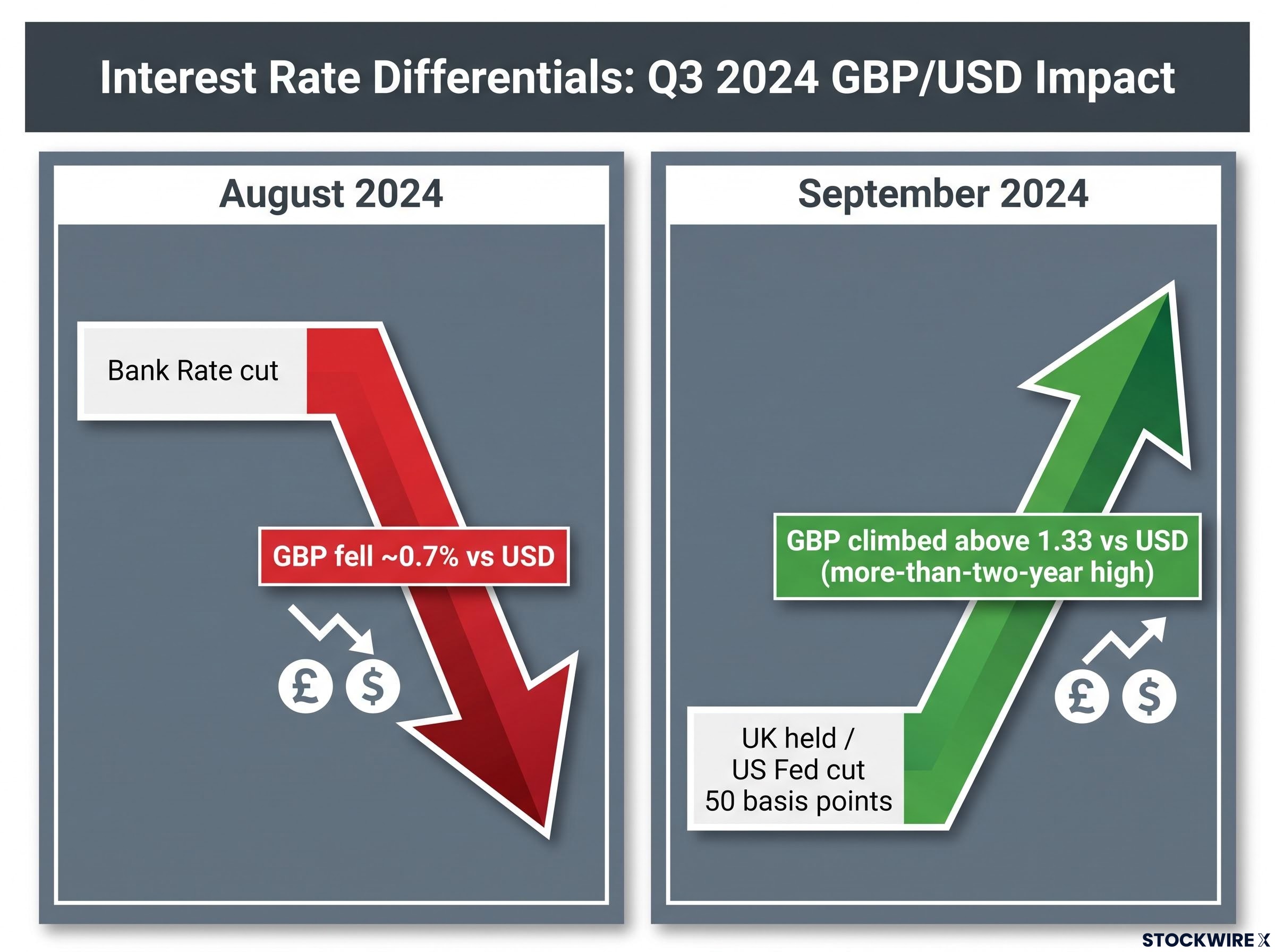
Recent history shows the mechanics in action. In August 2024, the Bank cut the rate and Sterling fell roughly 0.7% against the dollar as traders priced in more cuts to come. Yet in September 2024, the Bank held while the US Federal Reserve cut by 50 basis points, and the Pound climbed above 1.33 against the dollar, a more-than-two-year high, purely on the favourable differential.
The signal often arrives before the decision. The July 2026 meeting held rates at 3.75%, but the 6-3 vote split, with three members pushing for a rise to 4%, told markets plenty about the direction of travel.
The July 2026 MPC vote split of 6-3, with Pill, Greene, and Mann pushing for an immediate rise to 4%, is not just a procedural footnote; five-year swap rates had already crossed 4.52% ahead of that decision, meaning mortgage pricing in the real economy moved before the committee even voted.
| Policy Action | Interest Rate Differential Effect | Typical GBP Impact | Recent Historical Example |
|---|---|---|---|
| Rate cut | Narrows UK yield advantage | Weakens the Pound | August 2024: GBP fell ~0.7% vs USD |
| Rate hold while peers cut | Widens UK yield advantage | Strengthens the Pound | September 2024: GBP topped 1.33 vs USD |
| Hawkish vote split on a hold | Signals higher future path | Supportive of the Pound | July 2026: 6-3 hold at 3.75% |
For your currency exposure, the lesson is simple. The headline number matters less than the expectation of what comes next, so watch the committee’s forward guidance and vote splits far more closely than the immediate decision.
Quantitative easing and the dilution of currency
When rate cuts run out of road, the Bank reaches for a heavier tool. Quantitative easing (QE) is the emergency measure deployed when the economy has stalled and standard rate reductions simply are not enough to revive it.
The mechanics are direct. The Bank creates new money and uses it to buy assets, mainly government bonds and high-grade corporate bonds, from financial institutions, flooding the system with liquidity to get lending and investment moving again.
That extra money does something predictable to the Pound. Increasing the money supply while pushing domestic interest rates lower puts systematic downward pressure on the currency, a dynamic consistent with uncovered interest parity, the principle that lower relative returns should weaken a currency to keep cross-border investment balanced.
The Bank’s own research backs this up.
The Bank of England’s Quarterly Bulletin estimates that the UK’s first two rounds of quantitative easing caused the sterling exchange rate index to fall by approximately 4% in response to early announcements.
For you, the implication is concrete. When the Bank starts buying bonds on this scale, expect your purchasing power abroad to shrink, because injecting fresh money into the system dilutes the value of the currency already in circulation.
The limits of mechanical depreciation
The “QE weakens the Pound” rule is not ironclad, though. A 2026 Bank of England working paper found that while the exchange rate depreciated in almost all QE episodes, the size and even the direction of the move depended heavily on the prevailing macro environment.
These tools are state-contingent, meaning their effect shifts with the conditions around them. In moments of global stress, safe-haven flows can send money into certain currencies regardless of what the central bank is printing, occasionally overriding the standard dilution effect.
So treat the depreciation as the base case, not a guarantee. The wider global backdrop always has a vote.
Quantitative tightening in a high debt environment
If QE is the accelerator, quantitative tightening (QT) is the reverse. It is the process where the Bank halts new bond purchases and lets the bonds it already owns mature, or actively sells them back into the market, shrinking the balance sheet it built up during the stimulus years.
You might assume this simply reverses QE’s effect and strengthens the Pound. The reality is more complicated, and the current cycle shows exactly why.
The numbers illustrate the scale of the unwind. As of September 2026, the Asset Purchase Facility held roughly £489 billion in gilts, down from £553.2 billion at the end of December 2025, as the Bank works through a target to cut the stock by £70 billion over the year to September 2026.
Here is how the tightening actually transmits into your currency:
- The Bank stops reinvesting or actively sells gilts, increasing the supply of government bonds in the market.
- More supply pushes bond prices down and yields up, adding an estimated 20-30 basis points to the term premium on long-term rates.
- Higher yields can mechanically attract foreign capital, which supports the Pound through the interest rate differential.
- But those same higher yields raise the government’s debt-servicing costs, and in a high-debt environment that can spook investors worried about fiscal sustainability.
- If confidence wobbles, foreign investors pull back, and the currency support flips into currency weakness.
Gilt yields and debt sustainability are tightly linked in this environment: the Bank’s QT programme adds roughly 20-30 basis points to the term premium on long-term rates, which raises the government’s debt-servicing costs and can unsettle the overseas investors who hold approximately 25% of outstanding gilts.
That fifth step is the catch. Dumping gilts into a market already nervous about UK debt can unsettle the exact overseas investors the Pound depends on.
The evidence is recent. When the Bank announced a slower pace of bond rundown on 18 September 2025, Sterling initially weakened against the dollar, a clear sign that markets read the news as depreciatory rather than supportive.
The takeaway for you is to resist the tidy assumption. QT will not automatically strengthen the Pound the way QE weakened it, because in a high-debt environment the fiscal risks can easily outweigh the yield benefits.
This article is for informational purposes only and should not be considered financial advice. Investors should conduct their own research and consult with financial professionals before making investment decisions.
Applying this framework to future policy announcements
Put the three tools together and you have a working framework. Base rates steer the Pound through yield differentials and expectations. QE dilutes the currency by expanding the money supply. QT tries to reverse that, but in today’s high-debt setting its effect is asymmetric and far from guaranteed.
The one constant is that mechanics never operate in a vacuum. Geopolitical shocks, global oil prices, and the UK’s heavy public debt can all override the standard transmission, which is why the same policy move can send Sterling in different directions depending on the moment.
So when the next Monetary Policy Report lands, know what to look for. Check the vote split for the direction of conviction, read the guidance language for where rates are heading, and note the balance sheet run-down targets for the fiscal pressure building underneath.
Master those three signals and you stop reacting to central bank news and start anticipating it.
For readers wanting to put this framework into practice on the next live announcement, our full explainer on reading a Bank of England rate decision walks through exactly how to interpret vote splits, forward guidance language, and SONIA curve pricing before markets move.
Past performance does not guarantee future results. Financial projections are subject to market conditions and various risk factors. These statements are speculative and subject to change based on market developments and policy decisions.