Two of the most senior voices at the Federal Reserve spent the same week telling the public two different things. One leaned toward holding rates. The other warned that inflation had not slowed and there might be more work to do. Markets responded by pricing something close to a coin flip on whether rates go up.
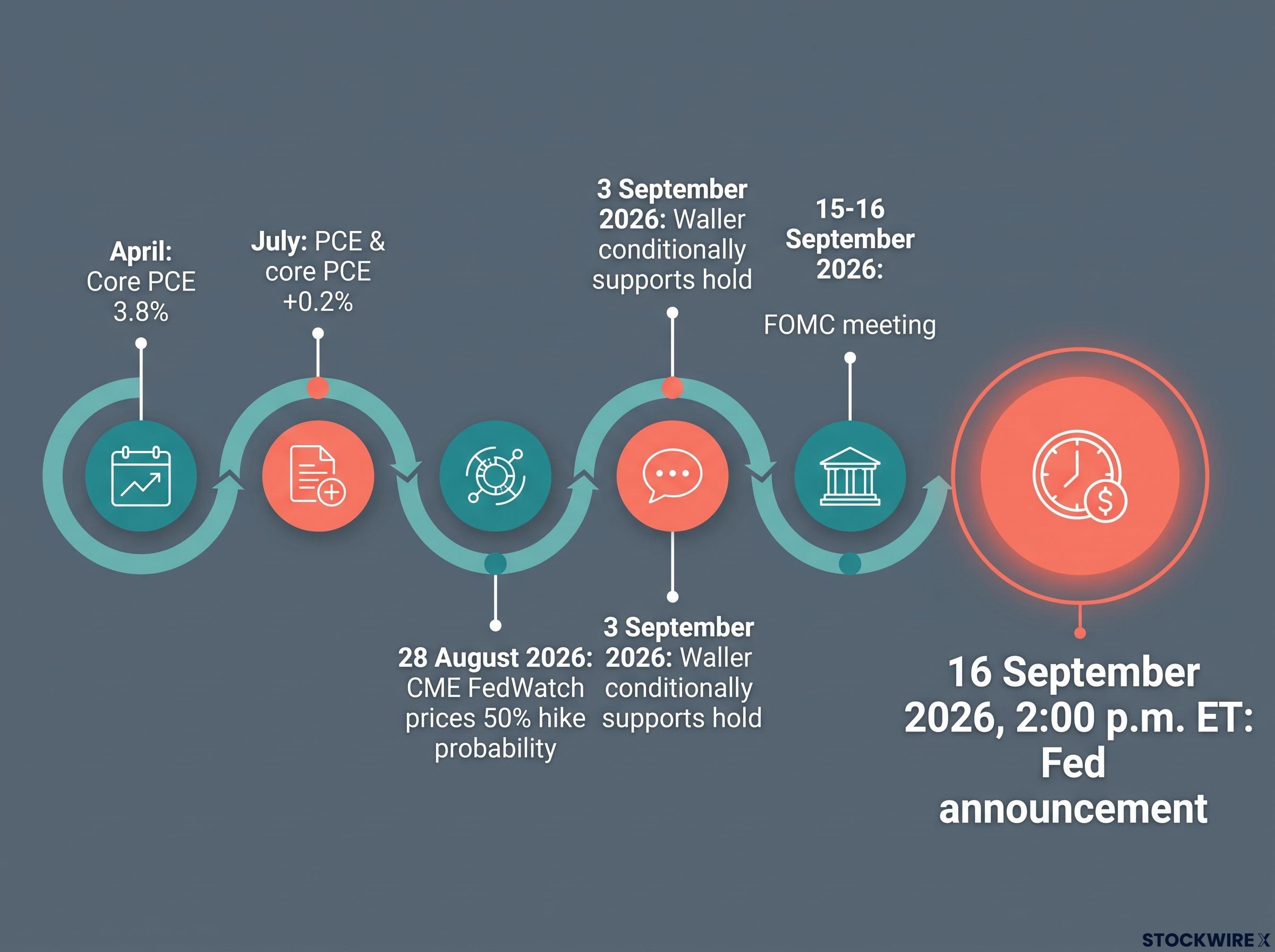
That is where the reader arrives: the September FOMC meeting scheduled for 15-16 September 2026, with no clear direction from the two officials most likely to shape it.
Governor Christopher Waller spoke on 3 September 2026, tying his vote directly to August inflation data that had not yet landed. Chair Kevin Warsh had already pushed the 10-year Treasury yield above 4.8% with hawkish inflation warnings. As of 28 August 2026, CME FedWatch pricing put the probability of a September hike at roughly 50%.
This is a decoding exercise, not a prediction. The goal here is to give you a structured way to read Fed communication accurately, so you weight the right signals rather than react to whichever headline moved markets most recently. That skill outlasts any single meeting.
What Waller actually said, and why it moved the needle
The headlines from Waller’s 3 September 2026 speech read as dovish, and for good reason. He acknowledged that inflation “remains meaningfully above” the FOMC’s 2% goal, but pointed to recent data that “suggest we are finally seeing some signs of disinflation.” He cited July PCE and core PCE, both up just 0.2% month-on-month, as evidence that price pressures are cooling, slowly but genuinely.
The July inflation data Waller cited as evidence of nascent disinflation showed headline CPI at 3.4% year-over-year and core CPI at 0.2% month-on-month, a second consecutive monthly decline from the 4.2% May peak, which is precisely the trajectory his conditional hold framework requires to continue through the August print.
Then he gave the market the sentence it wanted:
“If this continues in the data due over the next two weeks, I would be inclined to support holding the target for the federal funds rate at its current setting.”
That is the line that moved the needle. But it is only half of what he said. Directly after it came the escape clause.
“If the incoming data for August show this improvement has been fleeting, then it may be appropriate to raise the policy rate when the FOMC meets on September 15 and 16.”
Read those two statements together and the picture changes. Waller did not commit to a hold. He described the conditions under which he would support one, and named the exact conditions under which he would abandon it. His decision, in his own framing, “will be heavily influenced by what we learn about August inflation.”
That distinction matters for how you position. If you anchor on the dovish headline and treat it as a settled outcome, you are building on a conditional promise, not a commitment. The actual signal to watch is not Waller’s speech. It is the August CPI or PCE release, because that data, not the Governor, decides which half of his statement becomes operative.
How Waller’s position shifted from July to September
The conditionality is easier to read once you trace the arc. In July 2026, Waller warned the Fed may need to raise rates “in the near term” if core inflation stayed well above 2%, describing policy as at a crossroads. By 3 September, he had shifted toward holding. That is a data-driven pivot, not a change of conviction.
The longer frame reinforces this. Back in January 2026, Waller argued tariff-driven inflation should be “looked through” as long as expectations stayed anchored, and in March 2026 he described tariff effects as “one-off.” His framework has been consistent: watch whether disinflation holds, treat supply-side shocks as transitory until proven otherwise, and move only when the underlying trend demands it.
When big ASX news breaks, our subscribers know first
Warsh’s hawkish signals and how markets misread the gap between the two
Chair Warsh gave the opposite impression. He warned that inflation had not “meaningfully slowed” and signalled that policymakers may still have “work to do” to return it to the 2% target. The market read the message immediately.
The 10-year US Treasury yield climbed to 4.73% following his warning, then pushed higher.
The July FOMC dissent, in which three officials voted for an immediate hike against the majority hold, established the hawkish faction that Waller’s conditional language is now navigating around, and the 30-year Treasury yield’s move to 5.21% at that meeting set the yield baseline from which Warsh’s subsequent warnings have been operating.
10-year Treasury yield above 4.8% The highest level since October 2023, driven by expectations of higher Fed rates, heavy corporate-debt supply, and concerns over a widening federal deficit.
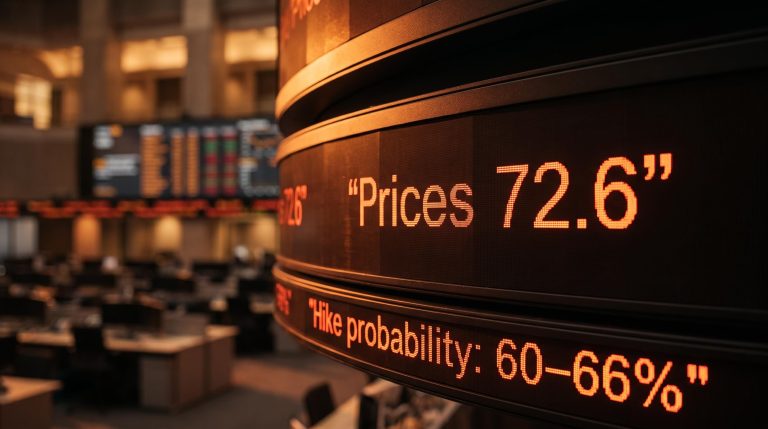
Money markets followed, pricing a near 50% chance of a September hike per CME FedWatch as of 28 August 2026. On the surface, Waller and Warsh look like they are pulling in opposite directions.
Step back, though, and the gap looks less like a contradiction and more like a structure. Here is the mechanism worth understanding. When a Fed chair removes explicit forward guidance, as Warsh has, Treasury yields become far more reactive to every new speech and data point. Communication itself starts functioning as a tightening or loosening instrument.
| Official | Date | Core signal | Market interpretation | Conditional trigger |
|---|---|---|---|---|
| Christopher Waller | 3 September 2026 | Leaning toward a hold | Dovish; hold likely | Hot August inflation flips to a hike |
| Kevin Warsh | Late August 2026 | Inflation not “meaningfully slowed” | Hawkish; hike risk elevated | No explicit trigger; guidance removed |
Seen this way, Warsh’s rhetoric and Waller’s conditionality may be playing complementary roles rather than contradictory ones. Warsh keeps financial conditions tight through ambiguity while Waller keeps the door open to a hold if the data cooperate.
That reframing changes what the 50% figure tells you. It is not evidence that a hike is likely. It is evidence that the market is reacting to Warsh’s deliberate ambiguity. Treat that probability as a sentiment reading, not a forecast, because reading it as a prediction is a category error. And understanding that yield moves can substitute for rate hikes helps explain why the Fed might hold even as yields climb, and why repositioning defensively at every yield spike can be premature.
What the “taper tantrum” tells us about guidance removal
There is precedent for this. In 2013, under Chair Ben Bernanke, markets reacted sharply to a shift in guidance about tapering asset purchases, sending long-term yields higher even though the policy rate itself did not move. The episode became known as the taper tantrum, and the mechanism is the one operating now: reduce guidance, and yields become hypersensitive to each speech and data release.
The pattern is not unique to Bernanke. Janet Yellen emphasised “gradual” normalisation without fixed timetables, and Jerome Powell repeatedly described policy as having “no preset path.” Each chair who de-emphasised forward guidance raised the market’s sensitivity to incoming data. Warsh sits squarely in that lineage.
The Fed-Treasury relationship as investors actually need to understand it
There is a further lens worth testing, and it comes from analyst Jim Carzan. His argument is that the perceived independence between the Fed and Treasury is more superficial than structural. He points to frequent visible coordination between the two institutions, and to the shared institutional background of both the Fed Chair and the Treasury Secretary, who are described as having hedge fund pedigrees and aligned operational goals.
Carzan’s framing casts Warsh as defending dollar credibility narratively while operationally supporting Treasury and administration objectives. The narrative context fits the tape: the 10-year yield approached 4.8%, pulled back after Waller’s remarks, then began recovering toward that level again.
The Treasury buyback programme, which doubled its per-operation cap to $4 billion for 10-to-30-year securities in August 2026, injected a parallel easing channel into financial conditions at precisely the moment Warsh was using yield-level rhetoric to keep conditions tight, complicating any clean read of whether the 4.8% 10-year level reflects genuine hawkishness or a partially offset signal.
This is worth handling carefully, so here is where the line sits.
- What Carzan’s argument claims: that Fed-Treasury independence is largely superficial, that coordination is visible and frequent, and that shared hedge fund backgrounds signal aligned objectives.
- What the research layer confirms: Warsh’s inflation warnings, their measurable impact on Treasury yields, and the near-50% hike pricing that followed.
- What remains unverified: the coordination thesis itself. Carzan’s assessment is attributed analysis, not independently corroborated in the available research, and should be read as one interpretive lens rather than established fact.
Why does the distinction matter practically? Because if the Fed and Treasury are operationally coordinating, then the market-implied hike probability is anchored to the wrong model. Rate decisions would be shaped by fiscal and dollar-credibility objectives as much as by inflation data, and the “what does the CPI print say” framing would miss half the picture.
What the coordination argument means for how you read future Fed signals
Here is the practical takeaway, and it holds whether or not the coordination thesis is structurally accurate. When a Fed decision seems inconsistent with the inflation data alone, widen the lens. Consider whether fiscal conditions, dollar credibility, or Treasury market stability might be carrying weight in the decision.
Investors who treat Fed statements as purely inflation-reactive will periodically be caught off-guard by decisions that also reflect these other objectives. You do not need to accept the coordination thesis to benefit from the wider frame. You just need to stop reading Fed policy through a single variable.
The December outlook and what the September data window actually decides
Waller was explicit that his September vote is a function of August inflation data. That has a consequence people often miss: a hold in September would not foreclose a December hike if disinflation stalls. The September meeting is a checkpoint, not a conclusion.
The Fed is working down from an elevated baseline. April core PCE ran at 3.8%, and the most recent positive signal is the July PCE and core PCE reading of +0.2%. Whether that improvement holds through the autumn is the entire question.
The December calculus is further complicated by long and variable lags: policy effects can take well over a year to reach the real economy, meaning the tightening already delivered through higher yields may still be working through credit channels even if the September decision is a hold.
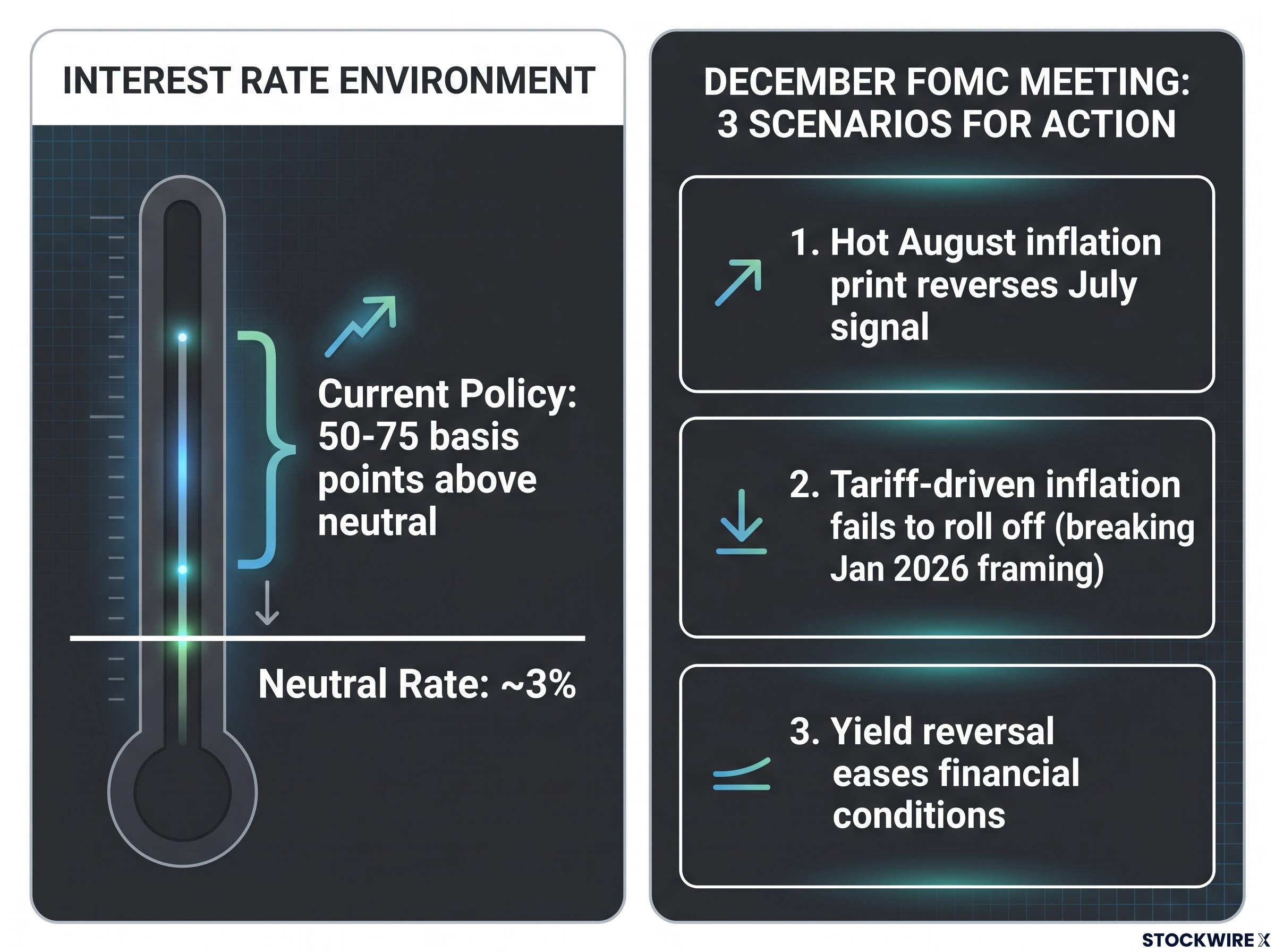
Neutral rate reference: approximately 3% Per Waller’s January 2026 framing, the current policy rate sits roughly 50-75 basis points above neutral. That gives you a concrete anchor: it is how much room the Fed has to move toward neutral before policy stops restricting demand.
Three scenarios that could change the December calculus
Three conditions could force the committee’s hand between now and the December FOMC meeting.
- A hot August inflation print that reverses the July disinflation signal.
- Tariff-driven inflation that fails to roll off as projected, breaking the transitory framing Waller has leaned on since January 2026.
- A yield reversal that eases financial conditions even as inflation stays sticky, removing the tightening-by-proxy effect and raising pressure for explicit rate action.
Analyst conviction, per Carzan, points to holds at both September and December. The reasoning rests on Waller’s dovish lean, the tightening already delivered through higher yields, and the expectation that disinflation continues. That is a scenario, not a certainty.
The read for you is straightforward. The September meeting is not the story. The August inflation data that lands before it is the story, and investors who wait for the FOMC outcome rather than anticipating the data inputs are consistently one step behind.
Reading the Fed clearly when the signals are designed to stay ambiguous
Pull the three threads together and a framework emerges. Waller offers conditional dovishness tied explicitly to data. Warsh offers deliberate ambiguity that keeps financial conditions tight without a formal commitment. And the coordination lens, unverified but useful, reminds you that rate decisions may answer to more than inflation alone.
Be honest about the limits. As of 4 September 2026, the September outcome is genuinely unknown, and the August inflation data that will decide it has not yet been published. The Fed announces on 16 September 2026 at 2:00 p.m. ET, but the decisive variable lands before then.
The precedents of Bernanke, Yellen, and Powell show that ambiguous communication is a recurring Fed strategy, not a Warsh-specific quirk. The ambiguity is a tool, not an information gap.
So here is the interpretive posture to carry into the next cycle:
- Watch the incoming inflation data, not the meeting itself.
- Weight Waller’s conditional language more heavily than Warsh’s directional rhetoric for the near-term signal.
- Treat the market-implied hike probability as sentiment, not forecast.
- When a decision seems inconsistent with the inflation data, widen the lens to fiscal and dollar-stability objectives.
This article is for informational purposes only and should not be considered financial advice. Investors should conduct their own research and consult with financial professionals before making investment decisions. Past performance does not guarantee future results. Financial projections are subject to market conditions and various risk factors, and these statements are speculative and subject to change based on market developments.