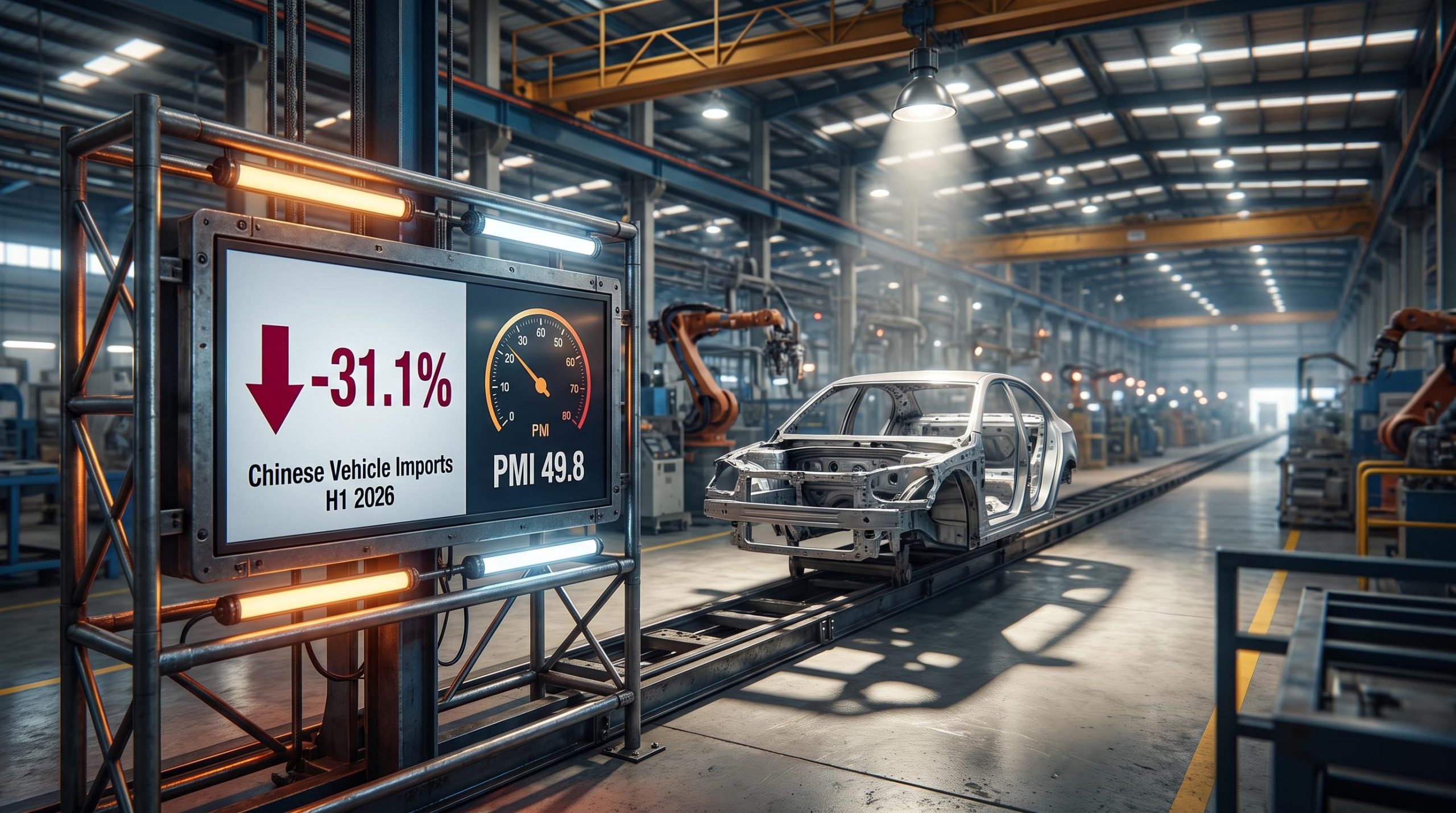
Chinese car imports into Mexico fell 31.1% in the first half of 2026, a decline steep enough to read as a policy triumph. Then, in August, the manufacturing sector that was supposed to benefit from that decline slipped back into contraction.
The dissonance is the puzzle. A trade barrier appears to be working, cutting foreign competition exactly as designed, yet the factories it was meant to protect are not visibly gaining. This is a live test of a question that stretches well beyond Mexico: when a government raises import walls, who actually collects the winnings?
The 50% tariff that took effect on 1 January 2026 is the policy variable. The import data and the purchasing managers’ index are the early returns. This piece will show you how to read those two numbers together rather than apart, and why a falling import figure and a contracting factory gauge are not a contradiction but two views of the same fragility.
What the 31% import collapse actually tells us
Start with the number everyone quotes. Mexico’s Economy Ministry (Secretaría de Economía) reported that Chinese vehicle imports fell to 158,571 units in the first half of 2026, down 31.1% year-over-year, a figure carried by El Economista on 31 August 2026 and confirmed by Economy Minister Marcelo Ebrard.
Secretaría de Economía headline figure Chinese vehicle imports: 158,571 units in H1 2026, down 31.1% year-over-year.
Across the full basket of newly tariffed goods from China, the value dropped 26.3% to US$8.869 billion, a loss of roughly US$3.165 billion against the prior year. Light vehicles alone shed about US$1.18 billion in import value between January and May, with unit volumes down 35%.
The decline is not confined to cars. The tariff package reached across categories, and the segment breakdown reveals a broad structural shift rather than an auto-specific story.
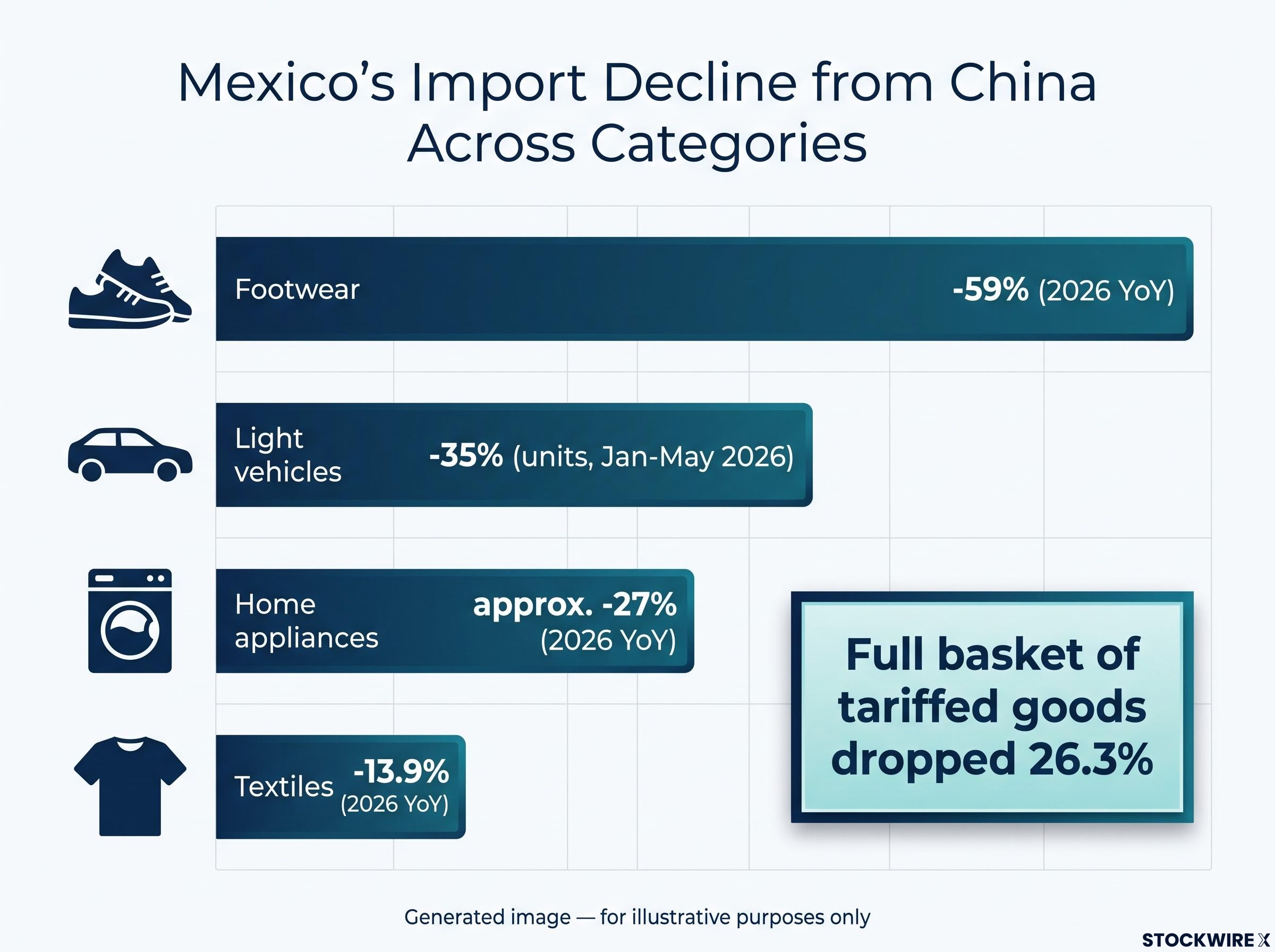
| Category | Import decline from China | Period |
|---|---|---|
| Footwear | -59% | 2026 YoY |
| Light vehicles | -35% (units) | Jan-May 2026 |
| Home appliances | approx. -27% | 2026 YoY |
| Textiles | -13.9% | 2026 YoY |
Here is where the headline needs qualifying. According to analysis from Prodensa, more than half of the vehicles Mexico imports from China are actually built by Western automakers in Chinese plants. The “Chinese import” label captures where a car was assembled, not which brand made it.
That matters for what the figure proves. China-built vehicles of all brands still accounted for 201,460 units sold in Mexico between January and July 2026, or 22.8% of total sales, according to INEGI and AMDA data. The tariff is redirecting where those cars come from, not erasing demand for them.
So read the 31% drop for what it is: a genuine price signal forcing importers and automakers to reposition. It is not evidence that Mexican factories have moved in to fill the space the imports vacated. That is a separate claim, and the next two sections test whether it holds.
When big ASX news breaks, our subscribers know first
How the 50% tariff works and why its protective effect is partial
To understand why import protection has not translated into factory strength, you need to understand how the policy is built. The mechanism has a ceiling and a feedback loop, and both are baked into its design.
The legal architecture is straightforward. Mexico’s Senate approved the tariff package in December 2025, it was published in the Diario Oficial de la Federación on 30 December 2025, and it took effect on 1 January 2026. The measure covers 1,463 product categories and lifted light-vehicle duties from roughly 15-20% to 50%.
That 50% figure is not arbitrary. It is Mexico’s bound tariff ceiling at the World Trade Organization, the maximum rate the country can legally charge on these goods. Prodensa characterises this as an indefinite policy sitting at the WTO limit rather than a temporary spike.
The measure is also broader than the China framing suggests. The 50% rate applies to every country without a free trade agreement with Mexico, not to China alone.
- China
- India
- South Korea
- Thailand
- Indonesia
- Brazil
- Russia
- Turkey
- Vietnam
Economy Minister Ebrard has framed the policy as protection for roughly 350,000 industrial jobs and as a way to stop Mexico from serving as a back door for Chinese goods entering the United States ahead of USMCA renegotiation. That is the intended benefit. The unintended cost sits inside the same mechanism.
The cost paradox domestic manufacturers did not ask for
The tariff does not only tax finished cars. Auto parts now sit in a 10-50% duty band, which means the manufacturers the policy aims to shield are paying more for the inputs they need to build.
S&P Global’s PMI commentary makes the effect visible. Survey respondents cited tariffs as a driver of input price inflation running among the highest in over 15 years. Firms reported reluctance to pass those cost increases fully through to customers, which compresses margins rather than expanding output.
The read for anyone modelling Mexico’s trade trajectory is this: the tariff cannot be raised further under WTO rules, so any future escalation would require a different instrument entirely. And the protection it offers arrives bundled with a cost penalty on the very sector it targets. That is why the factory data cannot be read as a straightforward win.
Reading the PMI trajectory: a fragile recovery interrupted
If the tariff were activating Mexican manufacturing, the PMI would show it. The purchasing managers’ index (PMI) is a monthly survey gauge where readings above 50 signal expansion and below 50 signal contraction. The 2026 sequence tells a story of a sector that appeared to turn a corner, then stumbled.
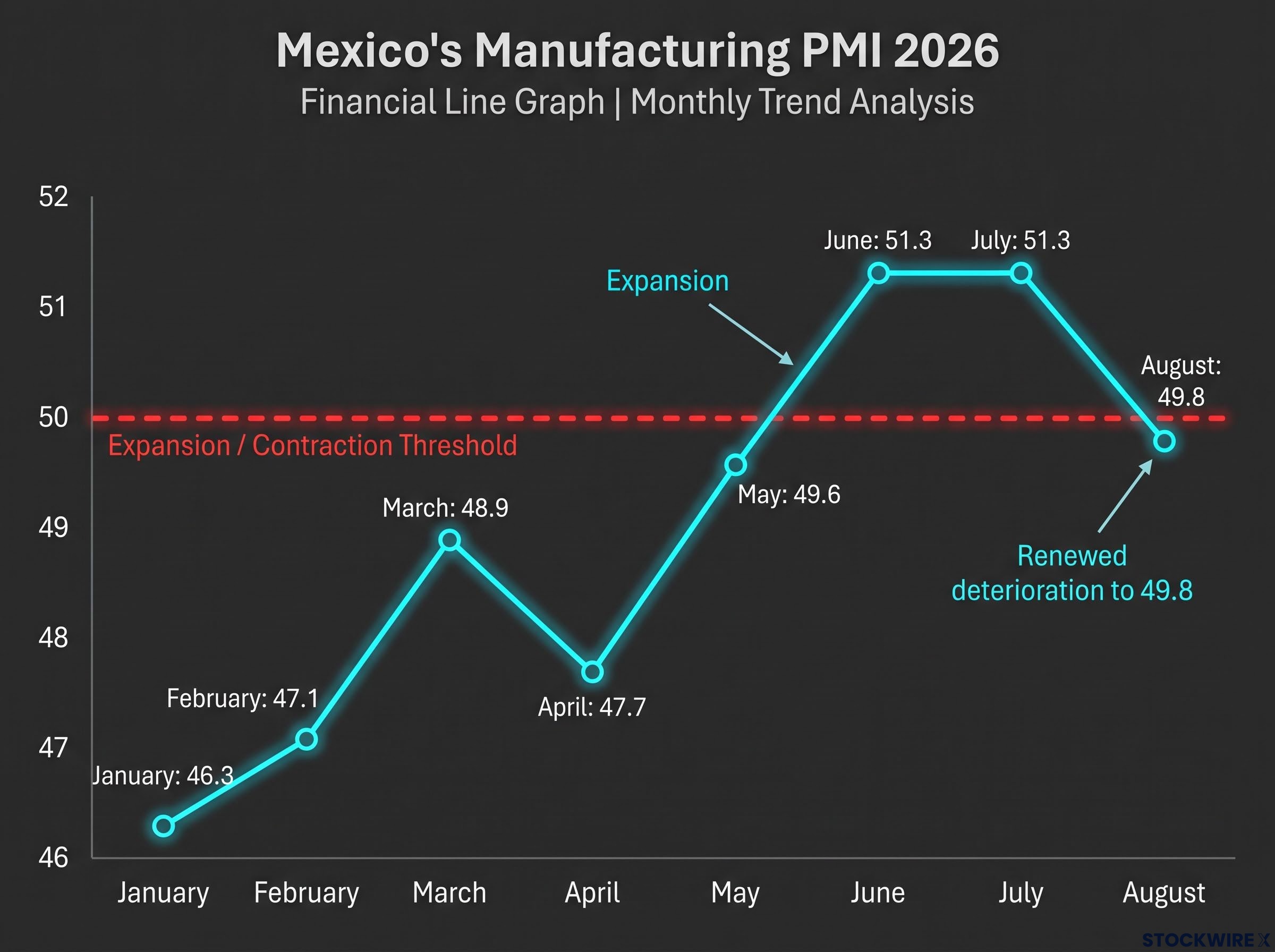
| Month | PMI | Status | Key driver (S&P Global) |
|---|---|---|---|
| January | 46.3 | Contraction | Weak U.S. demand, falling export orders |
| February | 47.1 | Contraction | Soft domestic and export demand |
| March | 48.9 | Contraction | Softer decline |
| April | 47.7 | Contraction | 8th consecutive month below 50 |
| May | 49.6 | Contraction | Mildest in nine months; new orders grew |
| June | 51.3 | Expansion | Return to growth |
| July | 51.3 | Expansion | Strongest since March 2024 |
| August | 49.8 | Contraction | Renewed deterioration |
The shape matters more than any single reading. The sector spent the first five months of 2026 below 50, with January’s 46.3 marking a deep contraction. May’s 49.6 was the joint-mildest decline in a nine-month downturn, and then June and July delivered back-to-back expansion at 51.3, the strongest readings since March 2024.
Then August broke the run.
August 2026 reading Mexico Manufacturing PMI: 49.8, described by Trading Economics as a “renewed deterioration” after two months of expansion.
The drivers of that reversal are the ones that matter. Factory output contracted at its steepest pace in eight months. New export orders fell at the fastest rate seen all year. S&P Global also cited subdued conditions, material shortages, and shipping delays tied to conflict in the Middle East.
Look closely at what dragged the number down. Weak U.S. demand for Mexican exports is a structural headwind that predates the tariff package entirely, and import protection does nothing to fix it.
A single month below 50 after two above it does not confirm a new downturn. But if domestic manufacturers were supposed to be gaining ground from reduced import competition, an export order collapse and an output contraction are precisely the wrong signals to see. The recovery was real in mid-2026. It was also shallow, and external demand kept its lid on.
PMI false recession signals appear in roughly 30-40% of sub-50 readings across advanced economies, a base rate that is worth holding in mind when interpreting August’s 49.8 print, which sits just below the expansion threshold after two consecutive months of genuine growth.
How Chinese automakers are responding, and what it signals for Mexico’s industrial future
The retrospective data tells you what happened. The strategic moves of Chinese carmakers tell you where this is going, and the signal is clear: the tariff has changed the game without ending Chinese participation.
Map the responses and a pattern emerges. Rather than exit, the manufacturers are retooling to produce inside Mexico’s borders.
China’s high-tech manufacturing expansion, with new energy vehicle output up 29.9% and industrial robots up 30.2% year-on-year in July 2026, is the industrial capacity that Chinese OEMs are drawing on as they reposition to serve Mexico from inside its borders rather than through its ports.
- SAIC-GM-Wuling: in advanced negotiations for local Mexican production (Automotive Logistics)
- GAC: confirmed an assembly plant targeting a 2026 start
- GM: plans to localise China-built Aveo and Groove models at Ramos Arizpe from 2027
- BYD: suspended greenfield plans in 2025, since reconsidered; reportedly exploring a plant acquisition in Aguascalientes (Reuters, unverified)
The read here is direct. The 50% tariff has successfully altered the cost calculus for Chinese OEMs, but the outcome is adaptation, not withdrawal. Mexico’s automotive sector will likely face Chinese competition from within its own borders rather than through the ports.
Who wins and who loses in the policy debate
That repositioning sits inside a genuine three-way argument, and the analysis owes you all three positions.
Domestic industry and government back the measure. AMIA President Rogelio Garza has called the tariff “positive,” arguing it guarantees fair competition and supports investment and jobs, echoing the government’s 350,000-job rationale.
China objects. Reuters reports the Chinese government warned Mexico to “think twice” and signalled it retains the right to retaliate, framing the duties as harmful to legitimate commercial interests.
A third group sits between them. Mexican business organisations and EV advocates warn that blanket 50% duties raise consumer prices and slow electric-vehicle adoption. Manufacturers including BYD have lobbied for EV-specific exemptions or preferential rates, arguing that taxing cleaner vehicles at the full rate stalls Mexico’s energy transition and narrows consumer choice.
For anyone tracking Mexico’s place in North American supply chains, the OEM response is the sharpest forward signal in the current data. The manufacturers are not retreating; they are relocating. Whether that produces genuine domestic value or simply moves the same supply chain inside Mexico is the open question.
What the data together reveal about Mexico’s industrial position
Put the three threads together and the picture resolves. The tariff is working as a trade-flow redirector, cutting imports by 31.1%. It is not yet working as a manufacturing activator, with the August PMI at 49.8 and export orders falling at the fastest pace of 2026.
The August drivers are the tell. Weak U.S. export demand, cost pressures, and cashflow constraints are structural problems, and none of them can be solved by keeping foreign cars out.
The Prodensa caveat More than half of Mexico’s vehicle imports from China are produced by Western automakers in Chinese plants, and roughly one in five vehicles sold in Mexico in 2025 was China-made.
Treat the 31% import drop and the 49.8 PMI as complementary signals pointing to the same conclusion. Policy has redrawn the trade map, but the factory floor remains fragile and externally dependent. As Mexico Business News cautions, falling imports do not automatically become robust domestic output where local capacity stays constrained.
The global trade rewiring visible in China-ASEAN volume growth of 17% and intra-Asia trade up 10% provides the broader structural backdrop for Mexico’s tariff experiment: supply chain rerouting is happening at scale across multiple geographies simultaneously, and Mexico is one node in a larger network adjustment.
Two variables will decide whether these signals harden into a trend: the trajectory of U.S. demand for Mexican goods, and whether Chinese localisation delivers real domestic value or just relocates the same supply chain. Resist reading a falling import number as industrial success, and resist reading one PMI dip as policy failure. The truth sits between them.
This article is for informational purposes only and should not be considered financial advice. Investors should conduct their own research and consult with financial professionals before making investment decisions.
Past performance does not guarantee future results. Financial projections are subject to market conditions and various risk factors, and forward-looking statements are speculative and subject to change based on market developments.