
The world’s central banks bought more gold in the second quarter of 2026 than in any second quarter on record. They did it knowing the asset yields nothing, produces no income stream, and carries ongoing storage costs. That deliberate choice, repeated across dozens of sovereign institutions, is the puzzle worth sitting with before reacting to it.
The context makes it sharper. Gold is trading at $4,500-$4,700 per ounce, record territory. U.S. government debt has crossed $40 trillion. Long-end bond yields have returned to heights last seen before the 2008 financial crisis. Financial media regularly presents this buying as a straightforward bullish signal for individual investors. The signal is real. The interpretation is almost always wrong.
What follows separates what central banks are actually solving for from what you are solving for, so you can use this data point correctly rather than being misled by it.
The scale of what central banks are actually doing
Start with the numbers before the narrative. They carry their own weight.
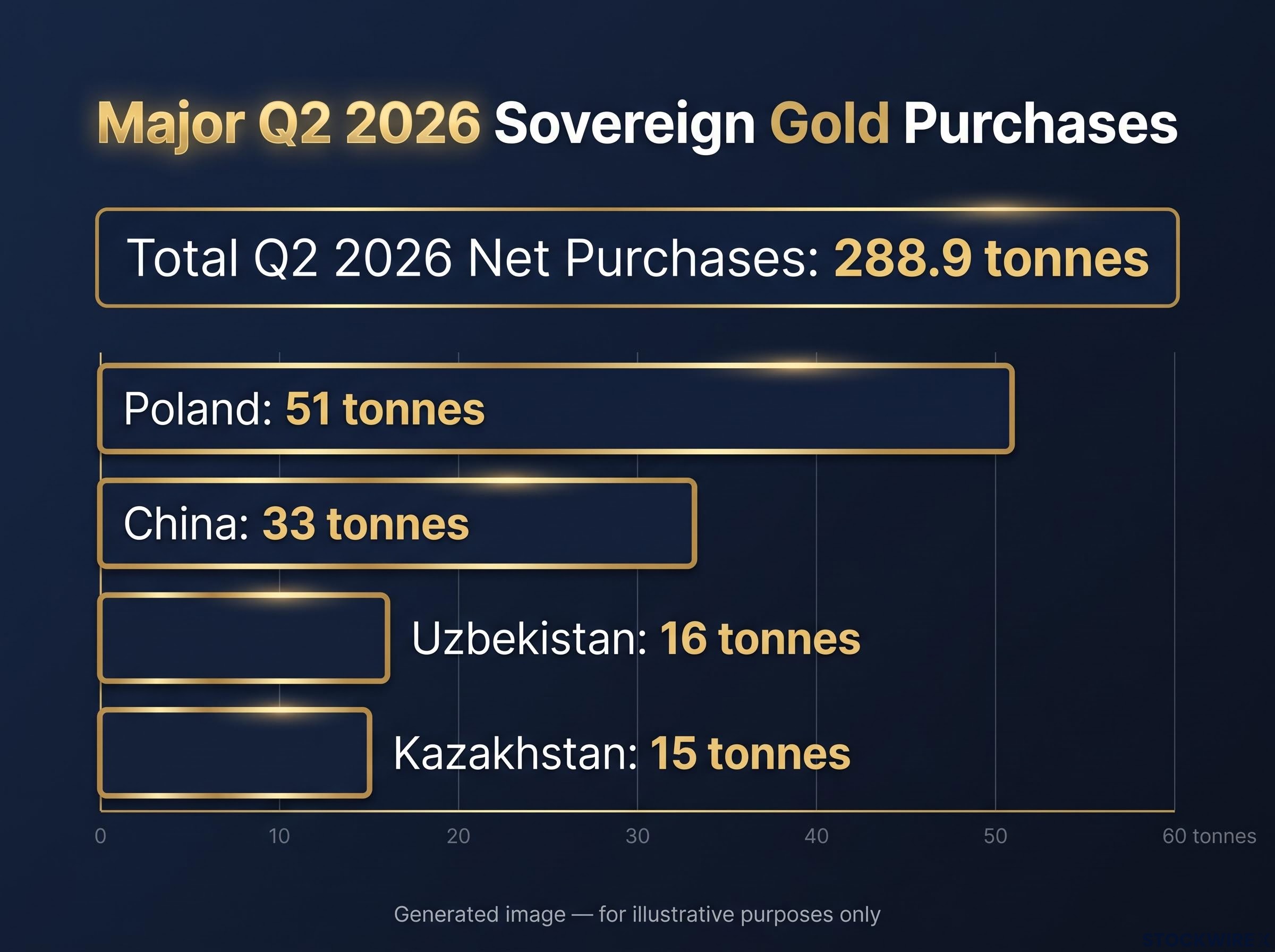
Net central bank gold purchases in Q2 2026 reached approximately 288.9 tonnes, the highest second-quarter total in World Gold Council recorded history. That figure sits roughly 62% above the 177.9 tonnes acquired during Q2 2025. Even after a weaker first quarter, first-half 2026 official sector demand came in at approximately 345 tonnes, historically strong by any standard other than the record-setting years immediately preceding it.
This is not new behaviour. Official sector institutions have maintained net buying positions for fifteen years running. The peak single-year figure remains 2022, when sovereign buyers collectively took in 1,136 tonnes, the largest haul in data stretching back to 1950.
“Central banks acquired 1,136 tonnes of gold in 2022, the largest annual purchase in records extending back to 1950.”
Who is buying, and where
The buying is concentrated in a specific group, predominantly emerging-market central banks:
- Poland: approximately 82 tonnes in H1 2026 (including 51 tonnes in Q2 alone), bringing total reserves to 632 tonnes
- Uzbekistan: approximately 41 tonnes in H1 (including 16 tonnes in Q2)
- China: approximately 40 tonnes in H1 (including 33 tonnes in Q2), bringing total reserves to 2,346 tonnes
- Kazakhstan: approximately 15 tonnes in Q2
That concentration matters for what comes next. These are not tactical market trades. They are structural reserve decisions made at the highest levels of sovereign finance, spanning years and billions of dollars. The institutions buying are solving a specific problem, and understanding that problem is the only way to interpret the numbers correctly.
When big ASX news breaks, our subscribers know first
What problem gold actually solves for a sovereign institution
The simplest way to understand why central banks want gold is to understand the problem they are trying to solve. It is not the problem you think.
The reserve management problem
Central bank reserves sit primarily in other countries’ sovereign bonds, most commonly U.S. Treasuries and euro-denominated debt. Those assets carry a structural vulnerability worth examining carefully: the bonds reside within another country’s legal and regulatory framework, meaning access to them is ultimately conditional on the policies and political disposition of the issuing nation, neither of which the holding central bank can influence.
For decades, the assumption was that sovereign bonds from major economies were effectively risk-free for reserve purposes. The legal and political dependency was theoretical.
In 2022, it stopped being theoretical. The U.S. and its allies froze a substantial portion of Russia’s foreign reserves in response to the invasion of Ukraine. Whatever your view of the geopolitics, the practical lesson for reserve managers was clear: access to foreign sovereign bond holdings can be cut off by the issuing government’s political choices. A number of central banks drew the obvious conclusion and began adjusting their reserve composition.
The OMFIF Global Public Investor survey released 30 June 2026, covering 90 sovereign institutions with over $7 trillion in assets, recorded the first time on record that net reserve diversification away from dollars outnumbered net dollar-increase intent, a structural shift corroborated by the World Gold Council, HSBC, and Goldman Sachs.
The freezing of Russian foreign reserves in 2022 demonstrated that access to foreign sovereign bonds depends on geopolitical relationships, not just credit quality.
What gold uniquely provides
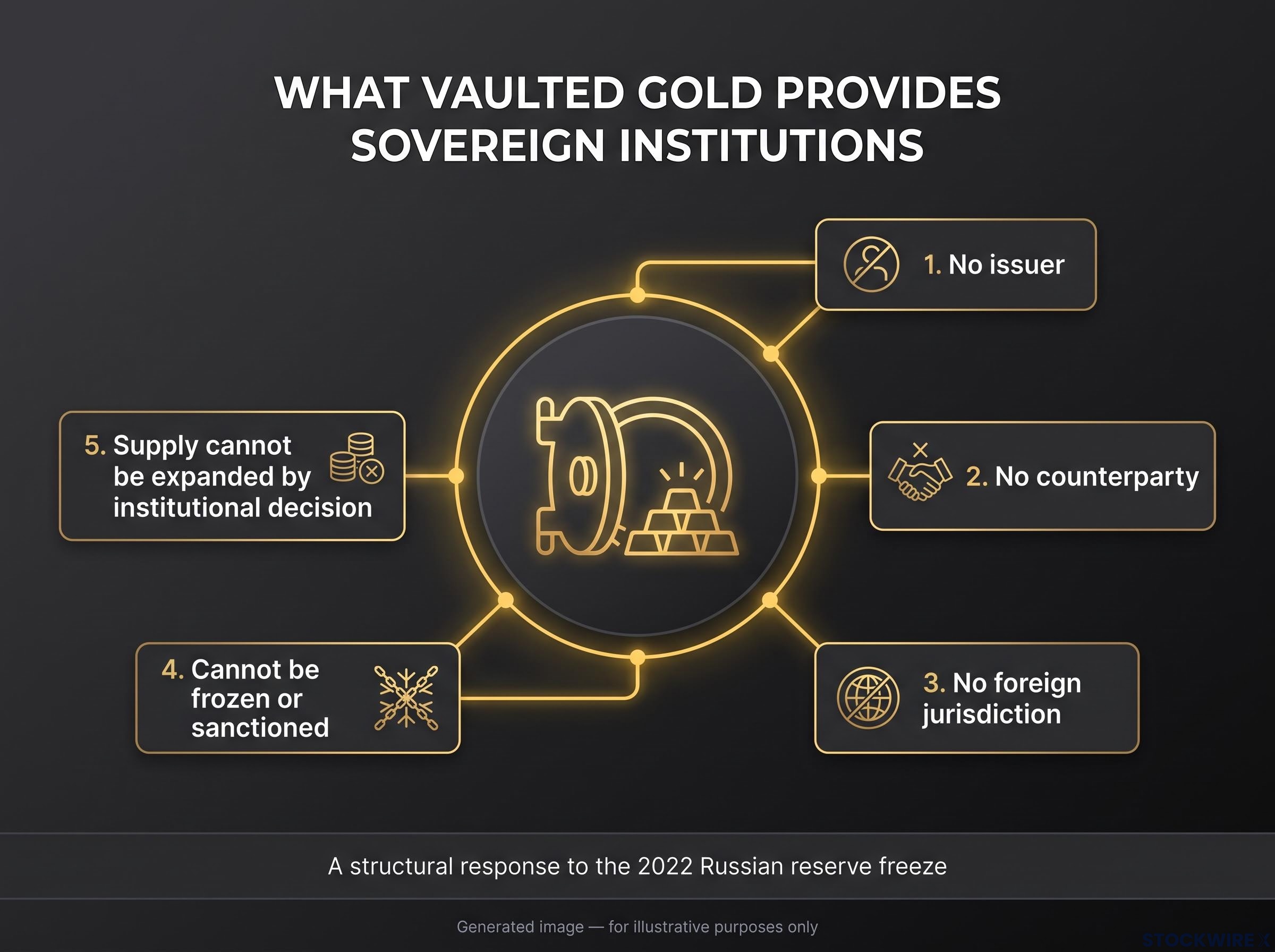
Physically held gold, stored in a domestic vault, addresses the reserve management problem through a specific set of characteristics:
- No issuer: Gold is not a claim against any government or institution; it carries no one’s promise.
- No counterparty: Ownership requires no ongoing relationship with or reliance on any other party.
- No foreign jurisdiction: Keeping it in a domestic vault removes exposure to another country’s courts or regulators.
- Cannot be frozen or sanctioned: No external authority holds the power to restrict a sovereign’s access to its own vaulted metal.
- Supply cannot be expanded by institutional decision: No government or central bank can increase the quantity of gold in existence through a policy directive, the way currency or bonds can be created.
The World Gold Council has identified portfolio diversification and reduced exposure to U.S. assets as primary stated motivations behind institutional gold accumulation. The Central Bank Gold Reserves Survey 2026 indicates that central banks expect official sector demand to remain elevated over the next twelve months.
Choosing a zero-yield asset is not a lapse in judgement by reserve managers hoping for price appreciation. It is a considered response to a geopolitical and legal problem, one that you, as a retail investor, simply do not face in the same form. Holding that distinction clearly changes how every “central banks are buying” headline should land.
Why central banks’ reasons for buying gold are not your reasons
Central banks are buying gold for sound institutional reasons. The error is assuming those reasons transfer to your portfolio.
The risk profile is categorically different. A central bank holds hundreds of billions in foreign sovereign bonds susceptible to sanctions, asset freezes, and foreign policy shifts. Your assets, equities, property, savings, local bonds, are primarily exposed to domestic volatility, inflation, and income risk. You are solving a different problem entirely.
Geopolitical fragmentation extends the reserve diversification story into retail portfolios directly: regional equity returns diverged sharply in the 12 months to early May 2026, with MSCI Emerging Markets returning 31-42% while the Euro Stoxx 50 returned only 7-9%, making the cost of geographic concentration measurable rather than theoretical for individual investors.
| Dimension | Central bank | Retail investor |
|---|---|---|
| Primary problem | Foreign jurisdictional and counterparty risk on reserves | Growth, income, and risk management |
| Assets at risk | Hundreds of billions in foreign sovereign bonds | Equities, property, savings, local bonds |
| What gold solves | Sanctions exposure, asset freeze risk, jurisdictional dependence | Diversification, tail-risk insurance, currency hedge |
| Opportunity cost | Acceptable; jurisdictional safety outweighs yield | Large; bonds now offer 2007-era yields vs. zero-yield gold |
Then there is the entry price problem. Central banks have been accumulating across fifteen years of lower prices. If you buy at $4,500 per ounce today, you are not positioning alongside them. You are buying the outcome of their accumulation. Future gains require additional demand from an already elevated base.
At current bond yields, the highest since 2007, choosing gold over bonds means giving up guaranteed cash flows for an asset whose return is entirely price-driven. That trade-off is far larger now than it was during the near-zero-rate era.
One more structural point worth absorbing: chasing central bank buying at record prices is a category error. That institutional demand accumulated over fifteen years and is already reflected in current prices; you are arriving after the fact, not ahead of the move. And gold’s price responds to flows, regardless of motive. If central bank buying slows or reverses, even for reasons entirely unrelated to your thesis, prices can fall sharply.
Gold as a hedge in a retail portfolio: the right frame
None of this means gold has no place in your portfolio. It means the place has to be defined honestly, with a role that matches your actual situation rather than an institution’s.
When gold belongs in a portfolio
Gold serves three legitimate functions for individual investors:
- Diversifier: Gold has historically shown low correlation with equities over long horizons, which can modestly reduce portfolio drawdowns in certain stress scenarios.
- System-independent store of value: Holding some wealth outside the financial system can be rational if you are concerned about banking crises, capital controls, or severe tail-risk events in your jurisdiction.
- Currency and institutional hedge: In environments of unstable monetary policy, elevated inflation, or political risk, gold can function as a hedge against domestic currency weakness and local financial repression.
These roles imply modest, defined allocations, not a primary position. For most diversified portfolios, a 5-10% allocation is sufficient to capture the diversification benefit without introducing concentration risk.
Choosing the right vehicle
The vehicle you choose should match the purpose of the holding. Physical allocated bullion, where specific bars are held in your name in a vault, provides jurisdictional independence. It sits outside the financial system. The trade-off is higher storage and insurance costs, lower liquidity, and more friction when you want to sell.
Exchange-traded fund (ETF) exposure, where you hold shares in a fund that owns physical gold, offers convenience and liquidity. You can buy and sell in seconds. But ETF shares remain inside the financial system, held through brokers and custodians, subject to the same institutional infrastructure you might be trying to hedge against.
The distinction matters. If the scenario you are hedging is systemic or jurisdictional risk, physical is the more consistent choice. If you are simply adding diversification to a standard portfolio, an ETF may be more practical.
Before sizing any gold position, answer five questions:
- What specific scenario are you hedging against?
- How likely is that scenario, and how severe would its impact be on your broader finances?
- Which vehicle, physical or ETF, matches the scenario you are hedging?
- What is the opportunity cost compared to bonds at current yields?
- What is your time horizon, and does it match the role gold plays in the allocation?
If you cannot name a specific scenario you are hedging and explain why gold is the right instrument for that scenario, your position size is not a decision. It is a bet.
For investors wanting to move from the sizing principles above into a full implementation framework, our comprehensive walkthrough of geopolitical portfolio positioning covers gold allocation alongside bond duration awareness, rebalancing cadence, and defence sector exposure across the current crisis cycle.
This article is for informational purposes only and should not be considered financial advice. Investors should conduct their own research and consult with financial professionals before making investment decisions.
What the central bank signal actually tells you about where things are heading
Step back from the individual portfolio decision. What does persistent, record-setting central bank gold buying tell you about the environment you are investing in?
Three macro signals sit underneath the headline:
- Sovereign debt loads are historically elevated. U.S. federal debt has crossed $40 trillion, and higher debt burdens contribute to upward pressure on long-term yields and downward pressure on the perceived safety of long-duration government bonds as reserve assets.
- Yield levels have shifted the opportunity cost calculus. With long-end yields at heights not reached since 2007, holding a zero-yield asset is more expensive than at any point in the past fifteen years. The fact that sovereign institutions are persisting with gold purchases regardless signals that concerns about jurisdictional and counterparty exposure are outweighing the forgone income.
- Geopolitical fragmentation is accelerating reserve diversification. The 2022 Russian reserve freeze marked a turning point, not an isolated incident. The event prompted a broad reassessment, and a growing number of sovereign institutions are now deliberately trimming their dependence on dollar-denominated reserve assets over the longer term.
The World Gold Council’s Central Bank Gold Reserves Survey 2026 indicates that central banks expect official sector demand to remain elevated over the next twelve months.
This supports a structurally stronger floor under gold demand over time. It does not eliminate price volatility or downside risk for any individual buyer.
Asian retail gold demand represents a second structural force reshaping the buyer base beneath the metal: Asian-listed gold ETFs captured approximately $25 billion in 2025 and reached roughly 30% of global gold ETF market capitalisation, up from near zero, adding a large and growing source of non-sovereign demand that operates independently of central bank accumulation cycles.
What sustained central bank diversification tells you is not that gold will rise. It tells you that the institutions with the most to lose from getting reserve strategy wrong have concluded the old arrangement carries more risk than they previously accepted. That is a meaningful signal about the macro environment you are investing in, regardless of whether you hold any gold at all.
Past performance does not guarantee future results. Financial projections are subject to market conditions and various risk factors.
Using the signal without being misled by it
Central bank gold buying is genuine, large-scale, and likely to persist. It tells you three things: sovereign institutions have grown structurally wary of concentrating reserves in dollar-denominated assets, gold’s property of carrying no counterparty obligation is being valued more highly in official reserve frameworks, and the direction of travel in global reserve management favours assets outside any single nation’s legal reach.
What it does not tell you is that gold is a buy at any price for a retail portfolio. Central banks are solving for jurisdictional safety and reserve integrity. You are solving for wealth accumulation and financial resilience. Those objectives share some common ground, but only in limited and specific areas.
Treat the data as evidence about macroeconomic and geopolitical conditions, not as a trading signal. Size any personal gold allocation to the specific scenario you are hedging. Choose the vehicle that matches the purpose. Account for the opportunity cost of bonds at current yields. And do not let the headline stand in for a thesis.
You now have a framework for interpreting this signal. What comes next in policy, geopolitics, and reserve management will be more legible because of it.