The US-Canada trade dispute has produced some of the most intense economic headlines of 2026. Trade war. Retaliation. Tariff escalation. The language suggests a wholesale breakdown of North American commerce.
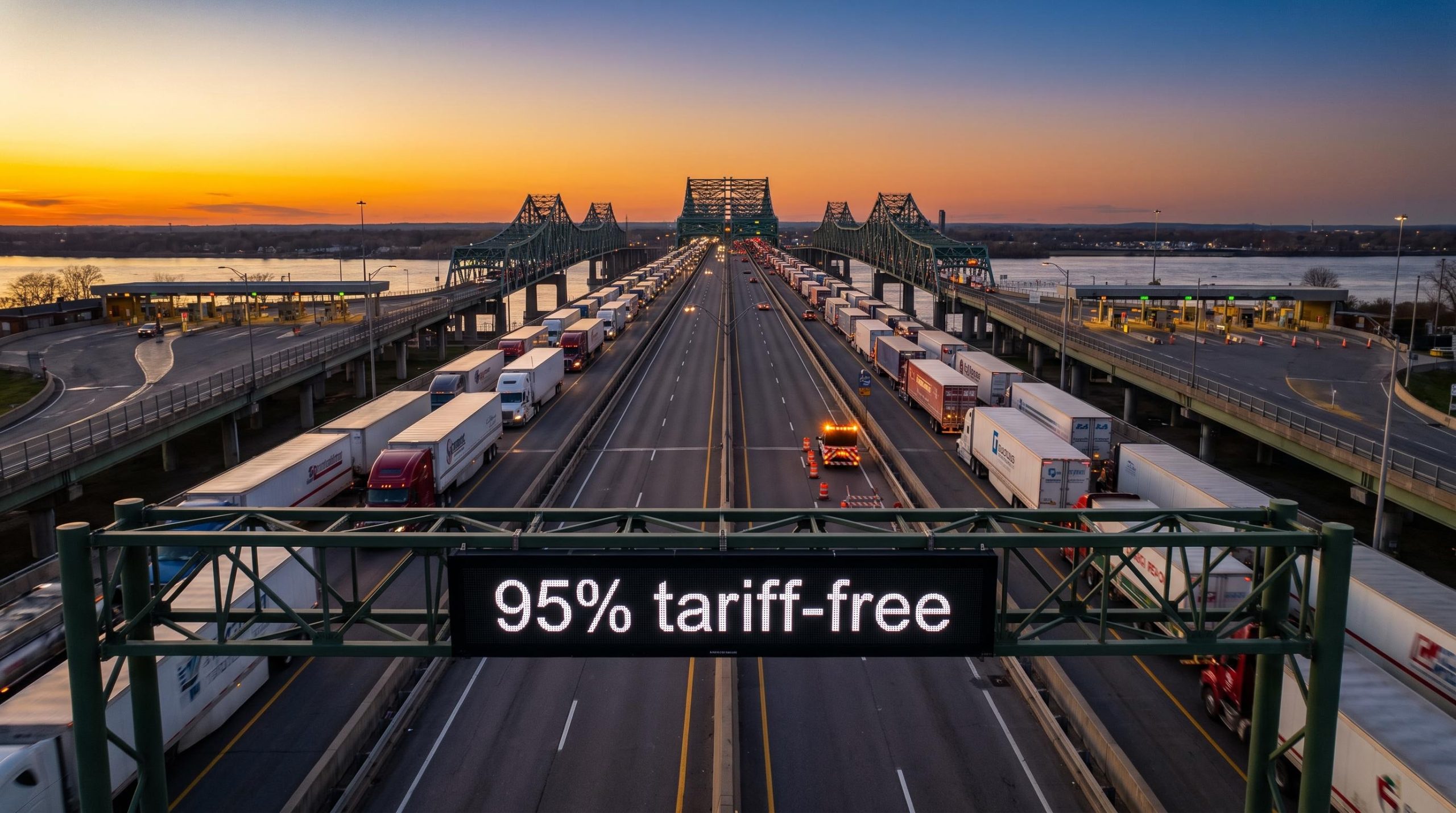
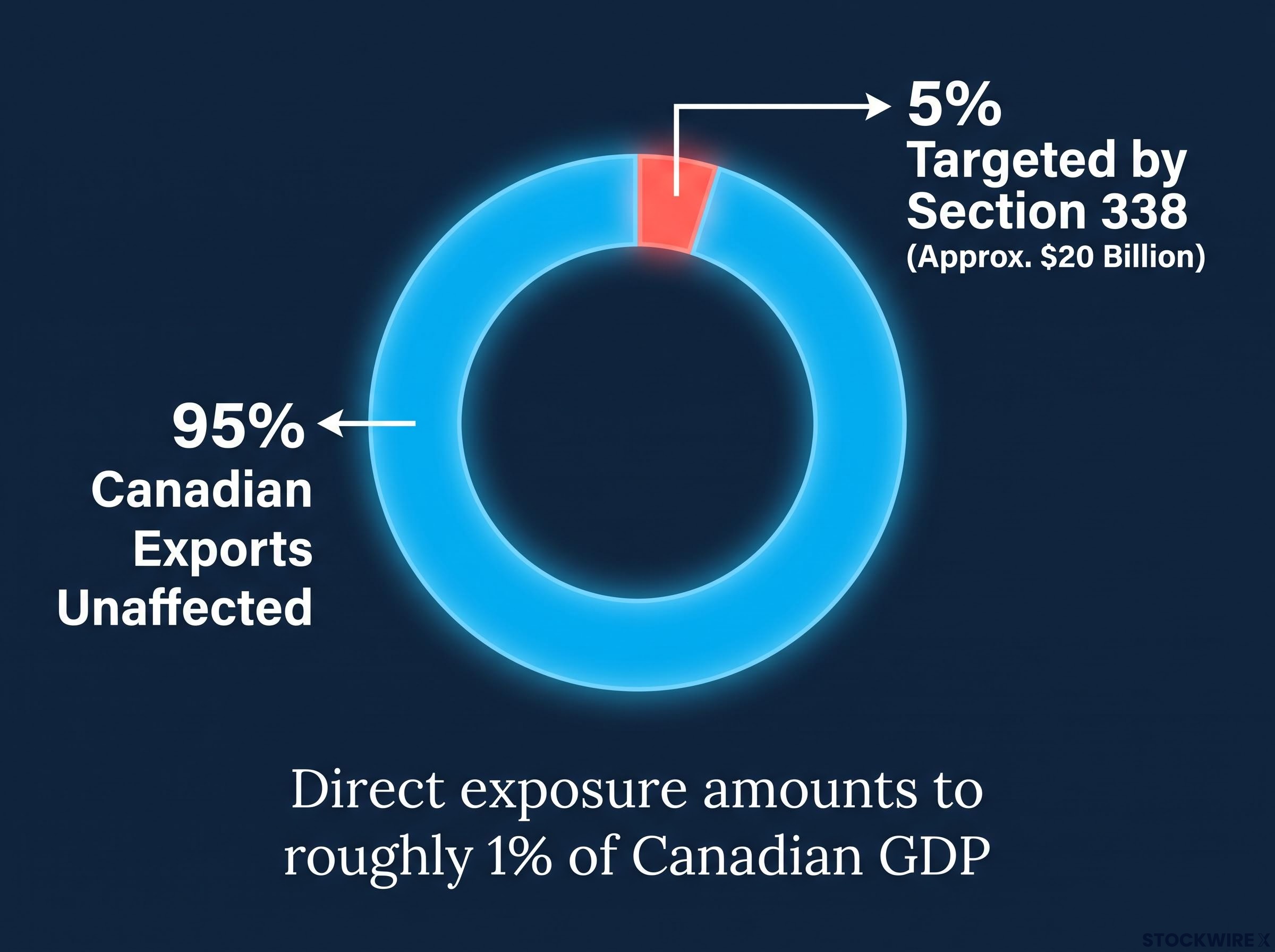
The actual numbers tell a different story. Roughly 95% of Canadian exports to the United States continue to flow without new tariffs. The Section 338 duties that took effect on 22 August 2026 cover approximately $20 billion worth of goods, a fraction of the bilateral relationship. Canada’s counter-tariffs begin phasing in on 8 September 2026, and the most painful measures announced, 50% tariffs on Canadian autos and steel, are not scheduled until 1 January 2027, conveniently after the midterm elections.
That gap between the headline intensity and the underlying structure is exactly what you need to understand. Here is a framework for reading every future development in this dispute: which signals point to genuine economic risk, which are designed for a domestic political audience, and which sit in between.
What the Section 338 tariffs actually cover (and what they deliberately do not)
On 20 July 2026, President Trump issued three proclamations under Section 338 of the Tariff Act of 1930, imposing an additional 50% duty on a specified basket of Canadian goods. Section 338 authorises duties of up to 50% against countries deemed to engage in unfair or predatory trade practices. The tariffs took effect on 22 August 2026.
The Section 338 legal mechanics matter here because the statute requires no formal investigation, no congressional oversight, and carries no sunset clause, meaning the administration can modify the product list or escalate to a full import ban by presidential proclamation without triggering any additional procedural steps.
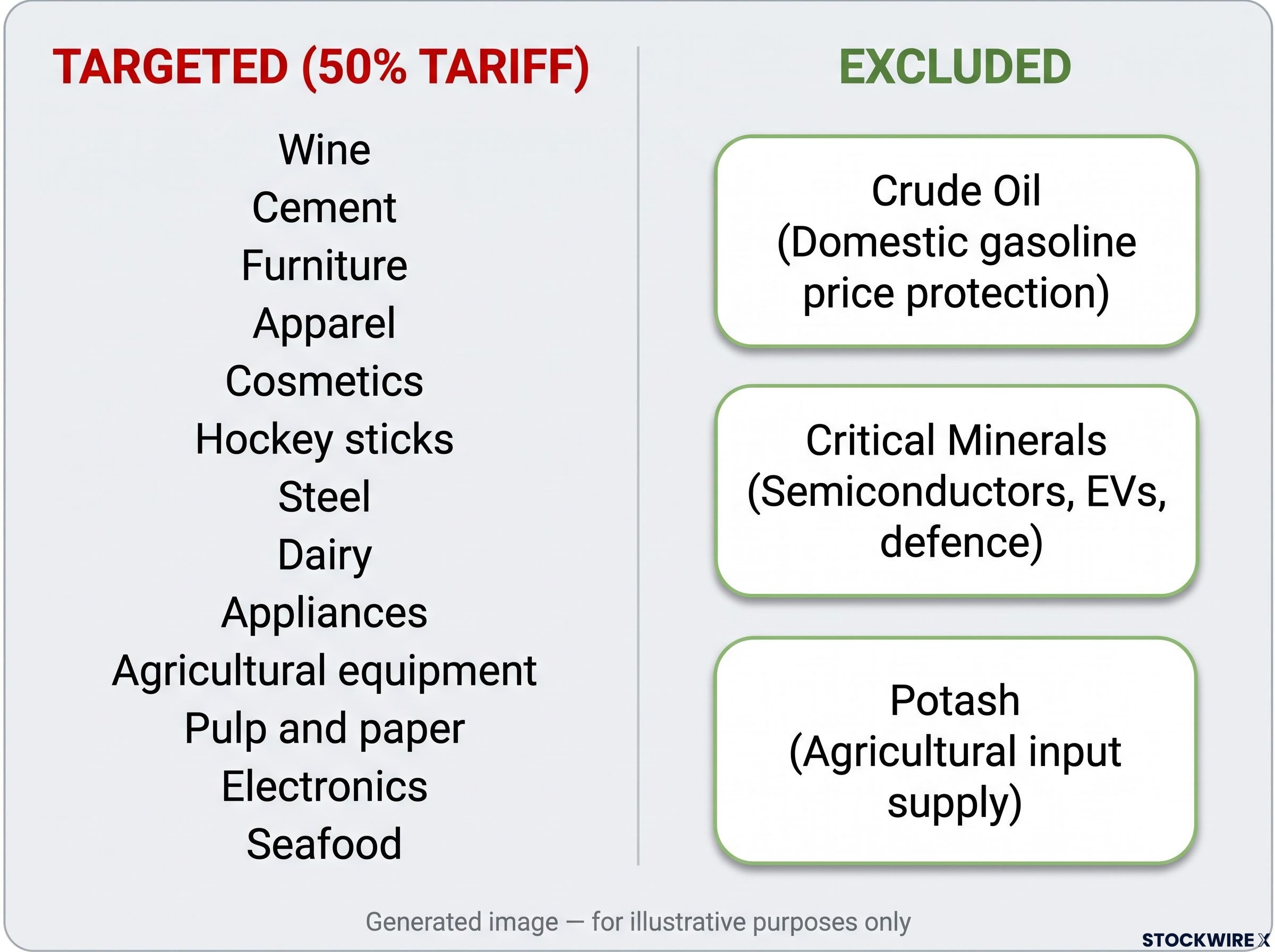
The targeted product categories include:
- Wine
- Cement
- Furniture
- Apparel
- Cosmetics
- Hockey sticks
- Steel
- Dairy
- Appliances
- Agricultural equipment
- Pulp and paper
- Electronics
- Seafood
That list covers approximately $20 billion in trade value, roughly 5% of Canadian exports to the United States. Canadian exports represent approximately one-fifth of the Canadian economy, which means the tariffed portion amounts to roughly 1% of Canadian GDP in direct exposure.
What the proclamations leave out matters just as much.
The strategic logic behind the exclusions
The proclamations explicitly carve out crude oil, critical minerals, and potash. Each exclusion reflects a self-interested US policy calculation, not a diplomatic gesture toward Ottawa.
Oil is excluded because taxing Canadian crude would raise US gasoline prices, a political outcome the administration cannot afford three months before midterms. Critical minerals are carved out because US manufacturers of semiconductors, electric vehicle batteries, and defence components depend on secure Canadian supply. Potash is excluded because it is a core agricultural input, and taxing it would raise costs for American farmers.
The household cost burden from the broader 2026 tariff regime, projected at $1,830 to $2,600 per American household by the Yale Budget Lab, is the political ceiling the administration cannot afford to breach, which is precisely why oil, potash, and critical minerals were carved out of the Section 338 product list.
| Category | Tariff Rate | Coverage Status | US Rationale for Exclusion |
|---|---|---|---|
| General goods basket (wine, cement, furniture, etc.) | 50% | Targeted | N/A |
| Crude oil | Excluded | Excluded | Domestic gasoline price protection |
| Critical minerals | Excluded | Excluded | Supply chain security (semiconductors, EVs, defence) |
| Potash | Excluded | Excluded | Agricultural input supply |
The exclusion architecture tells you something important: this tariff package was designed to inflict selective pain on Canada while protecting the US consumer categories that carry the most electoral weight. It is a political instrument shaped around domestic constraints, not a comprehensive trade sanction.
When big ASX news breaks, our subscribers know first
Why analysts call this political theatre, and what that label does and does not mean
The electoral calendar is the sharpest lens for reading this dispute. The Section 338 tariffs took effect approximately three months before the midterms. The most severe announced tariffs, 50% on Canadian cars, trucks, auto parts, and steel, are sequenced for 1 January 2027, after the votes are counted.
The announced automotive tariffs carry an effective date of 1 January 2027. No implementing proclamation has been issued as of late August 2026. The most disruptive measures are scheduled for after the midterm election, the clearest structural signal that the administration is managing political optics rather than executing a durable trade strategy.
That timing is not a coincidence. It is consistent with what analysts at BCA Research, including Matt Gerkin and Marco Papic, have characterised as a political strategy designed to energise a voter base without absorbing the full economic cost before an election.
But “political theatre” does not mean zero economic consequence. Several self-limiting dynamics constrain how far this goes:
- Domestic polling shows limited appetite among US voters for an escalating trade conflict with Canada, which places a practical ceiling on how far the administration can push
- 50% tariffs on consumer and intermediate goods contribute to inflation; BCA Research found that the tariff regime pushed goods-level inflation higher by roughly 0.5-1.0 percentage points (a directional estimate, not independently confirmed)
- Rising gasoline prices carry outsized electoral weight, which is precisely why oil was excluded
- Integrated automotive supply chains mean tariffs on Canadian inputs raise costs for US manufacturers, not just Canadian exporters
On the Canadian side, Prime Minister Mark Carney, in office since March 2025, is using the dispute to consolidate national solidarity, suppressing separatist sentiment in Alberta and Quebec by framing the conflict as a pan-Canadian cause. Vice President JD Vance publicly characterised Canadian trade conduct as unfair, providing the political framing for invoking Section 338.
The tariff timeline tells you that the administration is managing optics, not locking in permanent trade architecture. Post-election recalibration is the analyst base case. That does not make it certain. But it does mean most of the current market noise sits in the category of headline-driven volatility rather than structural policy lock-in.
The muted market reaction to the Section 338 announcement reflects more than a year of announce-delay-revise cycles that have trained investors to widen the gap between headline tariff rates and what actually gets implemented, producing a calibrated discounting framework rather than reflexive selling on every escalation headline.
The USMCA, auto supply chains, and where the real tail risk lives
You may have heard that the United States-Mexico-Canada Agreement (USMCA), the trilateral trade deal that governs most North American commerce, protects Canadian goods from these tariffs. That is an oversimplification that could cost you money if you rely on it.
The Section 338 proclamations explicitly state that 50% duties apply to covered goods regardless of whether a good qualifies for USMCA origin status. USMCA does not legally shield goods on the targeted list. However, because the targeted list covers only approximately 5% of Canadian exports, the practical outcome is that most USMCA-origin trade remains unaffected.
The correct framing is that USMCA functions as a politically self-imposed constraint, not a legal firewall. Trump negotiated the agreement himself, which gives him a strong incentive not to dismantle a signature achievement. But the legal tools to suspend or withdraw from USMCA exist. You should treat USMCA as a politically costly barrier to wholesale dismantlement, not an immovable structural limit.
| Risk Scenario | Status | Investor Implication |
|---|---|---|
| Section 338 goods tariffs (50%) | Implemented (22 August 2026) | Priced in; affects specific sectors (wine, cement, furniture, dairy, etc.) |
| Canadian counter-tariffs (15%, 25%, 50%) | Phasing in from 8 September 2026 | Affects US exporters to Canada in targeted categories |
| Auto and steel tariffs (50%) | Announced for 1 January 2027; no implementing proclamation issued | Primary tail risk; monitor for proclamation or delay signals |
The automotive supply chain problem in plain terms
The automotive sector is where the real tail risk concentrates. North American auto manufacturing is deeply integrated across the US-Canada border. Components cross that border multiple times during assembly; a single vehicle may move between countries at several stages of production before reaching its final form.
If 50% tariffs on Canadian cars, trucks, auto parts, and steel are implemented at the announced rate, the damage does not stay on one side of the border. US manufacturers absorb higher input costs on Canadian-origin components, raising the price of vehicles assembled in American plants. This is not a tariff that simply punishes Canadian exporters; it is one that cascades through integrated production networks in both directions.
For you, if you hold positions in US automakers or auto parts suppliers, the January 2027 announcement is the single variable most worth monitoring. But it is, as of late August 2026, an announced threat, not a locked-in policy. Distinguishing between those two categories is the difference between pricing in a low-probability tail risk and treating it as your base case.
The strategic layer that will outlast the election
Even if every headline tariff is dialled back after the midterms, one thread of this dispute does not go away.
A central US concern is that Canada might function as a channel through which Chinese-manufactured goods reach the American market, bypassing direct restrictions. This is a national security priority rooted in the broader US-China strategic competition, one that long predates the current electoral cycle and is unlikely to recede regardless of midterm outcomes. The same logic driving the exclusion of critical minerals, protecting US access to secure supply chains for semiconductors, EV batteries, and defence manufacturing, also drives scrutiny of firms using Canada as a platform to serve the US market with goods that may have Chinese-origin components.
Semiconductor supply chain restrictions sit outside trade negotiator jurisdiction, grounded in national-security law with bipartisan Congressional backing, which means the structural compliance environment driving US scrutiny of Canadian cross-border supply chains is durable regardless of how the current bilateral political dispute resolves.
The statutory choice of Section 338 itself signals this. Section 338 of the Tariff Act of 1930 is a distinct and deliberately escalatory legal tool, authorising duties of up to 50% against countries deemed to engage in unfair or predatory trade practices. Its invocation reflects a broader, durable US shift toward using trade instruments to police perceived supply chain circumvention.
What this means for you is a two-clock framework:
- The electoral political risk clock. This runs on a timeline measured in months. The administration’s tariff positioning is sequenced around the midterms, and the analyst base case is post-election recalibration. Resolution window: late 2026 to early 2027.
- The structural supply chain security clock. This runs on a timeline measured in years. The US posture toward policing Chinese goods flowing through allied trade partners is a bipartisan strategic priority with an open-ended horizon. Companies operating cross-border supply chains through Canada face ongoing compliance scrutiny regardless of how the current political dispute resolves.
The short-term volatility in this dispute is driven by political positioning. The durable risk is the structural compliance environment tied to US-China strategic competition. These are two separate investment signals requiring different time horizons and different responses.
What this dispute actually changes, and what it does not
The US-Canada economic relationship remains one of the largest bilateral trade relationships in the world. The current Section 338 tariffs, severe as they are for affected sectors, cover approximately 5% of that flow. Here is where each layer of the dispute stands as of late August 2026:
| Risk Category | Current Status | Key Threshold to Watch | Investor Action |
|---|---|---|---|
| Section 338 goods tariffs | Implemented (22 August 2026) | Any expansion of the product list | Sector-specific; largely priced in |
| Canadian retaliation | Phasing in from 8 September 2026 | Scope and severity of counter-tariffs on US goods | Monitor exposure of US exporters to Canada |
| Automotive and steel tariffs | Announced for 1 January 2027; no proclamation issued | Implementing proclamation or formal delay/modification | Primary tail risk; do not treat as base case |
| Structural China conduit compliance risk | Ongoing, open-ended | New regulatory actions targeting supply chain circumvention | Long-horizon theme; assess company-level exposure |
Post-election recalibration remains the analyst base case, but it is not a certainty. The administration retains the legal tools to escalate further. Polling consistently shows that US voters have little enthusiasm for trade conflict with Canada, which acts as a political brake on further escalation, though not an absolute one.
Every new headline you encounter on this dispute falls into one of three categories:
- A development within the existing, bounded Section 338 framework (affecting roughly 5% of Canadian exports)
- An escalation into the automotive tail risk (the January 2027 announced tariffs, which would represent a materially different scale of disruption)
- A signal about the longer-run structural compliance environment tied to US-China strategic competition
Those are three meaningfully different investment signals requiring different responses. The 5% figure is the most important anchor in this entire dispute. Hold that number, and you will read every subsequent headline with a proportionality that most coverage is not providing.
This article is for informational purposes only and should not be considered financial advice. Investors should conduct their own research and consult with financial professionals before making investment decisions. These statements regarding future policy developments are speculative and subject to change based on political developments and administration decisions.