Two investments sat in the same portfolio, side by side, for five years. One quietly grew in the background without asking for a single minute of attention. The other sent price alerts that triggered a knot in the stomach every time. If you could run both experiments at once, which one would teach you more about the numbers, and which would teach you more about yourself?
That question matters more than ever for Australian beginners. The barriers to getting started have collapsed: low-cost brokers, accessible ETF products, and financial podcasts have made the investing landscape legible in a way it was not a decade ago. More people are entering the market earlier, but most still lack a clear framework for deciding whether to buy the index or back a specific company. Ryan, a real investor who started roughly five years ago, ran both approaches simultaneously and arrived at an answer most beginners reach eventually, just the hard way.
His experience maps out exactly what each approach costs you beyond the dollar amount you put in: the time, the emotional energy, and the knowledge gap you did not know existed. Here is how that side-by-side comparison played out, and what it tells you about your own starting point.
Why compound interest changes how most beginners think about saving
Ryan’s path into investing started the way most do: a conversation. A friend he played Australian Rules Football with introduced him to a financial podcast, and what he heard reframed everything he thought he knew about building wealth. Before that moment, Ryan assumed the share market was only for people who already had serious capital behind them.
The idea that you needed a vast sum of money before you could even consider buying shares kept Ryan on the sidelines, as it does for many Australians. That assumption turned out to be a myth.
The concept that changed his orientation was compound interest, the process by which your returns generate their own returns over time. Ryan used an online compound interest calculator to visualise what regular contributions could become over 20 or 30 years, and the numbers startled him. The gap between saving into a bank account and investing into a compounding vehicle was not marginal. It was the difference between a comfortable retirement and a constrained one.
The historical data on shares vs cash in Australia quantifies that gap precisely: $10,000 invested in Australian shares in 1995 grew to $143,786 by 2025, compared to $33,677 held in cash over the same period, a verified 30-year outcome that makes the cost of inaction concrete.
A compound interest calculator shows that a $500 monthly contribution at 8% annual return grows to approximately $745,000 over 30 years, with more than $565,000 of that balance generated by compounding alone rather than by the investor’s own contributions.
A compound interest calculator typically lets you input:
- Your starting amount
- Your monthly contribution
- Your expected annual return
- Your time horizon (in years)
You can find one in under 30 seconds with a search engine. The output is not motivational fluff; it quantifies the actual cost of waiting. Every year you delay is a specific, calculable reduction in your long-term outcome. That realisation is what pushed Ryan from saving to investing, roughly five years ago, just before the COVID-19 period reshaped markets worldwide.
When big ASX news breaks, our subscribers know first
What Ryan’s experiment actually revealed about each approach
Ryan did something most beginners talk about but rarely execute. He bought a NASDAQ-tracking ETF and an individual stock at around the same time, creating a natural experiment in two investing philosophies running in parallel inside the same portfolio.
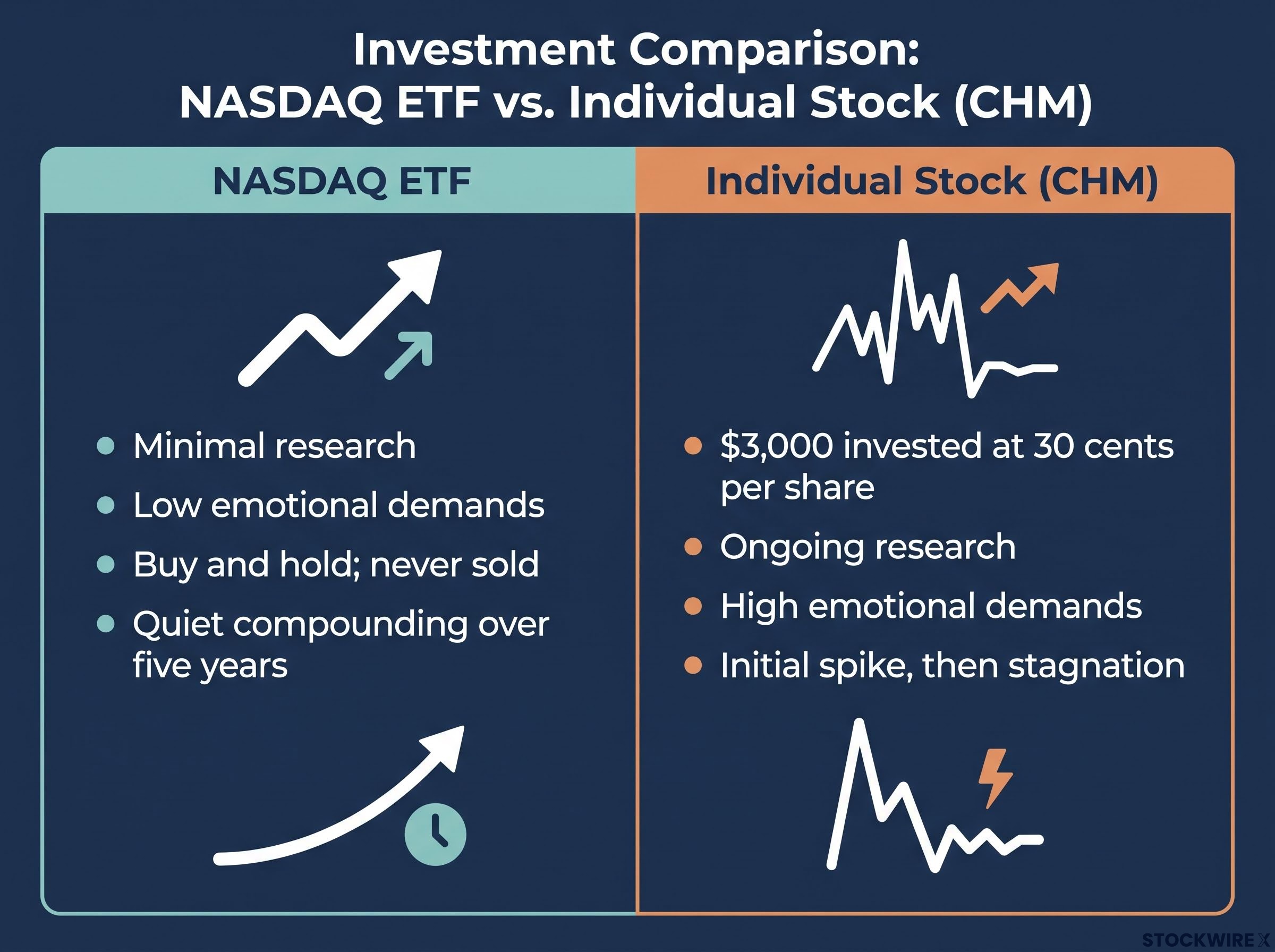
The individual stock was CHM, purchased at approximately 30 cents per share with roughly $3,000 invested. It ran up quickly after purchase. Then it stopped running. And that is when the work started.
When Ryan sat down with the company’s financial reports, he found the documents ran to hundreds of pages and the content quickly exceeded his grasp. He could make it through the opening sections but could not meaningfully evaluate what he was reading. Every earnings result, every management update, every competitor announcement required a decision: is this noise, or is this a warning? He felt he “should” understand these documents. He could not. That gap between obligation and capability is precisely where poor investment decisions get made.
The ETF, by contrast, asked nothing of him. No earnings calls to follow. No CEO changes to assess. No reactive decisions to make. He topped it up periodically and carried on with his life.
Not one of the ETF positions Ryan has ever purchased has since been sold. That inertia turned out to be a feature, not a flaw, reinforcing a buy-and-hold habit that compounded quietly over five years.
| Attribute | NASDAQ ETF | Individual Stock (CHM) | What this means for beginners |
|---|---|---|---|
| Research required | Minimal: check holdings occasionally | Ongoing: financial reports, news, competitor analysis | Your time commitment scales dramatically with individual stocks |
| Emotional demands | Low: broad diversification smooths volatility | High: every price move feels personal | Emotional strain leads to reactive trading, which erodes returns |
| Trading activity | Buy and hold; never sold | Constant temptation to trade around news | Frequent trading adds brokerage costs and potential CGT events |
| Outcome after five years | Quiet compounding; remains core holding | Initial spike, then stagnation; ongoing anxiety | Consistency tends to outperform intermittent attention over time |
The real lesson is not that CHM was a bad stock. It is that individual stock ownership creates an ongoing obligation to competence that most beginners have not yet built. Seeing that contrast play out in real time, over real years, is more instructive than any theoretical framework.
The costs that beginners underestimate: brokerage, management fees, and tax
Before you place your first trade, you need a clear picture of the three cost layers that shape every investing decision in Australia. Most beginners focus on the headline return without modelling what these costs subtract from it.
- Brokerage fees. You pay brokerage every time you buy or sell, whether the asset is an ETF or a single share. At the time Ryan started, fees were approximately $20 per transaction. Newer brokers now offer lower or tiered pricing structures, but brokerage is never zero for standard CHESS-sponsored accounts. On a $500 trade, a $20 fee represents 4% of your investment consumed before the position has moved a cent.
- Management Expense Ratio (MER). This is the annual fee an ETF provider charges for running the fund, deducted inside the fund rather than billed to you separately. For broad market ETFs in Australia, the MER commonly sits in a low single-digit basis point range annually, meaning you might pay a few dollars per year for every $10,000 invested. Individual stocks carry no MER, but the diversification and lower research burden an ETF provides may more than offset this small cost for a beginner.
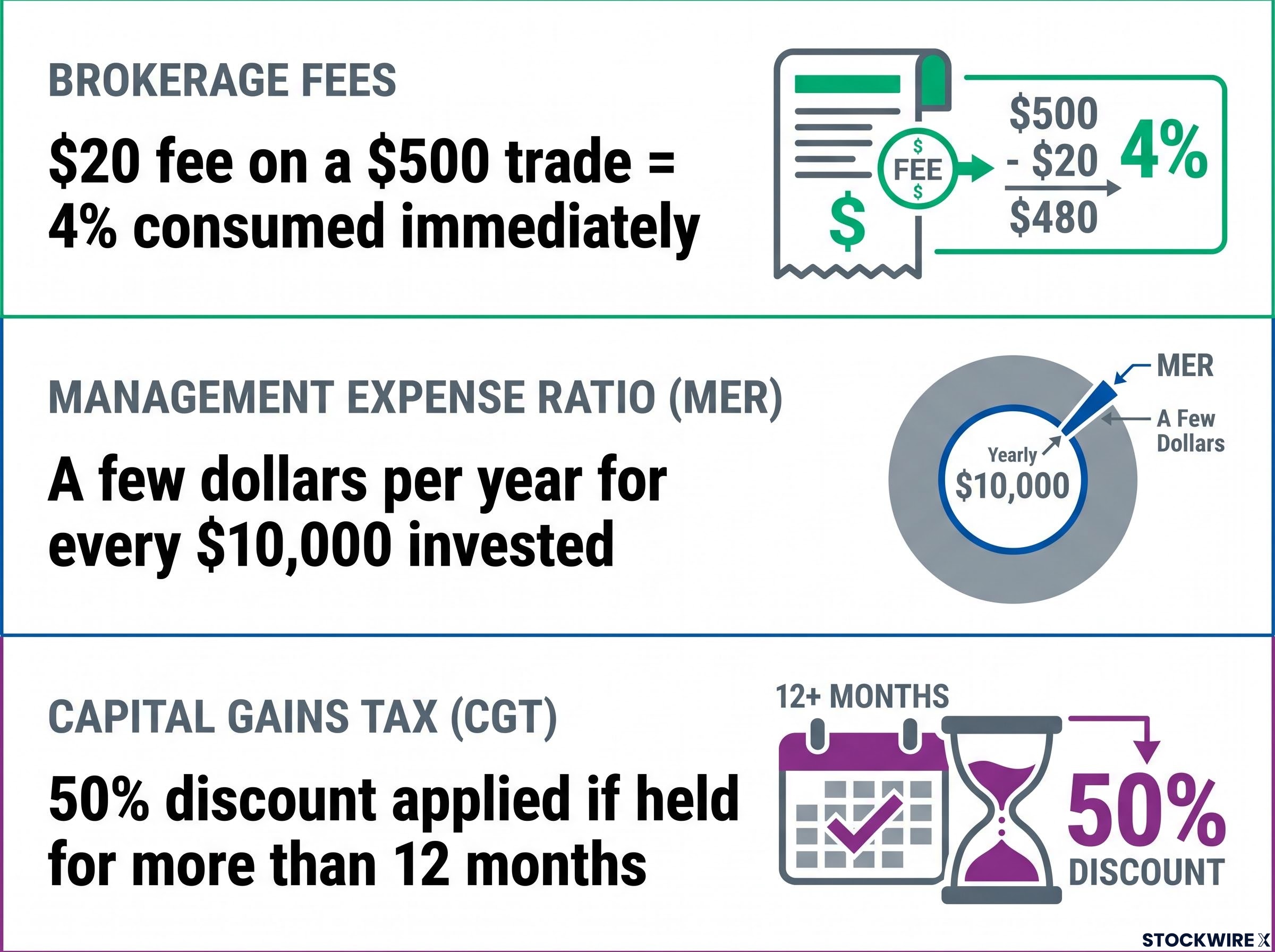
- Capital Gains Tax (CGT). Selling any investment at a profit triggers a taxable event. The gain is added to your assessable income for the financial year in which you sell.
If you hold an investment for more than 12 months before selling, you receive a 50% discount on the capital gain. This structural incentive rewards a buy-and-hold approach.
How capital gains tax affects your sell decisions
Every sale of an investment at a profit is a taxable event in Australia. The gain, calculated as the difference between your purchase price and sale price (minus costs like brokerage), is added to your assessable income for that financial year and taxed at your marginal rate. If you have held the asset for more than 12 months, the 50% CGT discount applies, meaning only half the gain is added to your income.
This does not mean you should never sell. It means you should factor tax into every sell decision consciously, not discover it at tax time. Ryan noted that selling his ETF positions would create tax obligations, which reinforced his preference for holding. For a beginner tempted to “take profits” on a rising ETF position, the combined cost of brokerage plus CGT on each sell decision can meaningfully erode the compounding effect you are trying to build. Holding is often more valuable than it appears.
Volatility, diversification, and why concentration risk matters to beginners
Volatility sounds like an abstraction until you own a single stock that drops 15% on an earnings miss. Then it feels very specific. The good news is that volatility is a variable you control through portfolio construction, not a force you simply endure.
A broad ETF spreads your money across many companies, sectors, and often geographies in a single trade. When one constituent falls, others may hold steady or rise, dampening the overall movement. An individual stock offers no such cushion. One regulatory change, one management departure, one missed earnings target can move the price sharply in either direction.
For beginners, that concentrated volatility triggers reactive behaviour. The emotional triggers include:
- Earnings surprises that send the price sharply in either direction overnight
- Management changes that alter the investment thesis you originally relied on
- Sector-wide news that disproportionately affects your single holding
- Competitor announcements that reshape the competitive position of your company
Broad index-level moves, by contrast, tend to be slower, more gradual, and easier to hold through. Ryan experienced this firsthand. His ETF holdings never prompted a panic response. His individual stock prompted constant internal debate about whether to hold, sell, or buy more.
Ryan’s portfolio has evolved into a diversified ETF-based structure organised by geographic region, with no intention of returning to individual stock selection. He acknowledged some overlap between his NASDAQ and S&P 500 ETF holdings, a real consideration worth checking in your own portfolio construction.
If you want the learning experience of stock picking without betting your entire portfolio on it, the core-and-satellite framework gives you that structure. Place 80-95% of your portfolio in broad ETFs as the stable core, and allocate up to 5-20% to individual stocks treated as higher-risk, higher-learning money.
| Portfolio size | ETF core (90%) | Stock satellite (10%) | ETF core (80%) / Stock satellite (20%) |
|---|---|---|---|
| $5,000 | $4,500 | $500 | $4,000 / $1,000 |
| $20,000 | $18,000 | $2,000 | $16,000 / $4,000 |
| $50,000 | $45,000 | $5,000 | $40,000 / $10,000 |
This structure is not a compromise. It is the design choice that lets you stay invested through market turbulence while developing the stock-picking literacy that makes individual stock ownership eventually viable.
Five steps to start investing in Australia with a clear framework
The lessons from Ryan’s five-year experiment and the cost mechanics covered above translate into a concrete sequence you can follow this week.
CHESS sponsorship is the single most important criterion when choosing an Australian broker for share ownership. A CHESS-sponsored account links ownership of your shares to your own Holder Identification Number (HIN), meaning you, not the broker, are the registered owner on the ASX sub-register.
- Choose a reputable, CHESS-sponsored broker. Understand its fee structure before placing your first trade. Compare brokerage costs, platform features, and whether the account is CHESS-sponsored or held under a nominee structure.
- Start with one or two broad ETFs. An Australian shares ETF plus a global shares ETF covers a wide base. Alternatively, a single diversified ETF that blends multiple asset classes and regions can simplify your first step further. Avoid overcomplicating your initial holdings.
- Set up regular contributions. Monthly or quarterly contributions put compound growth to work without requiring you to time the market. Automate where possible and treat investing contributions the same way you treat a recurring bill.
- If you want stock-picking experience, cap it. Allocate a small percentage of your portfolio, say 5-10%, and treat it explicitly as an education budget, not a wealth-building engine. The discipline of capping this allocation is what separates beginners who build wealth from those who keep starting over.
- Keep accurate records of all trades. Record dates, prices, and brokerage paid for every transaction. This is not optional. Your future self will need these records for CGT reporting, and reconstructing them years later from broker statements is tedious at best and inaccurate at worst.
What Ryan’s five-year experiment tells you about your own starting point
Ryan’s conclusion after five years is not that individual stocks are wrong. It is that they are a different job from passive wealth-building, and most beginners do not realise that until they are already inside both positions simultaneously.
His settled position is a diversified ETF portfolio organised by geographic region, supplemented by a BetaShares managed portfolio product that constructs allocations on his behalf. He has no plans to return to individual stock selection. The compounding principle, staying invested, contributing regularly, and minimising unnecessary selling, is the underlying driver of his long-term strategy.
Your decision does not need to look exactly like his. Before you commit to either approach, ask yourself three honest questions:
- How many hours per week can you realistically spend on investment research?
- Are you comfortable with your money concentrated in a single company’s fortunes?
- Do you want to build wealth passively or develop active investing skills alongside it?
If the answer to the first question is “not many,” and the answer to the second is “not really,” then a broad ETF core is where most Australian beginners are best served starting. If you genuinely want to learn the craft of analysing individual companies, the core-and-satellite framework gives you room to do that without risking your financial foundation.
The ETF compounded quietly. The individual stock demanded attention. Over five years, that difference reshaped an entire investing philosophy. Your version of that experiment starts the moment you make your first purchase, and now you have a framework to make it deliberately.
This article is for informational purposes only and should not be considered financial advice. Investors should conduct their own research and consult with financial professionals before making investment decisions.