
Most investors think owning a business makes the stock market feel riskier. Ryan, a co-owner of five gyms across Sydney, found the opposite. Once he was inside a private business, watching cash flow fluctuate and member numbers shift week to week, a diversified portfolio of listed companies started to feel like the safest thing he owned.
That experience cuts against a belief most Australian small business owners carry: that every spare dollar belongs back inside the venture. The logic sounds right. You know your business better than any fund manager does. The returns on internal reinvestment feel tangible. But that reasoning, taken to its conclusion, leaves your income, your assets, and your long-term wealth all sitting inside one illiquid position in one industry in one city.
Here is what Ryan’s story actually tells you about investing for small business owners, and why your business ownership is not a reason to stop building wealth outside it. It is the strongest argument for starting.
What co-owning five gyms taught one investor about where the real risk lives
Ryan was already an ETF investor before he became a gym co-owner. ETFs, or exchange-traded funds, are diversified baskets of stocks that track a market index, giving you exposure to dozens or hundreds of companies through a single holding. That investing foundation was already in place when he took on the concentrated risk of business ownership, which means his shift in perspective was earned through experience, not borrowed from a textbook.
The ASIC MoneySmart guidance on ETFs explains how these listed products give Australian retail investors exposure to a broad range of companies through a single, low-cost holding, which is the structural feature that makes them a practical counterweight to a concentrated private business position.
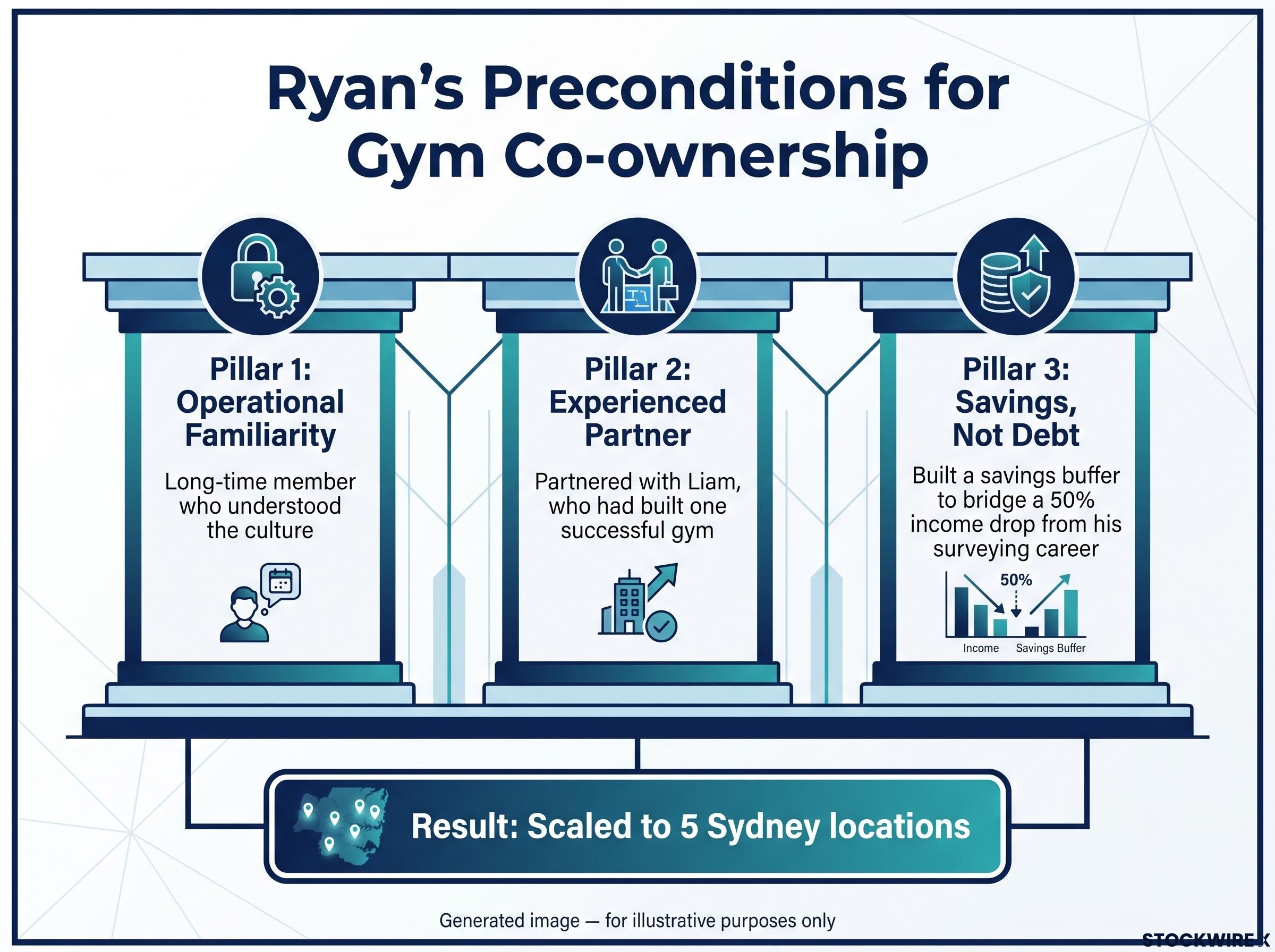
He did not enter the business blind. Three preconditions shaped his decision:
- Operational familiarity: Ryan had been a long-time member of the gym. He understood the community, the culture, and the daily reality of how the business ran.
- Experienced partner: His business partner, Liam, had already built and scaled one successful gym location, giving Ryan a proven operational model and ongoing mentorship.
- Savings, not debt: Ryan funded his entry with savings he had built beforehand, avoiding the personal loan risk he watched other entrepreneurs take on.
Those were not coincidences. They were preconditions that made everything that followed, including his ability to invest externally, possible at all. If you are considering entering a business, that sequence matters: buffer first, then commitment.
The financial and psychological reality of the first two years
The income shift was immediate. Moving from a surveying salary to gym co-ownership roughly halved Ryan’s income. He bridged the gap with the savings he had already set aside, not with credit.
The psychological pressure matched the financial hit. Constant concern about attracting and retaining members. Low-level cash flow anxiety that never fully switched off. A deep respect for entrepreneurs who stack personal loan repayments on top of all that operational stress.
The business scaled from a single location to five Sydney sites within a few years of Ryan joining. That growth is a genuine achievement. It also shows how much capital, energy, and attention a scaling private business demands, and why so few owners find the headspace to think about what sits outside it.
When big ASX news breaks, our subscribers know first
How running a private business shifts your perspective on listed market risk
The shift in Ryan’s thinking was not theoretical. It came from living inside a concentrated position every single day and realising that a broad ETF, by comparison, felt remarkably stable.
The reasoning holds up when you examine it. A broad, low-cost ETF spreads your capital across dozens or hundreds of large companies. Each one files audited financials, employs professional management, and operates under regulatory oversight. A single private business concentrates your risk in one venture, in one geography, in one industry, dependent on local competition, staff turnover, and customer behaviour that you cannot fully control.
Broad ETF diversification is the mechanism that makes listed exposure feel so different from private business ownership: a single ETF share in a broad index fund provides simultaneous exposure to hundreds of large companies, each filing audited financials and operating under regulatory oversight that no private gym network faces.
Ryan’s core reasoning: large publicly traded companies are significantly less likely to fail than a single small private business. When you are living inside that private business every day, feeling the operational pressure firsthand, diversified listed exposure starts to feel like a rational counterweight rather than a speculative gamble.
This is not about one path being safe and the other dangerous. Both carry risk. The difference is the type and concentration of that risk, and once you have operated a private business, you understand concentration risk better than most investors ever will. You are living inside it.
| Attribute | Private business | Broad ETF | What this means for you |
|---|---|---|---|
| Diversification | Single venture, single industry | Dozens to hundreds of companies across sectors | Your business already concentrates your risk; external holdings spread it |
| Liquidity | Illiquid; selling takes months or years | Traded daily on public exchanges | You can access listed investments quickly in a personal emergency |
| Transparency | Private financials, no external audit requirement for most small businesses | Audited financials, regulatory oversight | Listed companies face disclosure requirements your business does not |
| Geographic scope | Typically one city or region | National or global exposure | Your business depends on one local market; ETFs do not |
The practical implication is direct. Your daily experience of operational risk is itself evidence for why external diversification makes sense. You do not need someone to explain concentration risk to you. You feel it every time a key staff member leaves or a new competitor opens nearby.
The problem with putting every dollar back into the business
The all-in argument deserves genuine respect. Reinvesting funds growth. Better equipment, stronger marketing, new locations, more staff. Many owners do know their business better than the market. Internal reinvestment often delivers the highest return on capital available to them.
The problem is not reinvesting. The problem is only reinvesting.
When every dollar stays inside one private, illiquid enterprise, the consequences compound:
Concentration risk in practice behaves very differently from how it appears in theory: a single speculative position with a 10% chance of a 5x return carries an expected value lower than its face cost, a calculation that becomes viscerally clear to anyone who has staked income, assets, and net worth on one private venture.
- Your income depends on the business performing this quarter.
- Your assets are locked inside something you cannot sell quickly.
- Your net worth rises and falls with a single venture you cannot hedge.
- There is no buffer for a personal crisis, a medical bill, or a family emergency.
- There is no Plan B if the business hits a sustained downturn.
The question is not “should you invest outside your business?” It is “how much of your total wealth can you safely hold in one illiquid, private position?” Framing external investing as portfolio risk management rather than a vote of no confidence changes the entire conversation.
Why industry structure shapes how quickly you can start
Ryan’s specific industry gives him an advantage most owners should be honest about. A gym operates without physical stock on hand. Unlike product-based businesses, there is nothing to purchase in bulk, warehouse, mark down on clearance, or absorb as a write-off when demand shifts. That removes a layer of cash flow strain that product-based businesses deal with constantly.
If you run a retail operation, a manufacturing business, or a food venture with heavy inventory and working capital demands, you may need more capital inside the operation in the early years. That does not change the goal. It changes the timeline. Understanding your business’s specific cost structure, its fixed obligations, its margin profile, helps you determine when external investing becomes realistic, not whether it should happen at all.
A practical starting point for business owners who want to invest outside their venture
The framing that makes everything else cohere: treat your business equity as the largest, most concentrated position in your personal portfolio. Because that is exactly what it is. Once you see it that way, the question shifts from whether to invest externally to how you balance the risk of a very large, illiquid holding.
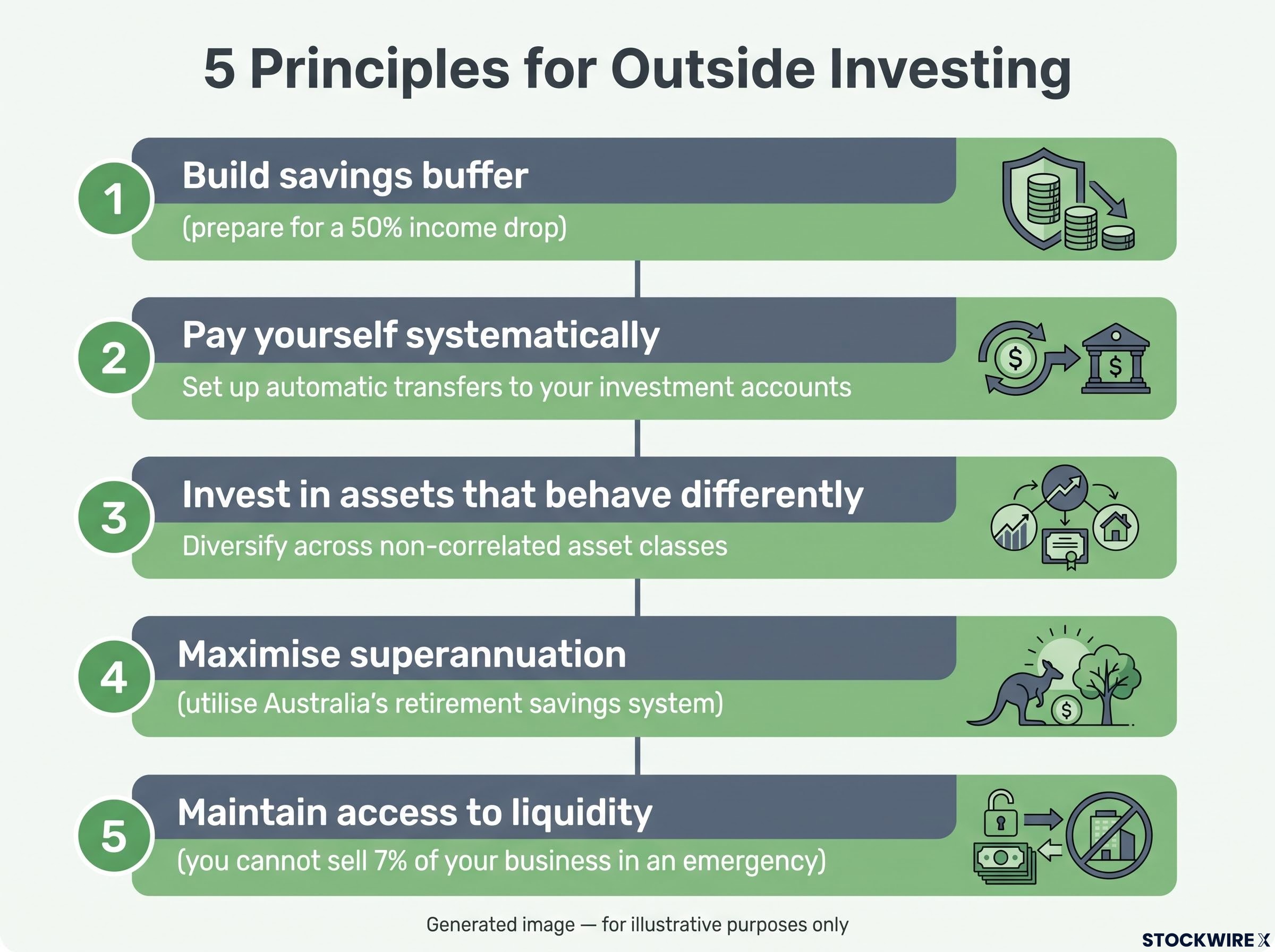
The sequencing matters. These five principles are ordered by when they should happen, not by importance:
- Build the savings buffer before your income drops. When Ryan moved from his surveying career into gym co-ownership, his take-home pay dropped by around 50%, a gap he covered using savings built up in advance. Hold at least several months of personal lifestyle expenses in liquid assets before business pressure begins. That buffer is far harder to build once you are already under strain.
- Pay yourself systematically and invest the surplus personally. Instead of leaving all surplus cash inside the business, increase your own salary or distributions and direct the difference into personal investments. This creates separation between business capital and personal wealth.
- Invest in assets that behave differently from your business. A broad mix of listed investments, ETFs, diversified equity funds, bonds, and cash, gives you exposure to companies and sectors far beyond your own industry and geography. These assets do not react to your local competitor, your lease renegotiation, or a staff departure.
- Maximise your superannuation contributions. Superannuation, Australia’s compulsory employer-funded retirement savings system, is the vehicle many small business owners consistently under-use. It offers tax-advantaged growth on top of the diversification benefit, and for business owners channelling everything back into operations, it is often the first external investment that makes sense.
The superannuation tax advantages available to Australian business owners are often larger than they expect: concessional contributions are taxed at 15% on entry rather than at marginal rates up to 47%, and earnings in pension phase from age 60 attract zero tax under current legislation.
- Maintain access to liquidity. You generally cannot sell 7% of your business to cover an emergency. Listed investments and cash can be accessed relatively quickly, giving you optionality when life does not follow the business plan.
None of these steps require you to stop believing in your business or reduce operational reinvestment to zero. The goal is a consistent, systematic allocation to outside assets. Not a complete rebalancing away from the venture.
Owning a business is not a reason to stop investing: it is the reason to start
Ryan’s perspective was not handed down from an adviser’s office. It was built from the inside: from halving his income, from watching cash flow fluctuate across five locations, from feeling the weight of concentration risk in a way that no portfolio theory lecture could replicate.
What that experience produced was not stock-picking skill. It was a visceral understanding of what concentrated risk feels like, and why diversified external exposure is a rational response to it, not a timid one. His ETF holdings function as a financial buffer against the concentrated risk of the gym business. The two roles are complementary, not competing.
Your business is where you take concentrated, active risk. It is your engine of income and impact. Your external portfolio is the counterweight: diversified, passive, long-term wealth that can survive a bad year or a bad decade in your industry.
Investors exploring which ETFs to hold outside their business will find our full explainer on common ETF portfolio mistakes useful; it covers thematic overlap, fee drag, and how a seemingly diversified fund set can quietly concentrate in the same handful of mega-cap names.
The more convinced you are of your business’s potential, the more reason you have to protect your personal financial position outside it. Belief in the business and external investing are mutually reinforcing. If you have not started building that counterweight yet, superannuation contributions and a simple, low-cost ETF allocation are the two most accessible starting points for Australian business owners at any stage.
This article is for informational purposes only and should not be considered financial advice. Investors should conduct their own research and consult with financial professionals before making investment decisions.
—