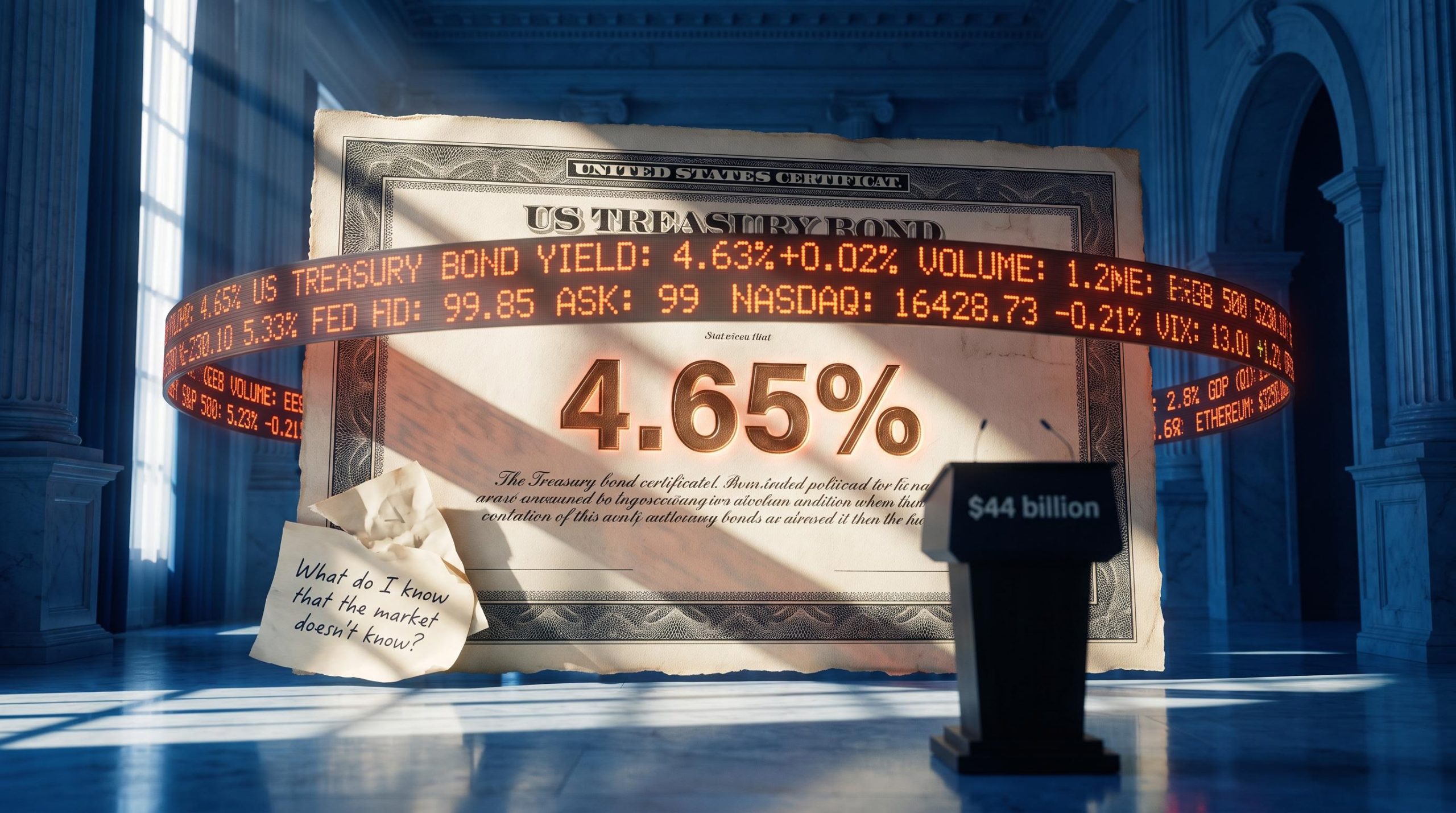
A senior Treasury official telling the bond market he knows something it does not, and then refusing to say what that knowledge is, would be unusual from any policymaker. From the official who controls issuance volumes, maturity mix, and buyback operations, it is something else entirely. That is what Scott Bessent did on 20 August 2026, and the market has been pricing around the silence ever since.
The context matters as much as the quote. One day before the CNBC interview, the Treasury announced it would at least double the size of its long-dated buyback operations, raising the per-operation cap from $2 billion to at least $4 billion, effective 9 September. The rhetorical signal arrived with an operational commitment already on the table, a combination that turned a provocative claim into something the market could not easily dismiss.
Treasury buyback mechanics explain why the signal here outweighed the raw dollar volume: the programme’s incremental liquidity support represents roughly 0.04% of the overall Treasury market, meaning short-squeeze dynamics and positioning effects drove most of the yield reaction, not the direct supply absorption.
Here is the framework for reading what happens next. This week’s core PCE print today, the $44 billion 7-year note auction tomorrow, and Fed Chair Kevin Warsh’s address at Jackson Hole on Thursday together form the crucible in which the durability of Bessent’s US Treasury market intervention will be decided. By the time all three resolve, you will know whether the Treasury’s credibility bet is paying off or unwinding.
How Bessent moved the market without saying anything specific
“What do I know that the market doesn’t know?”
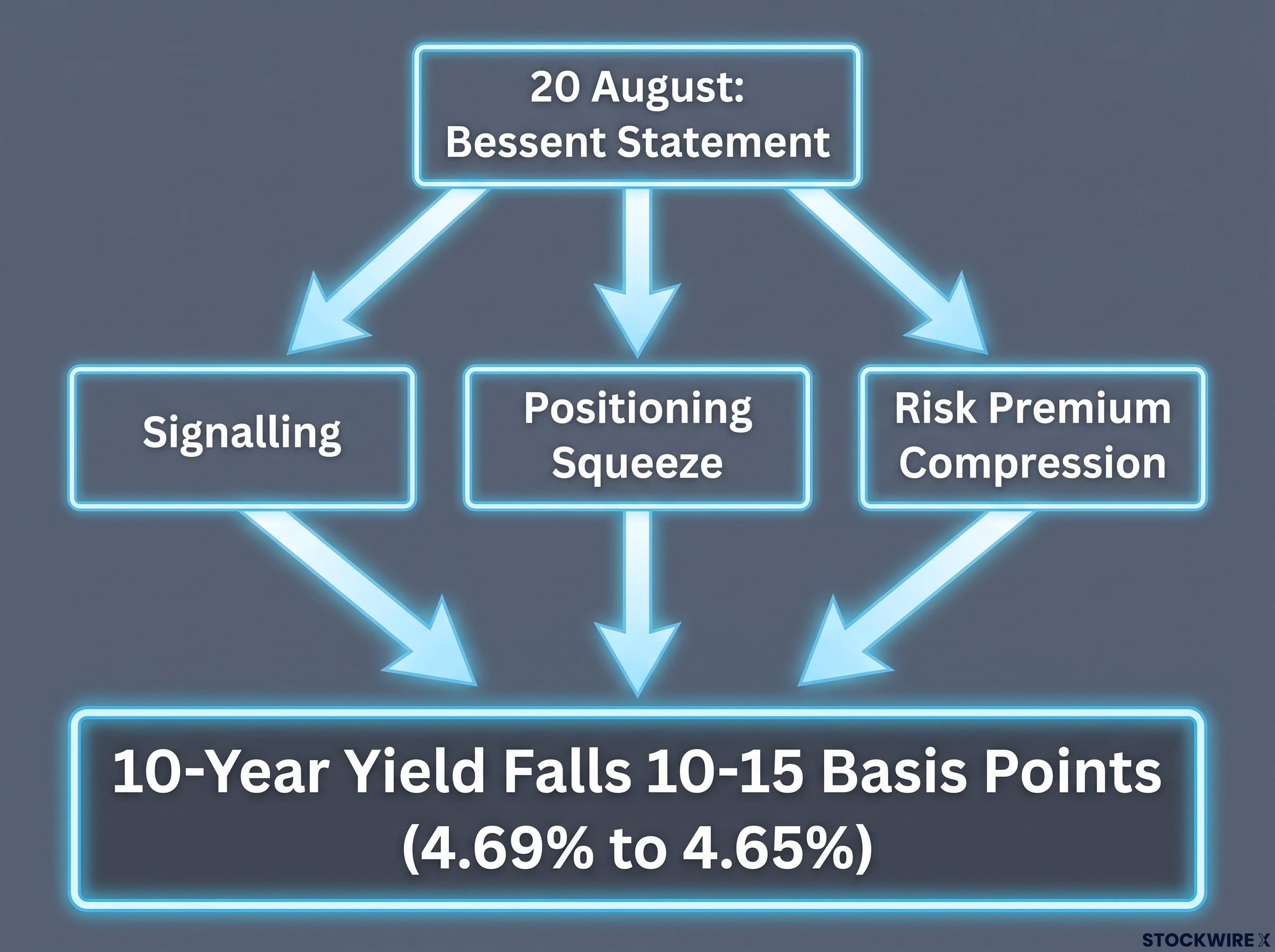
That single rhetorical question, posed on CNBC on 20 August and left deliberately unanswered, drove long-end Treasury yields roughly 10-15 basis points lower over the following week, a move attributed to ING analyst Chris Turner. The 10-year yield, which sat near 4.69% on the day of the interview, drifted toward 4.65% heading into today’s PCE release.
The vagueness was not a flaw in the communication. It was the instrument. An unspecified informational claim cannot be directly challenged until data arrives, which gives it temporary but real market power. Three transmission channels explain how the ambiguity moved prices:
- Signalling: A Treasury Secretary claiming an information advantage forces investors to update their assumptions about the balance of risks around growth, inflation, and funding conditions, even without knowing what the specific information is.
- Positioning squeeze: After a strong yield rise earlier this summer, speculative and hedging positions were skewed toward higher long-end rates. The threat of a policy-backed “Treasury twist” encouraged shorts to cover rather than fight official action.
- Risk premium compression: Any official hint that authorities know something that makes long-end risk safer than the market assumes naturally compresses the extra compensation (or term premium) investors demand for holding longer-dated bonds, the additional yield they require for locking up capital for 10 or 30 years instead of rolling short-term instruments.
Each channel amplified the others. The signal triggered the squeeze, the squeeze compressed the premium, and the compressed premium validated the signal.
The buyback escalation that gave the words weight
Rhetoric without operational backing would have landed very differently. Long-end yields had already risen on heavy corporate issuance, thin 30-year liquidity, and persistent deficit concerns. The market had reasons for pricing where it was.
The 19 August buyback announcement changed the calculus. Raising per-operation caps from $2 billion to at least $4 billion beginning 9 September told the market the Treasury was prepared to absorb duration at scale, not just talk about it. The words on 20 August had weight because the operational commitment on 19 August had already been made. By week’s end, yields had partially retraced, but the compression held enough to reshape the conversation heading into this week’s catalysts.
When big ASX news breaks, our subscribers know first
What “asymmetric information” actually claims, and why it matters
Asymmetric information describes a situation where one side of a transaction possesses material knowledge the other side does not. In most market contexts, this is a regulatory concern: insider trading laws exist precisely to prevent informed parties from exploiting uninformed ones.
When the party making this claim is the US Treasury Secretary, the implications are categorically different from those of a private fund manager saying the same thing. Bessent does not just claim to know more; he controls the levers that determine how much debt gets issued, at what maturities, and how aggressively the government buys back its own bonds. Three implications follow:
- Market power: Policy control combined with claimed informational superiority gives the Treasury a unique capacity to move prices. A hedge fund manager claiming an edge can trade on it. The Treasury Secretary can trade on it and reshape the supply side simultaneously.
- Perception of fairness: Asserting “I have asymmetric information” while actively influencing bond prices raises questions about whether public policy decisions are being made with knowledge ordinary investors cannot access, even if no legal boundary is crossed.
- Credibility shelf life: The claim’s durability is entirely contingent on subsequent data validation. If growth or inflation re-accelerates, or if auction demand fails to materialise at lower yields, the informational claim loses potency at exactly the moment the Treasury may need it most.
| Dimension | Private participant’s claim | Treasury Secretary’s claim |
|---|---|---|
| Market power | Can trade on the edge | Can trade on it and reshape supply |
| Ability to act | Limited to own capital | Controls issuance, maturity mix, buybacks |
| Accountability mechanism | Regulatory scrutiny, legal liability | Political accountability, market credibility |
| Information half-life | Erodes as market reprices | Erodes if data contradicts, but policy tools can extend it |
Markets have treated the remarks primarily as a signal about future supply-demand dynamics at the long end rather than a tradable tip about a specific upcoming event. That interpretive choice preserves the intervention’s influence while sidestepping its most legally sensitive readings. Bessent also explicitly linked the strategy to coordinated action with Japan, situating the move within a broader pattern of unconventional 2026 Treasury interventions, including currency operations, all unfolding against a backdrop of US national debt surpassing $40 trillion.
The asymmetric information claim is simultaneously a market signal, a policy warning, and a credibility commitment. If incoming data contradicts it, the tool breaks precisely when it is needed most.
The broader policy context for this intervention is informal yield curve control: Bessent’s approach differs from formal YCC on three critical dimensions, with no published yield targets, capped and finite operations, and no Federal Reserve participation, which is precisely why signalling must do the heavy lifting that mechanical purchases cannot.
The Dollar in the middle: real yields, risk appetite, and what actually drives the currency
The instinct is to connect Bessent’s words directly to Dollar moves. The reality is more layered. The rhetoric is at most an initiating signal; the currency’s actual path depends on the real-yield configuration that emerges after this week’s three catalysts settle.
Two FX transmission channels connect the Treasury intervention to the Dollar:
- Real-yield differential: Lower nominal long-end yields, if not offset by a hot inflation print, reduce US real yields (nominal yields minus inflation) relative to G10 peers and erode some of the Dollar’s carry appeal. Carry refers to the return investors earn simply from holding a higher-yielding currency against a lower-yielding one.
- Risk sentiment: If investors interpret Bessent’s move as reducing tail risks around funding or growth, it supports risk-on flows into non-USD assets, applying modest downward pressure on the Dollar.
| PCE scenario | Expected yield response | Expected Dollar response |
|---|---|---|
| Hot (above 0.2% MoM) | Long-end yields rise, challenging intervention premise | Dollar firms on renewed rate support |
| In-line (~0.2% MoM) | Yields consolidate near current levels | Dollar stays range-bound, consolidation continues |
| Soft (below 0.2% MoM) | Yields drift lower, validating intervention narrative | Dollar weakens as real-yield premium compresses |
According to ING analyst Chris Turner, a core PCE reading of 0.2% MoM marks the dividing line between a Dollar-supportive and Dollar-neutral outcome for both the currency and long-end yields. Heading into today’s release, the 10-year sat near 4.65%, up approximately 2 basis points on the day as investors positioned ahead of the print.
DXY range-bound for a reason
The DXY’s contained reaction, trading up against the 99.00-99.10 area on the topside while finding support around 98.60 on pullbacks, is not indifference. It is rational positioning uncertainty ahead of three sequential tests that will determine the sustainable real-yield outcome.
The real yield floor provided by 30-year TIPS near 3% helps explain the DXY’s contained range: OCBC analysts conclude that dollar-supportive and dollar-capping forces are in rough equilibrium, a structural stalemate that Bessent’s intervention nudges at the margins without resolving.
The Dollar’s near-term trajectory is a referendum on whether Bessent’s informational claim proves well-founded. That makes this week’s data and auction results more important for USD positioning than almost any routine Fed communication.
The three tests that will confirm or undo the yield compression this week
The three catalysts unfolding between today and Thursday are not independent data points. They form a sequentially dependent chain, where each result feeds directly into market positioning ahead of the next.

- Core PCE (today, 26 August): The inflation validation test. Consensus sits at approximately 0.2% MoM (with year-on-year estimates near 3.3%, though that figure is not independently confirmed). A reading at or below 0.2% validates the premise that market pricing at the long end had deviated from fundamentals. A hot print challenges it directly.
- $44 billion 7-year auction (27 August): The real-money demand test. This is the most direct market verdict on whether institutional buyers accept lower yields. The metrics to watch: bid-to-cover ratio (total bids divided by the amount offered), the tail (the difference between the auction’s high yield and the when-issued yield just before the auction, where a positive tail signals weaker demand), and the split between direct, indirect, and dealer absorption.
Treasury demand composition is the structural variable the 7-year auction will probe directly: foreign official holders have plateaued at roughly 33% of outstanding debt, with domestic commercial banks absorbing marginal supply, meaning auction results now reflect a buyer base that is more price-sensitive and less structurally committed than reserve managers historically were.
- Warsh at Jackson Hole (28 August): The Fed alignment test. Fed Chair Kevin Warsh’s speech is the week’s culminating monetary policy signal. Comfort with current yield levels and demonstrated inflation progress would effectively endorse the compression Bessent initiated. Emphasis on persistent inflation risks or concern about premature easing in financial conditions would push back against it.
The sequential logic matters: a benign PCE print supports stronger auction demand. A well-bid auction reduces pressure on Warsh to push back on easing financial conditions. Conversely, a hot inflation reading weakens the auction setup and gives Warsh reason to lean hawkish. The chain compounds in either direction.
| Event | Date | Strong result looks like | Weak result looks like |
|---|---|---|---|
| Core PCE | 26 August | 0.2% MoM or below; validates lower-yield narrative | Above 0.2% MoM; challenges intervention premise |
| 7-year auction | 27 August | Small or negative tail, strong indirect bid | Large positive tail, heavy dealer absorption |
| Warsh at Jackson Hole | 28 August | Comfort with conditions, endorses inflation progress | Pushback on easing conditions, emphasis on inflation persistence |
What you are watching this week is a real-time credibility test of government market intervention. Each catalyst either extends or erodes the yield compression Bessent bought with the asymmetric-information claim. The sequence is now underway.
What holds, what breaks, and where to position your attention after Jackson Hole
Bessent’s intervention has demonstrably achieved something: it bought time and room at the long end, brought long-end yields down by roughly 10-15 basis points, and kept the DXY trading within a narrow band below the 99.00-99.10 area. What it has not achieved, and cannot achieve through rhetoric alone, is durable validation.
Two conditions must hold for the yield compression to become durable rather than a temporary positioning effect:
- Data validation: The PCE print needs to confirm that fundamentals justify lower long-end yields, not that markets were simply talked into them.
- Real-money demand: The 7-year auction needs to clear without a large tail or outsized dealer absorption, demonstrating that institutional buyers accept the new yield level on its merits.
If both conditions are met and Warsh’s Jackson Hole framing aligns rather than contradicts, the compression carries into September, when expanded buyback operations begin on 9 September at the new $4 billion-plus per-operation scale.
Forward anchor: 9 September. Regardless of this week’s rhetorical outcome, expanded buyback operations begin on this date. That is when sustained Treasury action at the long end becomes an ongoing market force rather than a one-off signal.
After Jackson Hole, the variable that matters is where real yields settle, not where they moved in the immediate aftermath of the intervention. With the DXY capped near 99.00-99.10 on the upside and 98.60 acting as the key level on the downside, those boundaries mark the territory within which the week’s verdict will be rendered.
The asymmetric-information claim was a credibility bet the Treasury placed publicly. The payoff on that bet will be readable in yield levels and auction results before the week is out. Watch the chain, not the commentary.
This article is for informational purposes only and should not be considered financial advice. Investors should conduct their own research and consult with financial professionals before making investment decisions. Forward-looking statements regarding yield movements, Dollar direction, and policy outcomes are speculative and subject to change based on market developments and incoming data.