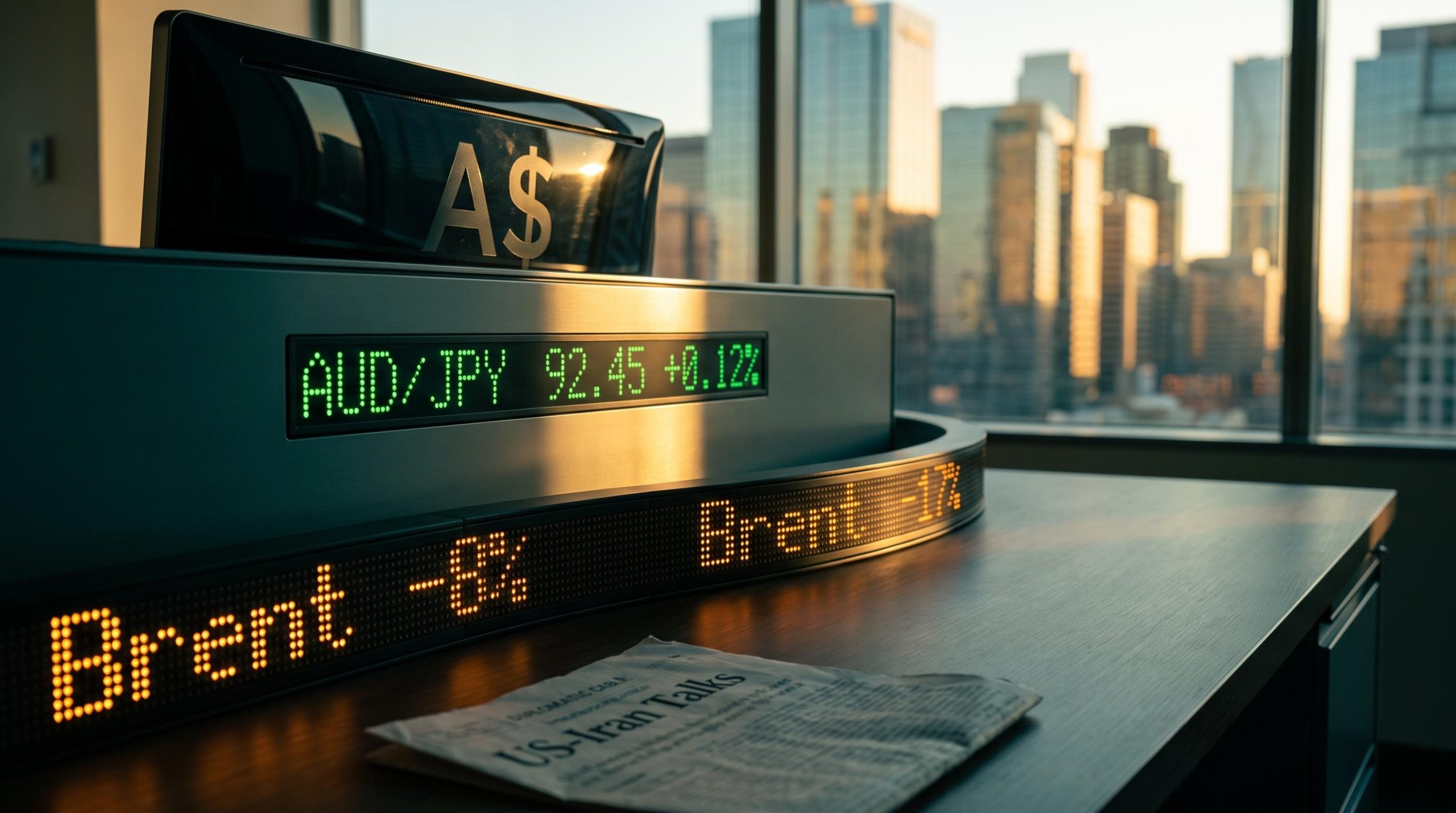
A diplomatic conversation brokered in Islamabad is now showing up as a position on the AUD/JPY screen. That is not a metaphor. Pakistani-mediated peace talks between the US and Iran have pulled crude oil down roughly 8% in a single week, compressed volatility across G10 foreign exchange markets, and reopened a carry trade window that most desks had quietly shelved after months of geopolitical noise.
The timing is what makes this worth examining closely. Australia’s July Consumer Price Index (CPI) data landed overnight on 26 August 2026, with monthly inflation printing at 1.0% against an expected 0.8% and the annual figure at 3.5% against 3.3% forecast. At the same moment, oil was shedding its risk premium on Middle East peace signals. These two events did not just happen to coincide; their convergence is precisely what has revived carry trade interest in the Australian dollar.
Here is the framework for assessing whether the conditions that make AUD carry attractive right now are durable or fragile, and which specific variables to watch before acting on this setup.
What Australia’s July inflation data changes for carry traders
The numbers themselves are straightforward. Monthly CPI rose 1.0% in July against a 0.8% consensus. Annual CPI came in at 3.5% versus 3.3% expected. Trimmed-mean inflation, the Reserve Bank of Australia’s (RBA) preferred core measure, held steady at 3.6%, unchanged from June.
What makes this print structurally significant is the period it followed. In June, annual headline CPI had eased to 3.8% from 4.0%, a result that was widely framed as reducing immediate hike odds. Q2 trimmed-mean CPI came in slightly below forecast. Westpac expected no additional rate rises in 2026. UBS had tentatively pencilled in a later move at most. The market’s working assumption was that the RBA was done.
The June CPI baseline that July’s print overturned showed annual headline inflation easing to 3.8% with a trimmed mean at 3.6%, results that had led Westpac and the broader market to assume the RBA’s tightening cycle was complete, which is exactly why July’s beat produced a repricing from a no-hike assumption rather than merely confirming an existing hike expectation.
The RBA August 2026 board minutes confirmed the cash rate held at 4.35% and outlined the board’s inflation assessment, establishing the no-hike baseline from which July’s CPI beat has now forced a material repricing toward November.
July reversed that assumption. The beat was not marginal; it was broad-based, with core inflation also exceeding forecasts. The result was a material repricing of what happens in November.
ANZ shifted its positioning to project a 25 basis point rate hike at the RBA’s November meeting, a direct response to the July CPI beat. That repricing is the single most consequential market development for AUD carry positioning.
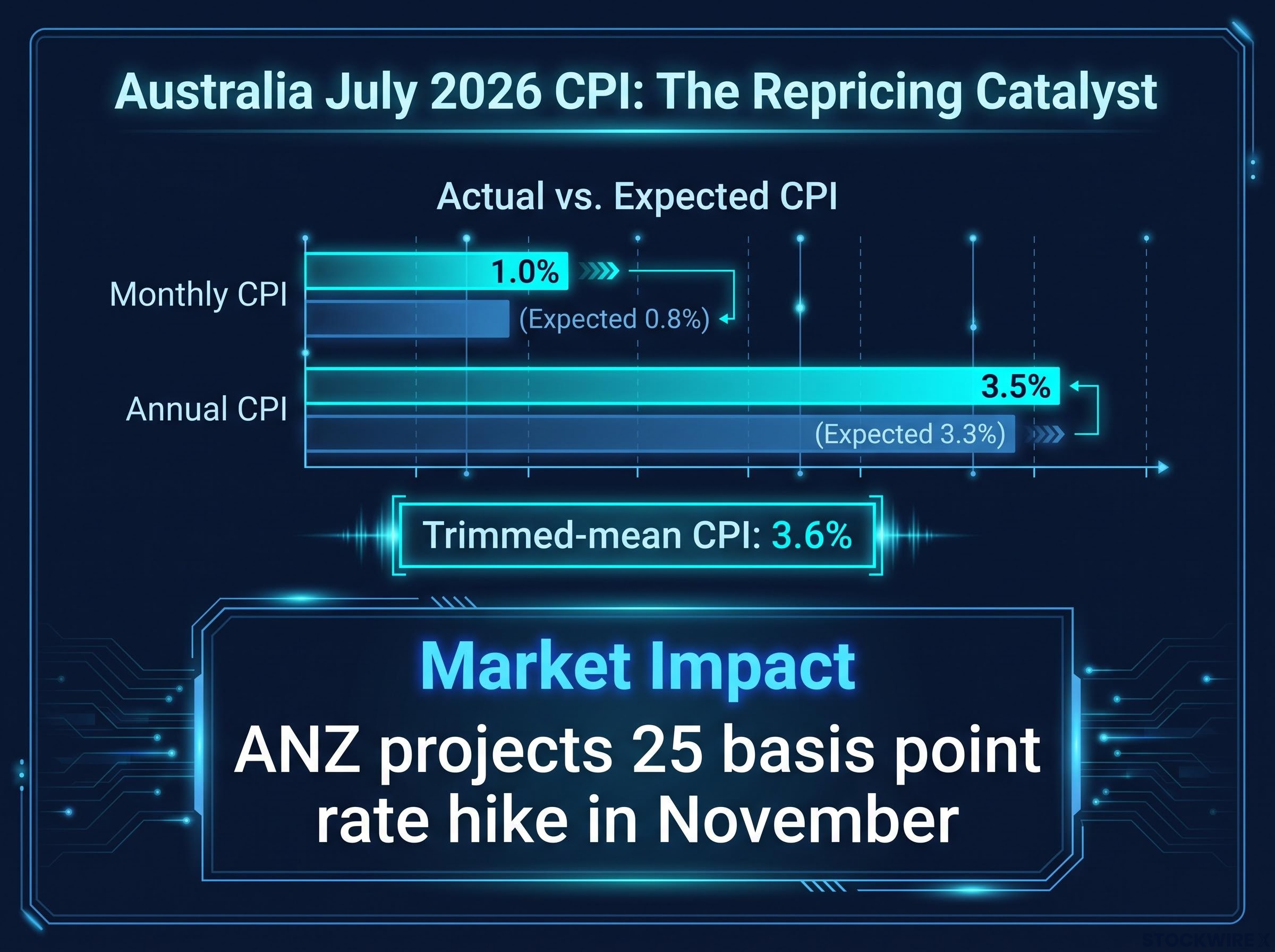
The distinction matters for how you size the opportunity. This is not a case where markets had already priced a November hike and the data merely confirmed it. The repricing is happening from a lower base, a no-hike baseline, which means the yield differential widening is incremental and fresh. For carry traders, that is the tailwind that is new, not already embedded in positioning.
| Metric | June 2026 | July 2026 (actual) | July 2026 (expected) |
|---|---|---|---|
| Monthly CPI | — | 1.0% | 0.8% |
| Annual CPI | 3.8% | 3.5% | 3.3% |
| Trimmed-mean CPI | 3.6% | 3.6% | Below 3.6% |
When big ASX news breaks, our subscribers know first
How geopolitical volatility compression opened the carry trade window
The connection between a peace talk in Islamabad and an AUD carry position runs through a specific chain. Each link is worth following because the chain tells you where the fragility sits.
- Middle East peace signals: Pakistan brokered new US-Iran diplomatic talks, easing fears of sustained conflict and Strait of Hormuz disruption.
- Lower oil prices: Crude shed roughly 8% in the week preceding 26 August 2026, with Brent slipping more than $2 per barrel to around $86.
- Softer US yield pressure: Lower oil dampened inflation expectations and took pressure off the long end of the US Treasury curve.
- Reduced interest rate volatility: As rate expectations stabilised, the spillover volatility that had been feeding into FX and equity markets eased.
- Revived carry trades: With cross-asset volatility compressing, leveraged currency positions became less likely to be whipsawed, making carry structures attractive again.
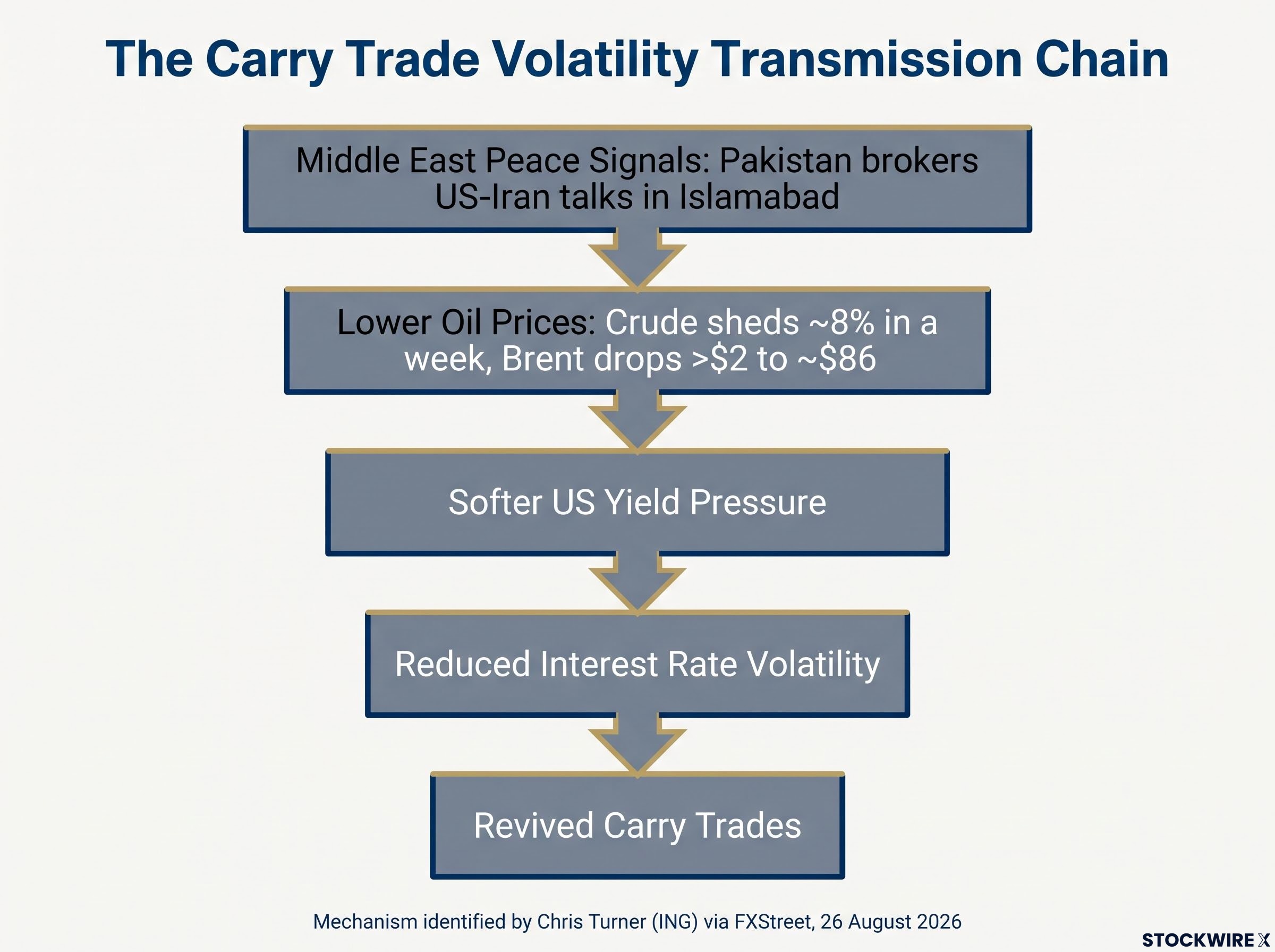
ING analyst Chris Turner, as reported by FXStreet Insights Team on 26 August 2026, identified this transmission chain explicitly, connecting the decline in US yields to a narrowing of interest rate volatility and the subsequent calming effect on both currency and equity market swings.
Geopolitical risk transmission from the Hormuz blockade through to central bank policy was made explicit by ECB Chief Economist Philip Lane on 13 May 2026, when he directly linked the oil shock to potential rate hikes, illustrating how a chokepoint disruption propagates into the rate volatility environment that carry traders must navigate.
Why oil prices are the volatility bridge, not just a commodity story
The temptation is to view the oil move as a direct commodity-price boost for AUD. That is not the mechanism that matters here. For carry trade purposes, the relevant effect of lower oil is its dampening impact on inflation expectations and bond yield volatility, not its direct effect on Australian terms of trade at this stage.
The oil price data tells the story of how quickly this bridge can shift. In late July, Brent dropped almost 4% and WTI around 3% in a single session after Pakistan pushed for new US-Iran talks. A further roughly 5% decline followed in early August on optimism about shipping route reopening.
But prices have not trended lower in a straight line. When Iran signalled the Strait of Hormuz would remain closed, Brent and WTI rebounded sharply. That pattern tells you the 8% weekly decline represents a geopolitical risk premium being partially priced out, not permanently removed. The volatility tailwind for carry trades is real today but could reverse quickly if talks falter.
Why AUD sits at the centre of G10 carry trade interest right now
A carry trade, in its simplest form, involves borrowing in a low-yielding currency and investing the proceeds in a higher-yielding one, pocketing the interest rate differential. It works when the higher-yielding currency does not depreciate enough to wipe out the interest income.
Three conditions need to hold simultaneously for a carry trade to be attractive:
- Relatively high or rising policy rate: The RBA’s cash rate sits well above the Bank of Japan and Swiss National Bank rates, and a credible November hike would widen that gap further. AUD currently satisfies this condition with momentum.
- Credible fundamental support for the currency: Australia’s commodity-exporting profile, combined with above-target inflation and a hawkish-leaning central bank, provides a fundamental floor under the currency. More orderly energy pricing reduces terms-of-trade volatility, which stabilises this backdrop.
- Contained cross-asset volatility: The oil-linked compression of rate and FX volatility has brought this condition into play. Leveraged positions are less likely to be stopped out in a low-volatility environment.
Any one of these conditions alone would be insufficient. Higher yields in a volatile environment get overwhelmed by drawdowns. Fundamental support without a yield edge does not compensate the carry trader for the risk of capital loss. Low volatility without a yield differential leaves nothing to harvest.
The current moment is notable precisely because all three are present simultaneously, even if each is imperfect.
The funding currency side: what yen and franc positions look like in this setup
The other side of the trade matters just as much. The Japanese yen and Swiss franc remain the primary funding currencies in G10 carry structures because of their persistently low policy rates. Bank of Japan policy remains accommodative relative to the RBA, which is the differential being harvested in AUD/JPY positions.
The risk from the funding side is distinct from AUD’s domestic story. Any surprise hawkishness from the BoJ, or a safe-haven demand shock lifting the Swiss franc, would compress the differential from below. That kind of move can unwind carry positions even if everything in Australia is going right.
Yen carry unwind risk operates through a different channel than AUD’s domestic story: the 2024 episode resolved within weeks with 40-60% of speculative positioning cleared in that window, but the episode also demonstrated how yen-driven deleveraging hits global equities, bonds, and emerging markets simultaneously, making the funding side a systemic risk monitor rather than a secondary consideration.
The risk map: four triggers that could unwind this trade
The setup is constructive. It is also fragile. If you have followed the thesis this far, the question is no longer whether the opportunity exists but what would need to go wrong, and in what sequence, for the trade to break down. Four risks, each operating through a different channel, deserve independent monitoring.
- Geopolitical reversal in the oil path (fastest-moving): Any setback in US-Iran diplomacy, particularly anything that revives fears of Strait of Hormuz closure, can rebuild the oil risk premium within a single session. The pattern is already visible: when Iran signalled the Strait would remain closed, crude rebounded sharply. A renewed spike in oil would re-inflate inflation expectations, lift global yields, and reintroduce the volatility that forces carry positions to unwind. Watchpoint: headlines from the diplomatic channel and Strait of Hormuz shipping data.
- US yields re-accelerating (most systemic): A strong US labour print or an upside inflation surprise would push Treasury yields higher and re-ignite rate volatility across all G10 FX. This risk is not AUD-specific; it is the macro floor beneath the entire carry trade complex. Watchpoint: US non-farm payrolls and CPI releases over the next data cycle.
- RBA communication disappointing before November (most calendar-dependent): July’s hot print has moved markets toward a November hike, but the prior quarters demonstrated how quickly softer data can shift RBA pricing. Westpac’s pre-July no-hike stance and UBS’s tentative positioning are evidence that one soft data print can materially compress the expected yield differential again. Watchpoint: Australian data releases and RBA speeches between now and November.
- Commodity cycle turning on iron ore and copper (slowest-moving): While lower oil reduces volatility, a broad sell-off in commodities that matter more directly for Australian terms of trade, specifically iron ore and copper, would weaken the fundamental support argument. The same commodity linkage that makes AUD attractive in calm conditions becomes a vulnerability if the cycle turns. Watchpoint: Chinese demand indicators and bulk commodity price trends.
The setup should be treated as an opportunity with clearly defined geopolitical and macro risk triggers, not a directional one-way bet. Each of these four risks has a different lead time and a different observable signal, which means the trade can be monitored actively rather than held on faith.
Positioning when the window is open but the hinges are loose
A rare confluence of a geopolitical volatility event and a domestic yield repricing has created a live AUD carry opportunity within G10 markets. The analytical case is coherent: Pakistani-mediated peace progress has compressed the oil risk premium, dampened cross-asset volatility, and arrived at precisely the moment Australian inflation data forced a repricing of the RBA’s November meeting from a no-hike baseline.
Institutional AUD positioning had already shifted before July’s inflation print: UBS formally recommended the Australian dollar as one of five preferred non-dollar currency holdings on 7 June 2026, citing its carry yield characteristics, though that recommendation was made against a backdrop of dollar weakness expectations that have since been complicated by the geopolitical and inflation data interactions described here.
But the opportunity is path-dependent. It will not persist unless both the diplomatic progress and the RBA November hike narrative hold. Three forward-looking variables deserve your attention before committing: Middle East diplomatic progress and its read-through to oil prices, Australian data releases and RBA communication between now and November, and the US yield path through the next data cycle.
Understanding an opportunity and acting on it are different decisions. The analytical work is here. The monitoring is yours.
This article is for informational purposes only and should not be considered financial advice. Investors should conduct their own research and consult with financial professionals before making investment decisions. These statements are speculative and subject to change based on market developments and company performance.