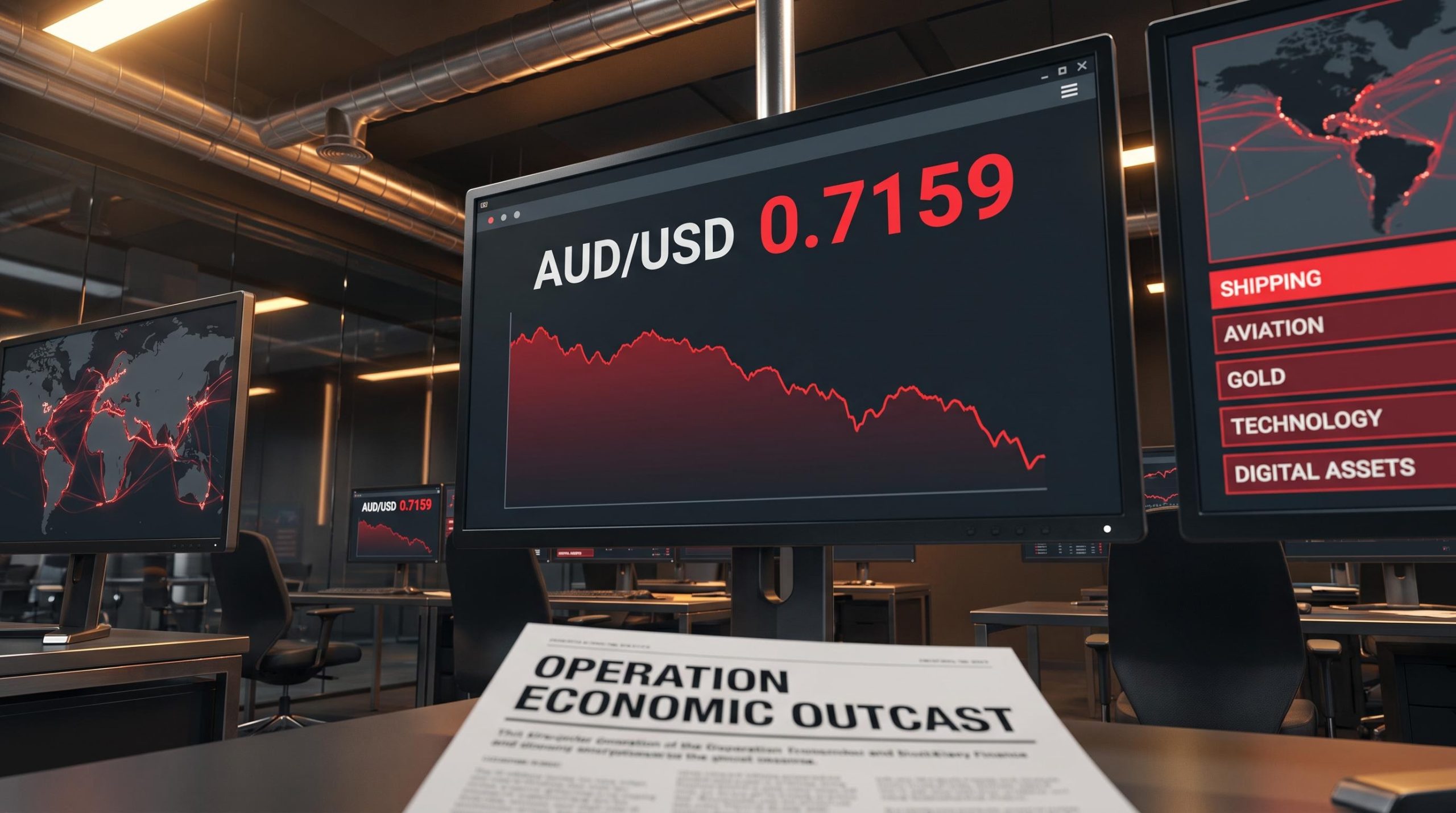
The US Treasury designated five entire sectors of Iran’s economy as sanctionable on 24 August 2026, acting under an operation it named Economic Outcast. This is not a handful of new names on a watchlist. It is a structural expansion of Washington’s sanctions architecture that puts any firm, anywhere in the world, at risk of designation for operating in Iranian digital assets, technology, gold, aviation, or shipping.
The five sectors are globally embedded. Banks in Singapore, shipowners in Rotterdam, crypto platforms in Dubai, and technology exporters across Asia all face a new reality: if their business touches Iranian-linked flows in any of these areas, the US dollar-clearing system gives Washington the lever to block them.
Here is what the new sanctions architecture actually does, why it reaches further than a standard enforcement action, and what the initial market reaction tells you about how investors are pricing the shift.
Operation Economic Outcast: what Treasury actually changed on 24 August
The action that took effect on 24 August 2026 introduced sectoral determinations under Executive Order 13902. That is an important distinction. Standard sanctions enforcement names specific individuals or entities on the Specially Designated Nationals (SDN) list, a designation that means “do not do business with this person or company.” Sectoral determinations work differently: they treat entire parts of an economy as sanctionable territory.
Treasury formally designated five sectors:
- Digital assets: Iranian crypto exchanges, facilitators, and any platforms servicing Iranian flows
- Technology: Hardware, software, and services feeding Iran’s finance, defence, or logistics ecosystems
- Gold: Trade, refining, and settlement activity linked to Iranian gold flows
- Aviation: Airlines, lessors, maintenance providers, and parts suppliers servicing Iranian fleets
- Shipping: Vessel owners, charterers, insurers, and port operators handling Iranian-linked cargo
Foreign persons operating in, or providing material services to, any of these sectors are now eligible for designation, even without a US nexus. A firm does not need to be named today to face sanctions risk tomorrow. That is what makes this announcement structurally different from a routine SDN update.
Treasury Secretary Scott Bessent positioned the action as Washington’s effort to sever Iran’s economic connections with the rest of the world, indicating that foreign governments had been given a specific timeframe to break commercial ties with Tehran. President Trump was described as directly engaging with foreign leaders to press for compliance.
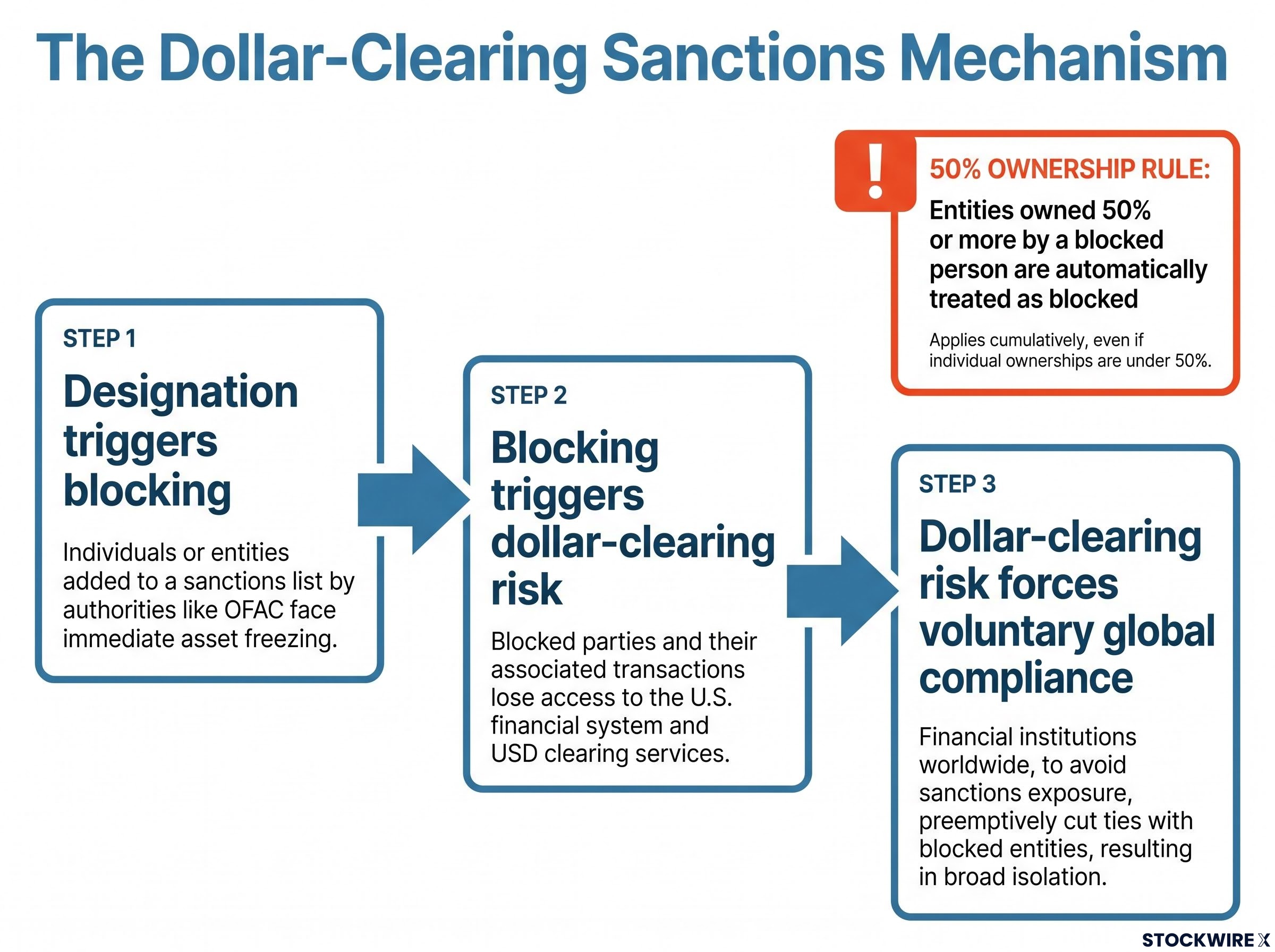
Under OFAC rules, entities owned 50% or more by a blocked person are automatically treated as blocked without requiring a separate designation. That ownership threshold means sanctions exposure travels through corporate structures silently.
The operation builds on earlier 2026 enforcement. Operation Economic Fury, launched earlier this year, designated Iranian crypto platform Nobitex and related facilitators, establishing the precedent that crypto rails receive the same treatment as traditional financial channels.
| Sector | What is targeted | Who faces secondary risk |
|---|---|---|
| Digital assets | Crypto exchanges, facilitators, DeFi platforms servicing Iranian flows | Global crypto exchanges, payment platforms, custodians |
| Technology | Hardware, software, and services supporting sanctioned activities | Asian and Middle Eastern tech exporters, component suppliers |
| Gold | Trade, refining, and cross-border settlement linked to Iranian gold | Regional gold traders, refiners, jewellers with opaque supply chains |
| Aviation | Airlines, lessors, maintenance providers, parts suppliers | Foreign aircraft lessors, MRO providers, parts distributors |
| Shipping | Vessel owners, charterers, insurers, port operators | Global shipowners, P&I clubs, freight forwarders, port authorities |
When big ASX news breaks, our subscribers know first
Why the dollar-clearing system turns US designations into a global compliance mandate
The reach of US sanctions extends far beyond American borders, and the transmission mechanism is straightforward once you see it.
- Designation triggers blocking. When OFAC places an entity or sector on the sanctions list, all property and interests of those designated parties in the United States, or under US-person control, are frozen. US persons are prohibited from providing funds, goods, or services to them.
- Blocking triggers dollar-clearing risk. Because most international dollar payments clear through US or US-linked correspondent banks, any transaction involving a blocked party that touches the US financial system is barred.
- Dollar-clearing risk forces voluntary global compliance. Non-US firms that want to preserve their dollar access and US market relationships must voluntarily comply, even when no US law technically compels them. The alternative is losing correspondent banking relationships entirely.
That three-step chain is why a policy decision made in Washington lands in the compliance departments of banks in Singapore, shipping firms in Rotterdam, and exchanges in Dubai.
The dollar-clearing mechanism that enforces compliance globally is also creating second-order financial consequences: the same sanctions architecture is quietly eroding foreign Treasury demand as China and other major holders accelerate the build-out of non-dollar payment infrastructure to reduce their structural exposure.
What “blocked” actually means in practice
Blocked property cannot be moved, transferred, or accessed. US persons cannot receive or provide anything of value to a blocked party. Treasury guidance specifies that all property of Iranian digital asset exchanges in US jurisdiction or under US-person control must be blocked and reported.
The 50% ownership rule adds another layer. A firm does not need to appear on any list to be legally treated as blocked if its ownership structure crosses that threshold. For shipping, this is particularly potent: Iran’s national maritime carrier (IRISL) and the National Iranian Tanker Company (NITC) operate through extensive networks of subsidiaries, front companies, and charter arrangements. Designation risk cascades through those ownership and charter chains to reach counterparties several steps removed from Iran itself.
For any institution that clears dollar transactions, compliance with these sectoral determinations is not optional. It is the cost of dollar access.
How markets responded, and what the reaction reveals about risk appetite
The market reaction was measurable but contained. Three concurrent signals arrived on the same Monday session (25 August 2026):
- AUD/USD recorded a loss of roughly 0.28%, with the pair quoted at 0.7159, as capital shifted away from risk-sensitive assets toward the US dollar
- Wall Street equity indices finished Monday’s session in negative territory
- The Chicago Fed National Activity Index moved to -0.08 in August from 0.06 in July, continuing to hover close to the zero trend-level benchmark
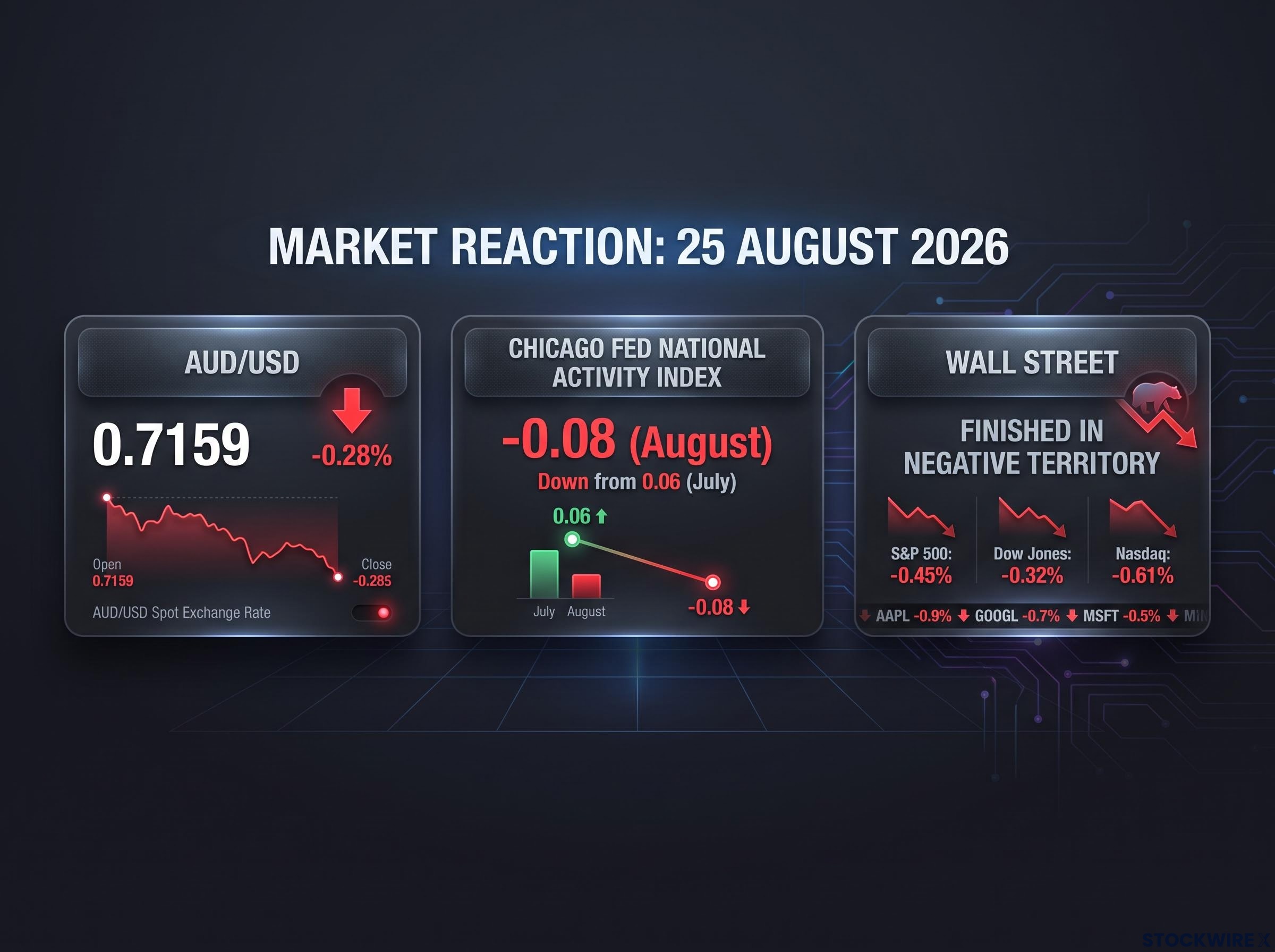
The AUD/USD pair was quoted at 0.7159, down around 0.28% on the session, with FXStreet analyst Christian Borjon Valencia attributing the Australian dollar’s weakness to a deterioration in risk sentiment triggered by the sanctions announcement.
The Australian dollar is widely treated as a high-beta, risk-sensitive currency. Its status as a commodity-linked unit makes it a barometer for geopolitical stress and shifts in global growth expectations. When uncertainty spikes, investors trim exposure to pro-growth currencies and rotate toward the US dollar.
The Chicago Fed reading added a modestly soft US macro backdrop to the session, but it is important to distinguish the two inputs. The sanctions announcement drove the risk-off rotation. The Chicago Fed data was a separate, concurrent signal, not the cause.
The AUD/USD pair maintained a broadly bullish near-term technical bias, trading above key moving average support levels. That tells you the weakness was sentiment-driven rather than a structural breakdown. Markets are pricing an incremental rise in geopolitical and compliance risk, not an immediate disruption to physical oil flows or a systemic shock.
The contained risk-off rotation on 25 August fits a pattern established across earlier escalation episodes: the cross-asset market impact of US-Iran tensions has repeatedly defied conventional safe-haven logic, with the US dollar strengthening on energy-exporter dynamics while gold moved against its traditional crisis-period direction.
What the five-sector reach means for shipping, commodity flows, and regional trade
The five sectors were not chosen at random. Together, they close the primary channels Iran uses to move goods, transfer value, and access the global economy outside formal banking. Understanding them as a system rather than a list reveals the strategic logic.
Shipping and aviation: closing the physical movement routes
Shipping and aviation are the physical-movement sectors. Designation increases risk for every participant in the logistics chain: shipowners, charterers, port operators, insurers, and aviation lessors.
IRISL and NITC illustrate how designation risk cascades. Both operate through layered ownership structures, front companies, and charter arrangements. A shipowner that charters a vessel to an entity later revealed as majority-owned by a blocked party inherits the sanctions exposure.
Treasury has also flagged a specific practice: Iran’s Strait of Hormuz toll and data-sharing demands. Shipowners that cooperate with these requests now face explicit sanctions risk, adding a compliance layer to routine transit operations.
Strait of Hormuz transit flows are the most direct indicator of whether physical disruption escalates beyond a compliance story: commercial crossings collapsed to as few as 14 vessels per day against a pre-war baseline of 120-140, and war-risk insurance premiums running at roughly 30 times normal rates confirm that a diplomatic declaration of openness has not restored operational normality.
Gold, digital assets, and technology: closing the value-transfer and enabling channels
Gold and digital assets are value-transfer sectors. Both allow wealth to move outside formal banking channels, and Iran has used both as fallback mechanisms when traditional finance is cut off. Gold can settle cross-border transactions without touching a bank. Crypto can move value pseudonymously across jurisdictions. Targeting both simultaneously creates redundancy in enforcement, closing two of Tehran’s most liquid alternatives at once.
Nobitex, designated under Operation Economic Fury earlier in 2026, is the concrete example. The sectoral determination now means any exchange with Iranian flows faces designation risk without needing a specific future enforcement action.
Technology is the cross-cutting sector. A technology designation gives Treasury flexibility to sanction foreign vendors and intermediaries whose products feed Iranian shipping, digital asset, or defence ecosystems. For Asian and Middle Eastern exporters, seemingly routine sales could later be judged as materially supporting a sanctioned sector.
| Sector | Evasion channel it closes | Affected counterparties outside Iran |
|---|---|---|
| Shipping | Physical movement of oil, goods, and sanctioned cargo | Shipowners, charterers, P&I insurers, port operators |
| Aviation | Air cargo and high-value item transport | Foreign lessors, MRO providers, parts suppliers |
| Gold | Portable value storage and cross-border settlement outside banks | Regional gold traders, refiners, settlement intermediaries |
| Digital assets | Pseudonymous cross-border value transfer | Global crypto exchanges, DeFi platforms, custodians |
| Technology | Hardware and software enabling sanctioned sector operations | Asian and Middle Eastern tech exporters, component distributors |
Where enforcement goes from here, and what to watch
There is a gap between having sectoral designation authority and aggressively using it. The announcement sets the legal perimeter. The market impact depends on what Treasury does next.
Three variables will determine whether this remains a contained compliance story or escalates into a broader market event:
Diplomatic reversal risk is a live variable in the sanctions calculus: when JD Vance withdrew from Geneva peace talks in June 2026, Brent fell below $80 per barrel in a single session, illustrating how rapidly markets reprice the geopolitical premium when the policy trajectory shifts, in either direction.
- Pace and scale of follow-on designations: If Treasury moves quickly to designate major non-US banks, shippers, or exchanges that have not yet cut Iranian ties, the compliance burden jumps from theoretical to acute
- Government responses to Bessent’s deadline: How quickly foreign governments move to enforce compliance signals whether the international coalition holds or fractures
- Physical flow disruption: Any evidence that oil shipments or Strait of Hormuz transits are being materially disrupted would shift the market’s pricing from a compliance story to a supply-shock story
Treasury Secretary Bessent communicated that foreign governments faced a fixed deadline to terminate their economic relationships with Iran, characterising the announcement as the opening move in a sustained enforcement campaign rather than an isolated measure.
The AUD/USD pair’s bullish technical bias above key moving averages provides a baseline. If that support breaks in coming weeks, it would signal that markets are repricing the sanctions from an incremental compliance burden to something more structural.
Tanker freight rates and energy risk premia are the other live indicators. Rising insurance costs for Gulf-adjacent shipping lanes would confirm that the physical-flow risk is being priced, not just the compliance risk. Traders and investors who understand the difference between authority and enforcement are better positioned to avoid over-trading the announcement itself while staying alert to the signals that would warrant genuine repositioning.
The most exposed counterparty categories right now are:
- Global shipping and logistics operators with Middle Eastern route exposure
- Digital asset platforms with opaque counterparty chains
- Asian and Middle Eastern technology exporters with Iranian-adjacent distribution
- Commodity traders with Iran-linked gold or freight flows
Operation Economic Outcast is a structural expansion of sanctions architecture, not a routine enforcement action. The market’s initial reaction, a modest risk-off rotation rather than a sharp selloff, reflects the gap between the announcement of new authorities and the exercise of those authorities. That gap is exactly as wide as Treasury’s willingness to use its new sectoral powers against major non-US counterparties. The mechanics are in place. What happens next depends on enforcement tempo, and that makes follow-on Treasury actions over coming weeks the single most important variable to monitor.
This article is for informational purposes only and should not be considered financial advice. Investors should conduct their own research and consult with financial professionals before making investment decisions. These statements regarding potential market impacts are speculative and subject to change based on geopolitical developments, enforcement actions, and market conditions.
—