The United States is asking foreign governments to buy more of its debt while simultaneously threatening those same governments with exclusion from the dollar system if they purchase oil from the wrong supplier. That contradiction has been building for years. On 24 August 2026, it sharpened considerably.
Today’s sanctions package against Iran represents the most sweeping financial action the administration has mounted against the country, with secondary measures explicitly trained on nations and entities that persist in buying Iranian crude. China, which takes in the overwhelming share of Iran’s oil exports, sits at the centre of that pressure. This is not a one-off enforcement action. It is the latest escalation in a maximum-pressure campaign that has been reshaping dollar-based trade architecture since early 2025, with multiple rounds of penalties targeting China-linked entities through mid-2026.
The question this raises is not whether today’s announcement disrupts a single auction cycle. It is whether the cumulative weight of these measures is structurally eroding the foreign official buyer base that the US Treasury market depends on, and how you separate that slow-moving signal from the quarter-to-quarter noise. Here is the framework for doing exactly that.
How secondary sanctions turn the dollar into a liability for its largest users
Secondary sanctions do not simply block a bilateral trade between two countries. They operate by threatening any institution that touches the sanctioned flow, whether a bank, shipping firm, or refiner, with loss of access to US dollar clearing and US markets. That threat carries weight because most large financial institutions still depend on dollar-based correspondent banking (the network of relationships banks use to process cross-border payments) for trade finance, foreign exchange hedging, and international settlements.
Dollar clearing infrastructure sits at the operational centre of this coercive mechanism: the dollar appears on one side of 89.2% of all global FX trades in a market turning over $9.6 trillion daily, which is why the threat of exclusion from that system carries weight far beyond any single bilateral trade flow being sanctioned.
The mechanism runs through three steps:
- Dollar clearing threat: The US identifies entities facilitating sanctioned flows and threatens to cut them off from the dollar payments system.
- Institutional response: Banks, insurers, and commodity traders either comply (dropping sanctioned clients) or begin routing transactions through channels that do not rely on dollar clearing.
- Reserve composition adjustment: Governments whose institutions are building non-dollar payment infrastructure gradually reduce their structural need for dollar reserves, and the Treasuries that underpin them.
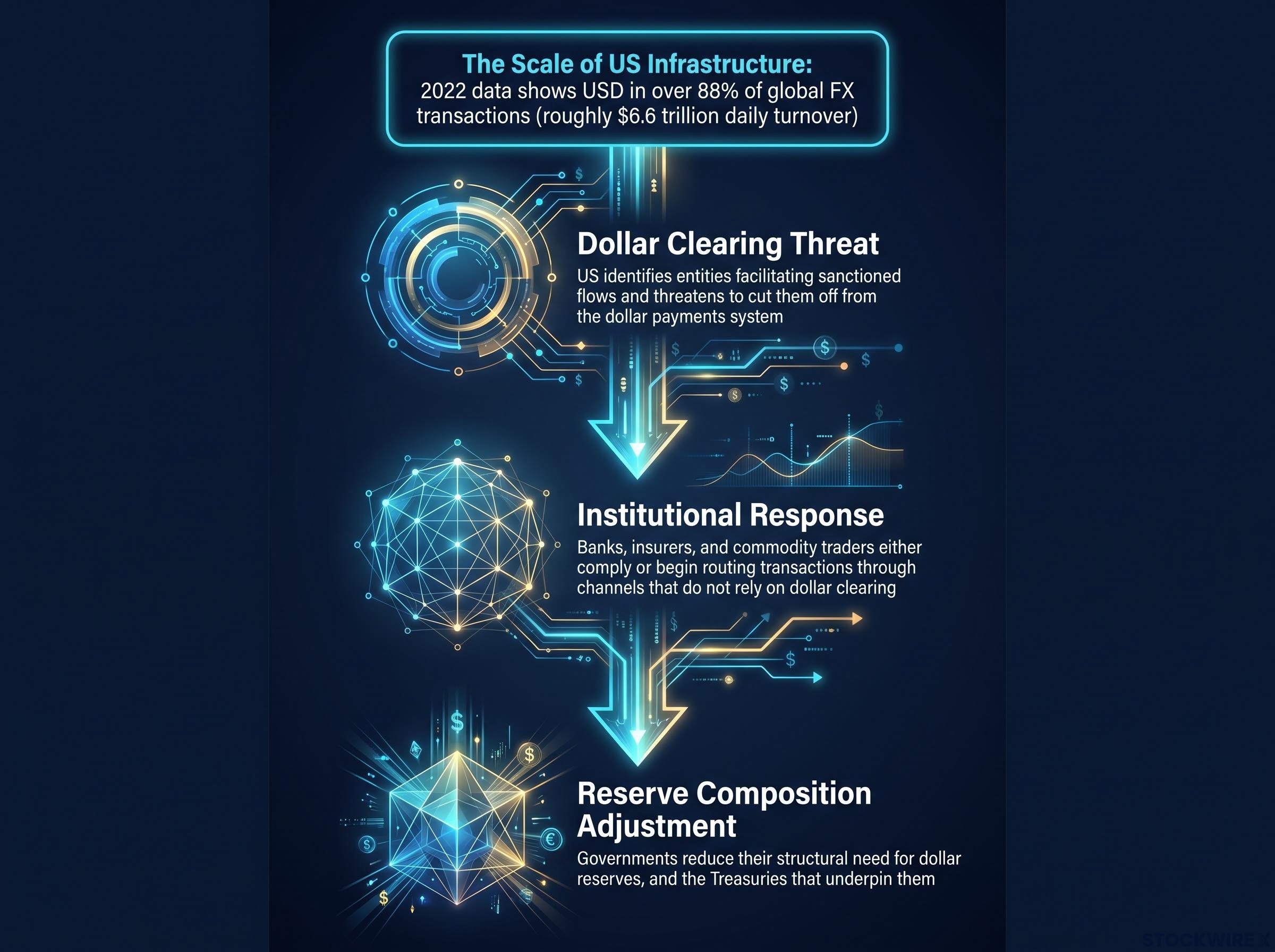
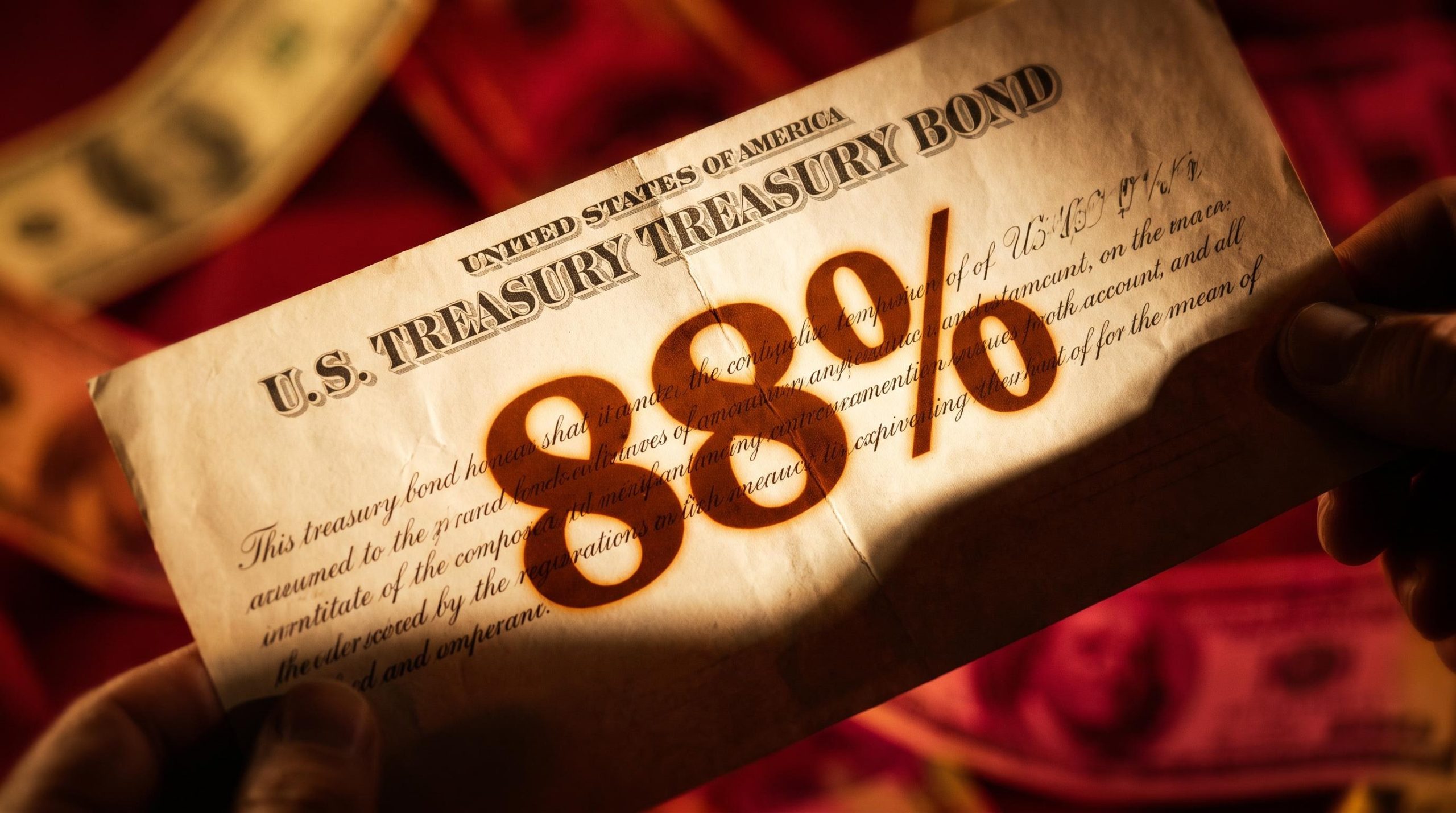
The US dollar is the world’s dominant trading currency, with 2022 data showing it featured in over 88% of all global foreign exchange transactions, representing average daily turnover of roughly $6.6 trillion. That is the scale of the infrastructure being used as a coercive instrument.
The structural contradiction is direct. The same countries being asked to finance US deficits through Treasury purchases are simultaneously subjected to dollar-infrastructure oversight of their energy procurement decisions. When a government faces a credible threat of dollar exclusion over how it buys oil, it does not limit its response to that single trade. It begins building institutional infrastructure to reduce its dependence on dollar access across all activities. That infrastructure, once built, permanently reduces the government’s appetite for dollar reserves, and for the Treasuries that sit beneath them.
When big ASX news breaks, our subscribers know first
China is already building the alternative architecture
China is by far the largest buyer of Iranian crude, taking roughly 80-90% of Iran’s exports in recent years. That makes the secondary sanctions story, in practice, a China story.
The scale of the trade, and how sharply it has been disrupted, tells you how much pressure is being applied to Chinese financial infrastructure:
| Period | Chinese imports of Iranian crude (bpd) | Dominant payment mechanism |
|---|---|---|
| 2025 average | ~1.4 million | RMB invoicing via smaller Chinese banks; barter arrangements |
| Early August 2026 (post-blockade) | ~534,000 | RMB invoicing; CIPS-routed settlements; obfuscated cargo routing |
Kpler analytics and Treasury reports confirm both the volume figures and the evasion tactics employed, including transshipment through intermediary ports and ghost fleet tankers that obscure cargo origins in customs records.
From sanctions evasion to institutional infrastructure
What matters for the foreign demand question is not the volume of Iranian oil reaching China in any given month. It is the payment architecture being constructed to facilitate that trade.
China has insulated its major financial institutions by routing payments through smaller banks already under US sanctions. It has scaled up RMB invoicing for Iranian crude. It has expanded barter-style arrangements, trading infrastructure projects for oil. And it has developed capacity through the Cross-Border Interbank Payment System (CIPS), China’s institutional alternative to SWIFT-based dollar clearing.
The distinction between evasion and infrastructure is the one that matters most here. Evasion is reactive and ad hoc: a workaround for a specific sanction on a specific trade. Infrastructure is deliberate, scalable, and cumulative. The RMB invoicing channels, the non-dollar shipping ecosystems, and the CIPS settlement capacity built for Iranian oil are not bespoke to Iran. They are general-purpose alternatives that reduce China’s structural reliance on dollar clearing for any trade it chooses to conduct outside the US financial system.
Every additional round of US sanctions on China-Iran oil flows does not simply disrupt a trade. It gives China a compliance-driven reason to accelerate infrastructure that makes dollar reserves structurally less necessary. That acceleration has direct, long-run implications for which assets sit in Chinese sovereign portfolios.
The documented link between sanctions escalation and foreign Treasury selling
The structural argument above would remain theoretical without evidence that it is already visible in market behaviour. The empirical record from recent months suggests it is.
The feedback from sanctions escalation into Treasury demand operates through three channels:
- Elevated political risk in holding dollar assets: Reserve managers at foreign central banks face a growing question about how much exposure they want to an asset class controlled by a government willing to impose punitive conditions on core economic activities.
- Observed selling during Iran-linked episodes: Federal Reserve custody data shows that foreign Treasury holdings contracted through June, with United Kingdom, China, and Japan each recorded as net sellers during that period.
- Multi-year reserve diversification: Empirical academic and central-bank research finds that sanctions exposure systematically encourages diversification away from the dollar in reserve composition over multi-year horizons.
Goldman Sachs reported that during the March 2026 Iran conflict escalation, dollar strength of over 2% coincided with foreign official institutions selling Treasuries rather than buying them, a pattern that inverts the traditional safe-haven assumption.
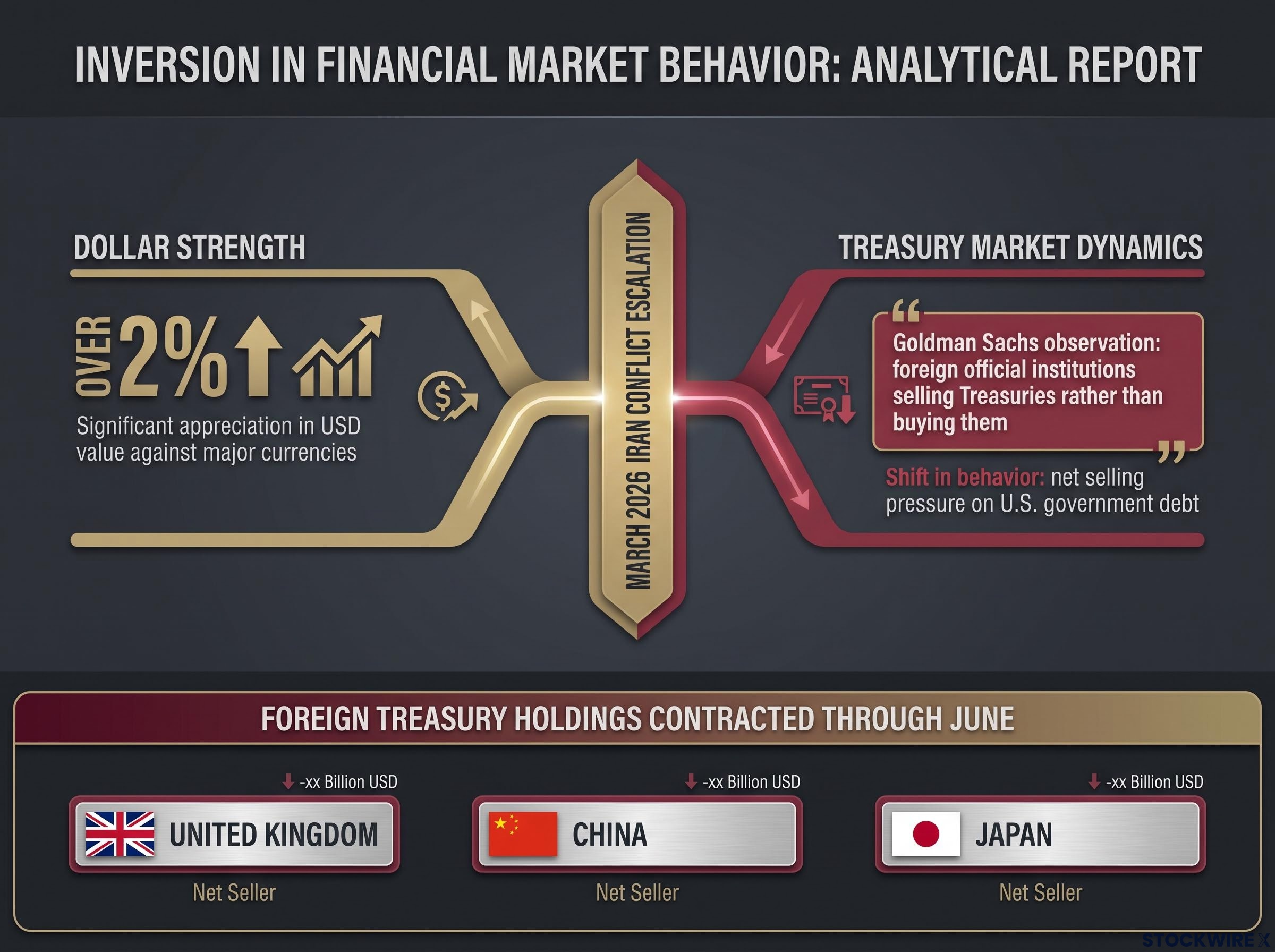
That Goldman Sachs observation deserves emphasis. In a conventional geopolitical shock, foreign capital flows into Treasuries as a safe haven. In March 2026, the geopolitical shock was generated by the United States itself, through sanctions enforcement tied to Iran. Foreign official holders sold into the stress rather than buying.
The structural composition of foreign Treasury demand has already been shifting before today’s announcement, with foreign holders plateaued at roughly 33% of outstanding debt and domestic commercial banks absorbing the marginal supply that official reserve managers are no longer reliably providing.
For a growing set of large holders, US Treasuries no longer function as an unconditional refuge when the United States is the source of the geopolitical pressure. Treasury International Capital (TIC) data, published monthly, is the mechanism through which you can track whether this pattern persists or reverses.
What the August 2026 measures add to an already-stressed structural picture
US Treasuries retain structural advantages that no alternative can replicate in the near term. The market offers unmatched depth, unmatched liquidity, and the network effects that make rapid substitution costly for any large reserve holder. None of that has changed.
What has changed is the cumulative weight on the other side of the ledger. The August 2026 package, which the administration has characterised as the most expansive financial offensive ever launched against Iran, adds one more increment to a structural headwind that has been building across multiple rounds of sanctions targeting China-linked entities through mid-2026. Each escalation pushes exposed governments further along the infrastructure-building and reserve-diversification path.
The US fiscal trajectory compounds the structural picture: annual interest payments have reached $1.17 trillion, exceeding the entire defence budget, and a $7 trillion-plus annual refinancing requirement means the Treasury market must absorb growing supply precisely as the foreign official buyer base that sanctions exposure is eroding becomes less reliable.
The impact will not show up cleanly in near-term auction data. Sanctions-driven de-dollarisation runs through years of sovereign portfolio decisions and infrastructure investment, not through immediate quarter-to-quarter flows. A separate but compounding dynamic, the domestic Treasury buyback programme, affects market liquidity through an entirely different mechanism and should not be conflated with the foreign demand erosion described here.
Three variables to watch as the sanctions regime deepens
- TIC data persistence: Track whether foreign official selling across major holders (China, Japan, Gulf states) persists across multiple consecutive months. Single-month declines may reflect cyclical positioning; multi-month patterns signal structural shifts.
- RMB-denominated trade growth and CIPS volumes: Sustained expansion in non-dollar trade invoicing and settlement capacity is the leading indicator of reduced structural need for dollar reserves. This separates the structural signal from rate-cycle noise.
- Secondary sanctions announcement cadence: Treat each new round as a duration factor with multi-year lags rather than an immediate demand signal. The infrastructure response to today’s announcement will unfold over years, not quarters.
Calibrating the structural risk without overstating the timeline
The structural contradiction is now well established. The United States is using the dollar’s centrality as a coercive instrument while depending on foreign dollar holders to finance its deficits. The 24 August 2026 sanctions deepen that contradiction, but they do not represent a break point.
This is a decade-scale structural headwind, not a buyers’ strike. The dollar retains its position as the dominant global FX currency by a wide margin, with its share of worldwide foreign exchange turnover exceeding 88%, and building a comprehensive alternative architecture remains a slow, expensive undertaking. The result over time is a gradual narrowing of the pool of fully dollar-integrated, politically aligned foreign official holders who reliably absorb large net Treasury issuance.
Academic and central-bank research finds that sanctions explicitly exploit US centrality in the global financial system and, in response, encourage sanctioned and at-risk countries to diversify away from the dollar to reduce vulnerability.
The analytical work required is not to predict when the system breaks. It is to track whether incremental de-dollarisation is accelerating or stabilising, because that rate of change, not any single enforcement action, is what determines the long-run cost of financing US deficits from abroad.
Treasury safe-haven risk and dollar reserve-currency risk are analytically distinct exposures, and conflating them leads to mis-calibrated hedging: investors who treat sanctions-driven foreign official selling as evidence of imminent dollar displacement are likely to over-hedge outright currency risk while remaining under-hedged on the term premium volatility that structural demand erosion actually produces.
This article is for informational purposes only and should not be considered financial advice. Investors should conduct their own research and consult with financial professionals before making investment decisions. Past performance does not guarantee future results. Forward-looking statements regarding sanctions impacts and reserve composition trends are subject to change based on policy developments and market conditions.