A bank posts record profit. It settles the last major class action hanging over its books. Its shares close the day up. And yet the stock sits 15% below where it traded at its peak, somewhere around $158 when the math says the business has never been stronger.
That gap between business quality and share price is the question every Commonwealth Bank of Australia investor is trying to resolve right now. The $249 million settlement announced on 26 August 2026, the FY2026 results released on 12 August, and the ongoing softness from the $185.59 52-week high are not three separate stories. They are one decision problem.
Here is the framework for working through what the numbers actually tell you, whether you hold CBA, are weighing an entry, or are comparing it against the other major banks.
The $249 million settlement: what it actually resolves
A quarter-billion-dollar settlement sounds dramatic. The market’s reaction on the day, shares up roughly 0.92% to $158.47, tells you the drama was already priced out.
The class action originated with Slater and Gordon, who filed proceedings in 2018 on behalf of affected class members. The case concerns certain cash and deposit options that CBA made available via Colonial First State superannuation and wrap products across a period running from November 2008 through to September 2021. The in-principle agreement, announced on 26 August 2026, lists CBA, Colonial First State Investments, and Avanteos Investments as respondents, none of whom have acknowledged fault or accepted liability.
The Colonial First State class action originated from cash and deposit options offered through CBA-related superannuation and wrap products across a thirteen-year window, and the full procedural history of the proceedings, from the 2018 Slater and Gordon filing through to the in-principle agreement, is covered in detail in the settlement announcement.
The investor-relevant facts sit in three lines:
- The $249 million was already accounted for through a provision set aside in an earlier reporting period, which means FY2026 earnings, capital ratios, and dividends are unaffected.
- CBA and the related entities deny the allegations and have not admitted wrongdoing, which limits reputational damage relative to an admission-of-fault settlement.
- Court approval from the Federal Court of Australia is still required before the settlement is finalised, meaning the timeline for distributing funds to class members remains uncertain.
That provisionment detail is the key insight. The settlement tells you the earnings-impact risk from this action has already been absorbed in prior periods. The FY2026 numbers you are about to review are clean of this liability; no discount is required.
The settlement is good housekeeping. It closes an eight-year legal overhang and removes the tail risk of a potentially more adverse court judgment. What it does not do is change the investment case. The case rests on the numbers that follow.
When big ASX news breaks, our subscribers know first
FY2026 by the numbers: what record profit looks like in practice
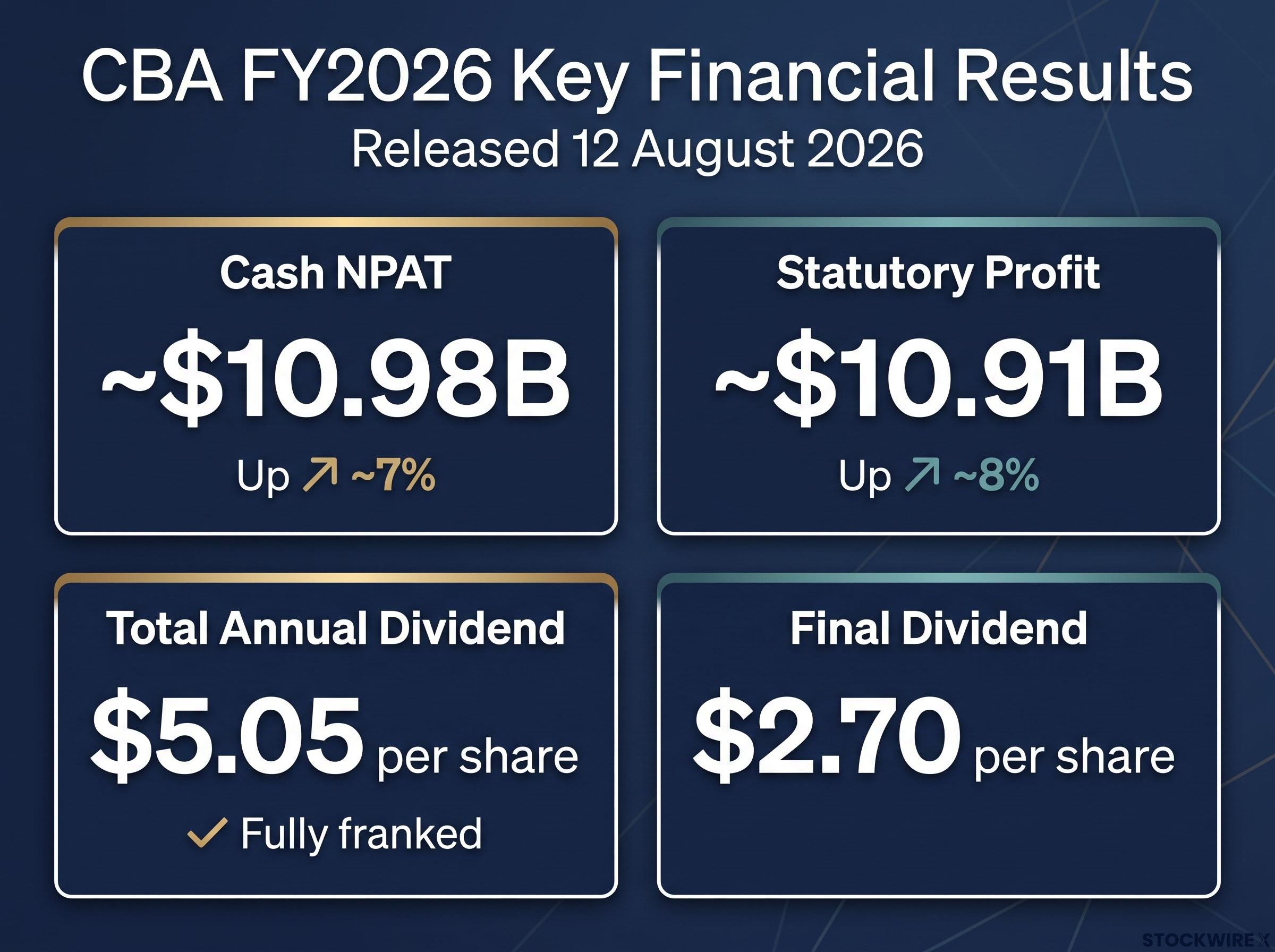
CBA reported its full-year results on 12 August 2026, and the headline number, approximately $10.98 billion in cash net profit after tax (NPAT), up roughly 7% year-on-year, deserves more than a glance. Mid-to-high single-digit profit growth from a bank that already dominates Australian retail banking tells you the franchise is still expanding its earnings base in a mature, competitive market.
Statutory profit came in at approximately $10.91 billion, up approximately 8%. The narrow gap between cash and statutory figures tells you the headline numbers are not distorted by large one-off items pulling in either direction. What you see is close to what the business actually earned.
| Metric | FY2026 | FY2025 (comparative) | Year-on-Year Change |
|---|---|---|---|
| Cash NPAT | ~$10.98B | ~$10.26B | ~7% |
| Statutory profit | ~$10.91B | ~$10.10B | ~8% |
| Final dividend (per share) | $2.70 | Prior year (lower) | Increased |
| Total annual dividend (per share) | $5.05 | Prior year (lower) | Increased |
Then there is the dividend. The total fully franked annual payout of $5.05 per share is not just a number; it is the stock’s income argument.
At a share price around $158, a fully franked $5.05 dividend delivers a cash yield that, once franking credits are included, materially lifts the effective return for Australian taxpayers, particularly those in superannuation structures or lower tax brackets. This is CBA’s “paid to wait” proposition.
For investors evaluating whether the current price is justified, the income return at these levels is not trivial. Even if the share price goes sideways for a year, the franked dividend means you are not standing still.
Understanding the 24x earnings multiple: what investors are really paying for
CBA trades at approximately 24x earnings. For a bank, that is a structural outlier, both against Australian peers (which trade at materially lower multiples) and against global banking comparisons. The question is not whether the multiple is high. It is what assumptions are baked into it.
Three factors sit inside that 24x price tag:
- Retail banking market leadership: CBA holds the largest share of Australian household deposits and mortgages, giving it pricing power and distribution advantages that smaller banks cannot replicate.
- Technology and customer engagement superiority: CBA’s digital banking platform consistently leads peer satisfaction metrics, creating lower cost-to-serve and higher customer retention.
- Lower perceived operational risk: Conservative provisioning, strong capital buffers, and a track record of managing regulatory challenges (the settlement being the latest example) contribute to a perception of relative safety.
When you pay 24x for those qualities, you are making a specific bet: that all three advantages persist, and that earnings continue to grow at a rate that justifies the price you paid. The margin of safety is thin. Negative surprises translate into disproportionate share price declines because there is so little cushion in the starting valuation.
ASX bank valuation entering the August 2026 reporting season was already under scrutiny, with the sector’s price-to-book sitting at levels last seen before the GFC and Australian banks tracking roughly three times below the returns European peers delivered in the same calendar year period.
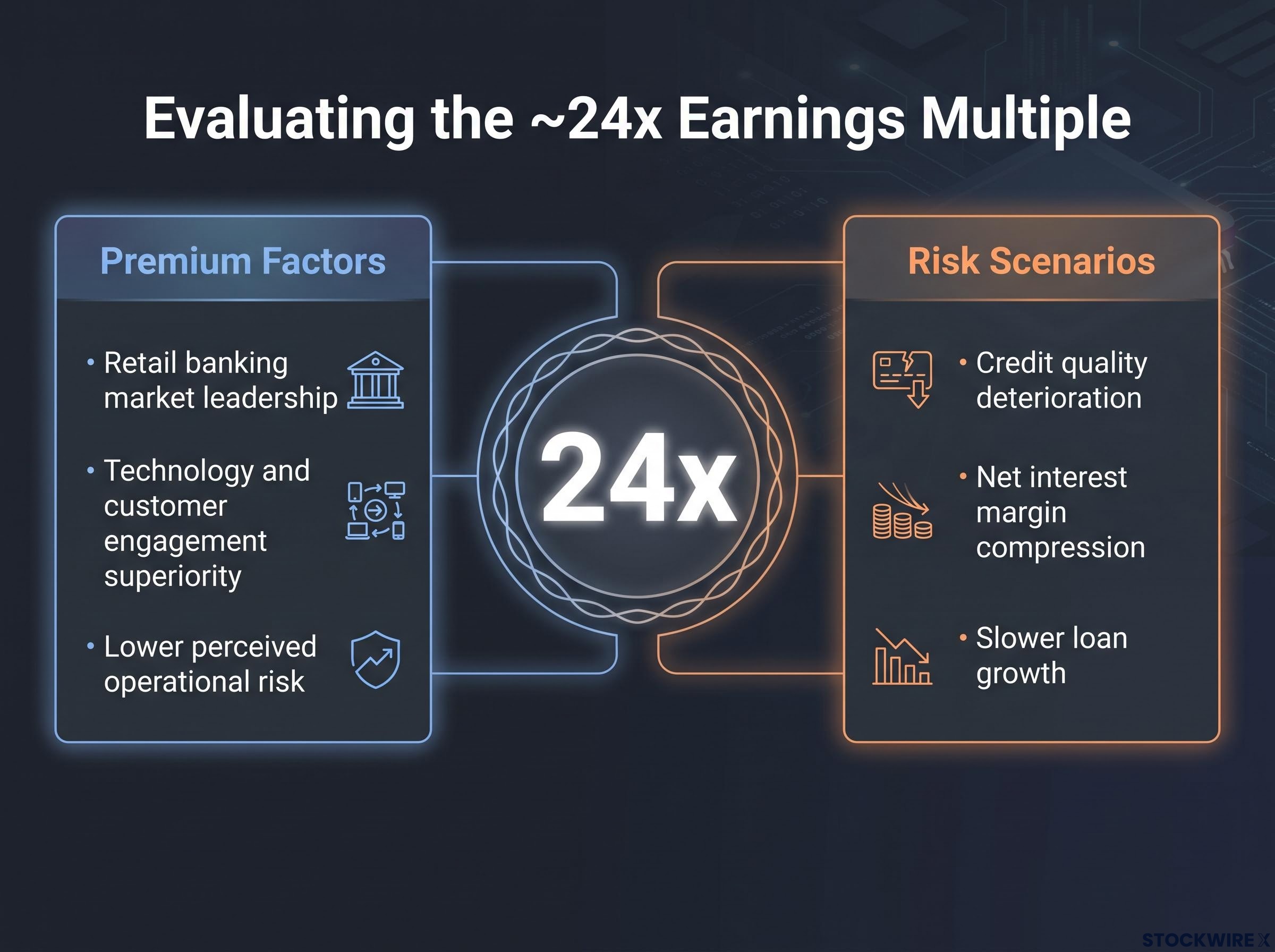
The three scenarios that would test that cushion most directly:
- Credit quality deterioration: rising arrears or impairments in household lending
- Net interest margin compression: from RBA rate changes or competitive pricing pressure
- Slower loan growth: if economic conditions weaken household and business borrowing appetite
What “premium compression” means for entry timing
Premium compression describes a valuation multiple contracting even as earnings grow, producing a flat or falling share price that does not reflect any deterioration in the underlying business. CBA’s flat year-to-date performance alongside 7% NPAT growth is a live example.
The 15% decline from the $185.59 52-week high to the current $158 range, set against record earnings, tells you the market is debating the appropriate premium for CBA’s quality, not questioning the quality itself. That distinction determines whether the pullback looks like an opportunity or a fair repricing, and the answer depends entirely on what type of investor you are.
Which type of investor does CBA at current levels actually suit?
The analysis above produces different conclusions depending on what you are trying to achieve. CBA at 24x is not universally right or wrong. It is specifically right for certain objectives.
The distinction that matters: CBA at current levels is a quality-and-income holding, not a value-and-upside play. Knowing which side of that line your portfolio sits on determines whether the current price works for you.
- Income-focused, long-term holders. The case is clear. A fully franked $5.05 dividend from a bank with scale advantages and conservative capital management makes CBA a credible core holding at current levels. The entry economics are materially better than buying near the $185 peak, even if the stock is not cheap in absolute terms. If your objective is dependable, tax-efficient income from a franchise that is unlikely to lose its market position, the current price offers a reasonable starting point.
The CBA dividend yield at current prices is materially better than it was at the $185 peak, but income investors comparing entry points across the Big Four will find that CBA’s grossed-up yield remains below peers even after the correction, a gap that the pull-back has narrowed without closing.
- Value-oriented or relative-value investors. At approximately 24x earnings, CBA does not screen as value by any conventional measure. Other Australian major banks trade at materially lower multiples while operating in the same sector environment. If your priority is earnings per dollar paid, the sector offers cheaper ways to access the same macro tailwinds. CBA’s quality premium is real, but you pay for it, and value investors are by definition looking for situations where they do not have to.
- Macro or tactically driven investors. The share price direction from here depends on three variables you can monitor:
- RBA rate path and net interest margin trajectory: rate cuts compress margins; rate stability or increases support them
- Credit quality in household lending and small business portfolios: rising arrears would hit both earnings and the premium multiple
- Regulatory or legal developments: the settlement clears the current overhang, but new regulatory action or compliance costs are a standing risk for all major banks
If economic data or RBA policy signals pressure on earnings growth, a bank trading at 24x has more room to fall than one trading at 14x, even if the underlying business remains highly profitable.
What the settlement clears, and what the valuation still requires
The three-part picture is now complete. The settlement removes legal uncertainty without new financial cost. The FY2026 results confirm strong, growing earnings and a tax-efficient dividend. The current price reflects a quality premium that is compressing from its peak but has not collapsed.
The forward view centres on that 24x multiple. If CBA sustains earnings growth above 7% and continues to deliver on the dividend, the multiple may be justified at these levels. If macro conditions compress margins or lift impairments, the premium is the first thing to go.
Three variables will determine which path plays out:
- The RBA’s rate decisions and their effect on net interest margins
- Household and small business credit quality through the next economic cycle
- Any further regulatory developments beyond the now-resolved class action
The $5.05 fully franked dividend provides an income floor while that question resolves, and the 52-week range of $146.98 to $185.59 shows you where the market has been willing to price CBA in the current environment. At $158, the stock sits roughly in the middle of that band.
The right question is not whether CBA is a good company. The results answer that definitively. The right question is whether the current price reflects the right amount of good, and that depends on your own objectives, your time horizon, and how much premium you are willing to pay for quality.
RBA rate decisions directly determine the net interest margin trajectory CBA’s earnings forecasts depend on, and the tightening cycle that lifted the cash rate to 4.35% across three consecutive meetings in early 2026 continues to shape how much margin pressure the bank’s retail book can absorb before earnings growth slows.
This article is for informational purposes only and should not be considered financial advice. Investors should conduct their own research and consult with financial professionals before making investment decisions. Past performance does not guarantee future results.