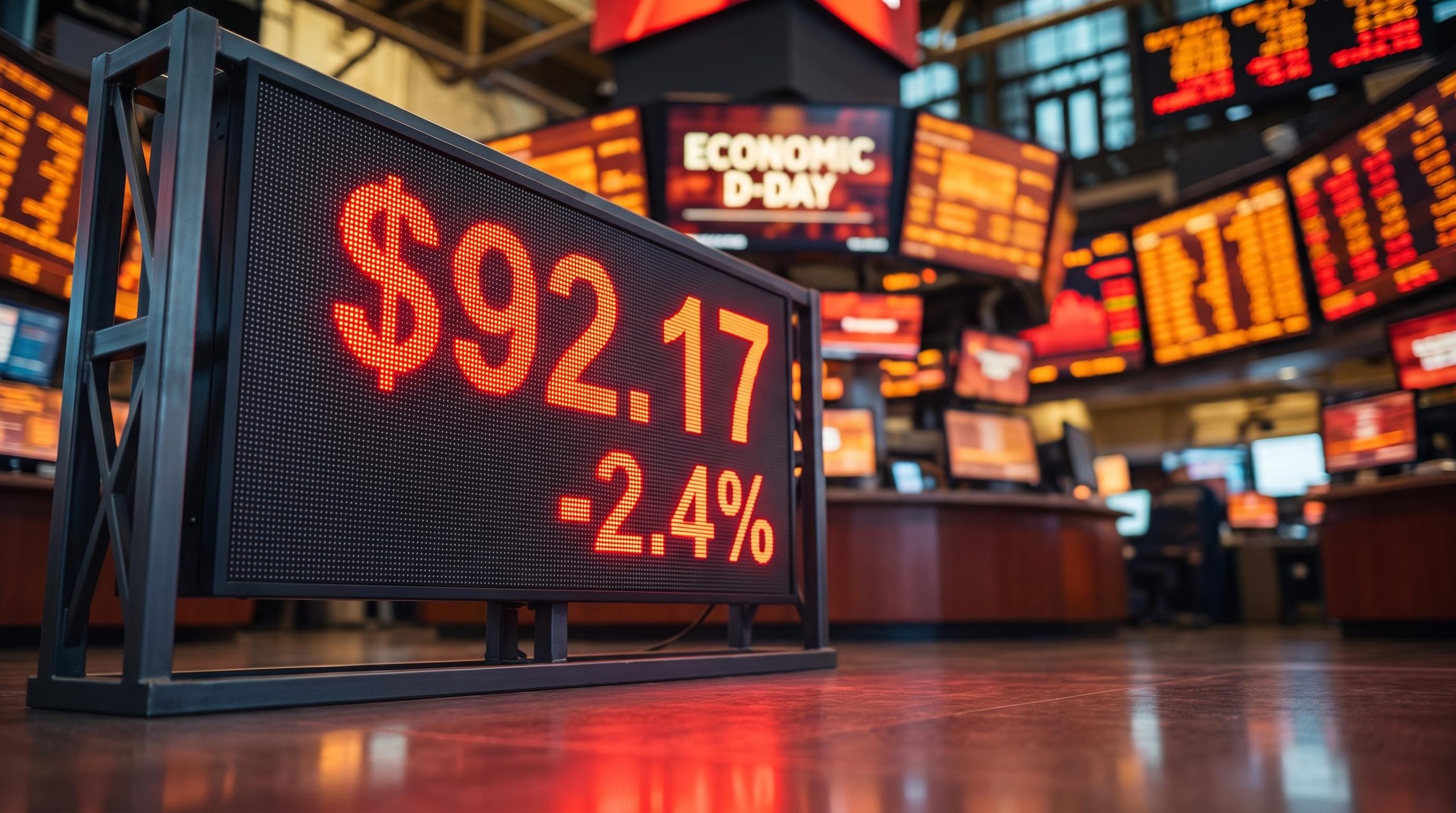
The US Treasury Secretary announced what he called an “economic D-Day” targeting Iran’s oil revenues on Monday, 25 August 2026. Brent crude promptly fell 2.4%, settling at $92.17 per barrel.
That is the paradox at the centre of this week’s most consequential energy market move. Scott Bessent stood in front of cameras and promised to sever Iran’s financial lifelines, and the commodity most exposed to that threat dropped rather than rallied.
The explanation is more instructive than the headline. Here is why the price moved the wrong way, what the session’s cross-asset ripple effects reveal about how Iran sanctions are actually being priced, and the five specific variables that will determine whether this episode tightens supply for real or fades into managed geopolitical noise.
The “economic D-Day” announcement: what Bessent actually said
Bessent’s framing was deliberately dramatic.
“Economic D-Day” was the Treasury Secretary’s own characterisation of the campaign, a phrase designed to signal maximum intent.
The substance, however, left significant gaps. Here is what was announced, and what was not:
The OFAC Iran sanctions program governs the full legal framework that Bessent’s Treasury team is operating within, including the Iranian Transactions and Sanctions Regulations that define which designations carry secondary consequences for non-US parties continuing to transact with Tehran.
- Stated objective: Cutting off Iran’s primary revenue streams by disrupting oil exports, dismantling associated shipping arrangements, and penalising the foreign parties enabling Iranian commerce
- Scope: The full breadth of economic activity keeping Iran’s economy functioning, with the Treasury having catalogued the relevant facilitators, payment mechanisms, and evasion methods
- Timeline: Measures to roll out over coming weeks, not with immediate effect
- What was omitted: The announcement provided no specific entity names, no enforcement schedule, and no enumeration of which nations might face secondary consequences for continued dealings with Iran
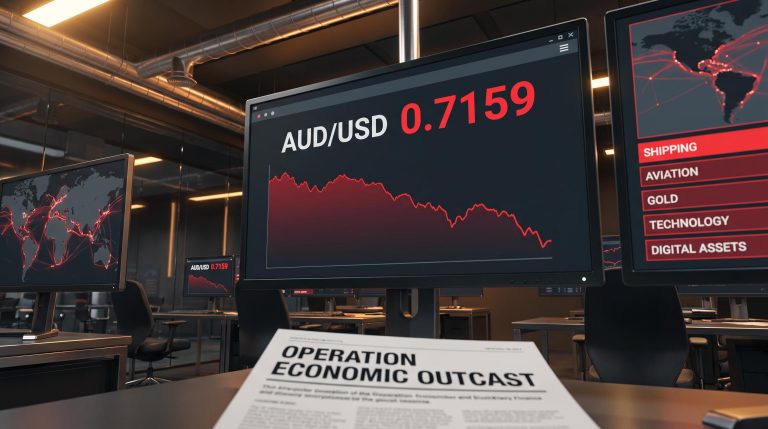
The sectoral architecture behind the announcement became clearer the following day, when Treasury’s Operation Economic Outcast designated digital assets, technology, gold, aviation, and shipping as sanctionable sectors, exposing global firms to compliance risk without requiring a US nexus.
The diplomatic backdrop added a layer of complexity. Concurrent with the announcement, Pakistan’s army chief had travelled to Tehran in an effort to advance mediation efforts, a development that coloured the geopolitical picture without shifting how markets interpreted the policy substance.
That reading was straightforward. Markets had priced for a definitive supply shock. What arrived was a directional signal, strong on intent but deliberately vague on specifics. That distinction is the gap that moved the price.
When big ASX news breaks, our subscribers know first
Why a supply threat drove prices down, not up
Four distinct forces converged on the same session, and taken together they made the pullback feel less like a surprise than an inevitability.
Market-structure factors
1. Profit-taking after a stretched rally. Oil had climbed sharply in the preceding weeks on hawkish Iran rhetoric, with Brent trading above $93-94 per barrel at its recent peak following earlier Trump threats of “the toughest sanctions in history.” Positioning was extended. When the announcement added heat but not clarity, investors locked in gains rather than added exposure.
2. Ambiguity suppressed directional conviction. Without named institutions, targeted volumes, or a specific enforcement timetable, traders could not reliably estimate how many Iranian barrels were genuinely at risk. That kind of uncertainty does not encourage fresh long positions; it encourages risk reduction.
Fundamental factors
3. Iran’s established evasion infrastructure. Markets have absorbed a consistent lesson from prior sanctions cycles: shadow fleet operations, relay trading through non-aligned nations, and informal settlement arrangements mean that even forceful policy announcements rarely produce immediate, proportionate barrel losses. Traders broadly assume that newly imposed constraints will take time to bed in and will be only partially effective in practice.
Shadow fleet operations, relay trading through non-aligned nations, and informal settlement arrangements have consistently allowed Iranian exports to continue at a fraction of face-value disruption, and the Hormuz shipping data from August 2026 illustrates how dramatically physical flows can diverge from official declarations.
4. Demand-side drag compounded the selling. Weakness in Asian consumption expectations, particularly from China, gave traders an additional reason to discount the bullish impact of prospective supply tightness. Softer demand assumptions reduce the price impact of any given supply disruption.
Brent settled at $92.17, down 2.4% on the day. WTI slipped to the mid-$80s range.
The broader point matters more than the single-day move. Commodity markets are not simply pricing supply; they are pricing the probability-weighted credibility of a supply disruption. That is a much harder number to estimate, and it is why the next announcement in this sequence, one with named designations and specific volumes, could produce a materially different response.
How the oil move rippled across equities and asset classes
The crude pullback did not stay in the commodity complex. Within the same session, winners and losers emerged across sectors and asset classes, and the pattern was instructive.
Across European equity markets, the session produced a clear divergence. The FTSE Eurofirst 300 finished the day unchanged, while the FTSE 100 posted a gain of 0.4%. The most striking sectoral performance came from European travel and leisure, which climbed 1.7% as lower crude prices improved the cost outlook for fuel-dependent businesses.
The 1.7% advance in travel and leisure names was the sharpest sectoral move of the session, and it illustrated precisely how a falling crude price feeds through into relief for operators whose margins are most sensitive to energy input costs.
The upstream-versus-downstream divergence played out in real time. Energy producers faced headwinds from the same price drop that lifted airlines and leisure operators. ASX energy stocks reflected similar upstream pressure. European benchmark indices had already retreated from the record highs they set earlier in August, with inflation worries weighing on sentiment, and the day’s crude move introduced yet another consideration for investors to weigh.
| Asset / Sector | Direction | Magnitude | Primary Driver |
|---|---|---|---|
| FTSE 100 | Up | +0.4% | Broad relief from lower crude |
| European travel and leisure | Up | +1.7% | Lower fuel input cost expectations |
| European energy producers | Down | Negative | Lower upstream revenue outlook |
| Emerging market importers | Mixed | Varies | Lower crude (positive) vs stronger dollar (negative) |
The currency and fixed income dimensions added further complexity. A potential easing in oil-driven inflation could affect rate expectations from both the Federal Reserve and the European Central Bank (ECB). Simultaneously, renewed sanctions risk supported US dollar safe-haven demand, which complicates the outlook for emerging-market borrowers reliant on dollar-denominated financing.
Oil-driven inflation has already prompted emergency fiscal responses across Asia and Europe during the current cycle, with Japan deploying approximately 1 trillion yen in fuel subsidies while 30-year JGB yields simultaneously hit record highs, a pairing that illustrates the bind facing governments if crude re-escalates from current levels.
Where you sit in the supply chain determines whether a crude pullback is a headwind or a tailwind. This session made that distinction visible in a single afternoon.
Five variables that will determine whether this sanctions round actually bites
Bessent’s announcement established intent but not enforcement. The gap between those two will be closed or widened by five specific variables, and until a critical mass of them resolves in the same direction, this remains a volatility regime rather than a directional trade.
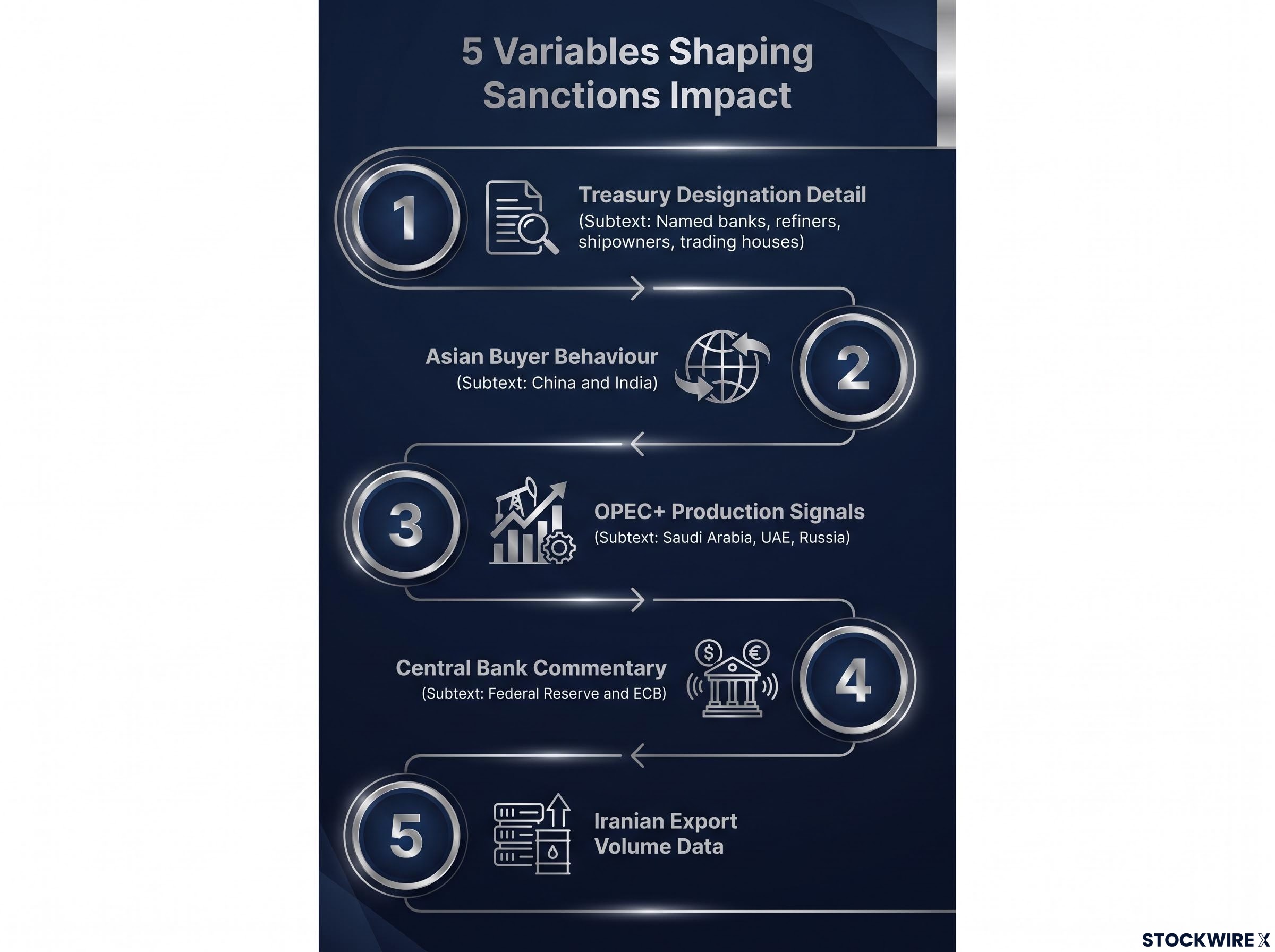
- Treasury designation detail. Named foreign banks, refiners, shipowners, and trading houses will be the clearest signal of whether rhetoric is hardening into enforcement. Until specific entities face penalties, markets will continue discounting the threat.
- Asian buyer behaviour. China and India are the single most consequential variable in this equation. Their response, whether seeking waivers, quietly diversifying supply sources, or resisting US pressure, determines how much Iranian oil actually disappears versus simply reroutes through different channels.
The Brent price scenarios ranging from $90-100 in the base case to $100-120 in the bull case hinge largely on whether sanctions escalate from targeted teapot refiners to Chinese state banks, a distinction that maps directly onto the Asian buyer behaviour variable outlined above.
- OPEC+ production signals. Saudi Arabia, the UAE, and Russia face a strategic choice: allow a tighter market to lift prices further, or compensate with additional output to stabilise the market. Their communications in the coming weeks will shape medium-term price trajectories.
The macro and ground-truth signals
- Central bank commentary. The Federal Reserve and ECB responses to any oil-driven shift in inflation expectations affect rate timing, energy equity valuations, and the broader risk environment simultaneously. Crude fundamentals cannot be evaluated in isolation from monetary policy.
- Iranian export volume data. This is the ground-truth test.
Iranian export volumes will ultimately show whether the “economic D-Day” rhetoric is translating into actual barrel losses. Everything else is signal; this is the evidence.
Until at least two or three of these variables resolve in the same direction, you should treat this as a volatility regime requiring position discipline rather than a directional trade requiring conviction.
What this episode reveals, and where oil goes from here
Monday’s session delivered a clear lesson. Markets are pricing the credibility of disruption, not just its possibility, and the Bessent announcement did not clear the credibility threshold required to sustain a supply-shock premium.
The $92.17 settlement is not just a price. It is the market’s working estimate of how credible an “economic D-Day” actually is, and investors should calibrate their own views accordingly. The next meaningful catalyst would need to look materially different: specific designations, named volumes, named countries, or visible enforcement action that moves Iranian barrels off the water.
Until that arrives, this is a volatility management situation, not a directional one. Strategy should reflect that asymmetry. The Iran sanctions story is ongoing, the variables are in motion, and the next data point, whether a Treasury list, an OPEC+ signal, or an Asian import figure, could shift the picture sharply in either direction.
This article is for informational purposes only and should not be considered financial advice. Investors should conduct their own research and consult with financial professionals before making investment decisions. These statements are speculative and subject to change based on market developments and policy implementation.
—