Four years ago, Shein raised private capital at a valuation of approximately $98.2 billion. On 1 September 2026, the company is expected to debut on the Hong Kong Stock Exchange at an implied valuation of roughly $27 billion. That is not a rounding error. It is a 70-75% repricing of what the company is worth.
The gap between those two numbers contains a full inventory of what can go wrong between a private funding round and a public listing: trade policy deterioration, regulatory scrutiny on two continents, and a competitive war that has compressed margins across an entire sector. The venue itself carries information. Shein spent years pursuing a US listing before sustained political and regulatory pressure forced a pivot to Hong Kong, a shift that signals as much about the environment for Chinese consumer technology companies as it does about Shein specifically.
Here is the framework for understanding what drove the valuation collapse, what structural risks persist at the IPO price, and what you would need to believe to consider the current pricing attractive.
From $100 billion to $27 billion: what four years of pressure actually looks like
The compression from $98.2 billion to $27 billion was not a single event. It arrived in three stages, each corresponding to a specific category of risk materialising rather than a vague shift in sentiment.
- 2022 fundraising round: approximately $98.2 billion. This peak valuation priced in maximum optionality: rapid international expansion, a clear path to a US listing, and a structural cost advantage through the de minimis shipping channel. The thesis assumed all three would hold.
- 2023-2024 private transactions: approximately $64 billion. By this stage, US regulatory scrutiny had intensified, the de minimis channel was under political pressure, and competitive dynamics had shifted with Temu’s aggressive market entry. The thesis had partially degraded.
- Current IPO pricing: $26.8-$27 billion at the top of the HK$47.60-$49.50 per share range. Trade policy risk, European regulatory frameworks, and a sustained promotional war among rivals had all moved from prospective risks to active constraints on the business model.
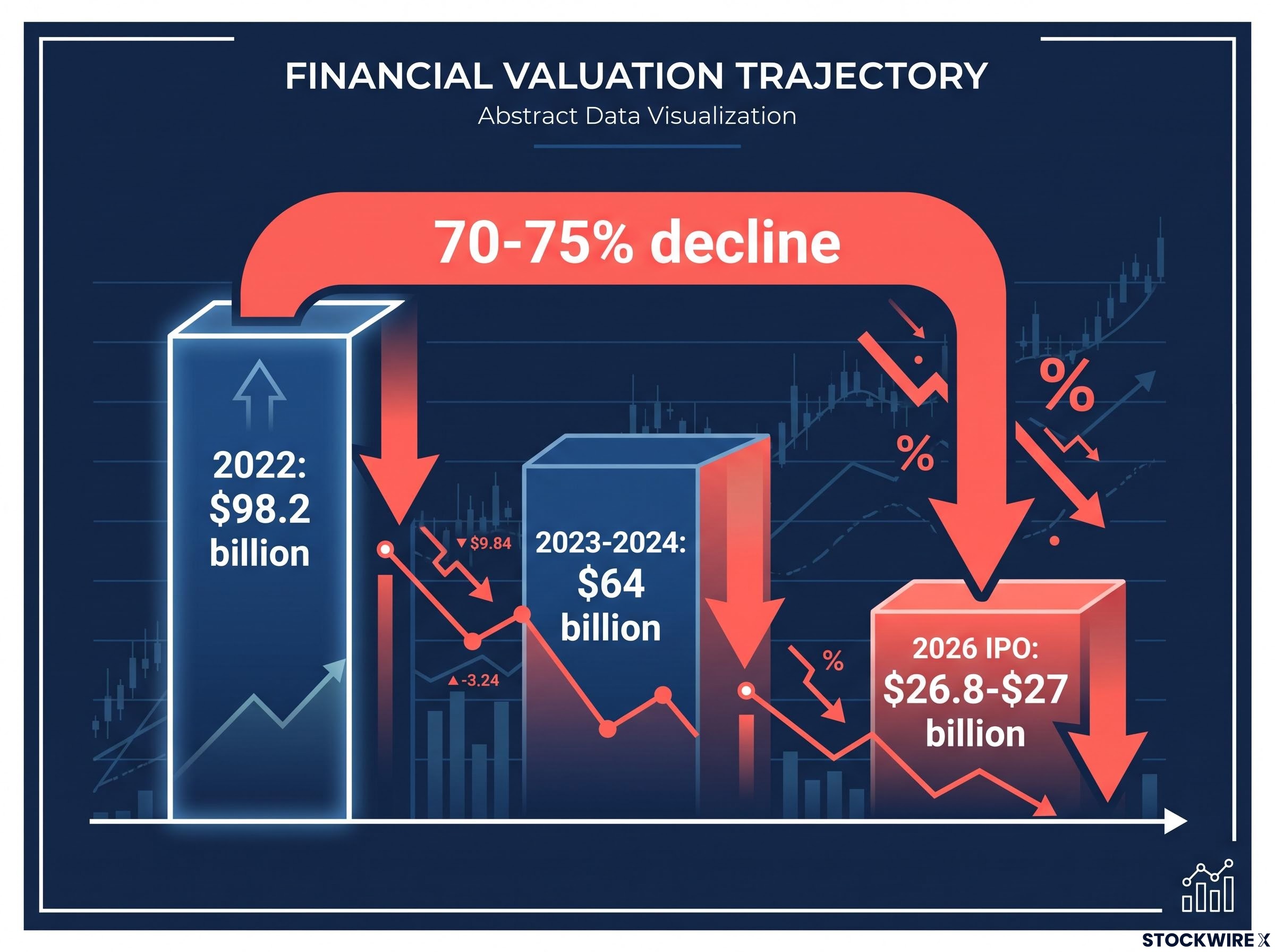
The decline from peak to IPO pricing: approximately 70-75%. This is not a routine mark-to-market. It tells you the original thesis investors were buying has been substantially falsified, and any new investor is being asked to price in a very different set of assumptions about Shein’s future.
The offering is expected to raise up to approximately HK$13.86 billion (roughly $1.77 billion USD) from the sale of approximately 280 million Class B shares. That capital is not being raised to fund expansion from strength. Where it is going is part of the story.
When big ASX news breaks, our subscribers know first
What Shein’s business model actually depends on, and where it is breaking down
Shein’s model was built on a specific structural logic. The company serves customers across more than 150 countries, but its revenue is concentrated in western markets, particularly the United States and Europe. That international orientation is what differentiated it from domestic Chinese rivals and gave it a distinct growth profile. It also concentrated its exposure to western trade and regulatory policy in a way that domestic-focused competitors do not face.
The cost advantage that underpinned that international model rested heavily on direct-from-China shipping, exploiting the US de minimis threshold that allowed goods valued under $800 to enter duty-free. That channel is under sustained pressure. The de minimis exemption has not been formally and fully repealed through completed legislation, but the policy environment has deteriorated materially. Political scrutiny from both sides of the US Congress has intensified, enforcement attention has increased, and the economics of the channel have worsened to the point where the structural cost advantage is no longer reliable.
The legal architecture underpinning US tariff authority has itself been under court challenge in 2026, with two federal rulings dismantling the broadest statutory pillars of executive tariff power; the shift from a binary executive shock model to a slower legislative uncertainty model changes how investors should probability-weight the de minimis and cross-border tariff risks that sit at the centre of Shein’s valuation case.
CBP’s suspension of duty-free de minimis treatment for shipments valued at $800 or less, effective August 29, 2025 under Executive Order 14324, converted what had been prospective legislative risk into an active structural cost constraint for any business model built around direct-from-China shipping economics.
The fact that Shein’s IPO proceeds are explicitly earmarked for supply chain localisation and compliance investment tells you the company is pricing in the cost of defending its model, not expanding from a position of strength. Prospectus disclosures indicate proceeds will go toward expanding supply chain and logistics capacity, potentially investing in onshore or near-shore manufacturing to mitigate tariff exposure, and technology and marketing spend to defend market share. Each of those capital allocation priorities maps directly onto a risk category that drove the valuation down.
- US risk environment: Deteriorating de minimis economics, sustained political and legislative scrutiny, prospective tariff tightening on cross-border e-commerce shipments
- EU risk environment: Codified regulatory frameworks including the Digital Services Act, specific product safety investigations, and structured scrutiny of labour conditions in supply chains
European regulatory risk: enacted frameworks versus political overhang
The distinction between these two geographies matters analytically. In the United States, the risk is primarily a policy environment in motion: investigations, proposed legislation, and enforcement discretion that may or may not culminate in specific rule changes. In Europe, several of the regulatory instruments are already enacted. The Digital Services Act imposes defined obligations on platforms of Shein’s scale. Product safety directives carry specific enforcement mechanisms. These are not proposals. They are frameworks with compliance costs that are already being incurred or will be imminently.
Structured regulatory frameworks with defined enforcement mechanisms carry different analytical weight than investigations or proposed legislation. When you are assessing the probability-weighted cost of regulatory risk, enacted frameworks deserve higher weighting than political commentary, regardless of how loud the commentary is.
The competitive map: Temu, TikTok Shop, Amazon, and a sector in retreat
The competitive pressure Shein faces is not a one-rival problem. It is a multi-front promotional war. Temu (operated by PDD Holdings), TikTok Shop, and Amazon are all engaged in persistent free-shipping and discount campaigns that compress margin across the entire fast fashion and cross-border e-commerce sector. Shein is not being squeezed by a single competitor; it is operating in an environment where every major player is subsidising customer acquisition at the expense of profitability.
The sector-level data confirms this is not Shein-specific. By August 2026, the Chinese online retail sector had shed roughly 20% of its value on a year-to-date basis, reflecting broad-based deterioration rather than company-specific distress.
| Company | Year-to-date performance (as of August 2026) | Context |
|---|---|---|
| Alibaba | Approximately -22% | Broad e-commerce and cloud exposure; domestic consumption weakness |
| Meituan | Year-to-date losses of approximately -24%; share price around 77 CNY, a fraction of its 2021 high near 460 CNY | Local services and delivery; sustained margin pressure from competition |
| PDD Holdings (Temu parent) | Share price around $88 USD on its US listing | Analyst price targets range from approximately $17 to $134; deep disagreement on margin sustainability |
PDD Holdings analyst target range: approximately $17 to $134. A spread of that magnitude reflects something more substantive than differing models. It signals that professional investors hold genuinely opposed views on whether the headwinds battering this sector represent a cyclical dip or a permanent shift in the competitive and regulatory landscape.
That uncertainty transfers directly to how you should think about Shein’s IPO pricing. A newly listed company entering a sector already under this level of pressure must demonstrate it can defend or expand margins against well-capitalised rivals. The current IPO price only looks attractive if that case can be made credibly, and the sector data suggests the competitive environment is not easing.
Note: PDD Holdings price and analyst target range figures are sourced from research conducted in August 2026 and should be verified against current market data.
What Shein’s cross-border model teaches about IPO valuation risk
Shein’s three-point valuation timeline, from $98.2 billion to $64 billion to $27 billion, is a useful teaching case for understanding how IPO valuation compression works. Private-market valuations reflect thesis-dependent optionality. Investors in the 2022 round were paying for a specific future: unimpeded international growth, a US listing, and a durable cost advantage. When the thesis degraded, each successive valuation converged toward a more conservative anchor.
IPO valuation compression is the process by which a company’s implied worth shrinks as it moves from private fundraising rounds to a public listing. Private rounds price in optimism and optionality because the investor base is smaller and the liquidity constraints are different. A public listing demands a price that a much broader, more sceptical pool of capital is willing to pay. When the intervening period between the private peak and the public debut is filled with risk materialisation, the gap between those two prices can be severe.
Upside and downside: the variables that resolve the range
The $26-27 billion IPO price is best understood as a point on a distribution of possible outcomes, not a stable anchor. Two scenarios define the range.
- Downside drivers: Continued tariff deterioration, regulatory enforcement escalation across US and EU jurisdictions, and persistent promotional warfare among Temu, TikTok Shop, and Amazon. Under this scenario, margin structure remains under pressure and valuation multiples compress further.
- Upside drivers: Competitive rationalisation as rivals pull back from unsustainable promotional spending, partial supply chain onshoring that closes the cost gap created by tariff exposure, and managed compliance costs that prove absorbable rather than structurally damaging.
These are not independent variables. The de minimis, regulatory, and competitive risks compound one another. A tariff increase raises the cost of goods. A regulatory enforcement action raises compliance costs simultaneously. A competitor’s promotional campaign forces price matching at the exact moment margins are under pressure from both directions. The recovery scenario requires improvement across multiple fronts simultaneously, not just one.
The key question for any prospective investor is not whether the valuation is “low enough” in absolute terms, but whether you have a well-reasoned view on which scenario is more likely to play out over your investment horizon. Prospectus data on revenue trajectory, profitability status, and valuation multiples relative to peers such as PDD Holdings or listed fast fashion names would help resolve that question. Without that fundamental anchoring, the analysis rests on narrative risk framing alone.
What the Shein IPO tells investors about Chinese tech listings in 2026
The Hong Kong listing venue is an analytical signal in itself. Shein explored a US listing over multiple years before pivoting, and the reasons were not tactical preferences about exchange liquidity or time zones. Sustained regulatory and political scrutiny from US lawmakers made New York inaccessible. This pattern is not unique to Shein. It reflects a broader structural shift in the accessibility of US capital markets to Chinese consumer technology companies, and any investor evaluating future IPOs in this category should treat the listing venue as an early-stage signal about the regulatory risk the company faces.
The CSRC overseas listing regime creates a dual-jurisdiction approval process that Chinese issuers must clear before any US exchange will accept a listing application, a structural constraint that applied to Shein’s abandoned New York pursuit and continues to shape the sequencing of any Chinese company’s path to public markets.
The three compounding risk categories that shaped Shein’s valuation journey function as a structural checklist for evaluating any cross-border Chinese consumer technology IPO:
- Trade policy exposure: How dependent is the business on a specific tariff regime or customs threshold, and what is the trajectory of that policy environment?
- Regulatory geography: Is the company subject to enacted regulatory frameworks with defined enforcement mechanisms, or primarily to political and investigative overhang? The distinction changes how you probability-weight the risk.
- Competitive dynamics: Is the company entering a sector where promotional warfare is compressing margins across all participants, and does it have structural advantages that survive a cost-up environment?
Shein’s prospectus capital allocation priorities, supply chain investment, potential onshoring, and technology and marketing spend, mirror the structural vulnerabilities this checklist identifies. The company itself is pricing in these risks in its forward planning. That confirmation is useful: it tells you the company’s own assessment of its risk profile aligns with the external analytical view.
Scheduled to begin trading on 1 September 2026 as Hong Kong’s largest IPO of the year, Shein arrives at its public debut having shed roughly three-quarters of the private-market valuation it commanded less than four years ago, now priced at approximately one-quarter of its $100 billion peak.
Shein’s listing venue pivot and valuation trajectory are a company-specific instance of a portfolio-wide structural shift: geopolitical fragmentation is increasingly sorting investable capital markets into distinct blocs with diverging regulatory and trade policy regimes, a dynamic that affects how cross-border consumer technology companies are priced across every stage from private round to public debut.
Sizing up the Shein IPO: the three questions that determine whether $27 billion is the floor or the ceiling
The analysis distils into three specific questions. Before forming a view on this IPO, you need to be able to answer each one:
- What is your view on the trajectory of US de minimis and tariff policy over your investment horizon? If you believe the policy environment stabilises or the economic impact of tightening is manageable, the current pricing may absorb the worst case. If you expect continued deterioration, the cost structure faces ongoing pressure with no clear floor.
- Do you believe the competitive intensity among Temu, TikTok Shop, and Amazon will rationalise, or is it structural? Temporary promotional warfare eventually ends as participants run out of subsidy appetite. Structural competition driven by well-capitalised platforms with strategic reasons to sustain losses does not. Your view on which dynamic is operating determines whether Shein can recover margin.
- Can Shein’s supply chain localisation investment credibly close the cost gap created by tariff exposure? The IPO proceeds are earmarked for exactly this purpose. The question is whether near-shoring and onshoring can replicate the cost economics of direct-from-China shipping at sufficient scale and speed.
The $26-27 billion IPO price is neither obviously cheap nor obviously expensive. It reflects a distribution of outcomes, and your view on these three questions is what resolves the distribution into a position.
The repricing from approximately $98 billion to $27 billion is itself the information. It marks the point at which private-market optimism gave way to a public-market demand for evidence. Shein’s debut on 1 September 2026 will test whether that evidence arrives.
This article is for informational purposes only and should not be considered financial advice. Investors should conduct their own research and consult with financial professionals before making investment decisions. Past performance does not guarantee future results. Financial projections are subject to market conditions and various risk factors.