Nvidia has told its largest customers that AI servers built on its next-generation platforms are getting more than 15% more expensive, and the market’s response arrived within hours, spanning continents.
The price hike landed on Monday 24 August 2026, less than 48 hours before Nvidia’s Q2 FY2027 earnings release, turning a supplier cost decision into a market-wide stress test. The question the semiconductor selloff is now forcing: can AI infrastructure demand absorb steeper prices, or is this where the supercycle starts to buckle under its own cost curve?
Here is the full chain of events, from the memory cost mechanics behind the price increase to the chip stocks and Korean index hit hardest, and the specific signals to watch for on Wednesday’s earnings call. This is a forward-positioned briefing, not a recap.
What is driving Nvidia’s AI server price increases above 15%
Memory now accounts for more than half the cost of building a frontier AI server. That single fact explains why Nvidia’s price hike looks less like a margin play and more like a forced pass-through.
Key figure: High-bandwidth memory (HBM), a specialised type of DRAM designed for AI workloads, now represents 53-62% of the total bill of materials for Rubin-class server systems, depending on configuration.
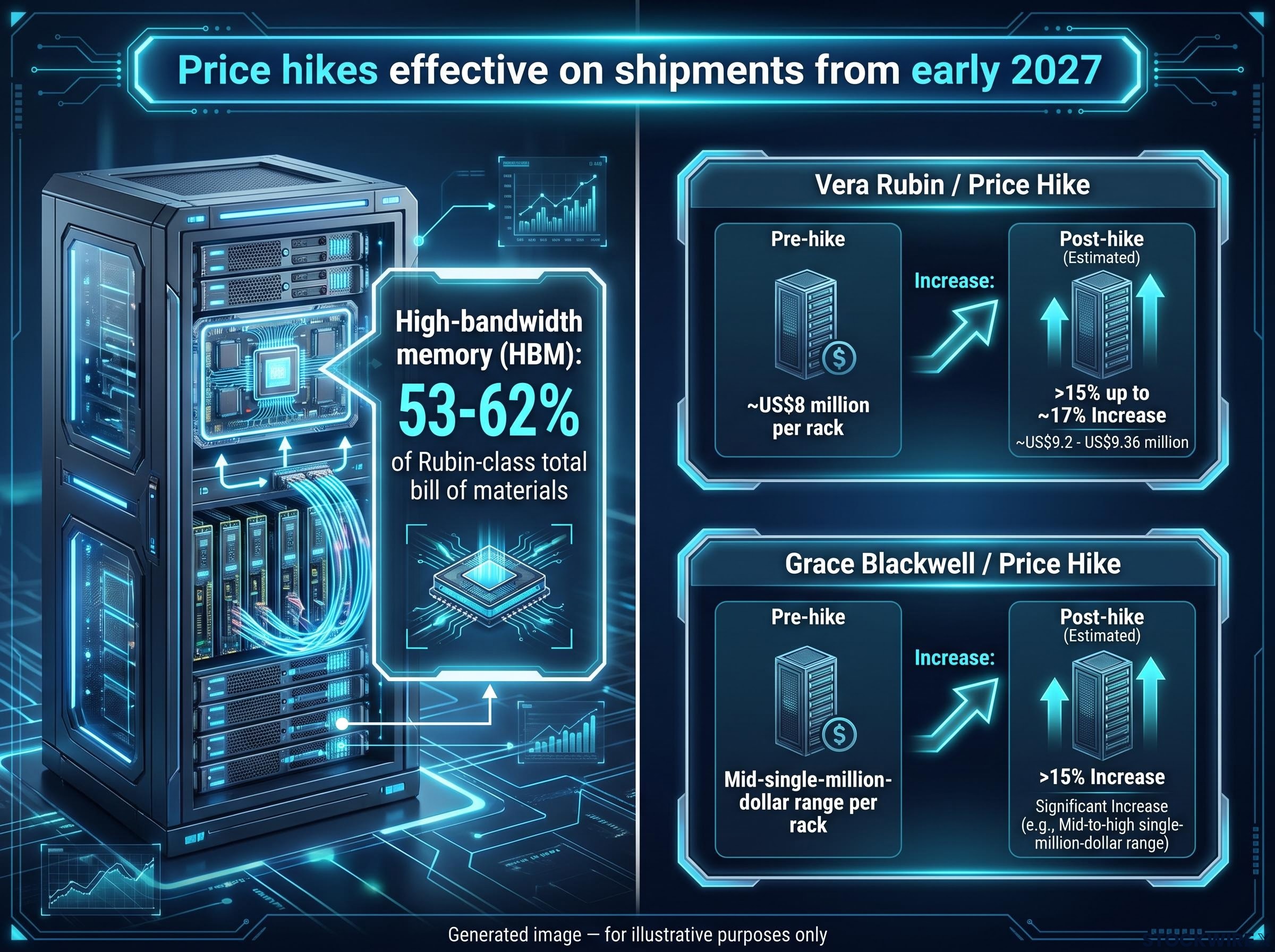
The increases are explicitly tied to surging HBM and DRAM costs from Samsung, SK Hynix, and Micron, the three suppliers that dominate high-performance memory production. According to customer notifications issued by Nvidia, rack systems on both of its next-generation platforms will be priced more than 15% higher from early 2027, with certain configurations seeing increases of close to 17%.
The memory cost trajectory extending through 2028 is not a cyclical peak but a structural repricing: Samsung, SK Hynix, and Micron collectively control roughly 89% of global DRAM supply and have permanently redirected capacity toward high-margin HBM, meaning the input cost pressure behind Nvidia’s price hike has years of runway remaining.
The hikes apply to two platform families:
- Vera Rubin and Grace Blackwell server platforms
- Price increases of 15% or more, up to approximately 17% on certain configurations
- Effective on shipments from early 2027
| Platform | Pre-hike rack price range | Announced price increase |
|---|---|---|
| Vera Rubin | Approximately US$8 million, some configurations higher | Greater than 15%, up to approximately 17% |
| Grace Blackwell | Mid-single-million-dollar range per rack | Greater than 15% |
Nvidia’s pricing power is real, but it is also constrained by its own supply chain. The company can raise prices because demand remains inelastic; hyperscalers need these racks to stay competitive in AI. But memory inflation is the force compelling the increase, and that same inflation is now the sector’s central risk heading into earnings.
When big ASX news breaks, our subscribers know first
How the selloff spread across chipmakers and sector ETFs
The sharpest single-stock move of the session belonged to SanDisk, and the reason went beyond memory cost anxiety. SanDisk fell approximately 7%, erasing roughly US$17 billion in market value, after circulating reports indicated that Washington was weighing whether to permit Apple to procure DRAM from Chinese producer CXMT and NAND from YMTC. That China memory-sourcing risk landed on the same day as Nvidia’s cost-driven price hike, compounding the pain.
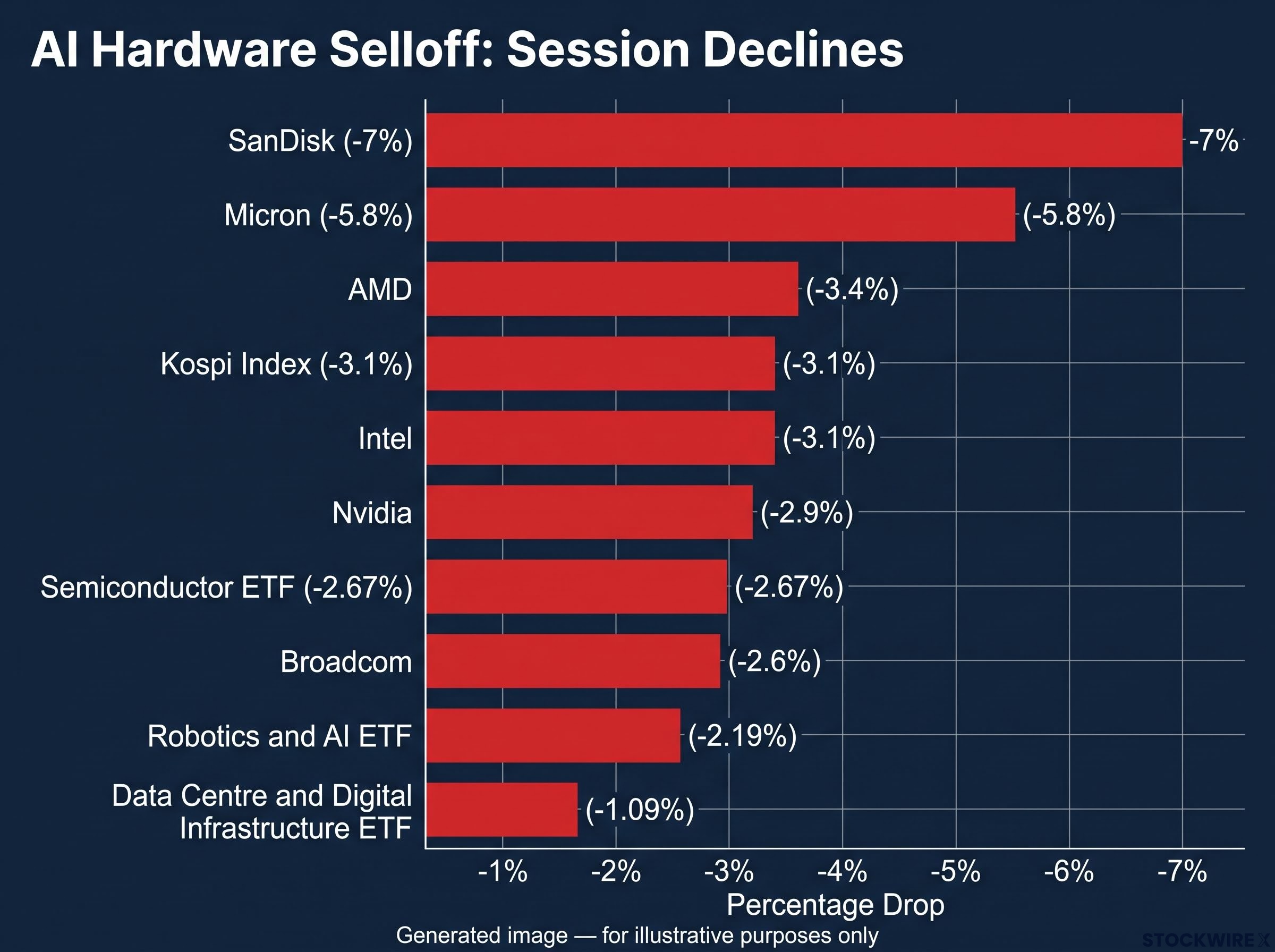
Approximately US$17 billion in market value erased from SanDisk in a single session.
From there, the declines followed a clear logic: memory names hardest hit, then broader chipmakers, then the sector ETFs confirming the selling was systemic rather than stock-specific.
| Company or ETF | Session decline | Key driver |
|---|---|---|
| SanDisk | Approximately -7% | China memory sourcing risk (CXMT/YMTC reports) |
| Micron | -5.8% | Direct HBM cost exposure as Nvidia supplier |
| AMD | -3.4% | Broader AI hardware repricing |
| Intel | -3.1% | Sector-wide risk-off |
| Nvidia | -2.9% | Price hike announcement and margin uncertainty |
| Broadcom | -2.6% | System-level AI infrastructure repricing |
| Semiconductor ETF | -2.67% (closed at 506.18) | Systemic sector selling |
| Robotics and AI ETF | -2.19% | AI capex cycle concerns |
| Data Centre and Digital Infrastructure ETF | -1.09% | Data centre cost inflation spillover |
SanDisk’s near-7% drop tells you that Western memory suppliers now face pressure from two directions simultaneously: cost inflation at the high end, where HBM prices are rising faster than customers can absorb, and potential market-share erosion at the commodity end, where Chinese manufacturers may gain access to major consumer OEM contracts. The breadth of losses, from individual memory names through system-level chipmakers and into diversified ETFs, signals the market is repricing the entire AI hardware supply chain, not isolating a single name.
Korean market takes the sharpest international hit as HBM suppliers face dual pressure
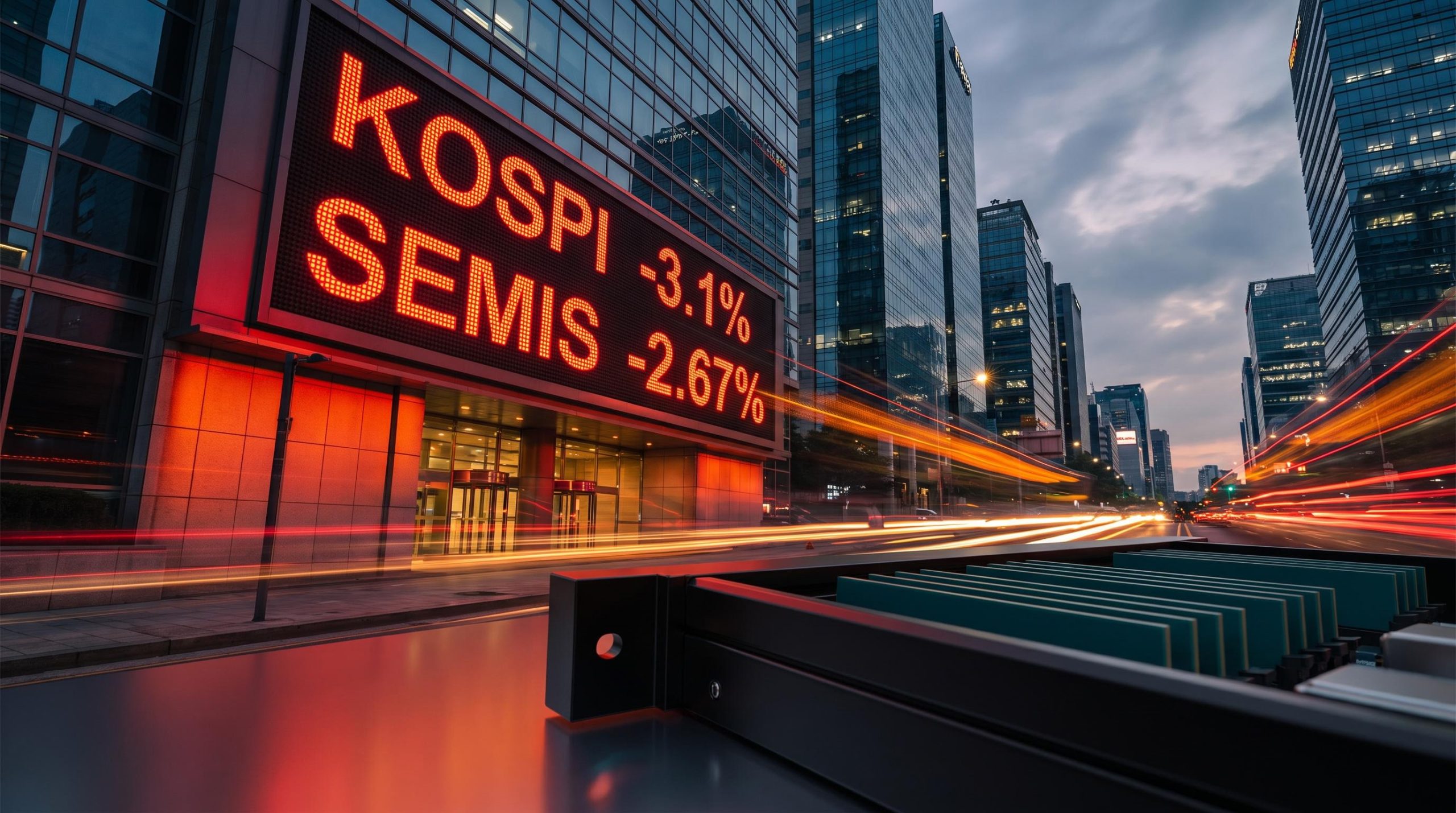
South Korea’s Kospi index shed 3.1% on Monday 24 August 2026 in what commentators described as one of the index’s most punishing sessions in recent memory, driven by an institutional flight from chip-sector exposure. The scale of the move is worth unpacking, and the structural explanation is not complicated.
- Kospi decline: -3.1% in a single session
- Foreign investor net selling: 3.69 trillion won in one day
- Named suppliers implicated: Samsung Electronics and SK Hynix
Samsung and SK Hynix are not peripheral players in this story. They are the companies directly named in Nvidia’s customer notifications as the source of rising HBM costs. That makes them both the cost drivers cited in the price hike and the potential demand-side casualties if AI server spending slows in response to higher prices.
Why institutional capital moved so fast
The 3.69 trillion won of foreign selling in a single session was not routine profit-taking. It was a rapid, large-scale reassessment of Korean chip exposure by institutional investors who recognised the dual risk: if Nvidia raises prices because memory is too expensive, and customers subsequently slow orders because servers are too expensive, Korean HBM suppliers lose on volume even as their unit prices climb.
For anyone tracking the AI hardware trade across geographies, the Korean selloff illustrates how tightly coupled this supercycle has become. A U.S. customer notification about server prices erased billions in market value in Seoul within hours.
Korean chip stock volatility of this magnitude has precedent from just weeks earlier: SK Hynix fell as much as 11% and Samsung dropped close to 10% on 28 July 2026 after a report raised questions about whether AI chip demand was organically driven or supplier-financed, confirming that institutional capital moves rapidly when any assumption underpinning the AI supercycle is questioned.
What the earnings call needs to answer about margins, capex, and AI demand
Nvidia reports Q2 FY2027 results on Wednesday 26 August 2026 after the U.S. market close, with the conference call at 2 p.m. PT (5 p.m. ET). With a two-day selloff already under way, the headline numbers matter less than what management says about what comes next.
Street estimates compiled by Investing.com place Q2 revenue at roughly US$91.9 billion, sitting just above the midpoint of Nvidia’s own published guidance range of US$91.0 billion plus or minus 2%, with consensus EPS forecast at approximately US$2.08.
| Metric | Figure |
|---|---|
| Nvidia’s own Q2 guidance | US$91.0 billion, plus or minus 2% |
| Analyst consensus revenue | Approximately US$91.9 billion |
| Analyst consensus EPS | Approximately US$2.08 |
According to consensus estimates compiled by Investing.com, the revenue bar sits only modestly above the midpoint of Nvidia’s own guidance range. That gap tells you the threshold for a positive market reaction is not simply beating the number. Management needs to deliver commentary that settles the pricing-power-versus-cost-spiral debate in the market’s favour.
Five specific topics will be scrutinised on the call:
- Gross and operating margins: How higher memory and server prices flow through to Nvidia’s profitability, and whether the price hike is accretive or merely cost-neutral.
- Hyperscaler and cloud capex signals: Whether large customers such as Microsoft, Google, and Amazon are adjusting AI deployment timelines or capital expenditure plans in response to higher total cost of ownership.
- HBM and advanced packaging supply: Signals on constraint levels, supplier diversification, and Nvidia’s capacity plans for Rubin-class production.
- Competitive dynamics: How AMD and specialised accelerators fare if price sensitivity among AI infrastructure buyers increases, and whether Nvidia sees any share risk at the margin.
- Policy and export-control risk: Any discussion of memory sourcing shifts between Western and Chinese suppliers, and broader geopolitical risk to the supply chain, particularly given the SanDisk-related reports about Apple potentially sourcing from CXMT and YMTC.
The bull-case and bear-case readings of the price hike are both live ahead of the call. Pricing power and margin expansion sit on one side. Customer pushback and elongated AI capex timelines sit on the other. Management’s tone on order visibility and hyperscaler sentiment will determine which reading the market adopts.
Pricing power or cost spiral: what Wednesday will decide
The two-day selloff has already delivered a tentative verdict. The Kospi fell 3.1%. SanDisk lost approximately 7%. The semiconductor ETF closed down 2.67%. Across stocks, ETFs, and a major international index, the market’s pre-earnings posture is cautious and risk-off.
The question now compressed into a single earnings call: is the AI infrastructure supercycle durable enough to absorb 15%+ server price increases, or is this the first signal that cost inflation is beginning to test demand elasticity?
The hyperscaler capex paradox sharpens the stakes of Wednesday’s call: the same $700 billion AI infrastructure wave funding Nvidia’s order book is simultaneously bankrolling the custom silicon programmes at Alphabet, Amazon, and Microsoft, meaning higher server prices could accelerate the very competitive threat Nvidia’s dominance currently masks.
- Bull case: Management emphasises sustained demand, strong order visibility, and a constructive outlook on memory supply. The price hikes are read as an assertion of pricing power, positive for Nvidia’s margins and a sign that AI demand is inelastic enough to absorb cost increases without slowing the build-out.
- Bear case: Commentary highlights customer pushback, elongated deployment timelines, or more cautious AI capex signals from hyperscalers. The price hikes are read as an early warning that cost inflation is testing the elasticity of AI demand, raising questions about the pace and durability of the infrastructure cycle.
Wednesday’s management commentary on order visibility, hyperscaler capex tone, and any Q3 FY2027 guidance will either confirm the market’s cautious pre-earnings positioning or sharply reverse it. The earnings call is scheduled for less than 48 hours after the price hike news landed, and the breadth of the selloff that preceded it means the stakes for management’s tone have rarely been higher.
Understanding the fork before the call puts you in a position to interpret results with context rather than reacting to headline numbers alone. That is the practical value of the preceding data: not a prediction, but a framework.
This article is for informational purposes only and should not be considered financial advice. Investors should conduct their own research and consult with financial professionals before making investment decisions. These statements are speculative and subject to change based on market developments and company performance.