
Most retail investors who try to beat the market through active strategies do not just fall short. They actively destroy capital that a passive approach would have grown. This is not a warning or an opinion; it is the consistent finding of decades of performance data across every major market.
The strategies covered here, margin trading, options speculation, copy trading, active stock picking, and short selling, are promoted aggressively through commission-free platforms, social media influencers, and trading communities. They feel like investing. They are not. They are speculation, and the distinction matters enormously for your long-term outcomes.
What you will find below is a practical map of which strategies carry structural disadvantages for retail participants, why the failure is predictable rather than personal, and what an evidence-based alternative actually looks like in practice. The pattern is the same across each one, and once you see it, the decisions become considerably clearer.
The line that separates investing from speculation
The distinction here is not academic. It is the single most useful filter you can apply to any financial decision you are considering.
Investing means owning pieces of productive businesses and allowing their earnings to compound over years or decades. Speculation means attempting to profit from short-term price movements, usually against counterparties who are better informed, faster, and better capitalised than you are.
Behavioural finance research from Brad Barber and Terrance Odean shows that retail traders systematically overtrade and underperform simple buy-and-hold portfolios, largely because of overconfidence and poor timing. That finding alone should give pause. But the structural picture is worse than individual behaviour suggests.
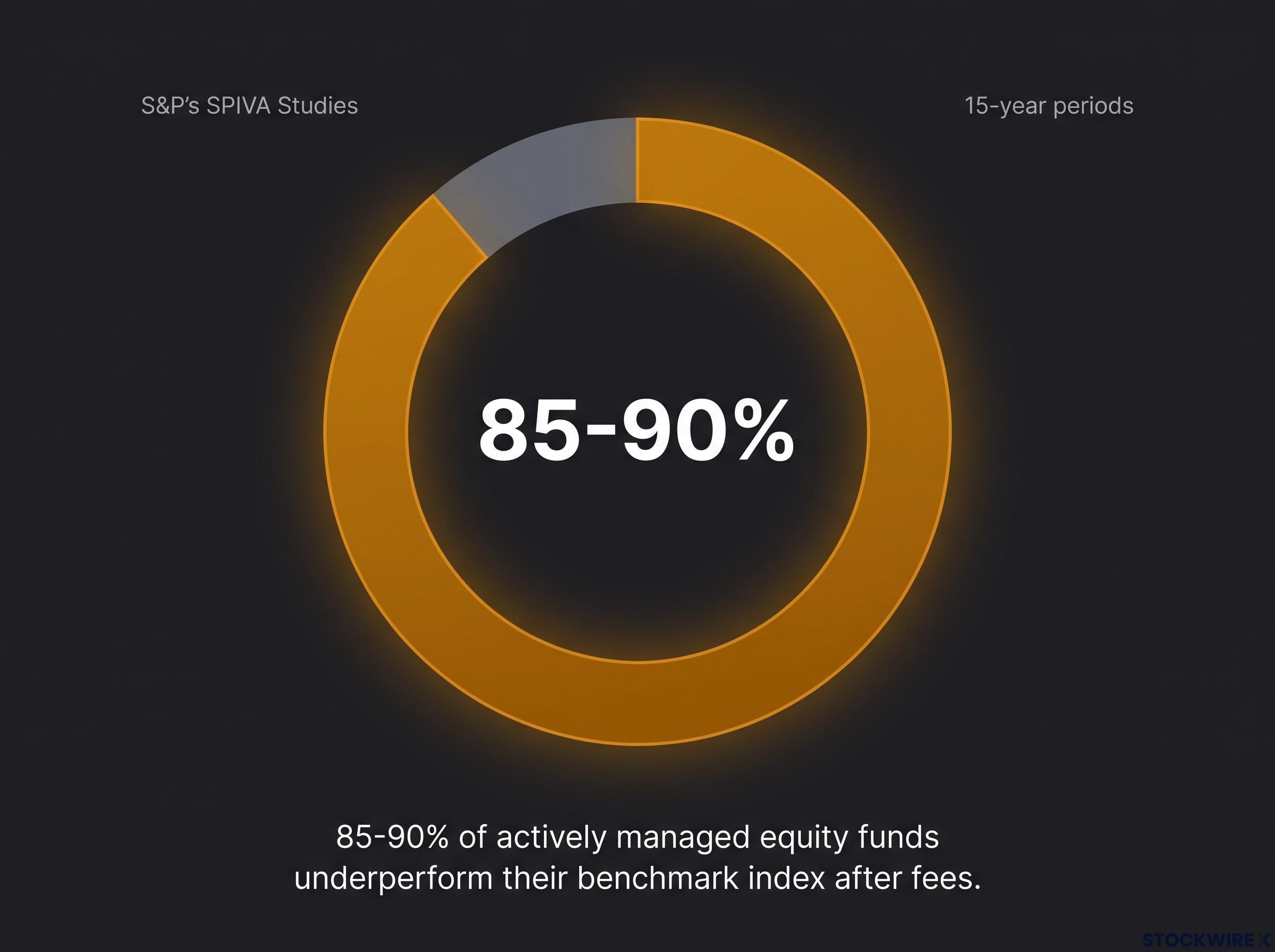
According to S&P’s SPIVA studies, over 15-year periods, 85-90% of actively managed equity funds underperform their benchmark index after fees. These are professional fund managers with research teams, institutional data, and decades of experience. If they cannot beat index returns reliably, the structural odds for someone trading from a laptop are worse still. The SPIVA data does not just describe professionals; it sets the ceiling for what informed, resourced active management can achieve. Your starting position sits well below that ceiling.
The SPIVA findings are not outliers; two decades of active vs passive investing data confirm that underperformance is structural, driven by William Sharpe’s arithmetic principle that active managers collectively must lag the market after fees because their aggregate pre-cost returns equal the market return by definition.
Here are the characteristics that separate speculation from investing:
- Duration: Investing is measured in years or decades; speculation is measured in days, weeks, or minutes.
- Intent: Investing seeks ownership of business earnings; speculation seeks to profit from price movement.
- Counterparty advantage: Speculators compete directly against institutions with superior speed, data, and execution.
- Compounding orientation: Investing harnesses compounding; speculation interrupts it with frequent entries and exits.
Every strategy covered in the sections that follow is speculative in nature, regardless of how it is marketed. That framing is what makes the failure pattern visible.
When big ASX news breaks, our subscribers know first
How leverage and margin turn small errors into permanent losses
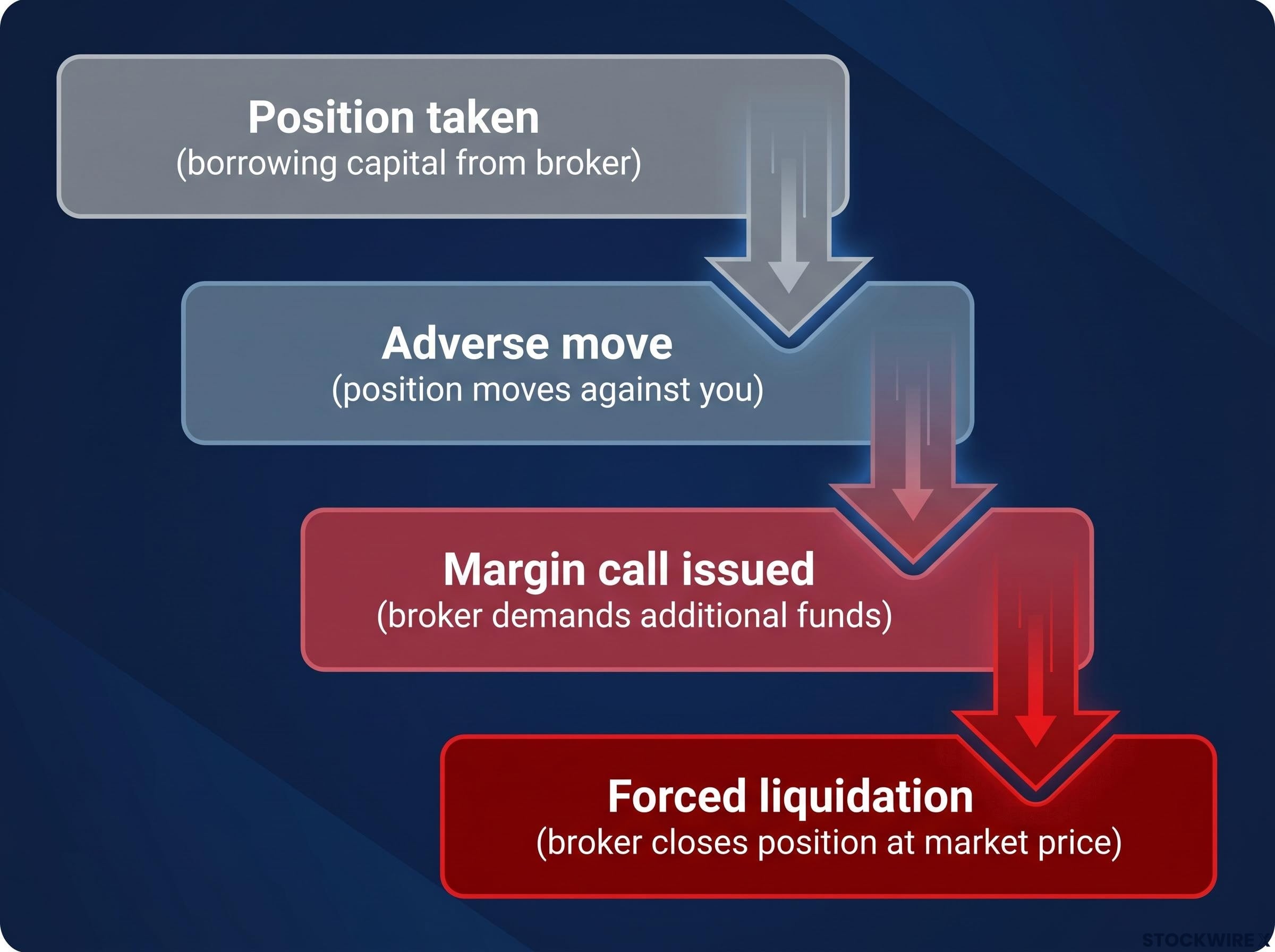
Margin amplifies both gains and losses symmetrically, but the consequences on the loss side are not symmetric at all. Here is the specific sequence by which a leveraged loss compounds into something permanent:
- Position taken: You open a leveraged trade, borrowing capital from your broker to increase your exposure beyond your own funds.
- Adverse move: The position moves against you. Because you are leveraged, the loss as a percentage of your own capital is larger than the price move itself.
- Margin call issued: Your broker demands additional funds to maintain the position. If you cannot meet the call, the next step is automatic.
- Forced liquidation: The broker closes your position at the current market price, locking in losses that an unleveraged investor could have simply waited out.
Research confirms that investors who employ margin accounts lose their capital substantially faster than those who do not. The margin call mechanism is the reason. It removes the one structural advantage retail investors actually have over institutions: the freedom to hold through downturns without being forced to sell.
ESMA’s product intervention analysis of CFD and leveraged product provision to retail clients found that the majority of retail accounts incurred net losses, with loss rates across surveyed jurisdictions consistently exceeding 70 percent, providing regulatory confirmation that the underperformance documented in academic research translates directly into real account outcomes.
Warren Buffett has named liquor, ladies, and leverage as three forces capable of bringing even intelligent people to financial ruin.
That is not conservative opinion. It is a recognition that leverage eliminates your ability to wait, and waiting is your primary edge.
Short selling stacks the same risk higher. A long position can only fall to zero. A short position carries theoretically unlimited loss if the asset rises, and shorting typically requires margin, meaning you face uncapped loss potential compounded by leveraged exposure. For non-professionals, these risk structures are fundamentally incompatible with building wealth.
Why options and active stock trading erode most retail accounts
Options and active trading feel like different strategies. On the surface, they are. Structurally, they share the same failure mechanism: time, friction, and competition against counterparties who are faster and better equipped than you.
The specific problem with options for retail buyers
When you buy a call or put option, you need three things to go right simultaneously. You must be directionally correct, correct within a specific time window, and correct by enough to overcome both the premium you paid and the daily erosion of time decay, known as theta. Theta is the amount an option loses in value each day simply because its expiration date is getting closer. It works against long option holders from the moment the position is opened.
Regulator and brokerage data show that retail participation in short-term options surged after commission-free platforms emerged, but most of these accounts lose money. Covered calls sacrifice your potential upside, while cash-secured puts tie up substantial capital that most retail investors cannot comfortably set aside. Only a small fraction of highly experienced investors managing substantial capital are appropriate candidates for options strategies.
Active trading: friction, speed, and adverse selection
Active stock, forex, and crypto trading expose you to a different but equally structural set of headwinds. Every trade incurs bid-ask spread costs. Every realised gain triggers a taxable event. Every execution competes against institutional algorithms with superior data and speed.
The behavioural dimension is just as damaging. Rapid feedback loops encourage overtrading and revenge trading, where losses prompt increasingly aggressive attempts to recover. Warren Buffett has observed that speculative behaviour in markets reached elevated levels following the rise of commission-free retail trading. The irony is that removing commissions reduced one friction cost while simultaneously accelerating the behavioural costs that do the real damage.
The behavioural costs of overtrading are quantified precisely by Barber and Odean’s research: the most active individual investors underperformed the least active by approximately 6.5 percentage points annually, a gap driven almost entirely by transaction costs and emotional overreaction rather than analytical error.
Technical analysis, widely used in active trading, has weak predictive validity. For you as a retail participant holding short-dated options or trading intraday, the friction costs and time decay are not incidental inconveniences. They are structural forces working against your position from the moment it is opened.
| Attribute | Options buying | Active stock trading |
|---|---|---|
| Primary structural headwind | Time decay (theta) erodes value daily | Adverse selection against faster, better-informed counterparties |
| Time pressure | Expiration date imposes a hard deadline | No expiration, but rapid feedback loops encourage overtrading |
| Friction cost | Premium paid upfront, plus bid-ask spread | Bid-ask spreads and frequent taxable events on every realised gain |
| Who benefits when the retail participant loses | Market makers and institutional option sellers | Institutional algorithms and high-frequency trading firms |
Copy trading and signal services: outsourcing the problem without solving it
The logic of copy trading is intuitive. If skill is the problem, mirror someone who has it. That reasoning feels sound, and it is exactly why so many retail investors try it.
Here is why it fails. The accounts that attract copiers typically show unusually high recent returns. Those returns may reflect luck, hidden leverage, or unsustainable risk concentration rather than repeatable skill. Abnormally high reported returns, even when genuine, should function as a warning signal, not an endorsement.
The structural failure runs deeper than account selection:
- Returns may reflect luck or leverage: High short-term performance is not evidence of a repeatable process. It often indicates concentrated risk that has not yet materialised.
- No exit guidance is provided: Most signal services and copy trading sources advise on entries but provide almost no guidance on when to exit. You end up executing half a strategy at best.
- No investor skill development occurs: Copy traders outsource decisions, gain no analytical capability, and remain exposed to the same behavioural pitfalls as if they were trading independently.
Those who generate consistent profits through trading do so working within the industry, not by selling subscriptions, courses, or online communities. Anyone actively promoting such services to retail participants has a commercial incentive that benefits them, not you.
Following tips and social media calls is repeatedly identified in the research as a core cause of retail losses, because it replaces independent judgement with unverified narratives. Copy trading feels like risk reduction but functions as risk transfer onto an unverified counterparty. You retain all the downside while surrendering any opportunity to build the judgement that would eventually make you competent.
Stock picking: closer to investing, but still harder than it looks
Stock picking sits in a different category from the strategies covered above. It involves owning businesses rather than betting on short-term price noise, and it builds investor knowledge over time. That makes it a categorically higher-quality activity than speculative trading or copy trading.
The problem is that quality does not guarantee results.
SPIVA data shows that only a minority of active fund managers outperform their benchmark indices after fees over 10-20 year horizons. These are professionals with research teams, institutional data infrastructure, and deep industry networks. For retail investors without those resources, the stock-picking challenge is harder than the professional benchmark suggests, not easier.
Two specific hazards cause the most permanent damage:
- Concentration risk: Holding too few stocks, or concentrating too much in a single name, exposes your portfolio to company-specific events such as fraud, disruption, or regulatory shocks that can permanently impair your wealth.
- Small and micro-cap exposure: Penny stocks, over-the-counter names, and micro and nano-cap equities carry risks that the evidence suggests are poorly rewarded. These markets are lightly regulated, thinly traded, and disproportionately associated with fraudulent schemes, meaning investors are rarely compensated adequately for the additional risk they take on.
Quality-focused stock selection, as practised by Warren Buffett, represents the strongest version of this approach: a diversified portfolio, a consistent methodology focused on high-quality businesses bought at reasonable valuations, and a time horizon measured in decades. Even this approach significantly reduces, but does not eliminate, the likelihood of underperformance relative to a simple index. For most individuals, an index-based core remains safer and more effective.
What evidence-based investing actually looks like in practice
If the strategies above are what not to do, you need a clear picture of what works instead. Evidence-based investing is not a consolation prize for people who lack the skill to trade. It is the empirically superior strategy for most retail investors precisely because it captures market returns without requiring an edge.
The framework has four core design features:
- Broad diversification: Own hundreds or thousands of stocks across sectors, countries, and market capitalisations through low-cost index funds or ETFs. This eliminates single-stock risk while capturing aggregate economic growth.
- Low costs and tax efficiency: Index funds typically carry much lower expense ratios than active funds, and that fee difference compounds significantly over decades. Lower turnover also means fewer taxable events, improving your after-tax returns over the long term.
- Systematic, long-term contributions: Invest regularly, regardless of headlines or short-term volatility. This avoids market timing, which the research identifies as a major and persistent source of retail underperformance.
- Clear asset allocation with periodic rebalancing: Mix asset classes based on your risk tolerance and objectives, then rebalance periodically to maintain targets. Risk management becomes a design feature of your portfolio, not an afterthought.
Fee selection and vehicle choice are among the highest-impact decisions a new investor makes: a 0.90% annual fee difference on a $10,000 starting investment compounded over 20 years at 7% gross return costs approximately $6,000 in lost growth, a figure that illustrates why the cost advantage of index funds is not a marginal consideration.
The behavioural dimension is non-negotiable. Staying invested through downturns, rather than selling in bear markets and missing subsequent rebounds, is one of the most reliably identified sources of long-run retail underperformance. The power of this approach is not that it is sophisticated. It is that it is structurally designed to remove the decisions, when to enter, when to exit, which stock to own, that research shows retail investors consistently get wrong.
SPIVA studies consistently find that 85-90% of actively managed equity funds fail to match their benchmark index after fees across 15-year periods. The implication is straightforward: rather than attempting to beat those funds, most investors are better served by simply holding the index those funds cannot outperform.
What the evidence tells you to do, and what it tells you to stop
The failure of active retail strategies is structural and predictable. It is not a personal shortcoming you could overcome with more effort, better picks, or a more expensive signal service. The pattern repeats across leverage, options, active trading, copy trading, and concentrated stock picking because the disadvantages are built into the strategies themselves.
The alternative, broad, low-cost index investing with regular contributions and a long time horizon, is not the easy option. Staying invested through volatility, ignoring promoters and signal services, and accepting market returns demands genuine behavioural discipline. Most active strategies actually undermine that discipline by training you to react rather than wait.
Your next step is not finding a better active strategy. It is building a simple, cost-effective, long-horizon portfolio and committing to leave it alone. The evidence on this point is not ambiguous.
This article is for informational purposes only and should not be considered financial advice. Investors should conduct their own research and consult with financial professionals before making investment decisions. Past performance does not guarantee future results.