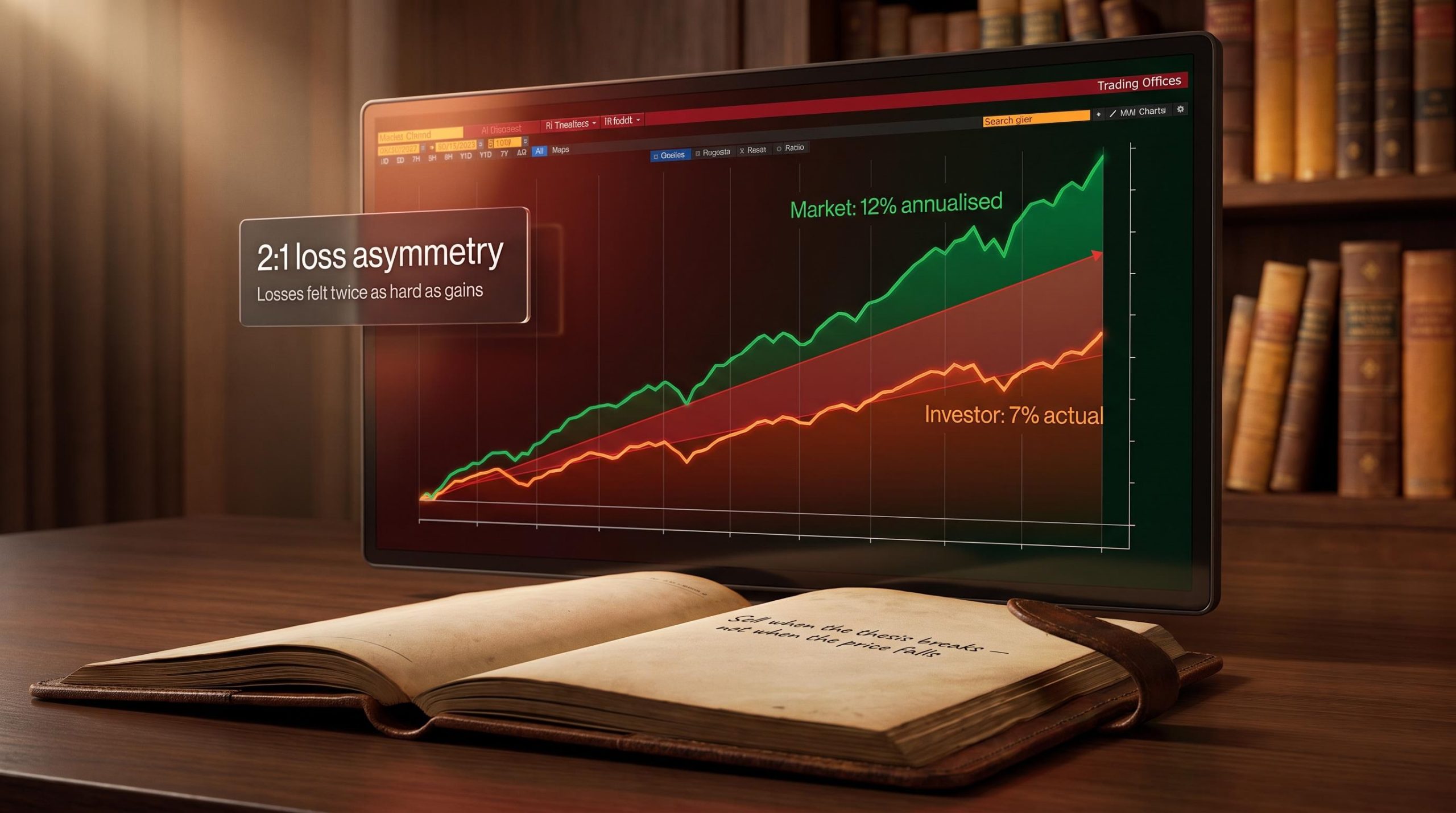
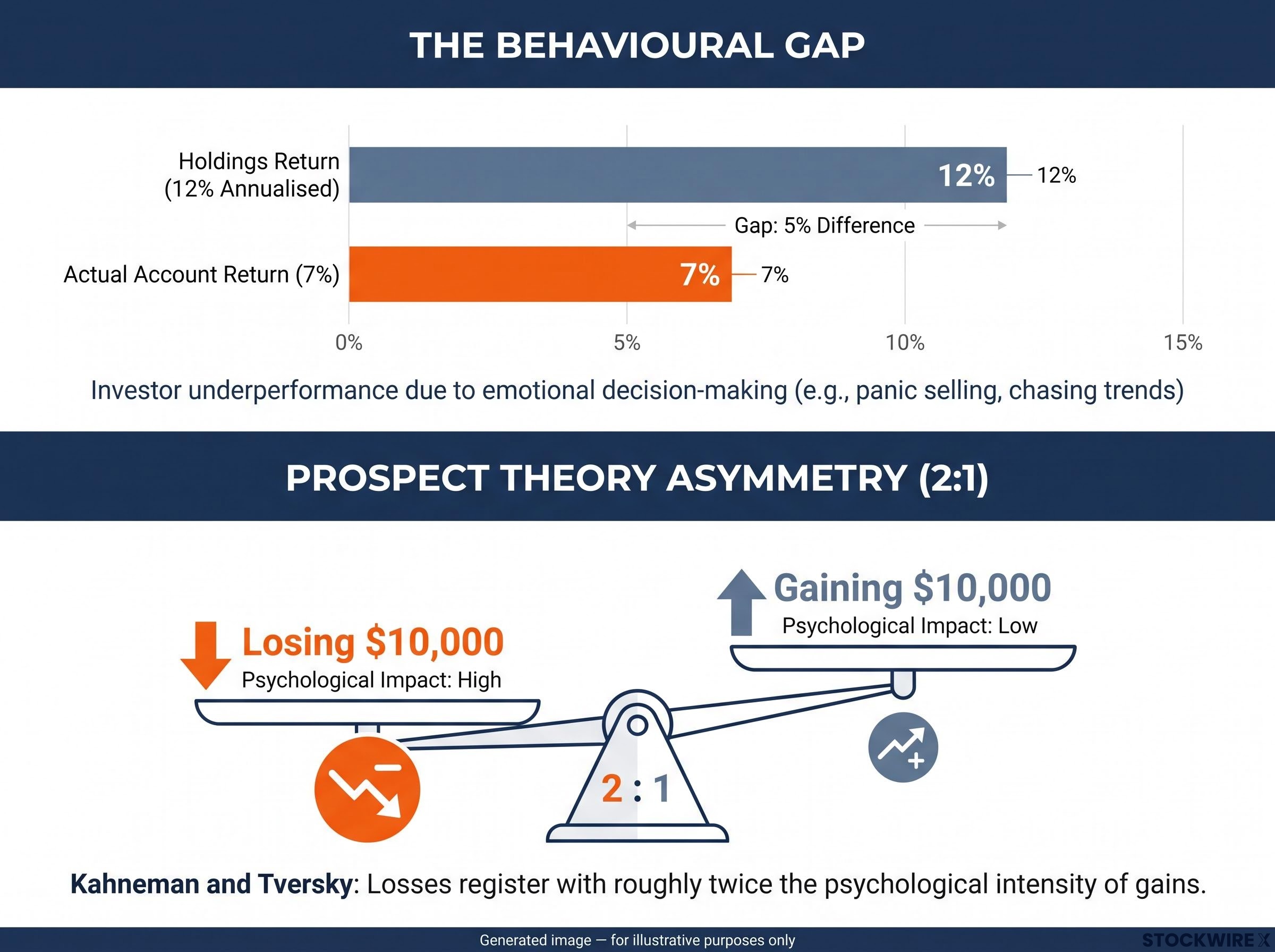
Consider an investor who picked every stock correctly. Strong businesses, growing earnings, durable competitive positions. Over a decade, those holdings returned 12% annualised. The investor’s actual account returned 7%. The gap had nothing to do with analysis. It had everything to do with behaviour.
That gap, between what markets return and what individual investors actually capture, is one of the most documented phenomena in finance. Three forces account for most of it: emotional decision-making driven by loss aversion, the misuse of leverage, and overtrading. None of them announce themselves. They operate quietly across years, compounding against you in ordinary moments rather than through a single spectacular failure.
Here is what each of these forces actually does to your returns, why they tend to show up together, and the specific behavioural shifts that interrupt the cycle before it costs you another decade of compounding.
Why your brain treats a falling price like a physical threat
Your brain does not process a portfolio loss the way it processes a spreadsheet. It processes it the way it processes danger. A red number on a screen triggers the same neurological stress response as a physical threat to your safety, activating fight-or-flight circuitry that overrides the analytical part of your mind before you have finished reading the figure.
This is not a metaphor. Behavioural finance research, most famously Kahneman and Tversky’s Prospect Theory, established that losses register with roughly twice the psychological intensity of equivalent gains. The value-function coefficient places the asymmetry at approximately 2:1.
The Prospect Theory asymmetry: Losing $10,000 feels roughly twice as painful as gaining $10,000 feels good. The emotional system does not weigh them equally, and no amount of intellectual awareness changes the ratio.
That 2:1 ratio matters because it means your emotional reaction to a 20% portfolio decline is not a reliable signal about whether selling is the right decision. The fear at that scale is structurally guaranteed, whether the underlying business has deteriorated or whether the price simply moved against you temporarily. Your feelings at that moment are real. They are also, from a decision-making standpoint, almost certainly wrong.
Morningstar’s ‘Mind the Gap’ research quantifies what loss aversion costs investors in practice: a consistent shortfall of roughly 1-2 percentage points per year, generated primarily by selling near market lows and re-entering only after prices have already recovered.
How the disposition effect turns this wiring into a trading pattern
The disposition effect is loss aversion expressed as a portfolio behaviour. You sell your winners too early, because locking in a gain feels like securing something real. You hold your losers too long, because selling at a loss forces you to confront the pain of confirmation: the position was wrong, and now you have made it permanent.
The investor holding a losing position often believes they are being patient. In practice, they are avoiding the psychological cost of admitting a mistake. The distinction matters, because patience driven by an intact thesis is a strength, while patience driven by pain avoidance is loss aversion wearing a rational disguise.
When big ASX news breaks, our subscribers know first
The buy-high, sell-low cycle that markets are designed to produce
If you have been investing for more than a few years, you have already lived through the emotional arc of a full market cycle. You may not have named it at the time, but you will recognise the shape.
- Enthusiasm: Prices are rising. Your positions are working. You feel validated. Adding more capital feels like the obvious move.
- Euphoria: Everything is going up. Friends and colleagues mention their returns. The fear of missing out becomes louder than any risk assessment. Buying at elevated prices feels safe because everyone around you is doing it.
- Panic: A correction arrives. The same positions that felt like certainties now feel like threats. You begin checking your portfolio hourly. The urge to sell something, anything, grows.
- Capitulation: The decline has lasted long enough that the pain exceeds your tolerance. You sell, often near the bottom, because holding feels unbearable and the evidence of further decline seems overwhelming.
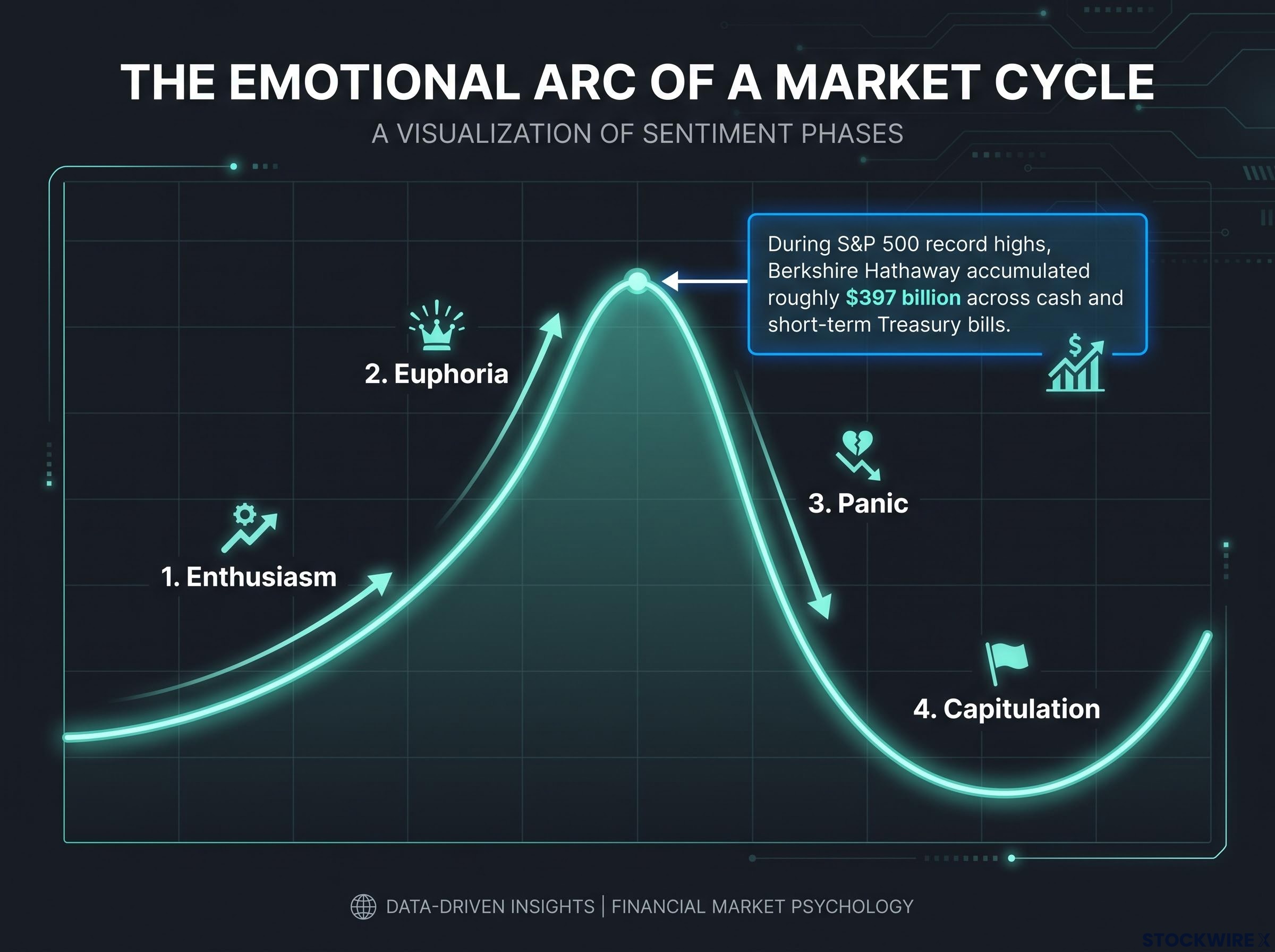
Recency bias is the engine driving this cycle. When markets have risen for months, your brain extrapolates that trajectory forward, making further gains feel inevitable. When markets have fallen for months, your brain does the same in reverse, making further losses feel certain. In both cases, the most recent data overrides the longer historical record.
Negativity bias compounds recency bias in a specific way: financial media publishes negative headlines at roughly 17 times the rate of positive ones, structurally flooding the information environment with fear-framed content at exactly the moments when panic selling feels most justified.
Warren Buffett’s contrarian framing captures the structural opportunity this creates: widespread pessimism often coincides with the most attractive future returns, and widespread optimism with the most stretched valuations. During a period when the S&P 500 was setting new record highs, Berkshire Hathaway had accumulated roughly $397 billion across cash and short-term Treasury bills, a pointed demonstration of how disciplined capital allocation can diverge sharply from the prevailing mood.
The moment investing feels most obviously correct is precisely the moment requiring the most scepticism from you, because the emotional environment is at its most distorting.
What loss aversion, borrowed capital, and overtrading actually are (and why they are often misunderstood)
Each of these three forces carries a common misunderstanding that makes it harder to detect in your own behaviour. Loss aversion is not simply “being scared of losing money.” Leverage is not simply “taking more risk.” Overtrading is not simply “paying too many commissions.” The real damage of each one is subtler, and that subtlety is why they persist undetected for years.
| Force | What it feels like in the moment | What it actually costs over time |
|---|---|---|
| Loss aversion | Prudence. You are protecting what you have. | You sell winners early and hold losers indefinitely, systematically cutting your best positions and nursing your worst. |
| Leverage | Ambition. You are accelerating your returns. | You surrender the ability to wait out declines. A paper loss becomes a permanent one the moment a margin call forces your hand. |
| Overtrading | Diligence. You are staying engaged with your portfolio. | Transaction costs, tax drag, and emotional noise compound silently, reducing net returns year after year. |
All three forces work in the background over extended periods rather than through any single dramatic event. That is precisely why they rarely surface as the obvious explanation for underperformance. While they are operating, they carry the texture of responsible, attentive investing.
Why these three forces cluster in the same investor at the same time
These are not independent errors. They reinforce each other in a sequence that accelerates once it starts. Emotional trading creates underperformance. Underperformance creates the temptation to use leverage to catch up. Leverage increases emotional volatility, which drives more overtrading. The cycle is self-perpetuating, and each turn tightens its grip.
That reinforcing loop is why addressing only one of the three rarely solves the problem. The cycle needs to be interrupted at multiple points simultaneously.
How leverage turns paper losses into permanent ones
Most investors who have been hurt by leverage understand that they lost money. Very few understand that what they actually lost first was the ability to wait.
“Leverage does not just amplify your losses. It removes your ability to wait them out.”
Consider what a 50% price decline looks like under two different conditions. Held outright, the position is painful but survivable. You reassess whether the underlying business has changed. If the fundamentals remain sound, you sit tight and let the recovery come to you. Nothing forces your hand. With borrowed capital in the picture, the same decline may push your equity below the lender’s threshold. A margin call arrives, and the decision is no longer yours. What had been an unrealised loss becomes locked in permanently at the worst point in the cycle, not because you chose to sell, but because you no longer had the option to wait.
This is the reframe that matters: leverage is not primarily a loss-amplification problem. It is a time-and-control problem. Three distinct constraints stack against you once borrowed capital enters the picture:
- Margin call risk: Once your equity falls below lender thresholds, forced selling occurs regardless of your view on the asset’s long-term value.
- Interest obligations: Borrowed capital carries ongoing costs that compound pressure to act, even when the optimal decision is to wait.
- Psychological stress amplification: The knowledge that losses are magnified and that forced selling is possible intensifies emotional reactions, making rational assessment harder at precisely the moments it matters most.
Leverage is typically increased when confidence is highest, during the euphoria stage of the cycle described above. That means exposure peaks precisely when valuations are richest and downside risk is greatest. Buffett has consistently cautioned individual investors against margin borrowing, noting that seemingly sensible people make deeply irrational decisions once borrowed money is part of the equation.
Current margin debt levels provide a concrete illustration of this dynamic at scale: US margin debt reached $1.416 trillion in May 2026, up 54% year-over-year, a pace the Leuthold Group identifies as having preceded three of the most significant drawdowns in recent market history.
If you currently use or are considering margin borrowing, the risk you are accepting is not primarily “losing more money.” It is losing the ability to wait for the recovery you know intellectually is likely.
Why frequent trading feels like diligence but compounds against you
In most areas of life, effort improves outcomes. Study harder, get better grades. Train more, run faster. Work longer hours, produce more output. This is action bias: the deeply ingrained intuition that doing more leads to getting more.
In investing, that intuition is wrong. Behavioural finance research consistently finds that investors who trade more tend to earn lower net returns, largely because they overreact to short-term information and pay more in accumulated frictions. The costs compound across three distinct channels:
Barber and Odean’s trading frequency research, published in The Journal of Finance, found that the most active individual investors underperformed the least active by roughly 6.5 percentage points annually, a gap driven almost entirely by transaction costs and behavioural overreaction to short-term information.
- Transaction costs: Every trade carries commissions and bid-ask spreads. Individually small, they subtract directly from returns with each round trip. Over hundreds of trades across a decade, the cumulative drag is substantial.
- Tax drag: Frequent realisation of short-term gains typically incurs higher tax rates than long-term holding. Each sale event resets the clock on favourable long-term treatment and prevents capital from compounding pre-tax over extended periods.
- Emotional noise: Checking prices daily or intraday converts normal volatility into a sequence of emotionally charged events. Each price movement becomes a decision prompt. Gains trigger short bursts of euphoria; losses trigger anxiety. Over time, this emotional volatility raises the probability of impulsive trades and erodes adherence to any long-term strategy.
The practical implication is direct: reducing your portfolio check-in frequency from daily to quarterly is itself an investment decision with a measurable positive impact on your long-term net outcome. It involves doing less, not more.
The cost of market timing is quantified precisely in S&P 500 data: missing just 10 of the index’s best trading days over a decade converts a $272,000 portfolio into a $153,000 one, a $119,000 shortfall produced by emotional exits rather than analytical error.
The Buffett countermodel: restraint as a return driver
Buffett’s documented approach inverts the action-bias assumption entirely. Identify superior businesses. Purchase them at valuations clearly below conservative intrinsic value estimates. Then allow compounding to work over years or decades, resisting the urge to tinker.
This is not passivity. It is a disciplined refusal to let action bias and emotional noise override an analytical thesis. Inaction during periods of uncertainty, when every headline screams that something must be done, is itself a financial decision with a positive expected value when the underlying thesis remains intact.
Five behavioural shifts that interrupt the cycle before it compounds
Each of the following disciplines corresponds directly to one of the three forces explored above. They do not make investing emotionless. They create a structure that prevents emotions from making the final call at the moments when they are most distorting.
- Sell only when the thesis breaks, not when the price falls. Define your sell criteria before you enter a position. “I sell when the business thesis is broken” is a decision rule. “I sell when I have lost 20%” is an emotional trigger disguised as discipline. The distinction matters because it separates genuine analytical reasons from in-the-moment pain avoidance.
- Treat leverage as a last-resort tool with pre-defined limits. If you use leverage at all, define strict maximum exposure and the specific scenarios that justify it before you deploy it. Acknowledge explicitly that using leverage trades away your most valuable asset: patience.
- Reduce monitoring frequency to quarterly or semi-annual reviews. Each time you check a price, you create a decision prompt. Fewer prompts mean fewer opportunities for emotion to override strategy. Quarterly reviews give you enough data to identify genuine changes without the noise of daily fluctuation.
- Write down your thesis and risk limits before entering any position. A written record anchors your future self against emotional pressure. When a position is down 30% and every instinct says sell, the written thesis forces you to answer one question: has the business changed, or has the price changed?
- Treat widespread optimism as a scepticism signal. When enthusiasm is universal, valuations are typically stretched. When pessimism is pervasive, future returns are often most attractive. This is psychologically difficult precisely because it requires acting against the emotional consensus, but it is the logical consequence of understanding how the cycle works.
“Write down your sell criteria before you buy. Your future emotional self will need the anchor.”
These disciplines do not guarantee returns. They interrupt the self-reinforcing cycle at its weakest links. You can audit your own behaviour against this list and identify which link in your personal version of the cycle needs the most reinforcement.
The real edge in investing is a behavioural one, and it compounds
Loss aversion, leverage misuse, and overtrading do not announce themselves as crises. They are slow-burning forces that erode returns incrementally over years, converting sound analytical work into disappointing outcomes through countless small decisions that appear entirely reasonable in the moment.
The skill that separates durable long-term investors from the majority is not stock selection. It is behavioural architecture: designing a personal system that protects you from acting on the 2:1 pain asymmetry, from surrendering patience to a lender, and from mistaking busyness for productive investing.
The gap between what markets return and what you actually capture is not fixed. It is determined by the behavioural choices you make from here. Every cycle will test the same wiring. The question is whether you meet it with the same instincts or with a structure that holds when instincts fail.
This article is for informational purposes only and should not be considered financial advice. Investors should conduct their own research and consult with financial professionals before making investment decisions.