China’s economy beat forecasts on almost every line on Monday, and the New Zealand dollar barely blinked. The Kiwi edged up to around 0.5655 in Asian trading, and one market-data report put it at 0.5659, up just 0.11%, still well below its 100-day average. If good news from New Zealand’s largest trading partner cannot move the NZD/USD exchange rate decisively, the forecast for the pair depends on something other than China.
That something arrives fast. New Zealand’s Q3 CPI lands on Thursday 22 October, the Reserve Bank of New Zealand (RBNZ) decides rates on 28 October, and the October Federal Open Market Committee (FOMC) meeting follows with Fed Chair Warsh having refused to pre-commit to anything.
Three catalysts in ten days, each capable of overriding the others. Here is how to separate the cyclical noise from anything structural, and which data points and price levels are most likely to decide the Kiwi’s next move.
Why does the Kiwi react so modestly to good news?
Before weighing this week’s catalysts, it helps to have a mental model of what actually moves the New Zealand dollar. Once you see the forces lined up, a small gain on a big China beat stops looking like a disappointment.
Structural drivers
Six forces do most of the work on the pair:
- Rate differentials: the gap between New Zealand and US interest rates. Higher expected RBNZ rates lift NZ yields and draw capital into the Kiwi; a Fed willing to hike pulls the other way.
- China and the export channel: China is New Zealand’s largest trading partner, so firm Chinese demand supports export earnings and the currency.
- Dairy: dairy is New Zealand’s main export, and prices feed directly into export income and the terms of trade (the ratio of export prices to import prices).
- Domestic data: strong growth, low unemployment and confidence support the NZD; soft figures weigh on it.
- Risk sentiment: the Kiwi is a liquid, pro-cyclical currency, meaning it tends to rise when investors feel confident and fall when they turn defensive.
- US dollar strength: a firm greenback can cap the pair regardless of what happens in Wellington or Beijing.
Because the NZD amplifies global mood, it often moves more on external news than on anything New Zealand reports itself.
Why the response was muted today
Monday’s session shows those forces cancelling out. China delivered the positive impulse, but US yields and the dollar remain supported by a Fed that has not ruled out further tightening.
The dollar side of that offset is largely a story of US Treasury yields, which have outweighed New Zealand’s own data in setting the Kiwi’s direction and explain why a firm greenback can cap the pair regardless of Wellington or Beijing.
| Driver | Current direction | Effect on NZD/USD |
|---|---|---|
| China data | Stronger than expected | Supportive |
| RBNZ hike expectations | Elevated, largely priced | Supportive, limited upside |
| Fed outlook | December hike widely expected | Weighs on the pair |
| Domestic NZ activity | Weak demand, spare capacity | Weighs on the pair |
| Risk sentiment | Mixed, AI-related swings | Uncertain |
| US dollar | Broadly supported | Caps gains |
A structural recovery would need sustained NZ growth and productivity, persistent Chinese demand, stronger dairy income, a clear RBNZ tightening cycle and/or a durable fall in US yields. Current reporting does not establish that combination, so the move is best classified as cyclical.
What this tells you is simple: when several drivers offset each other, a small move on a single headline is normal behaviour, not a signal that the trend has turned.
When big ASX news breaks, our subscribers know first
What China’s stronger data does and does not tell you
On paper, the numbers from the National Bureau of Statistics (NBS) were better across the board.
| Indicator | Actual | Prior | Expected |
|---|---|---|---|
| Q3 GDP (YoY) | 4.5% | 4.3% | 4.4% |
| Q3 GDP (QoQ) | 1.2% | 0.9% | 1.1% |
| September retail sales (YoY) | 1.1% | 0.4% | 0.5% |
| September industrial production (YoY) | 5.5% | 5.2% | 5.4% |
The retail and factory figures carry more weight than the headline. Retail sales more than doubled their August pace, which suggests activity is not leaning solely on exports or government support.
Even the GDP beat comes with an asterisk. FXStreet cited a 4.4% consensus, while other coverage put expectations nearer 4.6%, which would turn the beat into a miss; the 4.5% NBS outcome is the only figure that is settled.
Durability is the bigger question. Earlier previews flagged weak household demand, a soft property sector and growth possibly propped up by exports, and one strong month does not erase those concerns.
Recent precedent (not independently confirmed) In August 2026, weak Chinese July industrial production and retail sales reportedly did not stop NZD/USD climbing toward 0.5920, as broad US dollar weakness and fading Fed-hike expectations dominated.
If that pattern holds, China data nudges sentiment without setting the pair’s direction. Treat it as a supporting factor in your read of the Kiwi, not a primary signal.
Is an RBNZ hike already priced in?
Markets are confident the RBNZ will lift the Official Cash Rate (OCR), its benchmark interest rate, from 2.75% on 28 October, following a 25bp hike in September. The New Zealand Herald put the odds at about 70% on 18 October, while other coverage, including The Edge Malaysia, cited roughly 80-86%, and Commerzbank referenced around 80%.
That confidence hides a genuine split among the people paid to forecast the decision.
Analyst split
The hawkish camp points to inflation above the RBNZ’s 1-3% target band, a materially weaker Kiwi and rising fuel costs that could spread into non-tradable prices (domestic costs not exposed to global competition). The cautious camp argues most of the increase is first-round, driven by fuel, energy and administered prices, while household spending stays weak and wages subdued.
| Institution | Call | Key reasoning |
|---|---|---|
| ANZ | 25bp hike in October, lower conviction | Renewed inflation, very weak trade-weighted NZD, fuel and currency pass-through |
| BNZ | 25bp hike, more tightening signalled | Inflation pressures surged since September’s cautious messaging |
| Westpac | Hold, then December hike | Uneven recovery and weak housing; sees Q4 inflation near 4.2% |
| Commerzbank | More cautious than market | Weak activity, no visible second-round effects |
| Kiwibank | Case for a hike | Stresses labour-market slack and contained wages |
| ASB | Inflation risk elevated | Forecasts Q4 inflation around 4.2%, above the RBNZ’s 3.9% |
Even the central bank’s own economist is hedging.
“Completely open,” said Paul Conway, RBNZ Chief Economist, describing the choice between a hold and a 25bp hike, while adding that the OCR remains more likely to rise.
CPI as the swing factor
Thursday’s inflation print is the last major input before the decision. The forecast cluster is tight:
- Bloomberg consensus: 0.8% q/q, 3.8% y/y
- Westpac: 0.7%, 3.7%
- ANZ: 0.8%, with non-tradables at 1.3% q/q
- RBNZ projection: 0.8%, 3.9%
- BNZ: about 0.7%, 3.8%
Commerzbank’s Volkmar Baur expects the full release to draw unusual attention as investors reassess policy risk. A result near Westpac’s 3.7%, especially with soft core or non-tradable inflation, would weaken the hike case and could unwind the rate support the Kiwi has been leaning on.
That creates an asymmetry. With 70-86% already priced, a hike may add little unless the RBNZ signals more to come, while a hold would likely hurt. Your focus should be on the signalled OCR path and the breadth of Thursday’s CPI, not the headline decision itself.
For readers wanting the detail behind the split, our full explainer on the RBNZ October decision shows why ex-fuel inflation and weak card spending matter more than the headline print.
Warsh, the 100-day SMA and the levels that decide the next move
The US side of the pair is just as unsettled. The federal funds range sits at 3.75%-4.00% after September’s increase, with markets pricing roughly 15-18% odds of an October hike and 75-85% odds of a December move.
Two readings of Warsh
Speaking with IMF Managing Director Kristalina Georgieva in Bangkok on Friday, Federal Reserve Chair Warsh gave nothing away.
“I don’t prejudge meetings,” said Warsh, adding that he would not say in advance what he might do at the remaining meetings this year.
FXStreet’s Speechtracker scored the remarks 5.6/10 against a 6.1/10 baseline, though its Fed Sentiment Index held at 127.51. Warsh also admitted being “over-scarred” by the Global Financial Crisis, hinting at a risk-averse instinct.
Goldman Sachs took the hawkish reading: combined with other FOMC commentary, the remarks fit an October pause and a December hike. The alternative reading is that silence means no fresh tightening signal and a data-dependent Fed that could hold if activity or inflation softens.
Both are plausible, which means US data, not Fed rhetoric, will settle the argument.
Shifts in Fed hike odds, fed by oil prices and inflation fears, have driven six straight weekly losses for the pair, which is why December pricing matters more than any single Warsh remark.
Levels to watch
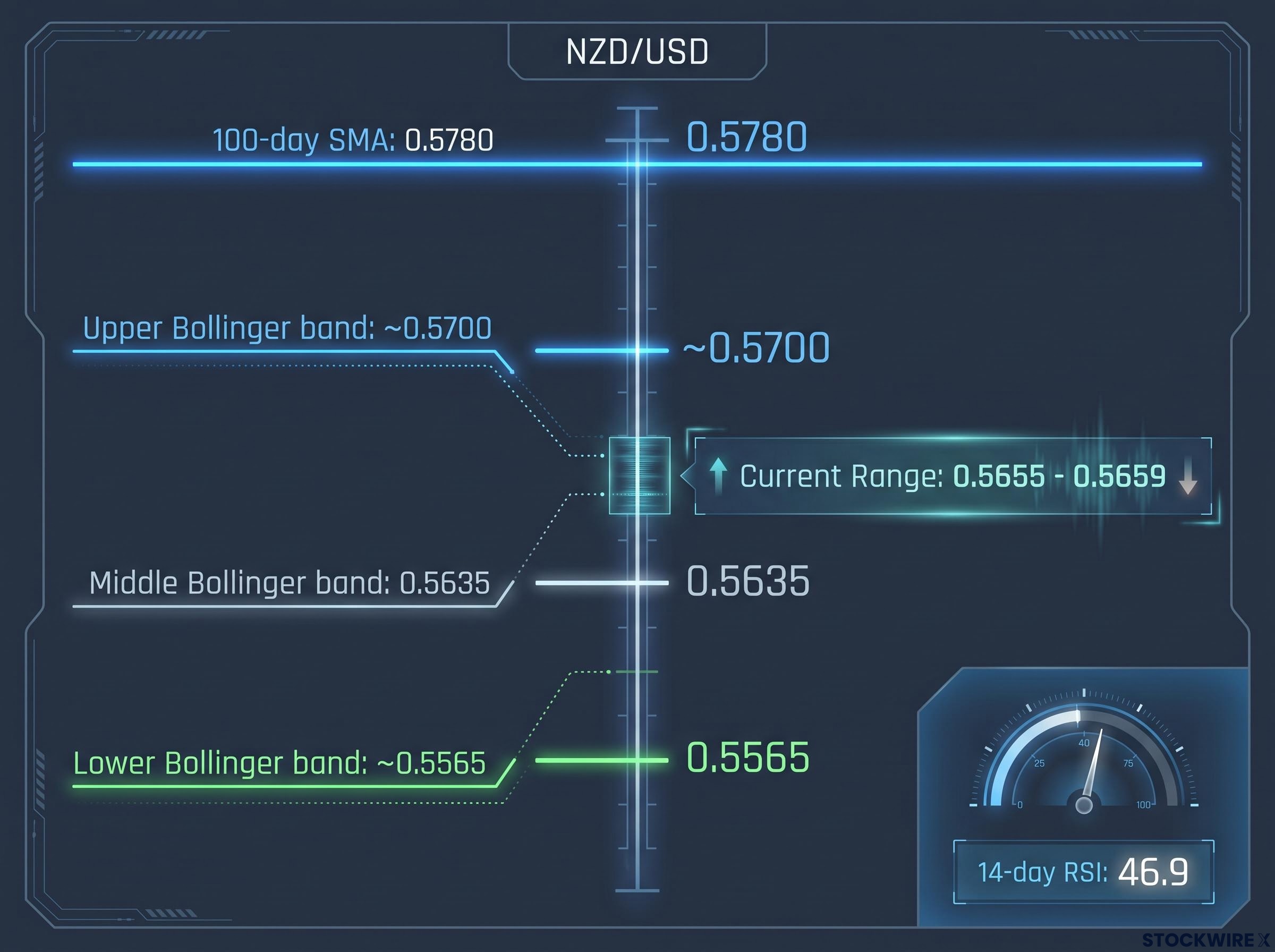
FXStreet’s daily chart analysis keeps the near-term bias bearish while price trades below the 100-day simple moving average (SMA), the average closing price over the past 100 sessions. The Kiwi sits just above the middle Bollinger band, a 20-day average used as a short-term pivot, suggesting tentative stabilisation, while the 14-day Relative Strength Index (RSI) at 46.9 is soft but not oversold.
| Level | Price | Role |
|---|---|---|
| 100-day SMA | 0.5780 | Key resistance; reclaiming it would challenge the bearish bias |
| Upper Bollinger band | ~0.5700 | First resistance |
| Middle Bollinger band | 0.5635 | First support |
| Lower Bollinger band | ~0.5565 | A break below opens further downside |
Four triggers could push the pair through these levels:
- CPI undershoot: a print near 3.7% weakens the hike case and pressures 0.5635.
- Hawkish US data: stronger inflation or jobs figures lift Fed odds and the dollar.
- China reversal: renewed weakness hits the Kiwi through trade and sentiment.
- AI risk-off: a pullback in AI investment or a tech shock damages risk appetite, while resilient AI-driven US growth could keep the dollar supported.
These levels matter most when the next US inflation or jobs release lands, because that data will decide which reading of Warsh the market adopts.
What the setup changes, and what it does not
Monday’s gain is cyclical. It reflects short-term repricing around China data, RBNZ odds and Fed expectations, and nothing in current reporting establishes a structural recovery for the Kiwi.
The evidence supports a neutral-to-cautious stance that is driven by events and levels rather than conviction. A broad CPI beat with firm RBNZ guidance, or softer US data, would tilt the picture more constructively; an undershoot or hawkish US repricing would strengthen the bearish bias.
Your near-term watchlist:
- CPI breadth on 22 October, especially non-tradables
- OCR guidance on 28 October, not just the decision
- US inflation and jobs data ahead of the FOMC
- 0.5635 support and 0.5780 resistance
This article is for informational purposes only and should not be considered financial advice. Investors should conduct their own research and consult with financial professionals before making investment decisions. Past performance does not guarantee future results, and forecasts are subject to market conditions and various risk factors.