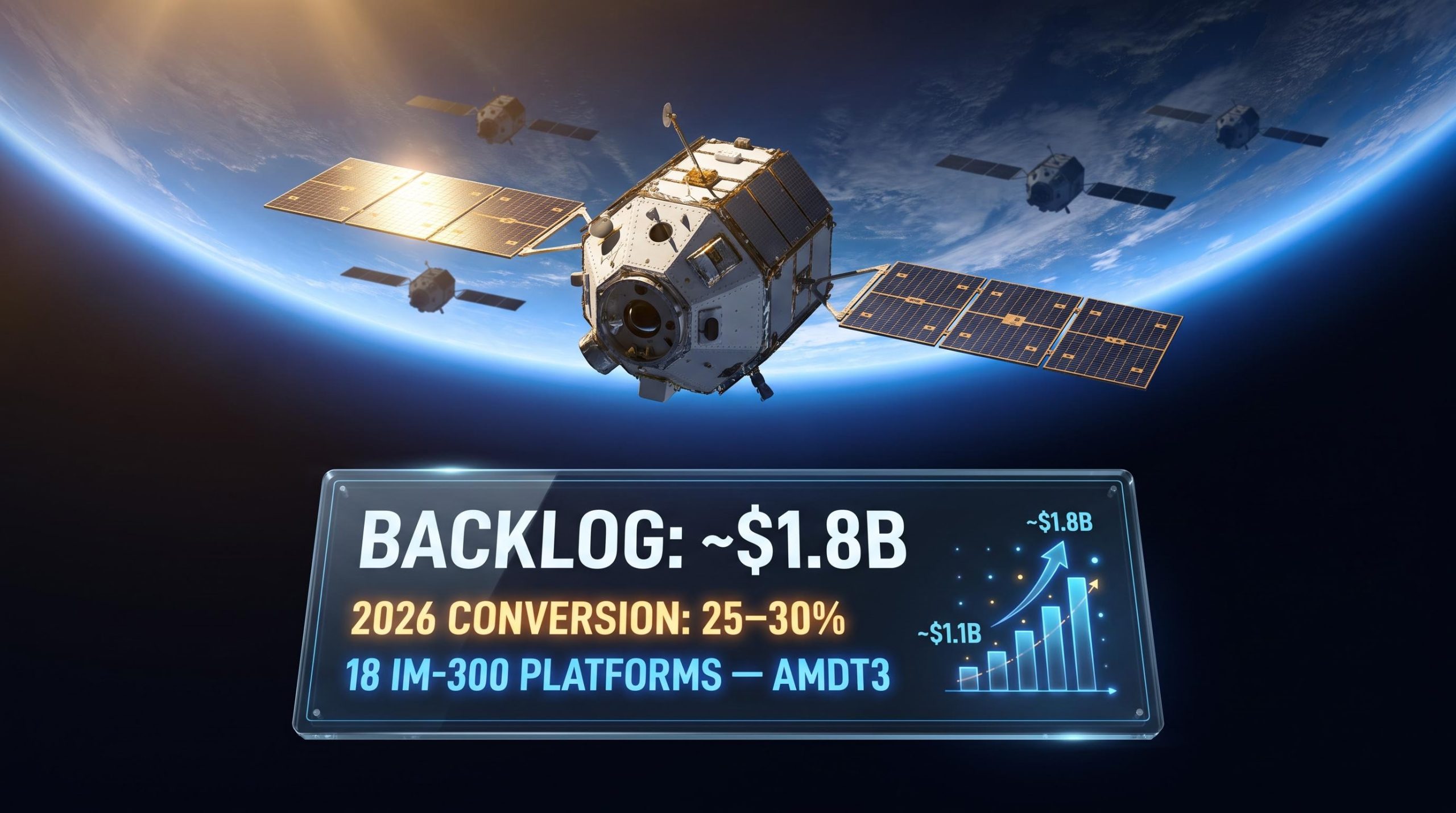
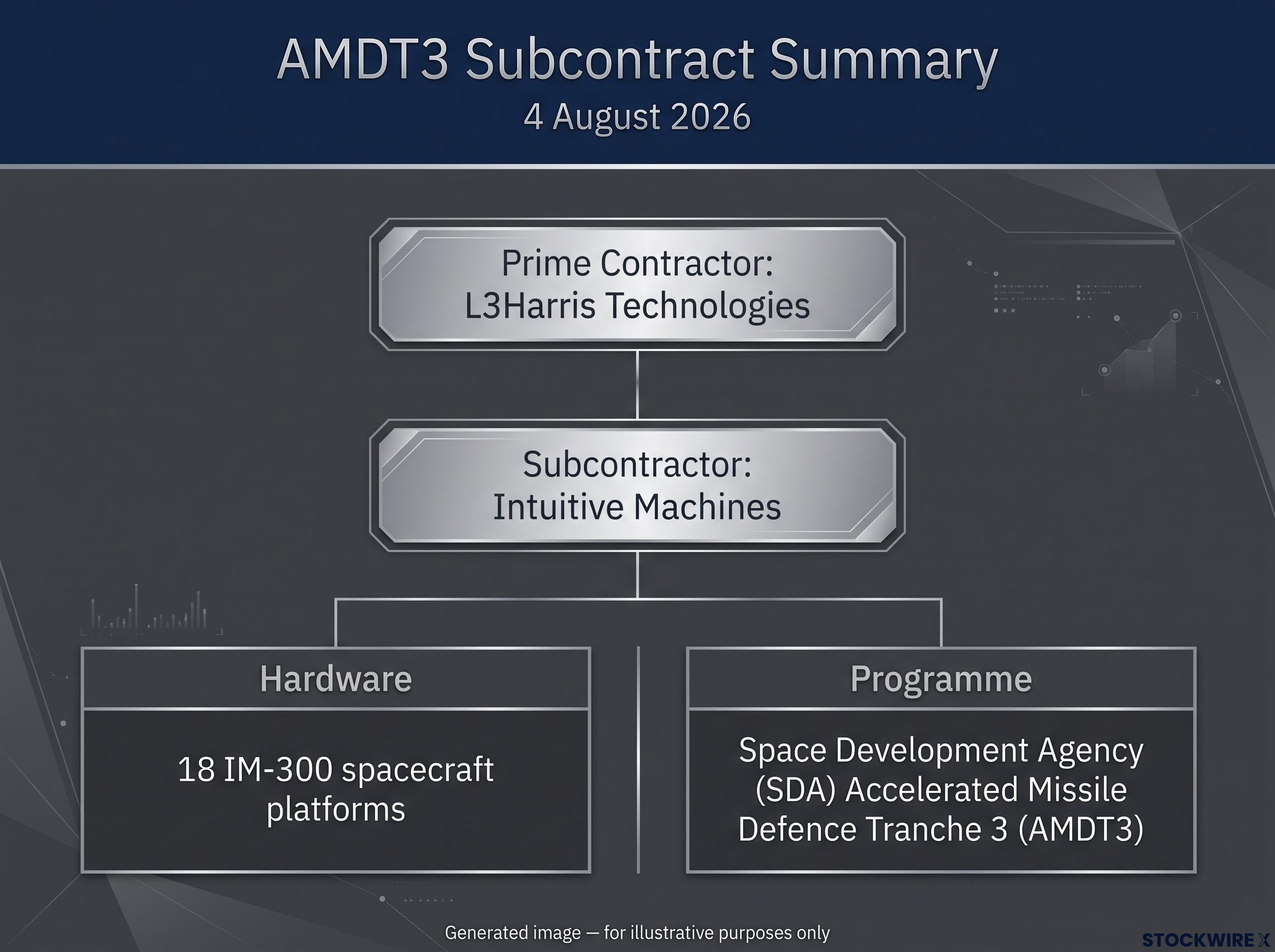
Intuitive Machines just locked in 18 spacecraft for a named defence prime, and the numbers tell you where this company is heading. The L3Harris AMDT3 subcontract, announced on 4 August 2026, commits the company to delivering 18 IM-300 platforms for the Space Development Agency’s (SDA) missile tracking constellation. The backlog has jumped from roughly $1.1 billion to approximately $1.8 billion in a single quarter.
Twelve months ago, Intuitive Machines was still primarily a lunar lander company, winning missions one at a time. The backlog now tells a different story: a multi-programme participant with civil and defence revenue streams anchored by a platform that keeps finding new applications. That strategic progress is real. So is the gap between a $1.8 billion backlog and the quarterly revenue run rate that has to convert it.
Here is what the L3Harris contract actually means for your LUNR position, and here are the four numbers and milestones that will tell you whether the thesis is holding or starting to slip.
What Intuitive Machines just committed to under L3Harris
The AMDT3 award places Intuitive Machines as a subcontractor under L3Harris Technologies, one of the largest U.S. defence primes, for the SDA’s Accelerated Missile Defence Tranche 3 programme. The SDA builds and operates distributed satellite constellations designed to detect and track hypersonic and ballistic missiles from orbit, a mission set that sits well outside LUNR’s original lunar and civil science work.
The contract terms are specific:
- Programme: SDA Accelerated Missile Defence Tranche 3 (AMDT3)
- Commitment: 18 IM-300 spacecraft platforms
- Role: Subcontractor under L3Harris (not a prime contract)
The subcontractor position matters more than it might appear at first glance. Working under a defence prime on a national security programme embeds Intuitive Machines in an environment where follow-on work, engineering change orders, and sustainment contracts are structurally common. That means the initial award value may understate the programme’s long-term revenue contribution. For your assessment of LUNR, the L3Harris relationship is not just a contract; it is a recurring access point to a spending category the company could not have reached on its own.
Defence prime relationships, such as the Northrop Grumman repeat order that anchored EOS’s March 2026 contract wins, illustrate how subcontractor positions with tier-one primes generate follow-on work through engineering change orders and programme expansions that the original award value does not capture.
When big ASX news breaks, our subscribers know first
How the IM-300 bus earned its place in missile defence
The IM-300 was not designed for missile tracking. It was built for lunar landings and data-relay missions, and its flight heritage in those roles is what earned it a seat at the SDA table. Defence programmes carry stringent reliability requirements, and the SDA does not select unproven platforms for a constellation that has to work on day one. The IM-300’s track record across multiple SDA tracking layer tranches gave L3Harris a bus with demonstrated capability, not a paper design.
From the Moon to missile tracking: what the IM-300 can do
Missile warning and tracking is a fundamentally different mission profile from lunar delivery. The spacecraft must operate in sustained orbital environments, maintain precise pointing for sensor payloads, and communicate within a distributed constellation architecture. That the IM-300 was selected for this role tells you something about deliberate capability investment: Intuitive Machines has been building a platform, not a single-use vehicle.
The SDA’s mandate is to modernise U.S. missile warning and tracking through a distributed, resilient orbital constellation capable of detecting and tracking hypersonic and ballistic threats.
Each successive defence win makes the next bid more credible. Platform heritage is compounding into a competitive position: the IM-300’s selection history across SDA tranches means future bidders have to compete against a bus with an operational record, not just a cost proposal. For LUNR investors, that compounding effect is what separates a one-cycle product from a recurring revenue asset.
The commercial space economy has already crossed $630 billion with 80% of revenues generated commercially, a structural shift that reframes how investors should evaluate platforms like the IM-300: not as single-mission vehicles, but as recurring infrastructure assets embedded in long-duration government and commercial programmes.
Reading the backlog: what $1.8 billion actually signals
The backlog growth is impressive. The conversion timeline is where the nuance lives.
Intuitive Machines exited Q1 2026 with approximately $1.1 billion in contracted backlog and roughly $186.7 million in quarterly revenue. By Q2, the backlog had climbed to approximately $1.8 billion, driven by the AMDT3 award and several commercial GEO satellite contracts. That is a $700 million increase in a single quarter.
But the conversion guidance shifted alongside the growth. Compare the two disclosure windows:
| Period | Backlog Level | Conversion Guidance |
|---|---|---|
| Q1 2026 (as of 31 March 2026) | ~$1.1 billion | 60-65% converting in remainder of 2026; 25-30% in 2027 |
| Q2 2026 | ~$1.8 billion | 25-30% converting in 2026; 35-40% in 2027; remainder thereafter |
The compression of near-term conversion rates tells you that LUNR’s revenue ramp is more back-loaded than it appeared three months ago. A larger backlog spread over a longer timeline changes the earnings profile for anyone evaluating this stock on a 12-month horizon.
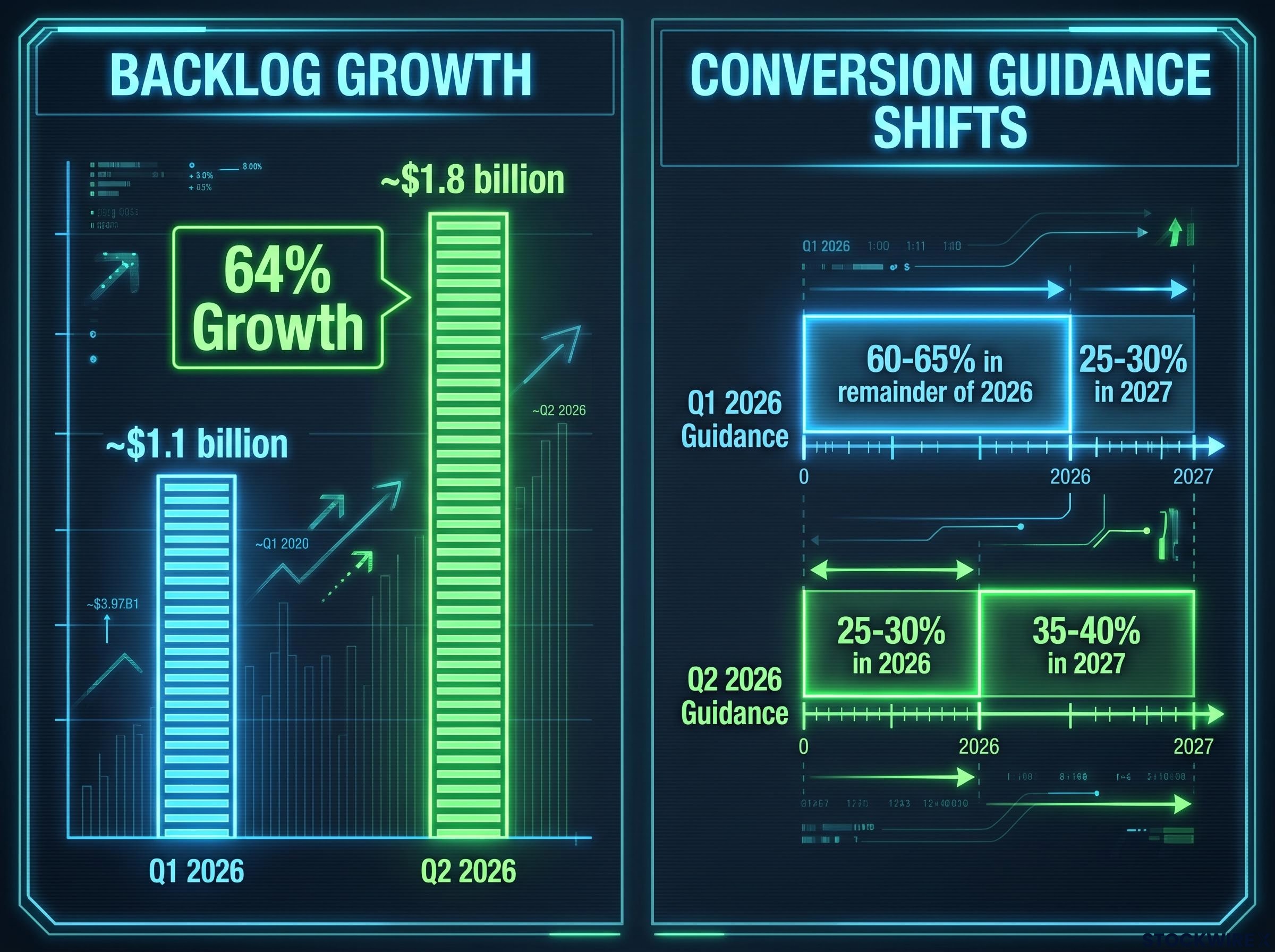
The backlog grew by 64% in one quarter. The share expected to convert within 2026 dropped from 60-65% to 25-30%. Both facts are true simultaneously. If you are holding LUNR for the multi-year thesis, the backlog expansion is exactly what you want to see. If you are watching for near-term earnings beats, the conversion timeline is telling you to recalibrate.
Defence contractor backlogs are not a straightforward measure of future revenue; the ratio of funded to unfunded backlog, book-to-bill trends, and conversion timing all shape whether a record backlog translates into earnings growth or simply a longer delivery queue.
Four execution risks every LUNR investor should track
The contract narrative is compelling. The execution narrative has not been written yet. These are the four signals that will tell you whether it is on track:
- Delivery schedule against AMDT3 milestones. The 18 spacecraft commitment is the execution benchmark. Hardware integration challenges, component sourcing delays, or government-driven schedule shifts will appear in backlog and guidance commentary before they show up in reported revenue. Watch quarterly earnings calls for delivery progress language.
- Backlog conversion efficiency. With $1.8 billion in backlog, the ratio of quarterly revenue to total backlog is the metric that matters. If backlog keeps growing faster than revenue, it may reflect genuine future demand, or it may reflect delays and scope changes. Track the conversion percentages quarter by quarter.
- Government contract concentration. CLPS lunar missions, SDA tracking layers, and AMDT3 represent significant concentration in large government programmes. A rebid loss, scope change, or funding delay in any single programme can materially affect quarterly results. Monitor programme-level disclosures and defence budget commentary.
- IM-300 production scalability and margins. Building 18 defence-grade spacecraft at the required quality bar raises the manufacturing capacity question. Watch capex guidance, hiring plans, supplier commentary, and any margin disclosures tied specifically to SDA and AMDT3 work for signs of whether Intuitive Machines can scale profitably, not just grow the top line.
These four watchpoints give you a concrete monitoring framework. The question from here is not whether the contract was won but whether the company can execute at the scale and margin required to make the backlog durable value.
What this contract changes for the LUNR investment thesis
The AMDT3 award is a credibility milestone, not an earnings event. It tells you that Intuitive Machines has a defensible platform strategy and a growing defence footprint. Whether the stock rewards that progress depends on whether execution matches the backlog story.
What changed:
- LUNR now has a named defence prime relationship with L3Harris and a missile-defence reference programme
- The $1.8 billion backlog is anchored across both civil and defence markets, reducing single-programme dependence
- The IM-300 platform has demonstrated multi-mission credibility, supporting a recurring revenue narrative that analysts view as consistent with the company’s broader strategic direction
What still requires proof:
- Margins on defence programmes at scale remain undemonstrated
- Revenue conversion is more back-loaded than early 2026 guidance suggested
- Manufacturing capacity for 18 defence-grade spacecraft has not yet been validated in quarterly results
For investors who entered LUNR on the lunar mission narrative, the company you now own is more complex. The AMDT3 award strengthens the medium-to-long-term thesis for those who can tolerate quarterly execution variability. Short-horizon investors face more uncertainty around near-term revenue conversion timing.
Tracking the thesis from here
Intuitive Machines has moved from a mission-by-mission lunar company to a recurring programme participant with a $1.8 billion backlog anchored in both civil and defence markets. The L3Harris AMDT3 award is the clearest signal of that transition yet, but it is the beginning of an execution story, not the end of one.
The quarterly signals to monitor: backlog conversion ratios against the 25-30% (2026) and 35-40% (2027) guidance, IM-300 delivery progress against AMDT3 milestones, margin commentary on SDA programmes, and capex disclosures related to production scaling. Those four data points will tell you whether the backlog is becoming revenue or remaining a number on the balance sheet.
Investors exploring how LUNR fits within the broader space equity universe will find our full explainer on top-performing space stocks, which profiles seven publicly traded names with one-year returns of 271% to over 1,000% and maps the structural growth thesis driving the sector.
This article is for informational purposes only and should not be considered financial advice. Investors should conduct their own research and consult with financial professionals before making investment decisions. Past performance does not guarantee future results. Financial projections are subject to market conditions and various risk factors.