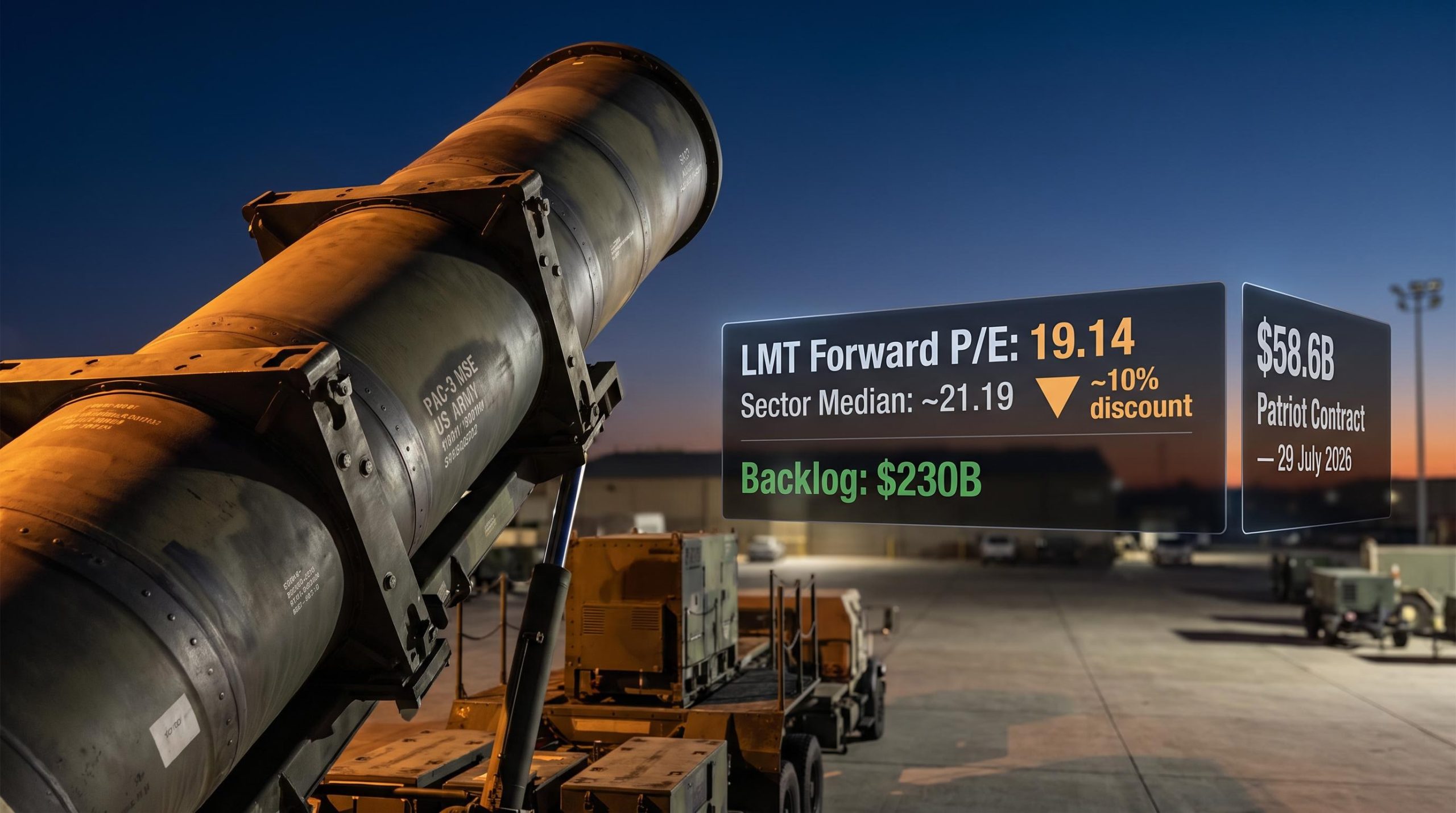
Two Pentagon contracts worth a combined $61.6 billion landed inside five days in late July and early August 2026, yet Lockheed Martin’s forward price-to-earnings ratio (P/E, the price investors pay per dollar of expected earnings) still sits roughly 10% below the defence sector median. That gap is either an opportunity or a signal the market has already priced what matters.
The $58.6 billion Patriot missile production award and the $3 billion component framework agreements with Northrop Grumman represent the most concentrated surge in missile-defence procurement in years. For investors watching LMT, the question is not whether these contracts are real. They are. The question is whether the demand behind them is durable or a conflict-cycle bulge that will normalise once stockpiles are rebuilt.
Here is what the data actually tells you about whether LMT’s discount to the sector is a buying signal or a trap: the contract scope, the backlog mechanics, the supply chain dependency most investors are overlooking, the demand durability question, and four specific signals to monitor before sizing a position.
What the Pentagon actually committed to, and what it did not
Two separate contract events landed in quick succession, and conflating them overstates what is locked in.
On 29 July 2026, the U.S. Army awarded Lockheed Martin a contract worth up to $58.6 billion over seven years to produce Patriot interceptor missiles through approximately 2032. That contract is described as “undefinitised,” meaning final terms, pricing mechanisms, and Congressional funding are not yet locked. Investors should treat the headline number as a demand ceiling rather than guaranteed revenue.
Five days later, on 3 August 2026, the Department of Defense signed framework agreements worth more than $3 billion with Lockheed Martin and Northrop Grumman to expand production of components for Patriot PAC-3 and THAAD (Terminal High Altitude Area Defense) interceptors.
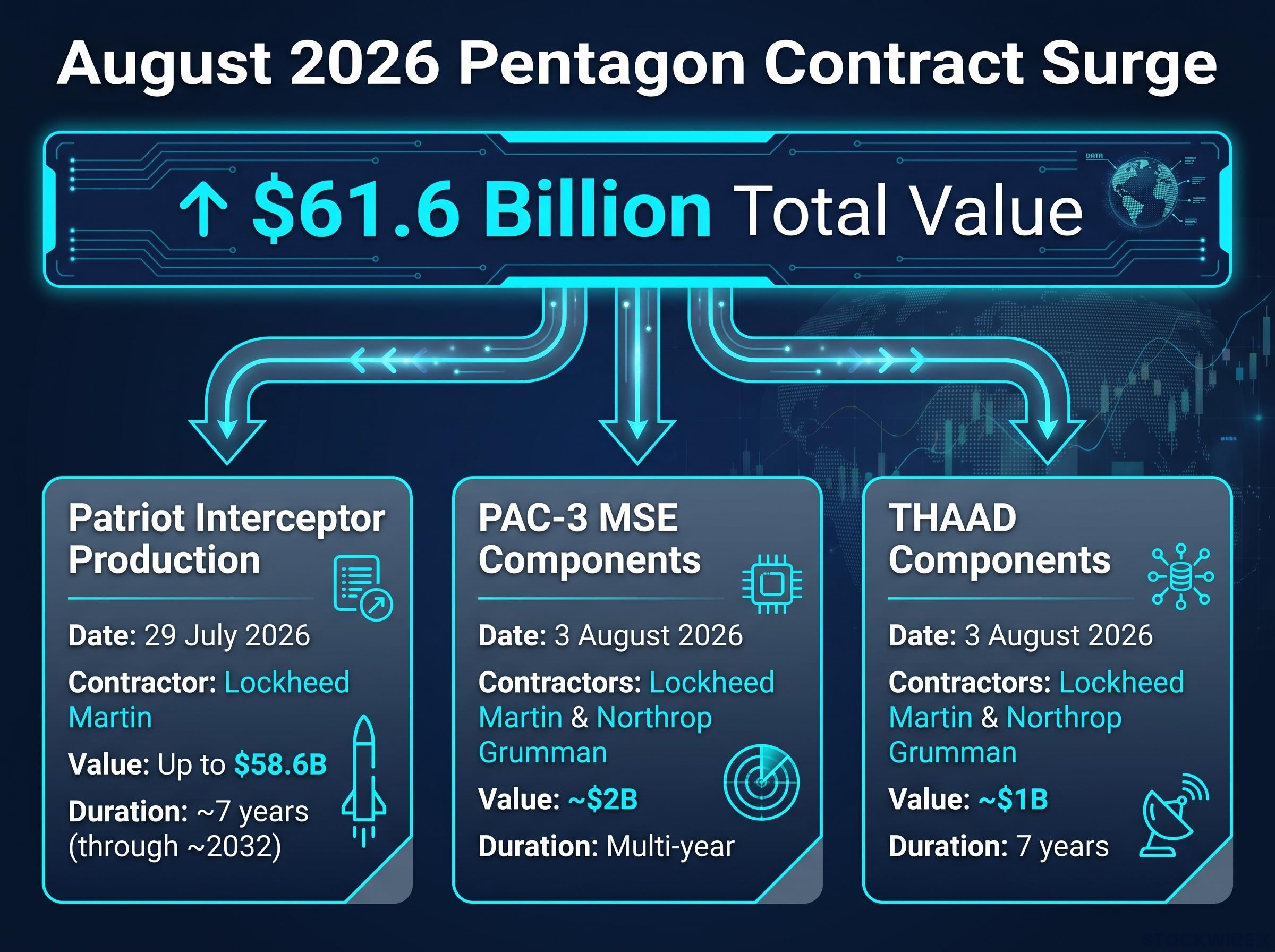
| Contract | Announced | Value | Term | Key Parties |
|---|---|---|---|---|
| Patriot interceptor production | 29 July 2026 | Up to $58.6B | ~7 years (through ~2032) | Lockheed Martin (prime) |
| PAC-3 MSE component framework | 3 August 2026 | ~$2B | Multi-year | Lockheed Martin, Northrop Grumman |
| THAAD component framework | 3 August 2026 | ~$1B | 7 years | Lockheed Martin, Northrop Grumman |
The production targets embedded in the frameworks are ambitious:
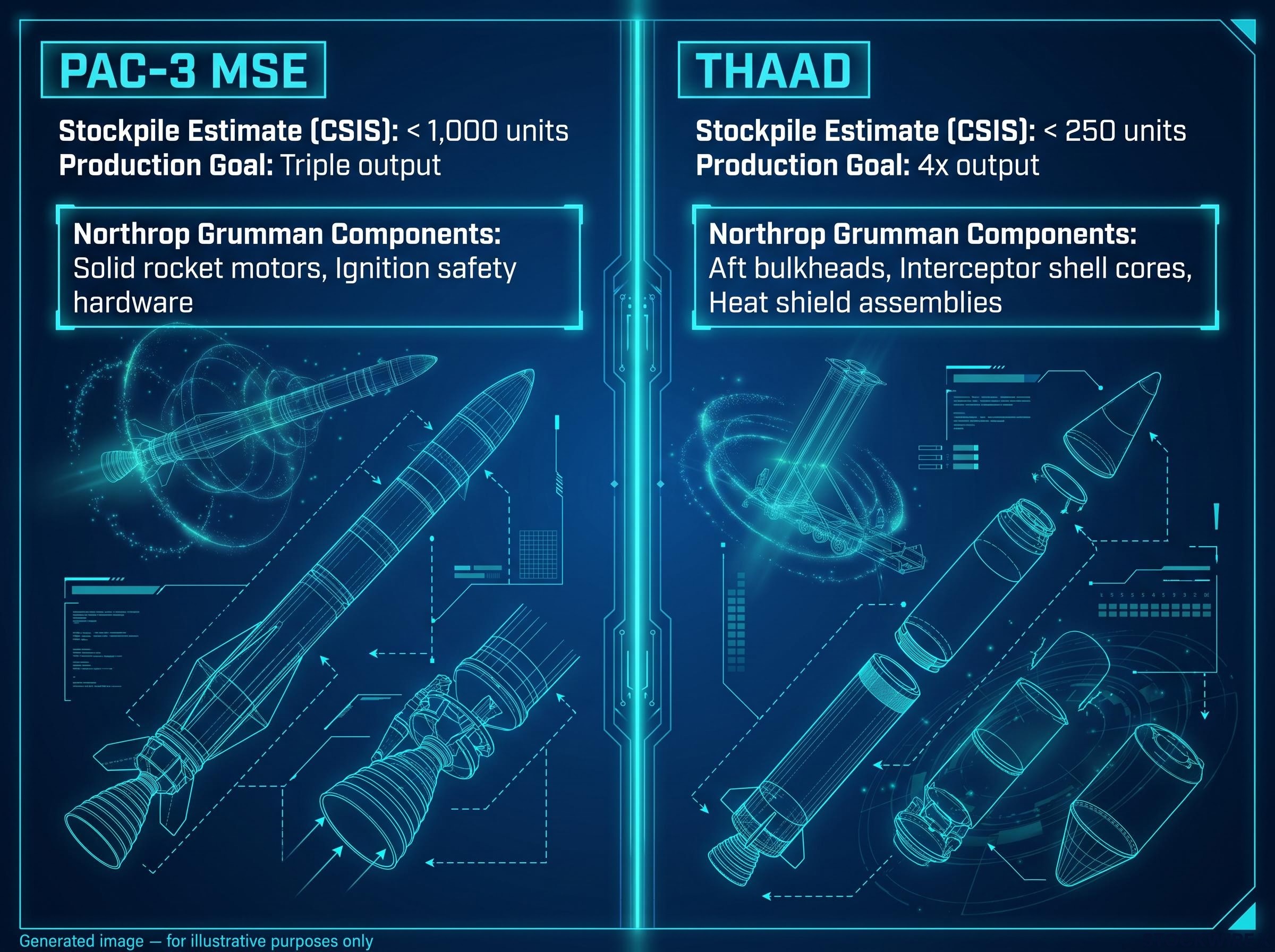
- The Pentagon’s stated goal is to triple PAC-3 MSE output from current monthly rates
- THAAD production is targeted to increase fourfold against existing throughput levels
- According to Centre for Strategic and International Studies estimates, U.S. Patriot interceptor stocks stood below 1,000 units at the time of announcement
- CSIS estimates placed U.S. THAAD interceptor holdings at under 250 units at the same point
The distinction between the headline figure and what is actually committed matters for how aggressively you underwrite near-term earnings. Until the $58.6 billion deal is definitised and funded, investors are modelling a demand ceiling, not a revenue floor.
When big ASX news breaks, our subscribers know first
Why the backlog makes LMT’s revenue trajectory unusually readable
Lockheed Martin exited Q2 2026 with a record backlog of approximately $230 billion, up roughly $64 billion year-on-year (note: the year-on-year figure is approximate and independently unverified).
That number does more than look impressive on a slide. In defence contracting, backlog functions as a revenue visibility tool: multi-year contracts already in hand allow analysts to model earnings with lower-than-normal uncertainty. Management raised 2026 guidance following Q2 results, and the PAC-3 interceptor programme was highlighted as a contributor to sustained long-term revenue growth.
Backlog analysis in defence contracting requires distinguishing funded from unfunded obligations and tracking book-to-bill momentum above 1.0x, metrics that are more predictive of genuine earnings trajectory than top-line revenue growth in any single quarter.
What the backlog means for modelling
The new Patriot and THAAD frameworks are incremental additions to a book of business that already extends well into the 2030s. For investors accustomed to evaluating companies where revenue visibility stretches one to two quarters, that structure fundamentally changes the risk profile of holding LMT through short-term noise.
A $230 billion backlog stretched across multi-year contracts means LMT’s revenue line is less sensitive to any single defence budget negotiation than the stock’s periodic selloffs on budget headlines would suggest. The backlog does not guarantee margins or cash flow conversion, but it significantly narrows the range of plausible revenue outcomes for the next several years.
The supply chain fix that makes the production ramp credible
What looks on paper like a routine supplier contract is, for LMT shareholders, a structural constraint being removed.
Solid rocket motors have historically been a binding production bottleneck for Patriot expansion. The Pentagon’s designation of Northrop Grumman as a second source for PAC-3 MSE solid rocket motors and ignition safety hardware is a direct attempt to break that constraint. This role previously did not exist for the company.
For THAAD, Northrop is extending a supply relationship it has held since 2002 rather than entering new territory. The components covered under that agreement include:
- Aft bulkheads
- Interceptor shell cores
- Heat shield assemblies
The framework is explicitly designed to increase monthly component availability, not just authorise spending.
What this means as an execution risk for LMT investors
Here is the part that most post-contract coverage has underplayed. Lockheed Martin’s ability to triple PAC-3 output now depends in part on Northrop Grumman ramping motors and components at scale and on schedule. Any production delays on Northrop’s side, whether manufacturing qualification issues, labour constraints, or cost overruns, become Lockheed’s delivery problem.
Prior to 3 August, LMT shareholders carried no exposure to Northrop’s ramp-up performance on PAC-3 motors. That linkage is now structural. The supply chain is more resilient in theory. It is also more interconnected in practice.
Is this structural demand or a conflict-cycle spike?
This is the most uncomfortable question in the thesis, and the contracts themselves do not resolve it.
The Pentagon’s own language frames these deals around “strained” stockpiles caused by conflicts in Ukraine and the Middle East. That is replenishment demand: restoring inventories to target levels, driven by a specific set of geopolitical conditions. It is not the same as structural demand growth, which would imply a permanent expansion of the addressable market for interceptors.
CSIS estimated that U.S. Patriot interceptor holdings had fallen below 1,000 units and THAAD stocks below 250 units by the time both contracts were announced.
The seven-year Patriot contract running through approximately 2032 provides a structural argument that even a replenishment cycle takes years to complete. But the distinction still matters for how you size and hold a position.
The CSIS missile inventory analysis framing these stockpile deficits as a multi-year rebuilding project reinforces why the seven-year Patriot contract structure reflects genuine procurement necessity rather than discretionary spending, making the demand ceiling argument harder to dismiss as pure political urgency.
Durable demand signals:
- Multi-year contract structures extending into the 2030s
- Allied nations deepening missile-defence cooperation, diversifying the customer base
Replenishment-cycle signals:
- Contracts explicitly tied to stockpile restoration caused by specific conflicts
- Both the $3 billion frameworks and the $58.6 billion Patriot deal remain subject to Congressional funding and final definitisation
If de-escalation in Ukraine or the Middle East arrives faster than expected, the political urgency behind accelerated procurement may fade after stockpile targets are met. The existing backlog would remain intact, but future awards and the multiple investors are willing to pay could compress. If the demand is primarily replenishment rather than structural, LMT’s order flow may front-load the next few years and then normalise. That is still a strong multi-year thesis, but a materially different one than pricing in permanent demand growth.
Historical analogues for conflict-driven rally reversals are instructive: defence stocks reversed by 10-30% after initial gains of 20-50% following the Gulf War, the 2002 Afghanistan buildup, and the 2003 Iraq invasion, each time as the gap between geopolitical urgency and actual budget appropriations became clear.
What LMT’s valuation discount to the sector actually signals
As of 13 August 2026, the numbers are straightforward:
| Metric | LMT | NOC | Sector Median |
|---|---|---|---|
| Forward P/E | 19.14 | 19.57 | ~21.19 |
| Discount to Sector | ~10% | ~8% | — |
| Risk Profile | Lower-volatility compounder | Higher-beta, margin recovery | — |
| Demand Exposure | Prime contractor, backlog in hand | Component supplier, execution-levered | — |
| Key Upside Driver | Efficient backlog conversion | New programme wins, margin expansion | — |
The market pricing implies one of three things: that LMT’s earnings growth is expected to be slower than peers, that risks are higher than they appear, or that the market has not yet fully priced the multi-year contract momentum.
A 10% forward P/E discount to the sector is only a genuine opportunity if the risks identified in this analysis, Northrop execution dependency, replenishment-cycle demand dynamics, and contract definitisation uncertainty, are already reflected in consensus estimates. If they are not, the discount may be warranted rather than mispriced. That is something you need to verify in the consensus models before treating the gap as free upside.
When weighing LMT against NOC, the contrasts are meaningful. LMT offers steadier compounding characteristics, with a substantial backlog already secured and lower earnings volatility. NOC carries greater execution risk given ongoing margin pressures, but also more upside optionality if new programme wins materialise and margins recover.
Four signals to watch before adding to a position
Rather than a buy or sell call, here are the four monitoring categories that will tell you whether this setup is strengthening or deteriorating:
- Northrop PAC-3 motor qualification and ramp milestones. No public timeline has been disclosed yet, making this a data gap. Any schedule slip disclosed by Northrop on PAC-3 motor production should be treated as a potential Lockheed delivery risk, because the two programmes are now structurally linked.
- LMT quarterly backlog and book-to-bill evolution. Watch whether the backlog holds above the Q2 2026 record of approximately $230 billion, and track the mix of U.S. versus international orders as a geopolitical diversification signal.
- Patriot contract definitisation and Congressional funding status. The $58.6 billion deal’s progression from undefinitised to fully funded is a near-term catalyst or risk, depending on direction. Look for updates in LMT’s quarterly filings and Pentagon budget documents.
Congressional funding constraints on defence appropriations operate within a broader fiscal context that investors in multi-year Pentagon contracts need to understand: US debt dynamics and deficit trajectory directly influence the political bandwidth for sustained procurement programmes of the scale embedded in LMT’s backlog.
- Geopolitical and defence budget developments. Trajectories of the Ukraine and Middle East conflicts are the macro override variable. Any material de-escalation or shift in U.S. fiscal priorities could alter the spending trajectory that underpins this entire thesis.
What the contracts change, and what they leave unresolved
The contracts meaningfully extend Lockheed Martin’s revenue visibility and partially de-risk the supply chain. A record $230 billion backlog, multi-year contract structures, and a forward P/E of 19.14 versus a sector median of approximately 21.19 make LMT one of the more defensible large-cap defence positions for investors with a multi-year horizon.
What they do not resolve is the demand durability question. The replenishment-cycle nature of the current procurement surge, the new execution dependency on Northrop Grumman, and the undefinitised status of the largest contract all remain open variables.
The core tension: strong multi-year visibility, paired with an unresolved question about whether the demand behind it outlasts the conflicts that created it.
This is not a set-and-forget position. It is a monitored one, where the four signals above are the levers that would cause a rational investor to add, hold, or trim. The margin of safety narrows meaningfully if the global security environment improves faster than the backlog converts.
This article is for informational purposes only and should not be considered financial advice. Investors should conduct their own research and consult with financial professionals before making investment decisions. Past performance does not guarantee future results. Financial projections are subject to market conditions and various risk factors.