You walk into Bunnings on a Saturday morning, grab a trolley, and start thinking about timber. At no point do you wonder who owns the building you are standing in, the car park beneath your wheels, or the land the whole site sits on. The answer, for dozens of locations nationally, is a company whose name has almost certainly never crossed your mind.
That gap between the brand on the shopfront and the entity on the title deed is not random. It is structural, and it repeats across thousands of sites nationally, from supermarkets to TAFE campuses to city office towers. Charter Hall Group (ASX: CHC) sits at one extreme of that gap: an ASX 100 company with more than A$92 billion in assets under management, operating a property footprint that millions of Australians move through each week with no idea who holds the title.
Here is how this model actually works, what it means for anyone thinking about ASX property stocks, and why a company shaping the physical infrastructure of daily Australian life can remain functionally invisible to the people inside its buildings.
Australia’s biggest property owner that most shoppers walk past every day
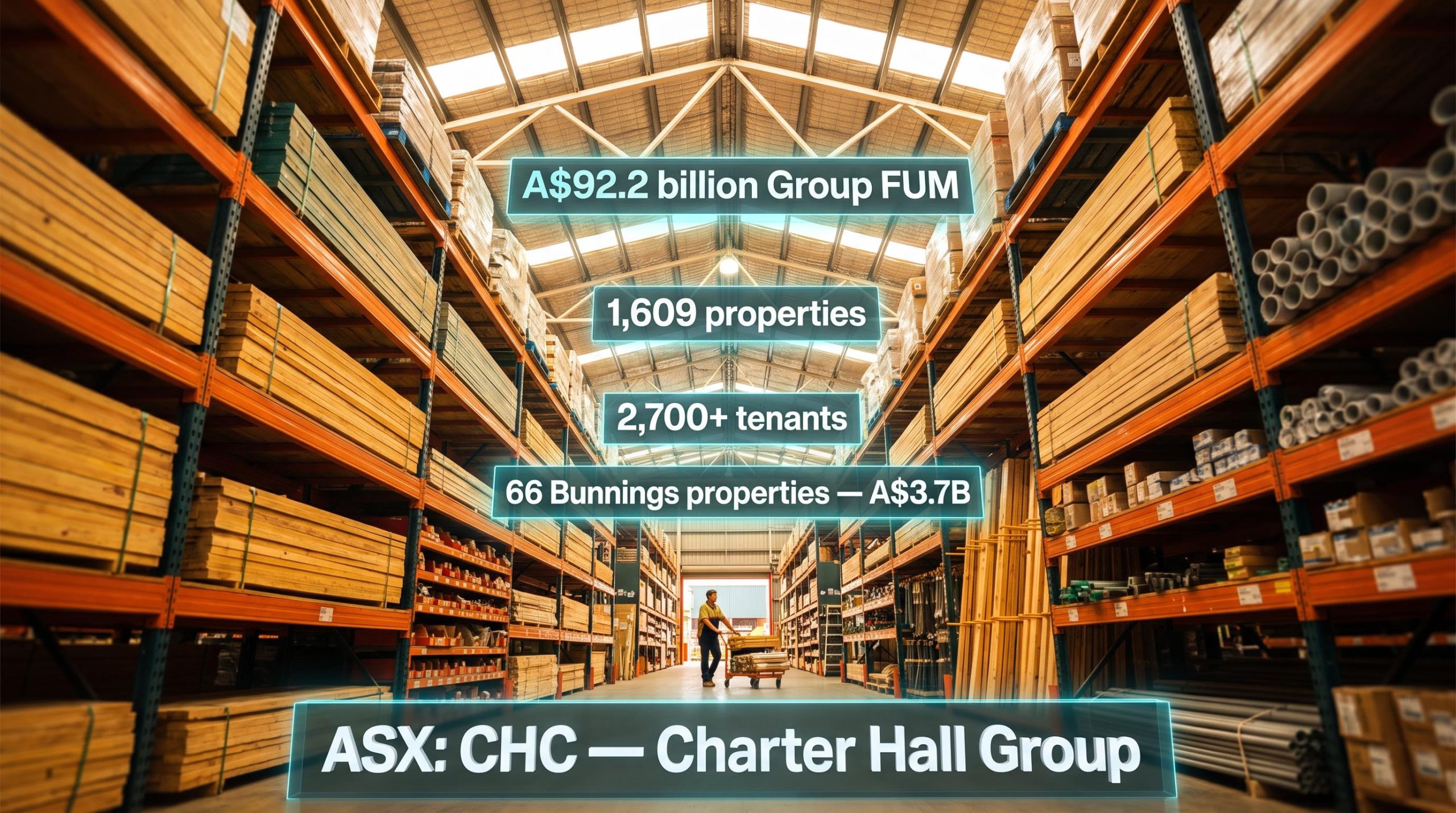
The asymmetry is simple to state and genuinely difficult to believe once you see the numbers. Charter Hall has grown over more than 34 years into the country’s leading fully integrated property investment and funds management group, holding ASX 100 status throughout that time. As at February 2026, the platform spans 1,609 properties across Australia, with a combined leased area exceeding 11.5 million square metres and a tenant base of more than 2,700 occupiers.
Most Australians have never heard of it.
The Bunnings relationship puts a fine point on why. At its 2022 peak, industry reporting put Charter Hall’s Bunnings holdings at 66 properties with a total attributed value of roughly A$3.7 billion, a concentration that represents one of the largest single-brand property positions held by any ASX-listed group.
Bunnings peak exposure: 66 properties nationally, combined value of approximately A$3.7 billion (2022 industry reporting). This figure derives from industry sources at a specific date, not live company disclosure.
That is not a curiosity. It tells you that ownership of Australia’s most visited hardware chain’s physical footprint is substantially concentrated in a single listed company you have almost certainly never considered when thinking about property exposure on the ASX. Group funds under management (FUM), the total value of assets Charter Hall manages across all its fund types, stood at approximately A$92.2 billion as at February 2026, including A$73.6 billion in Property FUM. Most people anchor their understanding of a business to its shopfront presence. Charter Hall’s scale proves that anchor is misleading.
When big ASX news breaks, our subscribers know first
How Charter Hall actually makes money (it is not what most people assume)
If you assumed Charter Hall runs stores, you have the model backwards. The business raises capital from institutional, wholesale and retail investors and deploys it into property, generating revenue through funds management fees rather than anything that happens at ground level inside those buildings. Financial performance is evaluated on metrics such as the creditworthiness and reliability of its tenants (tenant covenant quality), the average remaining duration of its leases weighted by income (weighted average lease expiry) and FUM growth, not foot traffic or brand recognition.
The property funds management model separates the entity that raises and deploys capital from the entity that experiences operational exposure at each site, with base management fees calculated as a direct percentage of FUM rather than any measure of what happens inside the buildings.
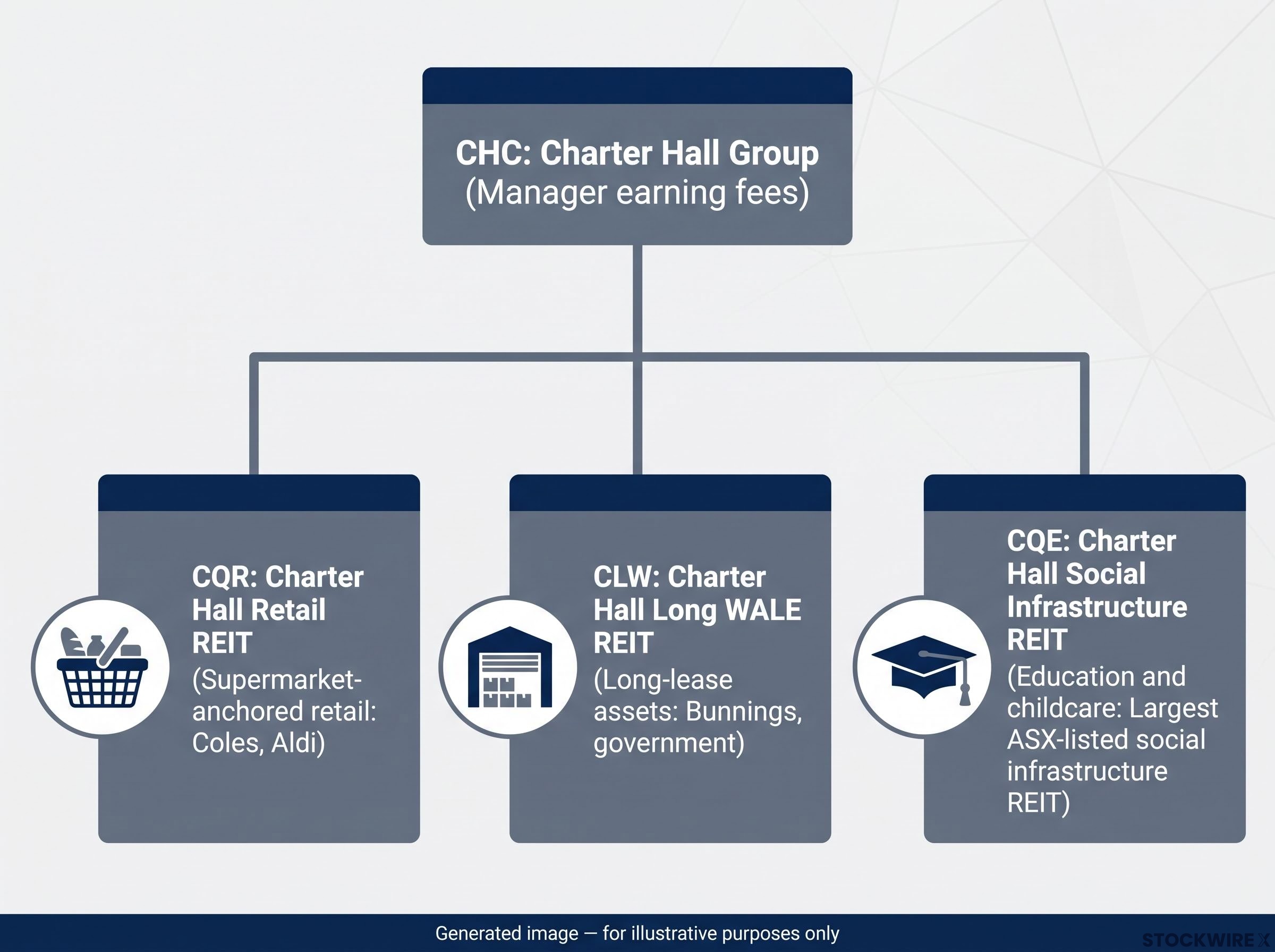
The platform operates through four listed vehicles on the ASX, each offering a different type of property exposure.
| Ticker | Vehicle Name | Asset Focus | Key Characteristic |
|---|---|---|---|
| CHC | Charter Hall Group | The ASX-listed manager itself | Earns fees from managing all vehicles |
| CQR | Charter Hall Retail REIT | Supermarket-anchored retail | Tenants include Coles and Aldi |
| CLW | Charter Hall Long WALE REIT | Long-lease assets | Bunnings and government tenants |
| CQE | Charter Hall Social Infrastructure REIT | Education and childcare | Largest ASX-listed social infrastructure REIT |
That four-ticker structure tells you something worth pausing on. Exposure to the Charter Hall platform is not a single binary decision. Each vehicle carries a different risk profile, lease duration and asset-class mix. Understanding which vehicle holds which type of property is the first step to evaluating any of them.
The ASX A-REIT listing framework governs how property trusts and managed investment schemes access public capital markets in Australia, setting the structural rules that underpin every vehicle in a platform like Charter Hall’s four-ticker suite.
The FUM growth trajectory shows how capital has compounded through this structure over time.
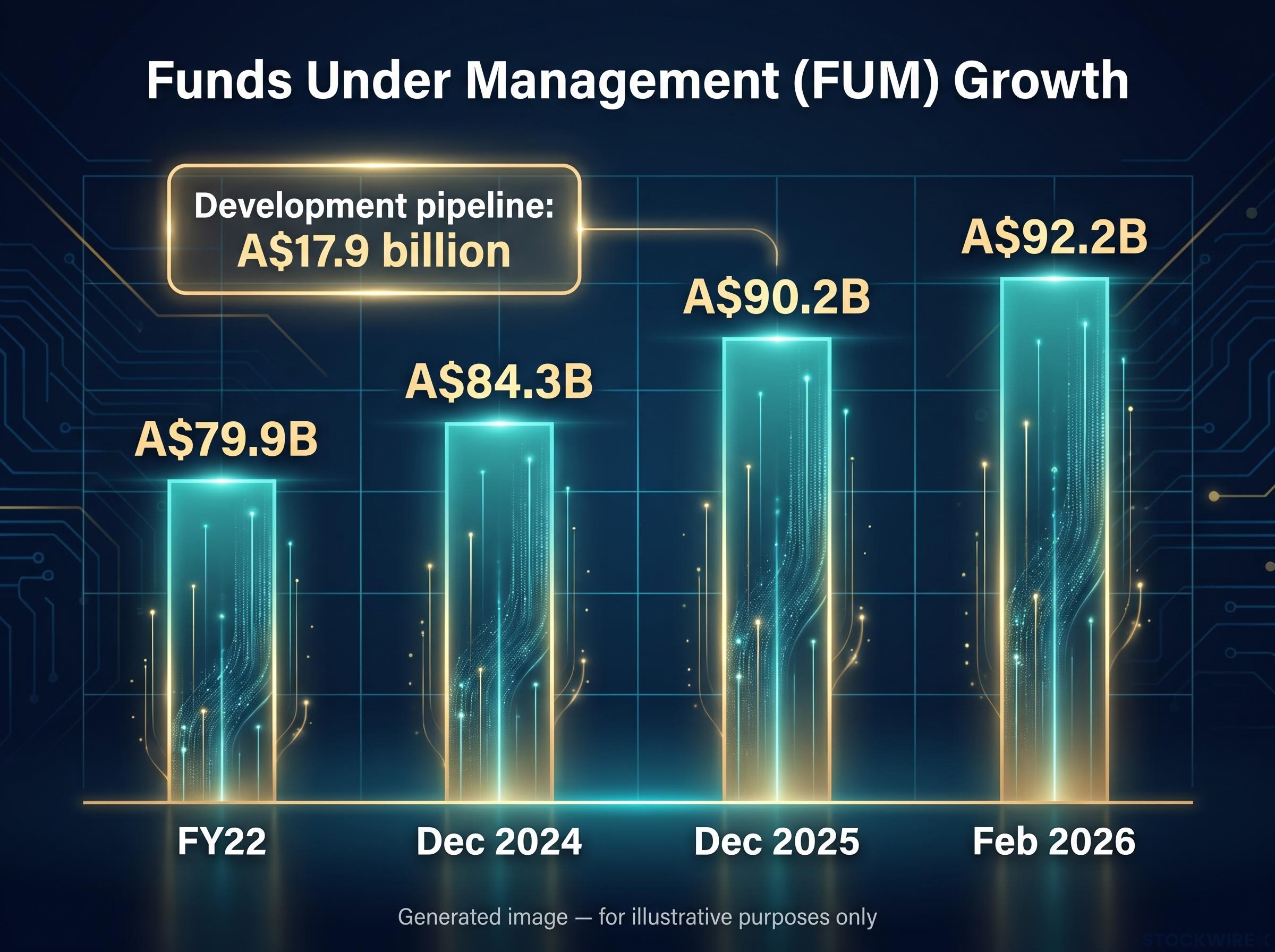
FUM growth: A$79.9 billion (FY22) → A$84.3 billion (December 2024) → A$90.2 billion (December 2025) → A$92.2 billion (February 2026). Development pipeline: A$17.9 billion.
Investors who treat Charter Hall as a conventional property company will misread the income model entirely. Growth here is measured in FUM trajectory, not comparable store sales.
What Charter Hall actually owns, and where you have almost certainly been
The Bunnings portfolio is the most recognisable piece, but it barely begins to describe the breadth. The full portfolio stretches across four asset class sectors, five capital cities and more than 1,609 properties. You have almost certainly been inside several of them without knowing it.
- Retail: Supermarket-anchored centres leased to Coles, Aldi and Bunnings through CQR and CLW
- Social infrastructure: TAFE campuses, childcare centres and government-funded facilities through CQE, the largest ASX-listed REIT investing in social infrastructure
- Office: Major commercial towers in key CBD locations, including 555 Collins Street in Melbourne and No. 1 Martin Place in Sydney
- Industrial and logistics: Logistics parks and industrial estates supporting supply chains nationally
The portfolio spans Sydney, Melbourne, Brisbane, Adelaide and Perth. That geographic and sectoral diversification means most working Australians encounter Charter Hall-managed property regularly, whether they are dropping children at childcare, buying groceries or walking into a city office.
How the Bunnings exposure grew over time
The Bunnings progression illustrates how institutional property accumulation compounds quietly. In 2019, Charter Hall held 48 Bunnings Warehouse assets valued at more than A$1.9 billion (per a company release). By 2025, industry reporting placed the count at 59 properties valued in excess of A$2.4 billion, with 50 of those in metropolitan locations. The 2022 peak figure of 66 properties at approximately A$3.7 billion remains the largest on record from available sources.
All three figures derive from industry reporting or dated company releases rather than live disclosure, and the current number may differ following subsequent acquisitions or disposals. The direction, though, is clear: the footprint has grown substantially over time.
Why most investors miss this, and what that means for how they think about ASX property stocks
If you have never heard of Charter Hall before reading this, you are not alone, and the reason is structural rather than accidental. Investors who use consumer brand recognition as a proxy for business quality will systematically overlook large, well-established institutional property operators. Charter Hall has no shopfront. Its name appears on no building you walk into. There is no consumer product to associate with it.
Yet it is an ASX 100 constituent. It manages approximately A$92.2 billion in Group FUM (with A$73.6 billion in Property FUM) across more than 1,600 properties and 2,700 tenant relationships. Each of those tenant relationships represents a diversification point invisible to any individual shopper.
The scale of the blind spot: ASX 100 member. A$92.2 billion in Group FUM. 1,609 properties. 2,700-plus tenants. And most Australian investors have never evaluated it.
Recognising Charter Hall’s scale relative to its low investor profile is not, by itself, a reason to buy or avoid the stock. What it does is prompt a more accurate mental model of what ASX property stocks actually encompass. The segment is considerably larger and more institutionally complex than brand-based thinking implies, and investors who close this knowledge gap gain more than familiarity with one company. They develop a clearer framework for assessing the entire portion of the ASX where institutional property funds managers operate, which is where a significant share of Australia’s commercial property exposure is actually concentrated.
How operational risk and ownership control sit on opposite sides of the lease
In institutional property, the party that faces day-to-day operational exposure at a site and the party that holds long-term structural ownership are routinely different entities, a distinction that most people have no reason to examine until they start thinking about it as investors.
When you walk into a Bunnings and the floor is dirty or the shelves are disorganised, that is the tenant’s problem. The tenant holds accountability for how the site looks, how safe it is and how customers experience it. The landlord, meanwhile, holds a long-dated income contract backed by a physical asset. The tenant’s day-to-day operational performance and the landlord’s income stream are separated by the terms of the lease.
This separation is why institutional landlords like Charter Hall are assessed through metrics such as lease expiry profiles and tenant covenant quality rather than foot traffic or consumer sentiment. Three structural layers insulate the landlord’s income:
- Long-lease terms lock in duration, giving the landlord income certainty measured in years or decades rather than quarters
- Covenant quality filters tenant risk, favouring tenants with strong balance sheets, government backing or essential-service status
- Diversification across sectors spreads exposure, so weakness in one property type or tenant category does not compromise the platform
CLW’s portfolio is a clear example: its long-lease assets, including Bunnings and government tenants, sit on the landlord’s side of the ledger with long weighted-average lease expiries and strong covenants. CQE’s social infrastructure holdings, where the tenant is often a government body or government-funded provider, offer a particularly durable income profile.
CQE’s FY26 results illustrate the income durability the article describes in practice: operating earnings per unit rose 13.1%, the portfolio carried 99.7% occupancy on an 11.4-year WALE, and two major acquisitions, including a 20-year triple-net-lease pathology lab, were completed without equity dilution.
Charter Hall is not passively holding existing assets, either. The A$17.9 billion development pipeline confirms active growth of the platform. For you as an investor evaluating ASX property stocks, the landlord-tenant risk split means the landlord’s income can remain stable even when a tenant’s retail business faces consumer pressure. That structural insulation is a core part of what institutional property funds management actually sells.
This article is for informational purposes only and should not be considered financial advice. Investors should conduct their own research and consult with financial professionals before making investment decisions.
Rethinking what “property exposure” means on the ASX
The businesses most Australians associate with a location are not the ones that own it. In institutional property on the ASX, operational visibility and structural ownership routinely sit with different parties, and that separation is a design feature of the model rather than an anomaly. Charter Hall is one example, the largest and most data-rich, within a broader category of institutional property funds managers operating the same structural logic.
The practical implication for you is specific. Evaluating ASX property stocks requires looking past brand recognition to a different set of questions entirely:
Applying a structured REIT valuation framework to any of Charter Hall’s four listed vehicles requires moving past FUM headlines to stress-test reported NTA against cap-rate shifts, compare yield spreads to government bonds, and assess gearing headroom before treating any discount as a genuine entry signal.
- Who actually owns the underlying property, and through what fund structure?
- Who are the tenants, and how strong are their covenants?
- How long are the leases, and what does the weighted average lease expiry profile look like?
- How does the manager grow and deploy capital on behalf of investors?
Charter Hall’s numbers, A$92.2 billion in Group FUM, 1,609 properties, more than 2,700 tenants, a presence across five cities and four sectors, built over 34-plus years, tell you that the answer to “what does Australian commercial property look like on the ASX” is far larger and more institutionally sophisticated than any shopfront would suggest.
The next time you walk into a Bunnings, a Coles, a TAFE campus or a city office tower, the question is no longer whether someone else owns the building. The question is whether your portfolio reflects the fact that they do.
—