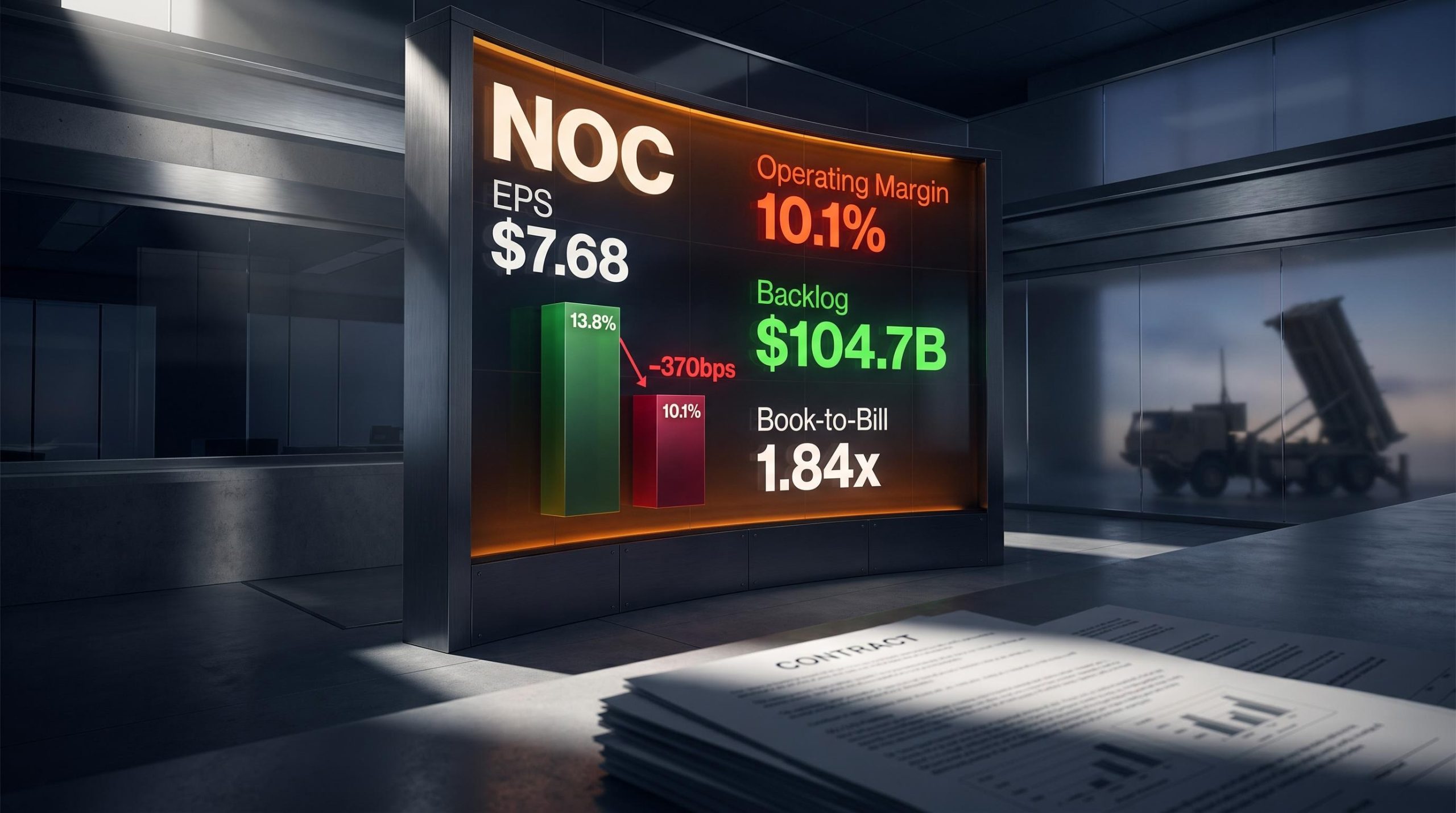
Northrop Grumman just reported a record backlog of nearly $105 billion, a book-to-bill ratio of 1.84x, and a clean EPS beat. Its operating margin fell from 13.8% to 10.1% in a single year.
Both of those things are true at the same time, and that tension is precisely what makes NOC one of the more complex reads in defence right now. Strong contract wins and raised guidance tell one story. Segment-level income declines in two of four business units, cost overruns in named programmes, and a stock that sold off on a beat-and-raise quarter tell another.
This piece untangles the two narratives, identifying which financial signals reflect temporary accounting noise and which reflect a structural margin problem that should change how you think about NOC’s risk profile before adding to a position.
What the Q2 2026 numbers actually show
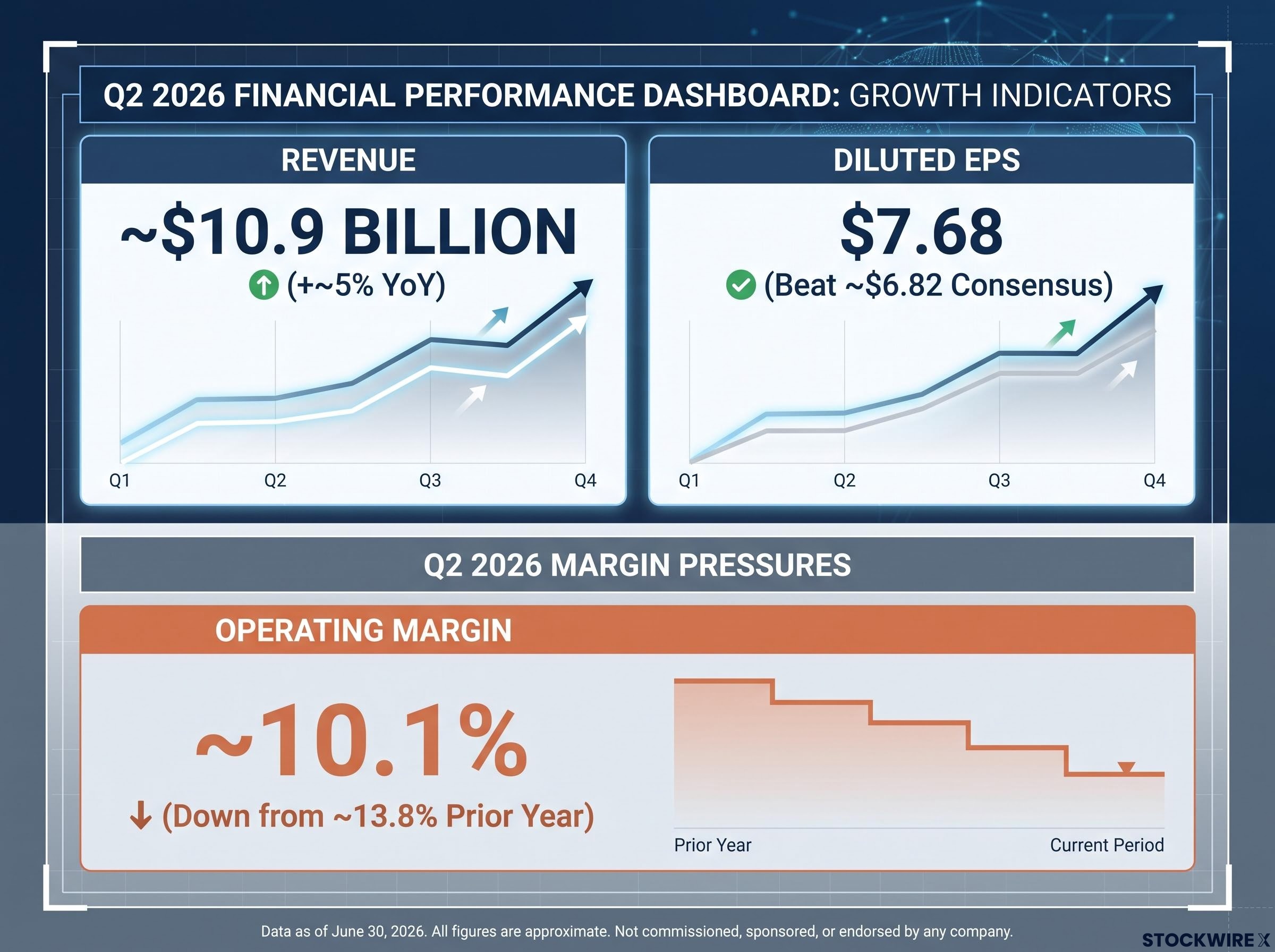
Northrop Grumman posted Q2 2026 revenue of approximately $10.9 billion, up roughly 5% year over year, with net earnings of approximately $1.1 billion and diluted EPS of $7.68. That EPS figure beat analyst consensus of approximately $6.82 by $0.86, a comfortable outperformance by any standard.
But EPS was also down approximately 6% from the prior year’s $8.15. The year-over-year comparison is structurally noisy: Q2 2025 included a gain on the sale of the training services business and larger pension-related benefits, neither of which repeats.
The number that actually matters sits one line deeper. Operating margin compressed to approximately 10.1%, down from approximately 13.8% a year earlier. That tells you Northrop Grumman is keeping materially less of each dollar it earns, and that dynamic does not resolve simply because the quarter beat consensus.
| Metric | Q2 2026 | Prior Year / Consensus |
|---|---|---|
| Revenue | ~$10.9 billion | +~5% YoY |
| Diluted EPS | $7.68 | vs. $8.15 prior year (~6% decline) |
| Consensus EPS | ~$6.82 | Beat by ~$0.86 |
| Operating Margin | ~10.1% | vs. ~13.8% prior year |
The margin signal: Operating margin fell from 13.8% to 10.1% in twelve months, a 370-basis-point compression that no EPS beat fully offsets.
When big ASX news breaks, our subscribers know first
Why the earnings beat is less reassuring than it looks
An EPS beat tells you a company exceeded expectations. It does not tell you how. The distinction matters here because the source of the beat shapes how much confidence you should assign to Northrop Grumman’s raised guidance.
Three specific factors inflated the headline:
- A lower effective tax rate in Q2 2026 contributed to the EPS outperformance. Part of the beat came from the tax line, not from stronger operations.
- Non-recurring prior-year comparison items made the consensus bar easier to clear. Q2 2025’s $8.15 EPS included a divestiture gain and larger pension-related benefits that do not repeat, meaning the year-over-year decline is partly an artefact of a distorted base period.
- Declining margin per dollar of revenue sits underneath the headline. Operating income of approximately $1.1 billion at a 10.1% margin represents the genuine operational output before tax and accounting factors adjusted the EPS number upward.
On a like-for-like operational basis, underlying profitability is weaker than the EPS number communicates. The beat is operationally hollow relative to what the segment data reveals.
If the effective tax rate normalises higher in future quarters, EPS could weaken even if operations hold steady. That means investors relying on the headline beat as a sign of operational health are accepting more downside risk than the number suggests.
Where the margin pressure is actually coming from
The 10.1% margin is a blended figure. Blended figures obscure where the pain actually sits. Segment-level data locates it precisely.
Year-over-year operating income fell across two of Northrop Grumman’s four business segments in Q2 2026:
- Space Systems and Defence Systems both saw income fall, driven by negative estimate-at-completion (EAC) adjustments. An EAC adjustment is an accounting catch-up: when actual programme costs exceed the original cost projections on a contract, the company revises its estimate for what the programme will ultimately cost, and the difference flows through as a hit to operating income in that quarter.
- Management named GEM 63XL and SiAW as the programmes where cost pressures are concentrated, attaching the margin problem to specific contracts rather than leaving it as a vague sector-wide concern.
EAC adjustments in development-stage programmes can persist across multiple quarters. If GEM 63XL and SiAW remain sources of negative revisions, the margin problem is not a one-quarter event but a sustained drag you need to price in.
Government space contracts, including the $40 billion FY2026 US Space Force budget, represent one of the structural demand drivers behind NOC’s Space Systems segment, which makes the negative EAC adjustments in that segment particularly significant: the demand environment is strong precisely because government spending is growing, making execution cost overruns the primary risk factor rather than revenue visibility.
How fixed-price contracts create margin risk
A fixed-price contract is exactly what it sounds like: the contractor agrees to deliver at a set price regardless of actual costs incurred. If costs come in under the fixed price, the contractor keeps the difference as profit. If costs overshoot, the contractor absorbs the loss.
This is structurally different from cost-plus contracts, where the government reimburses actual costs and pays a fee on top. Under cost-plus arrangements, overruns are largely the customer’s problem. Under fixed-price contracts, they are entirely the contractor’s problem.
The GAO analysis of fixed-price contract risk in major defence acquisition programmes confirms that contractors absorb cost overruns entirely under fixed-price arrangements, the precise mechanic generating the negative EAC adjustments that dragged NOC’s segment income lower in Q2 2026.
That is the mechanic behind the Q2 2026 segment results. When GEM 63XL and SiAW overshot cost projections, Northrop Grumman absorbed the difference, generating the negative EAC adjustments that dragged segment income lower even as revenue kept growing.
The bull case: record backlog and new contract wins
The margin concerns are real, but so is the demand picture, and dismissing it would be analytically dishonest. What Northrop Grumman is building in terms of future revenue visibility is genuinely formidable.
Northrop Grumman’s backlog reached approximately $104.7-$105 billion in Q2 2026, a record for the company, up in the mid- to high-teens percentage range year over year.
Three pillars underpin the bull case:
- Record backlog and a 1.84x book-to-bill ratio. Q2 net awards of approximately $20 billion mean the company is winning significantly more new business than it is recognising as revenue. That is a strong leading indicator for future revenue growth.
- New contract diversification. The PAC-3 MSE secondary supplier role opens a revenue line that did not previously exist for the company, while its established THAAD programme reinforces the broader missile defence franchise.
- Raised guidance. Management raised full-year 2026 sales and EPS guidance despite the margin pressures, reflecting real confidence in the demand environment.
Defence contractor backlogs are a leading indicator of future revenue, but the Parsons Corporation Q1 2026 case illustrates a nuance that applies directly to NOC: a record backlog can coexist with a fixed-price contract dragging organic revenue lower, which is why the composition of the backlog matters as much as its headline size.
The bull case is not wrong. It is arguing about the wrong variable. The debate for NOC investors is not whether revenue will grow but whether margin quality will recover alongside it, and a 1.84x book-to-bill does not answer that question on its own. Whether that growth comes with better or worse margins depends entirely on the contract terms of those new awards.
What institutional investors are signalling about NOC versus its peers
Sophisticated capital is already making a differentiated call within the defence sector, and the positioning data suggests the margin concern is not just an analytical construct but a live consideration for large allocators.
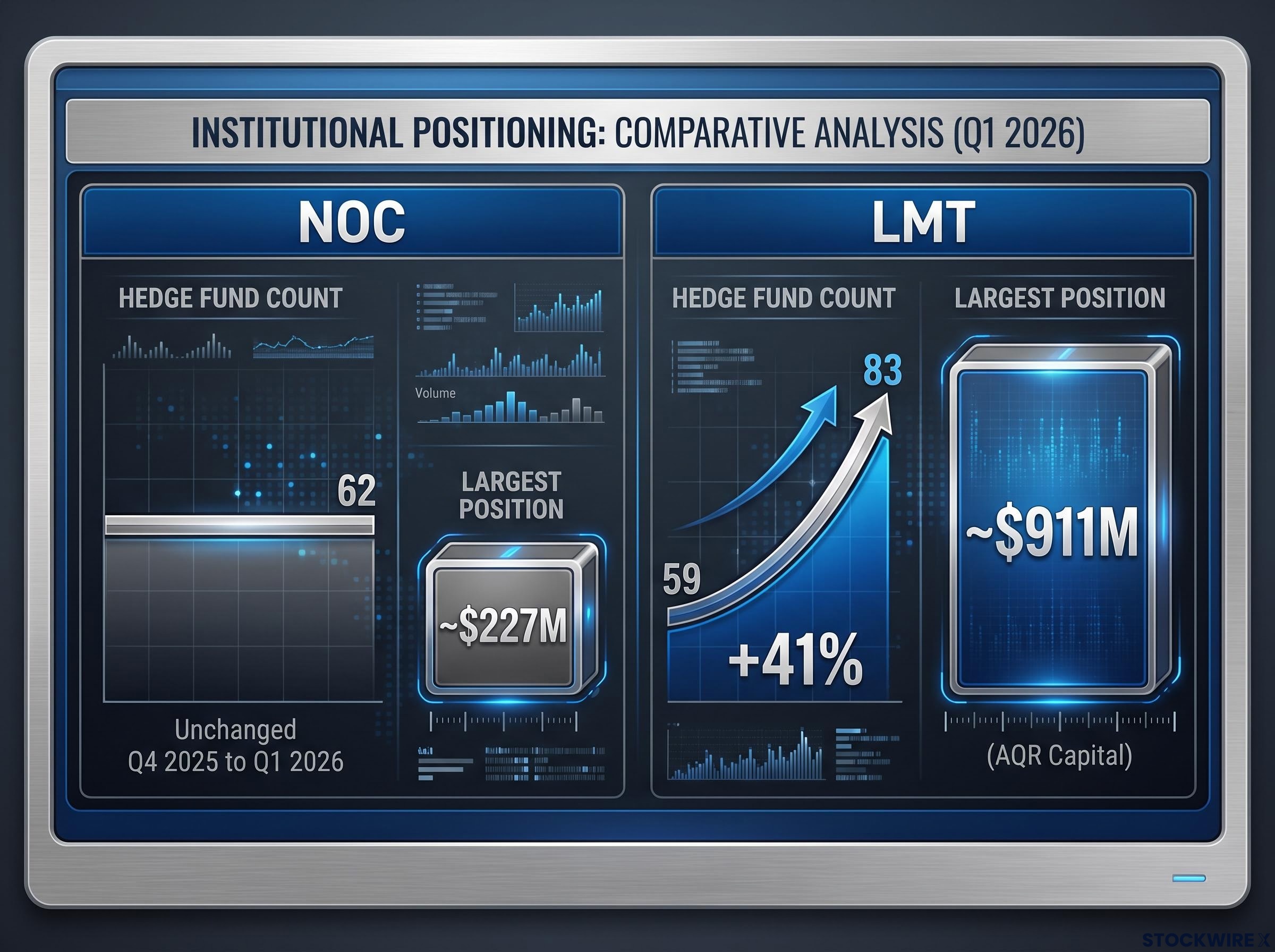
During Q1 2026, the number of hedge funds holding Lockheed Martin jumped 41%, rising from 59 to 83 funds, while the count holding Northrop Grumman held steady at 62 funds, exactly where it stood at the close of Q4 2025.
The conviction gap shows up in position size, too. AQR Capital Management ranked as the largest Lockheed Martin holder at over $911 million as of Q1 2026, with Two Sigma Advisors at approximately $815 million and D.E. Shaw at approximately $584 million behind it. The equivalent top-three positions in Northrop Grumman were considerably smaller, at approximately $227 million, $216 million, and $142 million respectively.
| Metric | NOC | LMT |
|---|---|---|
| Hedge fund count (Q4 2025) | 62 | 59 |
| Hedge fund count (Q1 2026) | 62 (unchanged) | 83 (+41%) |
| Largest position | ~$227M | ~$911M (AQR Capital) |
| Post-Q2 2026 earnings reaction | Stock declined | N/A |
When a stock sells off on a beat-and-raise quarter, that market signal deserves attention. It reflects institutional investors concluding that the quality of the earnings does not support a higher price, which is exactly the earnings-quality concern at the centre of this analysis.
Defence sector valuation multiples add a further layer to the NOC margin story: with ITA and XAR trading at roughly 24x and 23x forward earnings respectively, approximately 10-20% above their five-year averages, the sector-wide premium leaves little room for the kind of earnings-quality miss that NOC’s Q2 2026 results represent.
Four variables to watch before making a position decision on NOC
The current evidence does not resolve the bear case, but it does define the specific signals that would confirm or invalidate it over the coming quarters. Rather than forcing a verdict now, the right approach is to monitor four disclosed data points:
- EAC adjustment trends in Space Systems and Defence Systems. Track whether negative EAC adjustments in these two segments abate or persist across Q3 and Q4 2026 earnings reports. Stabilisation would suggest the cost overruns are contained; escalation would deepen the margin concern materially.
- Programme-specific updates on GEM 63XL and SiAW. Management commentary on cost trajectory for these two programmes is the most direct signal of whether the margin problem has concrete endpoints or is an open-ended risk. Watch for additional charges or, conversely, language suggesting costs are stabilising.
- Effective tax rate trajectory. A lower tax rate contributed meaningfully to the Q2 2026 EPS outperformance. Future quarter disclosures will reveal whether the lower rate was a one-quarter event or a more durable feature. If it normalises higher, EPS could weaken even if operations hold steady.
- Contract structure of new awards. As details emerge from filings and management commentary on PAC-3 MSE, THAAD, and other new contracts, the fixed-price versus cost-plus breakdown will tell you whether new backlog adds margin-accretive revenue or merely adds volume and execution risk.
None of these watchpoints require you to predict an outcome now. They require monitoring specific disclosed data across the next two to three quarters, which is exactly how a margin recovery thesis should be tested rather than assumed.
Systematic frameworks for evaluating defence contractors weigh pipeline visibility and margin stability alongside book-to-bill momentum, a combination that explains why a record backlog at a 1.84x award ratio does not automatically translate into a stronger investment case if the margin trajectory is moving in the opposite direction.
This article is for informational purposes only and should not be considered financial advice. Investors should conduct their own research and consult with financial professionals before making investment decisions. Past performance does not guarantee future results. Forward-looking statements regarding margin recovery, EAC stabilisation, and programme cost trajectories are speculative and subject to change based on market developments and company performance.
Revenue growth without margin recovery is a thesis to monitor, not act on
Northrop Grumman’s demand environment is genuinely strong. A record backlog, a 1.84x book-to-bill, new contract wins, and raised guidance are not cosmetic signals. They represent multi-year revenue visibility that most companies in any sector would envy.
But the current profitability evidence does not yet support treating that demand as a margin catalyst. Two segments are absorbing cost overruns on named programmes, the EPS beat was partly tax-driven, and institutional capital is differentiating away from NOC toward Lockheed Martin within the same defence spending environment.
If you are building a new position, the evidence says wait for EAC stabilisation before acting. If you already hold NOC, the four watchpoints above define the signals that will either validate the revenue-to-margin thesis or expose it as the gap that sophisticated investors are already pricing in. The margin quality question is what separates a strong revenue story from a strong investment, and right now, the revenue story is further ahead than the investment case.