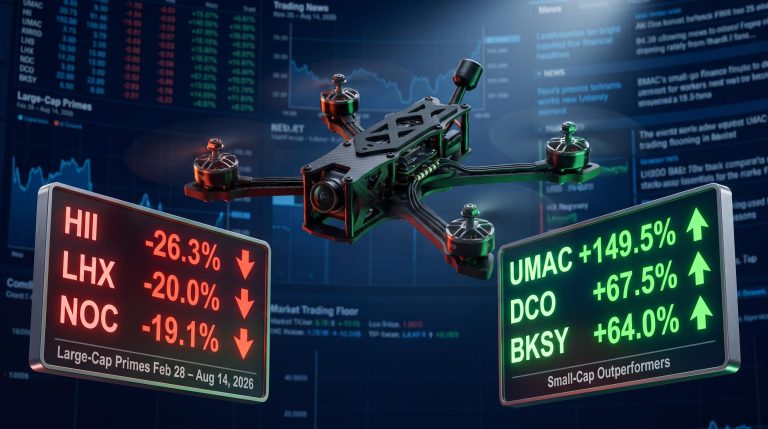
Since late February 2026, three small- and mid-cap defence companies have posted returns ranging from 64% to nearly 150%, a run that dwarfs what the S&P 500 and the major defence primes managed over the same period following the outbreak of hostilities involving U.S. and Israeli forces against Iran.
The conflict created an immediate, concentrated demand spike for drones, missile components, and real-time satellite intelligence. That demand did not flow evenly across defence. It flowed to the companies with the most direct exposure to the specific capabilities being consumed, and the gap between where the money went and where it did not tells you something concrete about how war-driven capital rotation actually works at the stock level.
Here is exactly which three companies captured that outperformance, what is driving each move, and what a late-stage entry into any of these names actually costs in risk terms today. The opportunity and the hazards sit side by side.
The three companies that led defence’s conflict-era rally
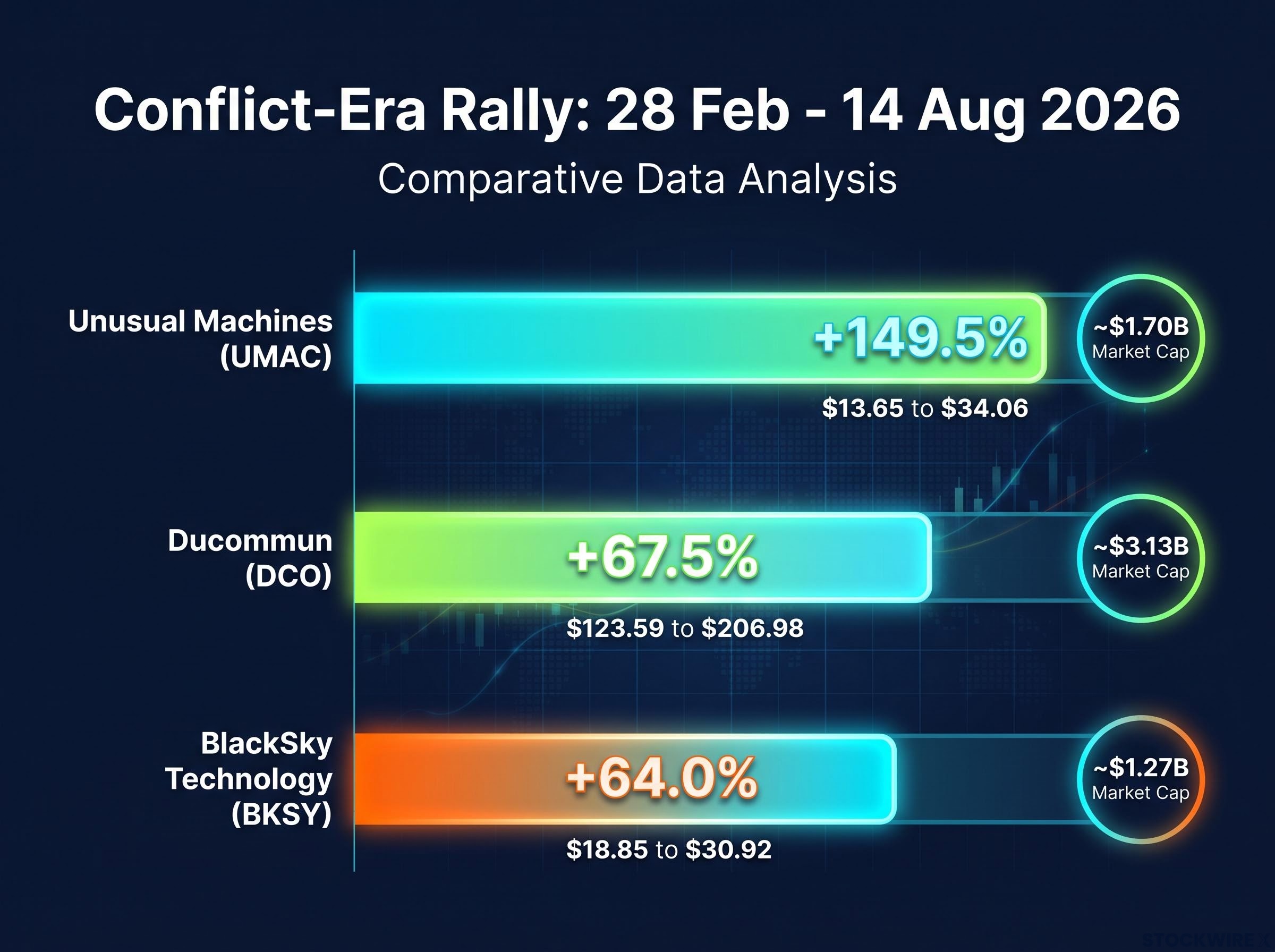
The numbers speak first. From 28 February through 14 August 2026, three small- to mid-cap defence names outperformed everything else in the sector by a wide margin.
| Company | Ticker | Gain (28 Feb – 14 Aug 2026) | Market Cap |
|---|---|---|---|
| Unusual Machines | UMAC | +149.5% ($13.65 → $34.06) | ~$1.70B |
| Ducommun | DCO | +67.5% ($123.59 → $206.98) | ~$3.13B |
| BlackSky Technology | BKSY | +64.0% ($18.85 → $30.92) | ~$1.27B |
None of these are the major primes. All three are technology-oriented names sitting at the intersection of a capability gap the conflict made immediately urgent:
- Direct drone warfare and autonomous systems exposure
- Missile supply chain components already being consumed at elevated rates
- Real-time satellite intelligence for active battlefield awareness
The spread between 64% and 150% across just three names tells you the market was making sharp distinctions about which type of exposure it valued most. Understanding those distinctions matters before any positioning decision.
When big ASX news breaks, our subscribers know first
Ducommun’s gains are grounded in something the others are not: a verified backlog
Founded in 1849 and now operating across a wide range of aerospace and defence programmes, Ducommun manufactures structural and electronic components that sit inside the weapons systems seeing the heaviest wartime consumption. Its product scope covers radar enclosures, ammunition handling systems, and flight control assemblies, with customers including RTX and Lockheed Martin on programmes such as AMRAAM, SM-3, SM-6, Tomahawk, PAC-3, and THAAD.
The financial record through the first half of 2026 separates DCO from its two peers:
- Q1 2026: Record quarterly revenue of $209.0 million, up approximately 9% year over year, marking the 20th consecutive quarter of year-over-year growth. Missile revenue climbed approximately 22%.
- Q2 2026: Another record at $224.5 million, up approximately 12% year over year, with missile-related sales surging on PAC-3 and SM-6 platforms.
- Remaining performance obligation (RPO): This is the total value of contracted work the company has yet to deliver. It grew from $1.074 billion in Q1 to approximately $1.16 billion in Q2, with military and space backlog reaching approximately $723 million.
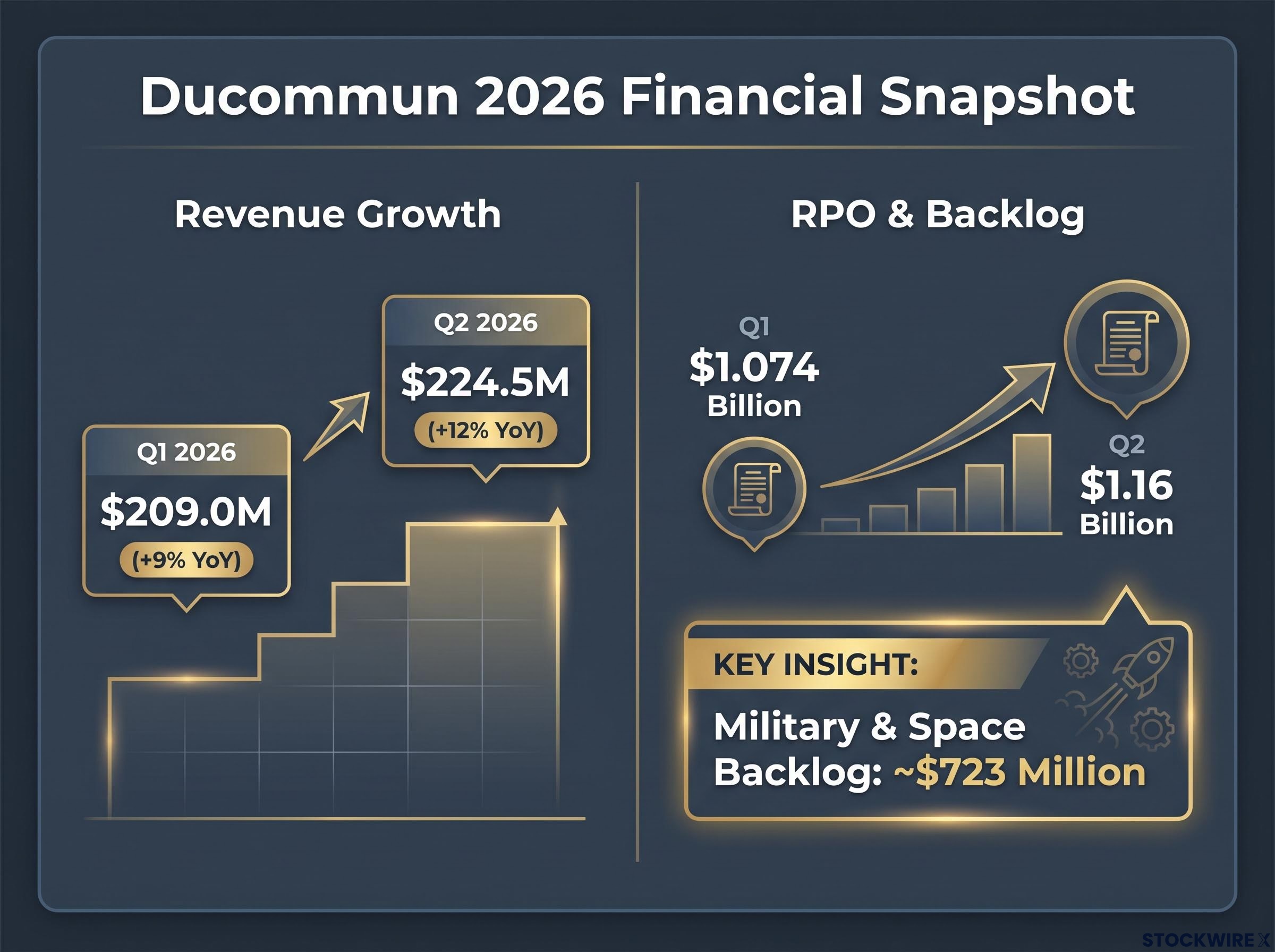
That backlog gives Ducommun multi-year revenue visibility that neither UMAC nor BKSY currently has. The stock is trading near its 52-week high with a market cap of approximately $3.13 billion.
The remaining performance obligation figure that separates Ducommun from its two peers is precisely the metric that backlog analysis in defence investing treats as the primary indicator of genuine growth, distinguishing companies with contracted forward revenue from those riding sentiment momentum.
What the 2027-2028 production ramp means for the next leg
Management expects production volumes on some programmes to increase between roughly 1.5x and 10x over the next seven years under framework agreements running through approximately 2027-2033. These multi-year contracts lock in production volumes for specific missile programmes, providing forward visibility but also creating risk: if procurement priorities shift or budgets are realigned, those ramp assumptions could be revised.
There is also a pull-forward dynamic to account for. Management has flagged that some Q2 strength was borrowed from future quarters, so second-half 2026 results may soften before the framework ramp begins in earnest around 2027-2028. A growing, long-duration backlog gives Ducommun a fundamentally different risk profile from its two peers, but investors entering now at elevated prices are buying at a point where much of that backlog is already reflected in the stock.
Unusual Machines surged 150% on drone demand and policy headlines
Based in Orlando and focused on the distribution of small commercial drones and autonomous system components, Unusual Machines became the market’s clearest small-cap expression of drone warfare demand once the conflict began. The stock moved from $13.65 to $34.06, a gain of 149.5%, in under six months.
The single most telling data point about what kind of move this actually is came on 28 May 2026.
UMAC surged approximately 57% in a single session, triggered by Wall Street Journal reporting on U.S. government financing negotiations for drone makers. At that point, the stock was already up roughly 116% year-to-date.
That single-day move was driven by a press report about potential funding, not a contract disclosure. Through a collaboration with Lantronix, the company has developed AI-driven edge computing capabilities for flight control systems, but the broader thesis rests heavily on prospective government funding that has not yet been formally committed. Retail and online investor communities have amplified the war-trade narrative around UMAC in ways that have themselves moved the price.
The FY 2026 NDAA drone procurement provisions established a Joint Interagency Task Force and a Small-UAS Industrial Base Working Group specifically to coordinate small-drone purchasing and assess supplier capacity, creating the legislative scaffolding that would underpin any formal government funding commitment to companies like Unusual Machines.
When a stock’s largest single-day moves are triggered by press reports rather than contract announcements, the same mechanism that drove it up can drive it down just as fast if funding news disappoints. UMAC is the purest sentiment expression in this group. That purity cuts both ways.
What BlackSky Technology actually sells, and why conflict made it matter
BlackSky Technology may be the least familiar of the three names. The firm runs a network of small Earth-observation satellites whose data feeds an AI-enabled analytics platform called Spectra. Spectra gives customers continuous, near-real-time visibility over ports, logistics routes, troop movements, and critical installations, precisely the kind of persistent situational awareness that becomes operationally essential when governments are managing an active military campaign.
The conflict re-rated BKSY’s strategic value. Its stock moved from $18.85 to $30.92, a gain of 64.0%, on a market cap of approximately $1.27 billion, the smallest of the three.
The strategic case is sound: governments always need intelligence, and wars accelerate that need. But the financial story underneath is the most conditional of the group.
BlackSky’s Spectra platform competes for attention in a Pentagon procurement environment that has rapidly restructured around a seven-vendor coalition: defence AI contracts are now flowing to firms with established classified cloud infrastructure and GPU compute capacity, a structural shift that shapes which intelligence-platform vendors gain multi-year government commitments and which remain episodic suppliers.
Conflict-driven demand for real-time imagery can spike rapidly during active engagements but may be episodic. Equity pricing in satellite intelligence tends to overshoot on war headlines, then compress as conditions normalise.
The 64% gain represents the market pricing in a step-change in strategic value. That pricing only holds if BKSY translates wartime demand into durable, multi-year government contracts, the kind of recurring revenue that would anchor the business the way Ducommun’s RPO does. Specific contract data and detailed financials for BKSY were not available in verified research, which itself speaks to the gap between narrative and verified fundamentals.
Understanding small-cap defence plays during an active conflict
Smaller, technology-focused defence companies tend to outpace the large primes during active conflict periods for a structural reason. The primes have diversified revenue bases and slow procurement cycles that insulate their earnings from any single event. Small caps with specific, conflict-relevant capabilities get re-rated quickly because the market prices in the expectation that their particular product or service is being consumed right now.
The entry-point risk applies not just to these three names but to the broader sector: defence sector valuation across ITA and XAR had already reached forward P/E multiples 10-20% above five-year averages by May 2026, with Goldman Sachs, BofA, and Barclays all flagging overcrowding before this rally extended further.
The analytical lens that matters most is where each stock sits on the fundamentals-versus-sentiment spectrum. At one end, Ducommun with verified revenue growth and a growing backlog. At the other, UMAC with policy expectations and narrative momentum as the dominant drivers. BKSY sits in between, with a clear strategic rationale but less verified financial momentum.
Three risk factors apply to every name in this category:
- Event and headline risk: Ceasefire developments, shifts in U.S. policy toward Iran, or changes in drone-export or satellite-intelligence rules can alter revenue expectations faster than these companies can adjust cost structures
- Entry-point valuation risk: Buying after gains of 64% to 150% means far less margin of safety if expectations are revised downward
- Thesis durability risk: The distinction between sentiment-driven re-ratings and contract-verified momentum determines which gains hold and which compress when conditions normalise
A 30-40% drawdown in any of these names would be consistent with their recent volatility history and would still leave early conflict-era buyers positive while severely impacting late entrants. None of these three companies carries the balance sheet depth or procurement diversification of the major defence primes.
What the risk-reward calculus looks like from here
The three investment cases are distinct, and treating them as a single “drone and surveillance stocks” trade misses the most important differentiator.
| Company | Thesis Basis | Key Upside Catalyst | Key Risk | Time Horizon Fit |
|---|---|---|---|---|
| UMAC | Policy/sentiment; drone demand narrative | Formal government funding commitment | Funding not yet firm; sentiment reversal | Short-term trade with strict risk controls |
| DCO | Record revenue; growing backlog; framework agreements | 2027-2028 production ramp under frameworks | Pull-forward risk; procurement tempo changes | Medium- to longer-term; evidence-based |
| BKSY | Real-time intelligence demand; Spectra platform | Conversion of wartime demand into multi-year contracts | Episodic demand; contract conversion uncertainty | Conditional on contract evidence |
Short-term conflict traders need a clear exit framework tied to policy or ceasefire news. Longer-term investors should demand evidence that war-driven demand is translating into durable contracts, recurring revenue, and margin expansion before sizing up.
The structural asymmetry is this: investors who entered before 28 February 2026 are in a fundamentally different position from those evaluating entry today. Conflating those two situations is the most common error in post-rally analysis. The most actionable insight here is not which stock to buy, but how to think about position sizing and thesis requirements given that the next phase requires more precise judgement about fundamentals and durability.
After 150% in six months, the trade has changed but the story has not ended
The conflict created a genuine and ongoing demand for drones, missile components, and real-time intelligence. That demand is real. What has changed is not the strategic narrative but the price at which investors are now being asked to own it.
The conflict remains active as of 17 August 2026, with no confirmed ceasefire or resolution. Further positive price movement is entirely possible. But position sizing must now reflect the entry-point reality of stocks that have moved 64% to 150% in under six months. The next material catalyst for this group is not a continuation of the current move but the resolution or escalation of the conflict itself, paired with the translation of war-era demand into durable, audited contracts for UMAC and BKSY, and the 2027-2028 framework ramp for Ducommun.
BCA Research’s framework on ceasefire risk is directly relevant to position sizing here: the firm warns that preliminary negotiations, not confirmed resolutions, drive the largest price reversals, and that commodities tied to conflict regions can reprice sharply without any change in physical supply, a dynamic that applies equally to the government contract pipelines underpinning UMAC and BKSY.
“The story is good” and “the trade is still good at today’s price” are two separate questions. Conflating them is the mechanism by which late entrants in conflict-era rallies consistently underperform.
This article is for informational purposes only and should not be considered financial advice. Investors should conduct their own research and consult with financial professionals before making investment decisions. Past performance does not guarantee future results. These statements are speculative and subject to change based on market developments and company performance.