A company can show genuine technological progress, real user growth, and credible management execution, and still never produce a financially self-sustaining business. That gap between operational achievement and financial viability is where most infrastructure-heavy technology investments quietly fail.
For investors in ASX tech stocks, this distinction matters more than it does in most other sectors. The pool of Australian-listed companies that have chosen to build their own infrastructure rather than resell someone else’s is small enough that each one becomes a referendum on whether the model can work at all. Pentanet Limited (ASX: 5GG) has just produced its first-ever full-year positive EBITDA (earnings before interest, tax, depreciation, and amortisation), the measure of whether core operations generate more cash than they cost to run. That makes it a useful live case study for understanding what this inflection point looks like, what it actually signals, and what it does not guarantee.
Here is the framework for reading the profitability inflection point in any capital-intensive ASX tech company, using Pentanet’s FY25 result as the worked example throughout.
Why building your own infrastructure makes the early numbers look so bad
There are two ways to become a telecommunications provider. You can resell capacity on someone else’s network, which means lower capital intensity and a faster path to margins. Or you can build your own infrastructure, which means higher upfront spending, longer periods of losses, and a delayed but potentially more durable earnings base once customer density catches up to the investment.
Companies that choose the second path are supposed to look loss-making in their early years. Network infrastructure spending on towers, equipment, and coverage expansion is incurred long before revenues scale to match it. Growth and losses coexist without contradiction, because the asset being built has not yet reached the scale where it generates enough recurring income to cover the cost of running it.
The ASX tech index has delivered a negative five-year return at the index level, but that aggregate figure blends profitable, recurring-revenue businesses with loss-making speculative names, making it a poor guide to individual stock assessment in a sector as structurally varied as technology.
The problem is that few companies attempting this ever reach sustainable economics. The reasons tend to cluster around three outcomes: funding is exhausted before the network achieves the customer density needed to operate profitably; the network is completed but the addressable market or pricing structure cannot support the cost base; or a larger operator acquires the company before it has the opportunity to demonstrate independent financial viability.
- Capital depletion before scale: funding runs out before the network reaches the density required for viable unit economics.
- Insufficient customer density: the network is built, but the market size or pricing cannot sustain the ongoing operating costs.
- Acquisition before independent viability: a larger operator absorbs the company before it can prove the model on its own.
And the balance sheet pressure is not front-loaded. For network operators, capital intensity is continuous. Equipment upgrades, coverage extensions, and capacity improvements require ongoing expenditure for as long as the network operates.
The difference between growing and sustainable
Revenue growth and financial sustainability are not the same thing. A company can increase revenue every year while still operating on a structurally unviable cost base, where each new customer costs more to serve than they contribute in margin. You cannot tell the difference from a revenue chart alone. That is why the profitability inflection point, not the growth rate, is where the real signal sits.
When big ASX news breaks, our subscribers know first
What Pentanet actually built, and why the model is harder than it looks
Pentanet did not choose one hard path. It chose two.
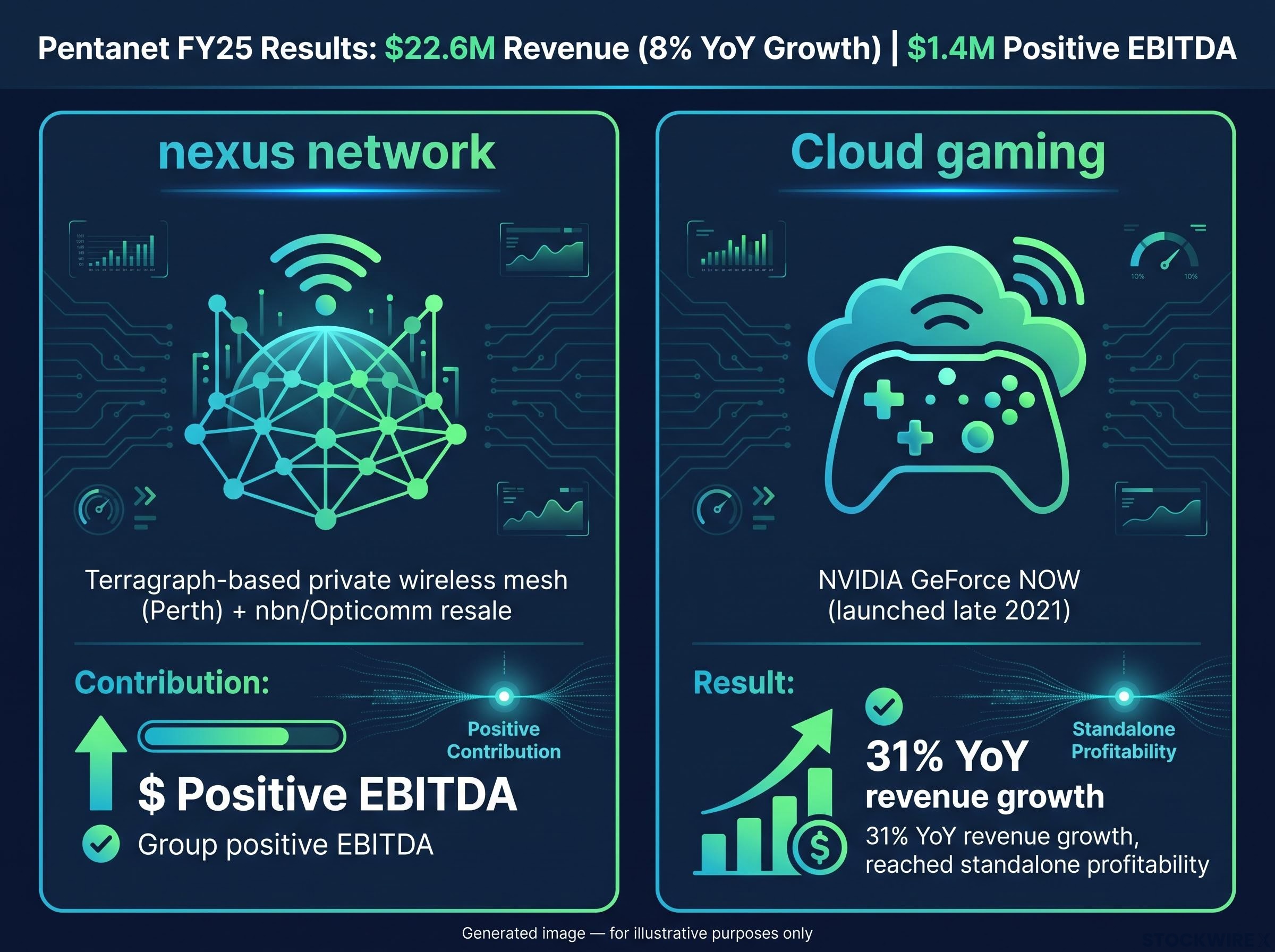
The first is the nexus network, a Terragraph-based private wireless mesh that Pentanet constructed over several years and which now holds the distinction of being Perth’s largest private wireless network. Rather than limiting itself to reselling third-party capacity, Pentanet built this proprietary layer from the ground up, while also offering services across nbn and Opticomm alongside it. That decision meant years of capital expenditure on towers, equipment, and coverage expansion before the network could support itself financially.
The second is cloud gaming. Via a commercial arrangement with NVIDIA, Pentanet became the first company to deliver GeForce NOW to Australian subscribers, a launch that went live in late 2021. Cloud gaming is not an adjacent product line bolted onto a telco. It is a genuinely different technology category, requiring its own infrastructure, its own customer acquisition strategy, and its own path to profitability.
That two-segment structure made the early years financially harder than they would have been for a single-product operator. Both divisions required investment before either reached profitability. The other side of that equation: when both segments arrive at profitability in the same reporting year, that outcome reflects more genuine breadth than the same milestone achieved by a business with a single revenue line, since it indicates each part of the strategy is earning its keep rather than being carried.
Proprietary infrastructure economics follow a consistent pattern across network operators of very different scales: the constellation or mesh is funded once, then each additional revenue layer adds margin without proportional additional capital expenditure, which is the operational leverage case that makes the model attractive once customer density reaches a viable threshold.
| Segment | Technology basis | Strategic path | FY25 profitability status |
|---|---|---|---|
| nexus (telecommunications) | Terragraph-based private wireless mesh, plus nbn/Opticomm resale | Build proprietary network | Contributing to group positive EBITDA |
| Cloud gaming | NVIDIA GeForce NOW platform | Market-first launch partner | Segment reached profitability for the first time |
What EBITDA actually measures, and why it is the right milestone to watch here
EBITDA in plain language: EBITDA strips away financing costs, tax, and non-cash accounting adjustments to answer one question: does the core business generate more cash from customers than it costs to run day-to-day?
That is why EBITDA is the natural first-profitability milestone for capital-intensive companies specifically. A business that owns its own infrastructure carries heavy depreciation charges, the accounting cost of spreading the purchase price of equipment and towers across their useful life. Those depreciation charges can push statutory net profit into the red even when the business is generating genuine operating cash flow from customers. EBITDA filters that out and focuses on the operational question: is the recurring revenue base covering the recurring cost base?
For FY25, Pentanet recorded a positive EBITDA of $1.4 million, marking the first occasion the company has posted a full-year positive figure on this measure, as disclosed in its annual results. The first half of FY25 had already shown interim positive EBITDA, so the full-year figure confirms a structural improvement rather than a one-half anomaly.
What EBITDA does not tell you is equally important. It deliberately excludes the cost of the infrastructure itself. A full picture of financial health requires looking beyond this single measure.
- What EBITDA confirms: the core business can fund its own day-to-day operations from customer revenue, rather than relying on external capital to keep the lights on.
- What EBITDA does not confirm: it does not account for depreciation on owned assets or interest costs on debt, so a company can be EBITDA-positive while still reporting a statutory net loss.
- What to watch alongside EBITDA: track capital expenditure levels and net profit trends over time to build a complete picture of whether the business is genuinely self-sustaining or simply clearing an intermediate hurdle.
This article is for informational purposes only and should not be considered financial advice. Investors should conduct their own research and consult with financial professionals before making investment decisions.
Reading Pentanet’s FY25 numbers: what the result actually shows
Start with the top line. Pentanet reported consolidated revenue of approximately $22.6 million for FY25, representing approximately 8% growth year-on-year, according to company-reported figures. The growth came from both business segments rather than one carrying the other. That matters, because a group revenue increase driven by a single division can mask structural weakness in the other.
The more telling detail sits in how the EBITDA result was constructed. At positive $1.4 million, the full-year result confirms what the first-half interim had suggested: the cost base has structurally improved, not just benefited from favourable timing in one reporting period. When a company moves from interim progress to a full-year positive result, it reduces the risk of one-off distortion and points to a genuinely more efficient operating structure.
Milestone: Pentanet reported its first-ever full-year positive EBITDA of $1.4 million for FY25, according to its annual results disclosure.
What the gaming segment result adds to the picture
The cloud gaming division reported revenue growth of 31% year-on-year according to company-reported figures, and reached profitability for the first time as a standalone segment. That is a structurally different result from a gaming division that simply adds revenue while deepening group-level losses.
When both segments of a two-division company reach profitability in the same year, it tells you the business model has genuine breadth. Each segment is covering its own costs, with neither side of the business leaning on the other to stay afloat. GeForce NOW’s market-first position in Australia, established through the NVIDIA partnership, is the foundation that gaming revenue is built on, and 31% year-on-year growth in that segment suggests customer adoption is accelerating rather than plateauing.
A framework for reading the profitability inflection point in any ASX infrastructure-heavy tech stock
The Pentanet example illustrates a broader framework you can apply to any capital-intensive technology company listed on the ASX. Revenue growth and build milestones are necessary signals, but they are not sufficient on their own. They must be accompanied by evidence that unit economics, the relationship between what it costs to serve each customer and what each customer pays, actually work at the company’s current scale and pricing.
Earnings quality, specifically whether a company’s profitability is grounded in sustainable unit economics rather than one-off timing benefits, proved to be the clearest dividing line between ASX tech stocks that recovered after the sector’s 48% drawdown and those that flatlined despite operating momentum.
A full-year positive EBITDA result is the inflection point that matters most for these models. It demonstrates that the combination of pricing, network utilisation, and operating cost structure produces sustainable operating earnings at current scale. That is a fundamentally different signal from revenue growth, which can coexist with a broken cost structure indefinitely.
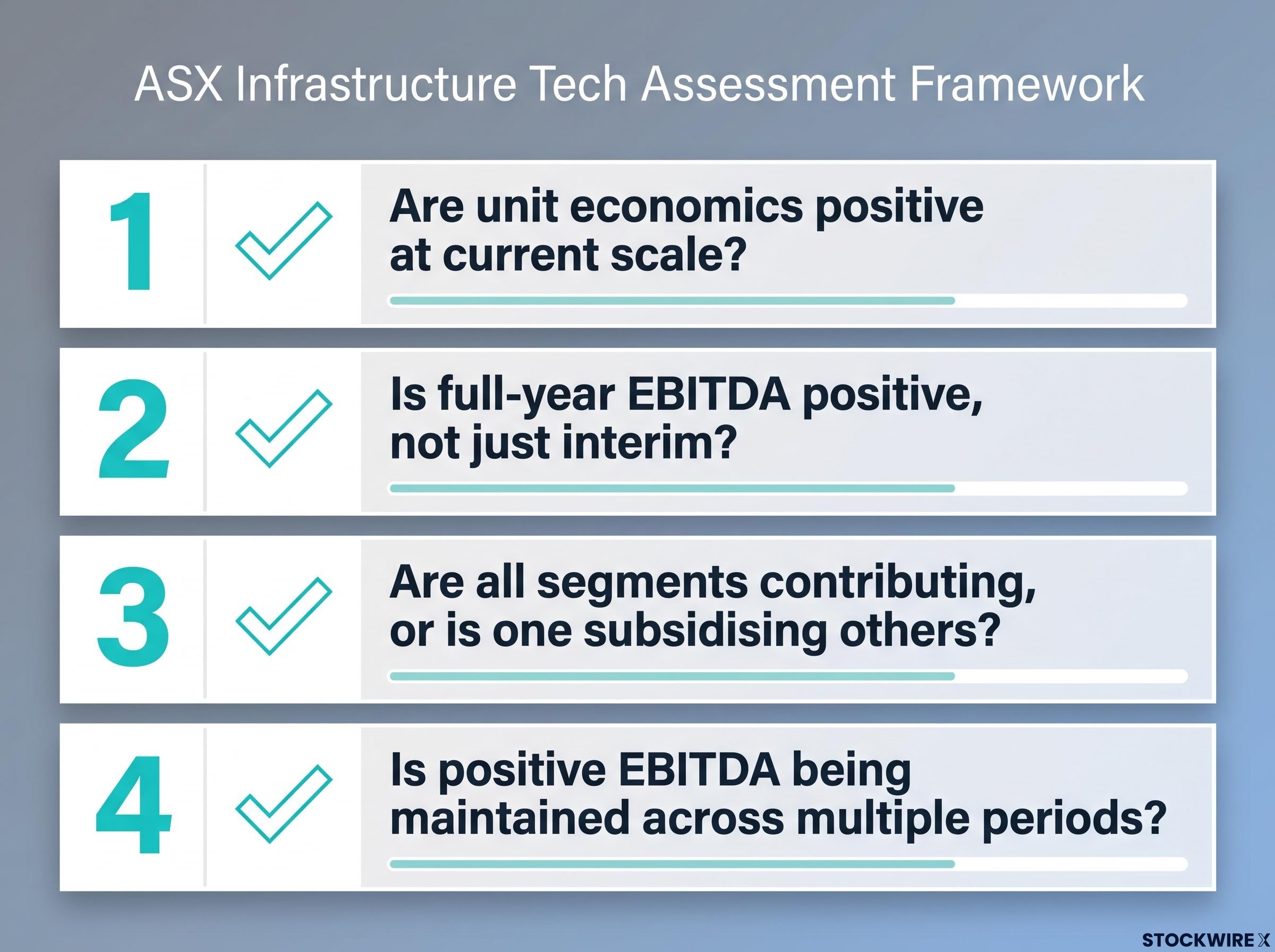
Here are four questions you can apply to any infrastructure-heavy ASX tech company at any point in its development cycle:
- Are unit economics positive at current scale? Revenue growth without positive unit economics means the company is scaling a loss-making structure, not building toward profitability.
- Is full-year EBITDA positive, not just interim? A single strong half can be flattered by timing. A full-year result carries more weight.
- Are all segments contributing, or is one subsidising others? In multi-division companies, assess whether each segment earns its place in the group result.
- Is positive EBITDA being maintained across multiple periods? A single positive year is a milestone. Sustained positive EBITDA across several reporting cycles is what confirms the model is durable.
A single positive EBITDA year is a milestone, not a guarantee of sustained profitability. Competitive pricing pressure, new capital requirements, or shifts in demand can reverse the result.
Pentanet’s case demonstrates that the patience required by infrastructure-heavy models can be rewarded. It also illustrates how unusual it is for companies of this type to successfully cross the threshold, which is exactly why the framework matters. The next company you evaluate may not cross it.
What Pentanet builds next, and what investors should watch
Reaching positive EBITDA shifts how capital can be deployed. Prior to this point, preserving the path to breakeven consumed management’s financial bandwidth; now that the business has demonstrated it can fund its own operations, reinvestment decisions can be made on the basis of growth opportunity rather than operational survival.
Pentanet’s management has flagged two strategic directions, according to its annual results disclosure:
- Broadening the nexus network’s footprint across Perth, adding coverage to areas not yet served by the proprietary wireless mesh.
- Continued development of the gaming platform, including higher-end tiers based on NVIDIA’s RTX SuperPOD infrastructure.
These directions reflect what management has communicated as its strategic priorities. They are not binding commitments, and actual outcomes will depend on factors that cannot be fully anticipated at the time of disclosure.
The qualitative shift in Pentanet’s investor relationship is real. Where previously the investment case rested on a forward-looking thesis that the market was asked to accept on trust, there is now a tangible financial result to point to. That changes the nature of the conversation between the company and its investors in a meaningful way.
But the more useful forward-looking question is not “has this company proven its model?” The FY25 result answers yes, for now. The question is whether Pentanet can sustain and build on what it has achieved. Sustained profitability over multiple reporting periods is what separates a milestone from a turning point, and the next few cycles will answer that.
For readers wanting to apply a structured risk framework to companies at the profitability inflection point, our dedicated guide to margin of safety in capital-intensive businesses walks through how to assess balance sheet strength, competitive position, and the discount to intrinsic value required before the model is genuinely de-risked.
Past performance does not guarantee future results. This article contains general information only and does not constitute financial advice. Investors should consider their own circumstances and consult a licensed financial adviser before making investment decisions.