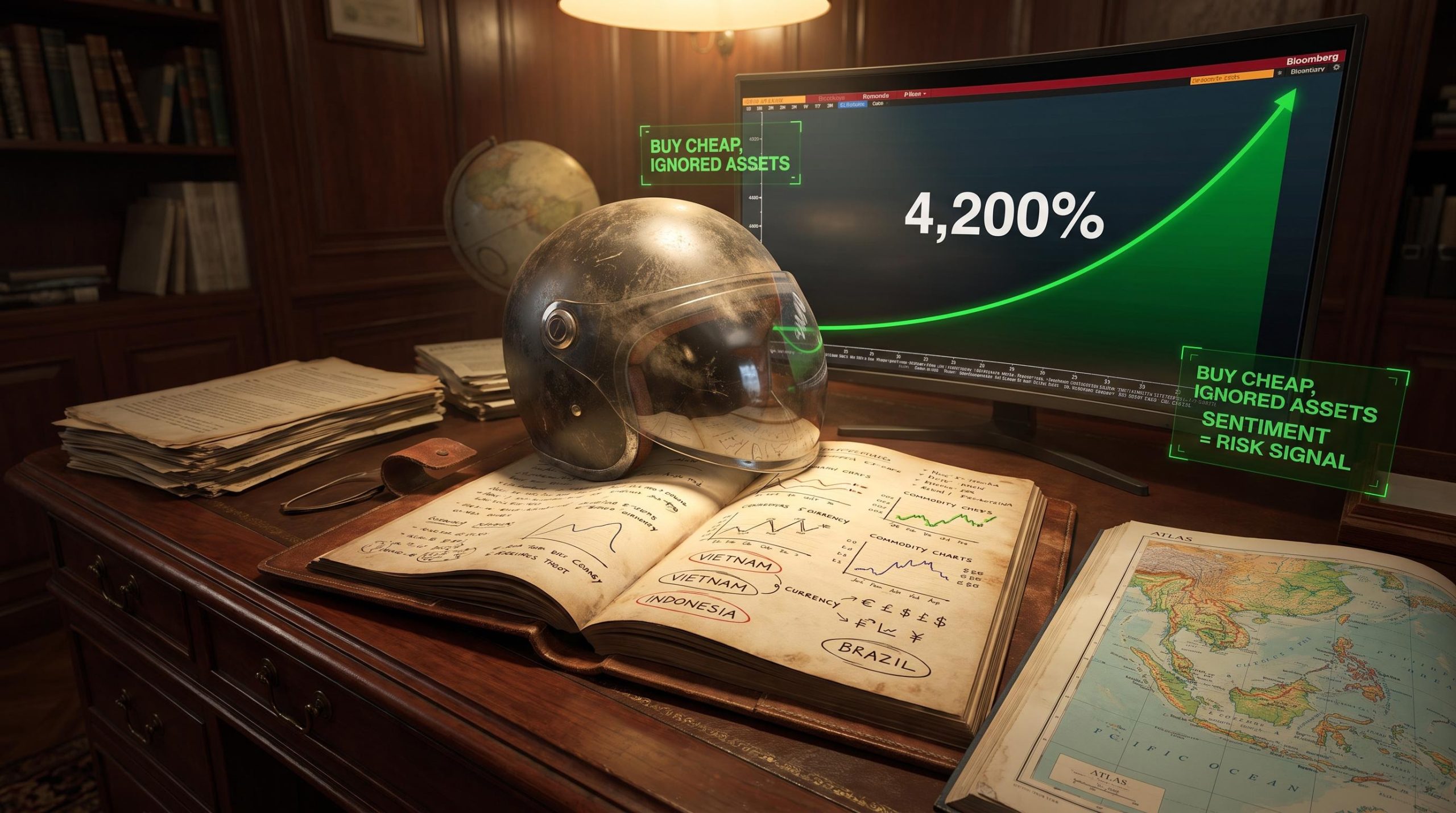
Jim Rogers built one of the most celebrated track records in global investing. His Quantum Fund, co-founded with George Soros, returned more than 4,200% over a decade. And his most consistent advice to ordinary investors is not to invest the way he does.
That is not false modesty. Rogers’ philosophy spans more than five decades of active positioning across commodities, emerging markets, currencies, and equities. His views on risk, timing, and crowd behaviour were shaped by costly personal errors, not only celebrated wins. The combination of candour about failure alongside the long-run record is what makes his thinking worth examining rather than simply admiring.
Here is what the framework actually is, where it has broken down even for him, and which parts of it translate honestly to a retail investor’s situation. This is not a list of trades to replicate. It is a set of disciplines to pressure-test against your own process.
The real method behind the contrarian label
Rogers does not identify as a contrarian investor. His description of the method is simpler and more specific: find cheap assets that others have abandoned or written off. Buy low, sell high. The contrarian positioning is a frequent outcome of that discipline, not the goal itself, and the distinction matters. Aimless contrarianism, buying something merely because others are selling, produces different results than a valuation focus built on deep, independent research.
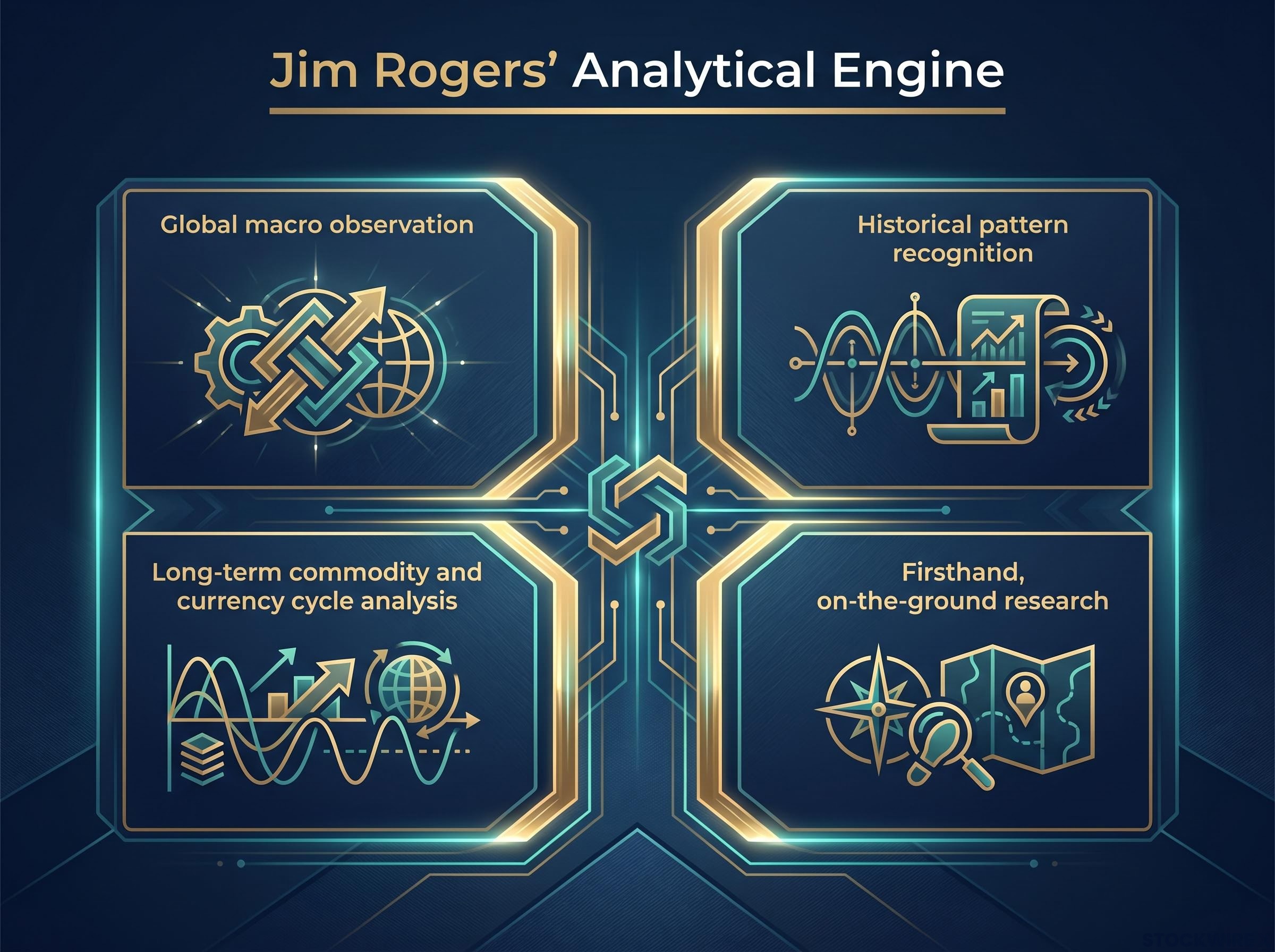
His analytical engine runs on four pillars:
- Global macro observation: tracking monetary policy, trade flows, and geopolitical shifts across regions
- Historical pattern recognition: studying how past commodity, currency, and equity cycles played out and applying those templates forward
- Long-term commodity and currency cycle analysis: identifying structural supply-demand imbalances that take years to resolve
- Firsthand, on-the-ground research: travelling directly through economies, interviewing locals, observing infrastructure and demographics before they appear in financial reporting
The research intensity Rogers applies before entering a position is itself the core of his method. What looks like a contrarian bet from the outside is, from his perspective, a deeply researched value judgment that happens to be unfashionable.
What “cheap and ignored” has looked like across his career
In practice, the screening criteria have produced a consistent pattern. Rogers has favoured metals like silver when they were down sharply from prior peaks and priced cheaply relative to equities. He has bought into emerging markets and politically unpopular countries when institutional capital had written them off, using demographic analysis, population growth trends, resource availability, and new trade routes as leading indicators. His well-documented global motorcycle journeys were not stunts; they were research trips designed to see infrastructure, rural economies, and social conditions directly before spreadsheets could capture them.
The pattern is not a catalogue of clever trades. It is a method that consistently targets assets where the gap between structural value and market sentiment is widest, and where Rogers has done enough firsthand work to hold the position through years of discomfort.
When big ASX news breaks, our subscribers know first
How sentiment becomes a risk signal, not a buying guide
Rogers uses public mood as a calibration tool, and his framework operates on a spectrum rather than a binary switch. At the mild end, rising enthusiasm around an asset class is a prompt to examine your exposure and demand a wider margin of safety. At the extreme end, widespread hysteria is the only condition under which he would consider shorting a broad market.
His markers of extreme sentiment are deliberately concrete:
Rogers has described the warning signs in terms of broad social contagion: when ordinary people who have no financial background are talking excitedly about a particular asset, when those in everyday service roles are handing out tips, and when people are walking away from steady employment to speculate full-time, the moment of peak risk has already arrived. At that stage, the straightforward gains are behind you and the exposure is piled up with those who entered last.
The three-stage template he applies across market history is consistent:
- A real, transformative trend emerges (railroads, electricity, the internet) and early capital enters at favourable valuations
- Peak enthusiasm arrives, pulling in broad public participation at valuations that embed years of future growth
- Late-entry investors absorb the most risk, even when the underlying technology ultimately succeeds, because the price they paid already reflected the optimism
Rogers is not arguing that transformative trends fail. He is arguing that the technology question and the entry-price question are separate problems. Railroads changed the world. Late-arriving railroad investors still lost their capital. For you, the practical implication is not to wait for a named bubble to be declared but to notice when an asset class moves from specialist discussion into everyday social conversation, and treat that shift as a prompt to examine exposure rather than increase it.
The practical challenge with Rogers’ sentiment framework is locating the real-time signal: sentiment divergence from market pricing is measurable, and the April 2026 episode, when the University of Michigan Consumer Sentiment Index hit an all-time low of 49.8 while the S&P 500 traded near record highs, illustrates how sharply public mood and asset valuations can decouple.
The gap between what he preaches and what he practices
Rogers publicly endorses a clean set of risk management principles. Cut losses without hesitation when you are wrong. Act on principles, not emotions. Maintain a margin of safety. Wait for clear catalysts.
Then there is what he actually does.
| What Rogers preaches | What Rogers acknowledges doing |
|---|---|
| Cut losses without hesitation when wrong | Tends to remain in losing positions until the pain becomes too great, frequently closing them at the wrong moment |
| Apply systematic stop-loss rules | Recognises the value of automatic exit rules but admits he has not reliably followed them in practice |
| Act on principles, not emotions | Relies on instinct built through decades of experience rather than a replicable rule-based framework |
| Maintain margin of safety before entry | Reflects that the gravest errors in his career came from committing capital before he had fully understood the position |
That gap is not an embarrassing footnote. It is arguably the most instructive thing Rogers has said about risk. He has acknowledged that serious mistakes can push back an investor’s financial freedom by years, regardless of how long they have been in the markets. The failure mode he describes, holding losers past the point of rational justification, is not an elite investor’s quirk. It is a universal investor error that happens to affect even someone with a five-decade track record.
Where his actual risk control lives
Rogers’ real first line of defence sits before the trade, not during it. His most consistent reflection on career mistakes is that the most important lesson is the value of patience and deeper research before committing capital, not better exit discipline after. His risk management, in practice, is front-loaded: exhaustive research, patience before entry, waiting for genuine margin of safety.
The margin of safety concept Rogers invokes is more precisely defined in value investing practice than a simple instruction to buy cheap: it is a function of business quality across multiple dimensions, including competitive dynamics, balance sheet strength, and management quality, with the required discount to intrinsic value widening as those risk dimensions deteriorate.
This reframes “risk management” as a pre-entry discipline rather than a position-management system. For you, that distinction matters. If your process focuses entirely on stop-losses and trailing exits but skips the deep pre-entry work, you are managing risk at the stage where Rogers admits he is weakest, and ignoring the stage where his actual track record was built.
What decades of market cycles teach about enthusiasm and timing
Rogers’ bubble recognition framework is not a technology-specific claim. It is a structural argument about the relationship between sentiment, valuation, and the timing of capital entry. The consistent features he has identified across manias are:
- A real, transformative underlying trend that attracts early capital
- Capital concentration as institutional money piles in and pushes valuations higher
- Euphoric valuation as public participation broadens and prices embed years of optimistic growth assumptions
- Late-entry risk as the final wave of buyers absorbs the most downside when conditions change
His analysis of long booms fuelled by easy money and debt produces the same pattern repeatedly. The underlying trend can be entirely real, and the investment opportunity can still be terrible if you arrive after the consensus has formed and the expected return is already priced in.
Rogers has pointed to the railroad era, the electricity boom, and the internet cycle as illustrations of the same structural dynamic. The technology in each case proved transformative. Yet investors who arrived once enthusiasm had become widespread suffered heavy losses, not because they misjudged the technology, but because the price they entered at had already absorbed the expected gains.
Applied to any current high-enthusiasm theme, whether artificial intelligence, clean energy, or the next cycle, the logic is identical. The question is not whether the technology is real. The question is where you sit in the cycle relative to when institutional capital and early adopters already entered. If you are arriving after the consensus has formed, the expected return is priced in and the risk is yours.
Index funds, expertise edges, and what Rogers tells most retail investors to do
Rogers’ foundational rule for active investing is deceptively simple: only take positions in what you genuinely understand, using firsthand professional knowledge as your edge. A pharmacist knows pharmaceuticals. A construction worker knows building materials. Without equivalent depth of knowledge, avoid niche, leveraged, or complex plays.
He backs this with an empirical position on index funds. The evidence has shown consistently that the overwhelming majority of investors do not beat the broader market across time. Rogers characterises simple, diversified market exposure as a rational default for most people, not a failure of ambition. For active investing to be justified, three conditions need to be met:
The empirical case Rogers points to is well-documented: decades of data on index funds vs active management show that roughly 90% of active large-cap managers fail to beat the market over a 15-20 year horizon, which is precisely the structural reality Rogers is acknowledging when he tells most retail investors to default to diversified exposure.
- Genuine expertise: a real informational or analytical edge in the specific asset you are considering
- Deep firsthand research: original work, not secondhand conviction borrowed from media or social sentiment
- Emotional capacity: the ability to hold through large, uncomfortable swings without abandoning the thesis at the worst moment
Rogers explicitly discourages investors from copying his positions or anyone else’s. His message across decades of interviews is consistent: most people do not have the time, temperament, or expertise to actively trade commodities, currencies, or emerging markets. In those cases, taking market-level returns through broadly diversified vehicles is a rational, evidence-backed strategy.
Why his anti-diversification view does not mean what it sounds like
Rogers opposes broad, mechanical diversification and has advocated putting all your eggs in one basket, then watching that basket with extreme care and depth of knowledge. That position is explicitly conditional. It applies to serious, knowledgeable investors who deeply understand their position, not casual traders hearing a catchy phrase.
Applied casually to a retail investor without that depth of expertise, the same statement would produce the opposite of his intended meaning. This is where the line between what Rogers does and what he recommends for others is sharpest. His own words draw the distinction clearly: concentrate if you have the knowledge, diversify if you do not.
What you can honestly take from five decades of Rogers, and what you cannot
Some of Rogers’ disciplines translate defensibly to any investor’s process. Others only work because of who he is and what he has built over five decades.
| Portable from Rogers | Requires his specific expertise and experience |
|---|---|
| Treat social euphoria as a risk flag, not a green light | Instinct-based risk management built through decades of living through market cycles |
| Front-load research and patience before committing capital | Global firsthand research infrastructure (motorcycle trips, on-the-ground interviews) |
| Define explicit exit criteria before you enter a position | Capacity to hold deeply hated assets through years of discomfort and drawdown |
| Invest only where you have a genuine informational edge | Multi-decade pattern recognition across commodity, currency, and equity cycles |
| Do your own work; do not act on others’ opinions | Emotional resilience forged through surviving large, career-threatening errors |
| Accept that simple diversified exposure is rational if you lack deep expertise | Concentrated positioning backed by conviction-level knowledge in specific assets |
| Use the expert-knowledge test before adding any position | A network and reputation that provides access to information retail investors cannot obtain |
Studying Rogers is most useful not for the trades but for the disciplines it reveals. The most honest outcome for most readers is a clearer understanding of which habits you can realistically adopt and which require a level of expertise and temperament you have not yet built. Five decades of Rogers distilled honestly produces fewer investment tips than most readers expect and more process discipline than most investors apply. That asymmetry is itself the lesson.
What the Rogers framework actually demands of you before it works
Rogers is compelling because he is both exceptionally skilled and unusually honest about the limits of his own approach. That honesty, not the commodity calls or the motorcycle trips, is the most transferable asset in his public career.
Your most productive next step is not to find the next despised asset. It is to run the expert-knowledge test on your own portfolio: identify where you have a genuine edge versus where you are riding momentum or secondhand conviction. Use his sentiment framework as an ongoing filter, not a one-time insight. And be honest about the answer. Rogers himself would tell you that is the harder part.
For readers who want to translate Rogers’ pre-entry risk discipline into a concrete checklist, our dedicated guide to portfolio crisis preparation covers a four-question diagnostic framework and an eight-point action plan for building resilience without relying on market timing.
This article is for informational purposes only and should not be considered financial advice. Investors should conduct their own research and consult with financial professionals before making investment decisions.