You can open an account, fund it, and trade short-dated options or futures contracts within minutes on an Australian platform. In many cases, it is the same app you use for everyday banking. The frictionless access is new. The risks embedded in these products are not.
ASIC released new educational resources on its Moneysmart platform in August 2026, specifically addressing exchange traded options, futures contracts, fractional share trading, and micro-investing. ASIC Commissioner Simone Constant and the regulator have flagged a specific concern: retail investors are trading complex products they do not fully understand. The mechanisms that cause rapid losses, leverage, time decay, margining, and ownership arrangements, are not intuitive, and no app explains them at the point of purchase.
This piece gives you a working understanding of how each of these products actually creates risk, and a four-question framework you can apply to any complex product before you commit capital.
When time is the enemy: how short-dated options actually work
What short-dated ETOs are
An exchange traded option (an ETO) is a contract that gives you the right, but not the obligation, to buy or sell an underlying asset at a set price (the strike price, meaning the price at which the option can be exercised) on or before a specified expiry date. You pay a premium for that right.
“Short-dated” means the expiry window is compressed to days or even hours. Weekly options expire within a few trading days. Zero-day options (0DTE) expire on the same day they are traded. These contracts are often marketed around specific events: earnings announcements, central bank meetings, economic data releases.
The mechanics that accelerate losses
The feature that makes short-dated options feel appealing, the compressed timeframe, is the same feature that makes them dangerous if you do not understand what is happening to your money in real time.
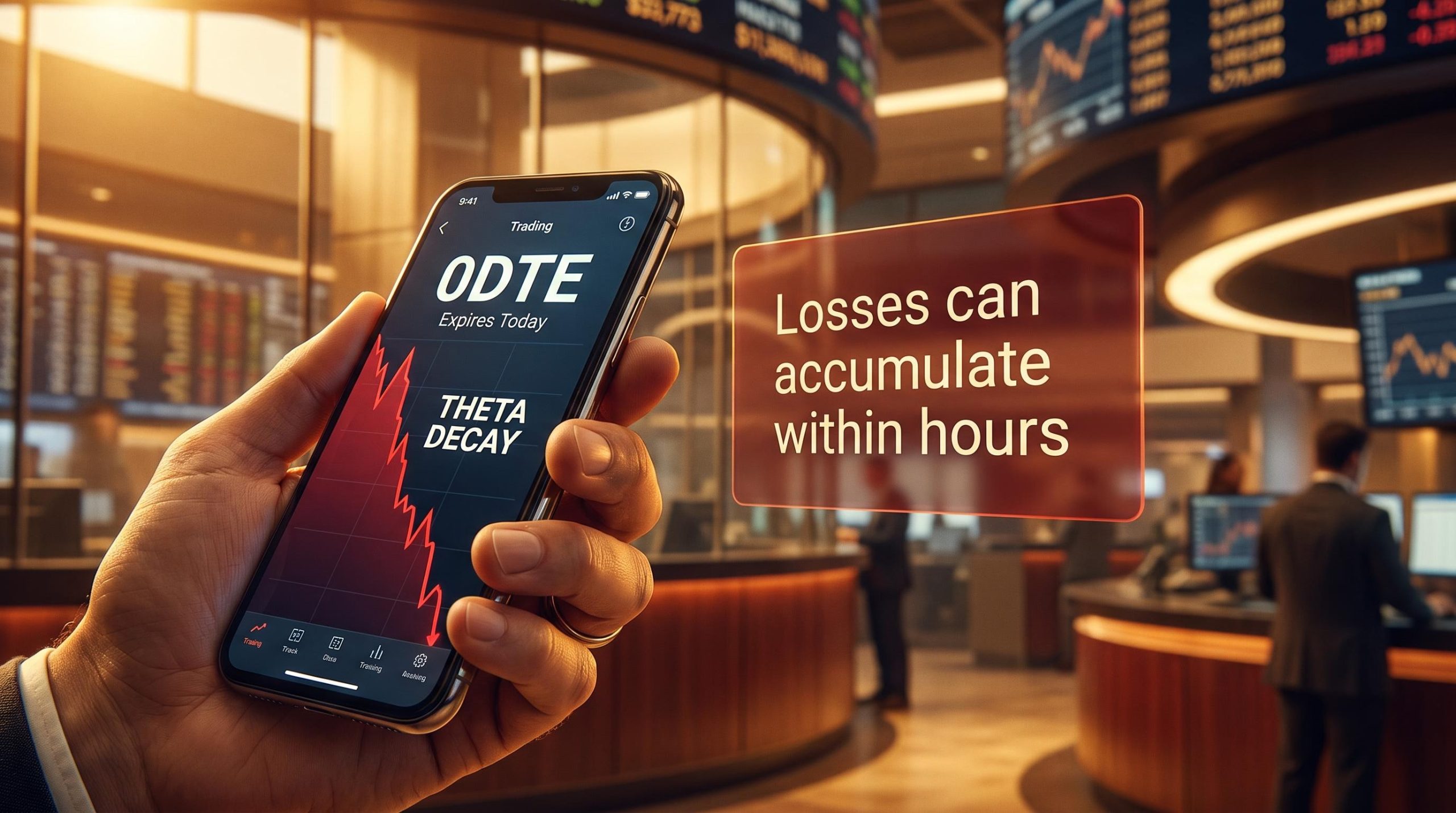
Time decay (theta) is the erosion of the time-value component of an option’s premium as expiry approaches. Every day that passes, the option loses some of its time value. That erosion accelerates sharply in the final days and hours before expiry. With a short-dated contract, you start with almost no buffer. If the underlying asset does not move in your favour quickly and by enough, the option can lose most or all of its value before you can react.
Sophisticated options traders deliberately reposition time decay as a structural force working in their favour rather than against them, using defined-risk spread strategies where positive theta accrues to the seller each day the underlying stays within a predicted range.
Leverage compounds the problem. The premium you pay for an option is a fraction of the notional exposure you gain. A small move in the underlying asset can produce a much larger percentage gain or loss in the option price. That leverage is especially acute in short-dated contracts used to trade intraday volatility.
Losses from highly leveraged products can accumulate within hours, according to ASIC guidance.
Before trading short-dated ETOs, you should be able to explain, in plain language, how the option’s value changes with:
- Moves in the underlying price
- Time to expiry
- Volatility
- What happens at expiry
If explaining any of those is difficult, ASIC treats that difficulty itself as a signal the product may not be appropriate for you at this stage. “Short expiry” is not a feature that limits your risk. It compresses the timeline for loss, leaving virtually no margin for learning or recovery once a position is open.
When big ASX news breaks, our subscribers know first
Futures contracts: what “obligation” actually costs you
A futures contract is a legally binding agreement to buy or sell an asset (such as an index, commodity, or currency) at a predetermined price on a set future date. That word, “obligation,” is what separates futures from options. An option gives you a right. A futures contract gives you a commitment that must be settled or offset before expiry. You cannot simply let it lapse.
Margin is the mechanism that gives you leveraged exposure. You post an initial deposit that is only a fraction of the contract’s total value. That deposit lets you control a much larger position. A relatively modest move in the underlying can therefore produce a loss that is large relative to what you put in, and in adverse scenarios, losses can exceed your initial deposit.
Losses on futures positions can exceed the initial margin deposit.
Here is what happens when the market moves against you:
- You post an initial margin deposit to open the position.
- Your futures position is marked to market and settled daily, meaning gains or losses are calculated and applied to your margin account at the end of each trading day.
- If losses cause your margin balance to fall below the maintenance threshold, you receive a margin call.
- The margin call requires you to deposit additional funds, typically within a very short timeframe.
- If you do not meet the margin call, the broker closes your position at the prevailing market price.
- That closure happens on the broker’s timetable, not yours.
The last point is where futures risk becomes qualitatively different from standard share investing. You may lose control over when your position is closed. Daily contract settlement creates the possibility that you are compelled to exit at a loss before you choose to do so. That distinction between a position being closed by market rules versus by your own decision is one that regulators, including ASIC, treat as a reason futures are generally unsuitable for retail investors who cannot monitor positions and respond to margin calls in real time.
| Attribute | Options (ETOs) | Futures |
|---|---|---|
| Nature of commitment | Right, not obligation | Legally binding obligation |
| Loss potential relative to initial outlay | Maximum loss is premium paid (for buyers) | Losses can exceed initial margin deposit |
| Settlement mechanism | Exercised, sold, or expires worthless | Daily mark-to-market with margin calls |
Understanding what you actually own with fractional shares
Fractional share trading lets you buy less than one whole share, so you can access high-priced stocks with a small dollar amount. That is a genuine benefit. It removes the monetary barrier that kept many Australian investors out of certain positions.
The question most investors skip is not “how much does it cost to buy?” It is “what do I actually own, and what happens if the platform fails?”
In standard Australian share ownership, your holdings are CHESS-sponsored: registered directly in your name on the ASX register, with a unique Holder Identification Number (a HIN, which is your personal identifier on the share registry). You are the legal owner. Your name is on the register.
Most fractional share arrangements work differently. Your holdings are typically pooled in an omnibus account or held through a nominee or custodian structure. You hold a beneficial interest, meaning you have the economic rights (dividends, capital gains) without direct legal title. The platform or its nominee is the registered holder.
The distinction between CHESS versus custodial ownership carries real legal weight: under CHESS sponsorship your holdings survive independently on the ASX register if a broker becomes insolvent, while custodial protection depends entirely on the trust and asset segregation structure the platform maintains.
| Attribute | CHESS-sponsored | Custodian / fractional model |
|---|---|---|
| Legal ownership | Registered in your name (HIN) | Held by nominee on your behalf |
| Transfer portability | Transferable between brokers | Often requires sale and repurchase |
| Voting rights | Direct voting rights | May be limited or absent |
| Protection if platform fails | Holdings on ASX register in your name | Depends on trust and custody arrangements |
Fractional positions often cannot be transferred to another broker or to a standard CHESS account as fractions. To move them, you may need to sell first, potentially at a time or price that does not suit you, then repurchase whole shares elsewhere.
Before depositing funds with any platform offering fractional trading, ask these questions:
- Are client assets held in segregated trust accounts?
- Who holds legal title to the underlying shares?
- What happens to your holdings if the platform becomes insolvent?
- Can your holdings be transferred to another provider, and under what conditions?
The answers are typically in the Product Disclosure Statement (a PDS, meaning the legally required document outlining a financial product’s features, risks, costs, and terms) and terms of business. For Australian investors accustomed to CHESS-sponsored ownership, the shift to a custodian or nominee model is not merely administrative. It changes what legal recourse you have if the platform fails, and understanding that difference before you deposit funds matters whether you hold $50 or $50,000 through the platform.
A self-assessment checklist before you commit capital
ASIC has outlined four questions to ask yourself before committing capital to any complex or high-risk financial product. These are not compliance formalities. They function as a genuine decision instrument, and the honesty of your answers determines whether you are ready to trade.
Why “available” does not mean “suitable”
A product being accessible through an app does not make it appropriate for your situation. Short-dated ETOs and futures contracts require active intraday monitoring. If you work a standard day and cannot watch positions in real time or respond to margin calls within hours, these products may not suit your circumstances regardless of how easy the platform makes them to access.
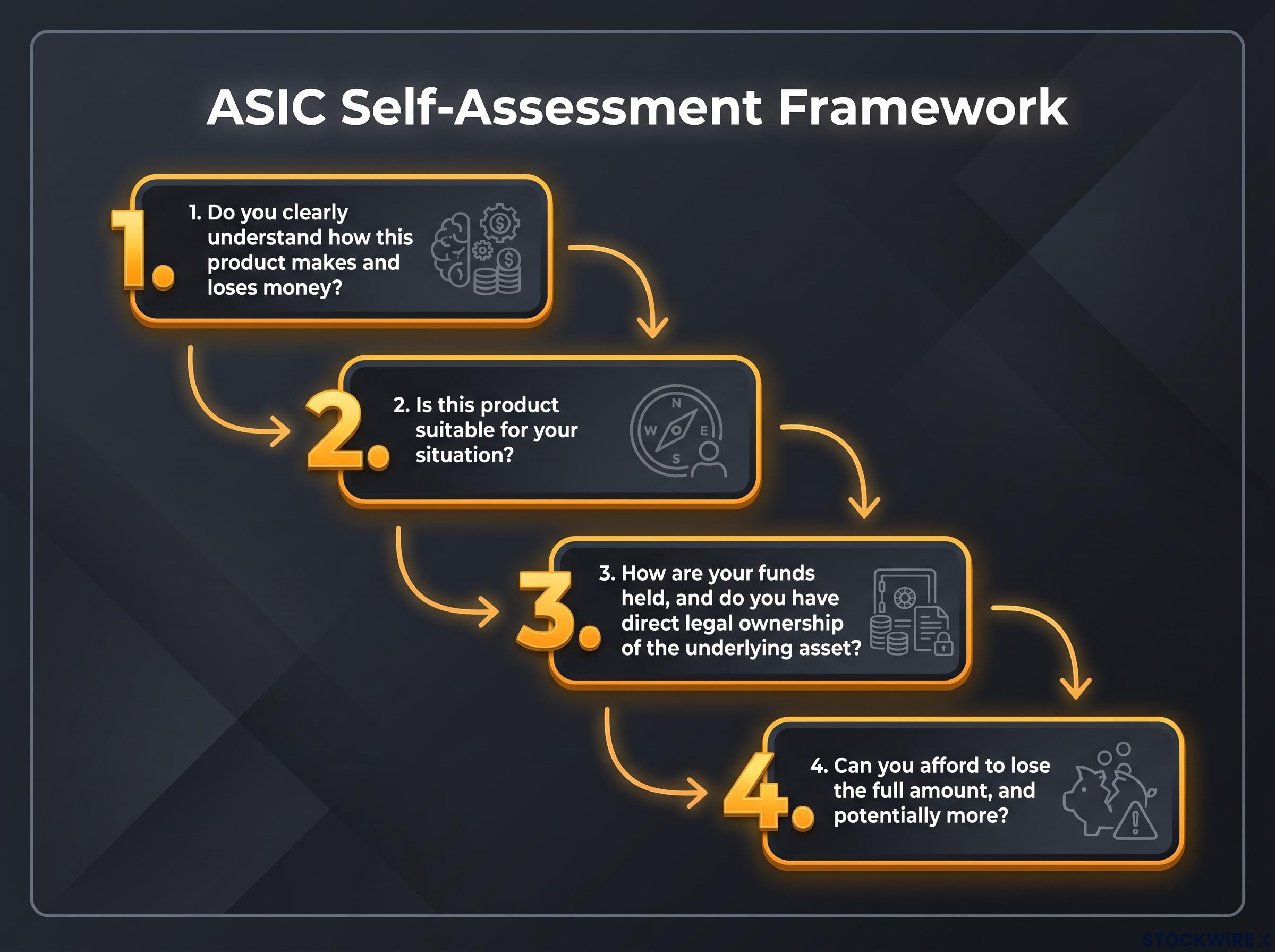
Here is the framework, with the practical sub-questions that give each one operational meaning:
- Do you clearly understand how this product makes and loses money? Can you explain, in plain language, the specific mechanics: how an option’s value changes with price, time, and volatility? How margin, daily settlement, and the obligation at expiry interact in a futures contract? How your beneficial interest in fractional shares relates to the underlying asset? If explaining any of this is difficult, that difficulty is your answer.
- Is this product suitable for your situation? Does your timeframe match the product’s demands? Do you have the experience to manage leverage, liquidity, and execution risk? Can you monitor and act on the same day if required?
- How are your funds held, and do you have direct legal ownership of the underlying asset? Are client funds in segregated trust accounts? Are you a direct registered holder, or do you have a beneficial interest through a nominee? What happens to your holdings if the platform becomes insolvent?
- Can you afford to lose the full amount, and potentially more? For options, assume 100% loss of the premium. For futures, assume losses can exceed the initial margin. Would a total loss create material harm to your financial position, meaning you could not meet living expenses or debt repayments? If yes, the product sits outside your prudent risk capacity.
ASIC treats difficulty in understanding a product as a potential indicator that it may not be appropriate for you at this stage.
No app or platform applies this filter on your behalf. You apply it yourself, and an honest “no” to any single question is a legitimate reason to stop before committing capital.
A plain-language glossary of the terms platforms use
These are terms you will encounter in a PDS, on a trading platform, or in the sections above. Each definition is framed around what the term means for you as the investor.
- ETO (exchange traded option): A contract giving you the right, but not the obligation, to buy or sell an underlying asset at a set price on or before expiry. You pay a premium for that right.
- Strike price: The price at which you can exercise your option. It is set when you enter the contract.
- Time decay (theta): The daily erosion of your option’s time value as expiry approaches. This is the mechanism described above that accelerates sharply in the final days, eating into your position whether the underlying moves or not.
- Zero-day option (0DTE): An option that expires on the same day it is traded. Maximum time pressure, minimum margin for error.
- Futures contract: A binding commitment to exchange an asset at an agreed price on a specified future date. Unlike an option, you cannot walk away.
- Margin: The deposit you post to hold a leveraged position. It is only a fraction of the total contract value, which is why your losses can exceed it.
- Mark-to-market: Daily revaluation of your futures position, with gains or losses settled to your margin account each trading day. This is the mechanism that triggers the margin call sequence described in the futures section.
- Margin call: A demand from your broker to deposit additional funds when your margin account falls below the required maintenance level. Failure to meet it means the broker closes your position, not you.
- Fractional share: A portion of a whole share, letting you invest in high-priced stocks with small dollar amounts. The ownership structure behind it matters more than the price.
- CHESS sponsorship: The ASX system that registers shareholdings directly in your name with a unique HIN. This is direct legal ownership on the share registry.
- Beneficial interest: Your economic rights in an asset (dividends, capital gains) held without direct legal title. You benefit from the asset, but someone else is the registered owner.
- Nominee/custodian structure: An arrangement where a third party holds legal title to assets on your behalf. Your rights depend on the terms of that arrangement and the platform’s trust and custody framework.
- PDS (Product Disclosure Statement): The legally required document outlining a financial product’s features, risks, costs, and terms. This is where custody, margin, and liquidation rules are disclosed.
What to do before your first trade: practical steps for Australian investors
Understanding the mechanics is the foundation. Acting on that understanding is the step that actually protects your capital. Here is a concrete sequence you can work through before committing to any complex product.
- Check ASIC’s Moneysmart resources. As part of its August 2026 response to surveillance findings, Moneysmart added dedicated educational pages on ETOs, futures contracts, fractional share trading, and micro-investing, each written for retail investors encountering these products for the first time. Start at moneysmart.gov.au.
Beyond ASIC Moneysmart, a range of free Australian investing resources, including the ASX Education Centre and paper trading tools, provide a structured way to build product knowledge before committing real capital to complex instruments.
- Read the PDS before you trade. Pay particular attention to the sections on margin requirements, liquidation rules, custody arrangements, and client asset protection. If the PDS is difficult to follow, that difficulty is information in itself.
- Start with non-leveraged products or paper trading. If you want to learn how options or futures behave, begin with simulated positions or small, non-leveraged exposure. Avoid short-dated options and futures until you can explain their risk profile without help.
- Consider seeking independent advice. If you are uncertain whether these products fit your circumstances, a licensed financial adviser can help you assess suitability and risk capacity. That conversation is worth having before the first trade, not after a loss.
- Use the ASX options knowledge hub. The ASX provides resources covering terminology, risk explanations, and trading mechanics for options specifically.
ASIC Commissioner Simone Constant has urged retail investors to visit Moneysmart before taking on new, complex, or high-risk products, so they can judge whether those products are right for their circumstances.
These steps are not optional extras for cautious investors. They are the minimum reasonable preparation for anyone considering instruments where losses can accumulate within hours.
Access is not the same as readiness
The democratisation of access to complex financial products is real. Australian retail investors can now reach instruments that were previously confined to institutional desks and specialist brokers. That access has not democratised the knowledge required to use them safely.
What would need to be true for you to be genuinely ready to trade these products? You would need to explain, in plain language, how each product makes and loses money. You would need to understand what you actually own and what legal protections apply. You would need to confirm that a worst-case loss would not create material harm to your financial position. And you would need the capacity to monitor positions and act in the timeframes these instruments demand.
If the four ASIC questions all return an honest “yes,” then for certain products, proceeding may be a legitimate decision. This is not a case for avoiding complexity altogether. It is a case for ensuring that preparation precedes participation.
For any investor who is not yet at that “yes,” the practical next step is straightforward: ASIC’s Moneysmart resources and the four-question framework give you a structured path to get there. Use them before you trade.
For investors who conclude that short-dated options and futures sit outside their current risk capacity, our dedicated guide to evaluating ASX shares walks through a six-step checklist covering business assessment, key financial metrics, and position sizing disciplines that apply from the first purchase.
This article is for informational purposes only and should not be considered financial advice. Investors should conduct their own research and consult with financial professionals before making investment decisions.