Australian 10-year government bond yields have breached 5% for the first time since approximately 2011, with late July 2026 readings landing in the range of 4.99-5.05%. That is not a routine move. It is the bond market pricing a fundamentally different inflation and policy outlook than anything Australian investors have navigated for the better part of 15 years.
The proximate cause is geopolitical. Fresh hostilities involving Iran and the risk of disruption to oil flows through the Strait of Hormuz have pushed energy prices sharply higher and kept them there, feeding cost-push inflation that refuses to settle back inside the Reserve Bank of Australia’s (RBA) 2-3% target band. The bond market is not simply reacting to a single headline; it has shifted to reflect the possibility that inflation will remain uncomfortably high, requiring the RBA to keep rates at restrictive levels, or push them higher, for longer than most investors expected six months ago.
Here is what this yield level actually means if you are deciding how to think about your bond allocation right now: the income, the real return arithmetic, how professionals are responding, and where the genuine uncertainties still sit.
Australian 10-year bond yields cross 5% for the first time since 2011
The 5% threshold is not simply a round number. It marks a genuine shift in what the bond market expects of inflation and monetary policy going forward, with the repricing demanding that Australian investors reconsider what this means for their portfolios.
According to Bryce Anderson, Senior Portfolio Manager at Morningstar Investment Management, speaking on the Morningstar Market Minute on 28 July 2026, the move in yields reflects a confluence of geopolitical risk and persistent inflation that has shifted the fixed income opportunity set in ways not seen in over a decade.
The core data points framing this moment:
- Australian 10-year government bond yield: approximately 4.99-5.05% as of late July 2026
- Last comparable level: circa 2011, roughly 15 years ago
- RBA cash rate: 4.35%, held at that level since June 2026, with futures markets pricing a modest probability of a further move toward 4.60% at upcoming meetings
Bryce Anderson, Senior Portfolio Manager, Morningstar Investment Management (28 July 2026): The late July yield increases reflect both geopolitical-driven inflation risk and a bond market that is now demanding compensation for a higher-for-longer rate environment.
This coincides with escalating tensions tied to Iran and sharply higher oil prices that shifted conditions on a near-daily basis. The bond market is not waiting for certainty; it is assigning a meaningful probability to inflation remaining persistently above target well beyond the consensus timeline.
The RBA’s June 2026 cash rate decision held the benchmark rate at 4.35%, with the Board explicitly flagging that returning inflation to the 2-3% target band remains the central policy priority, a stance that bond markets are now pricing as extending well into 2027.
When big ASX news breaks, our subscribers know first
From Tehran to Treasury: how geopolitical tension drives bond yields higher
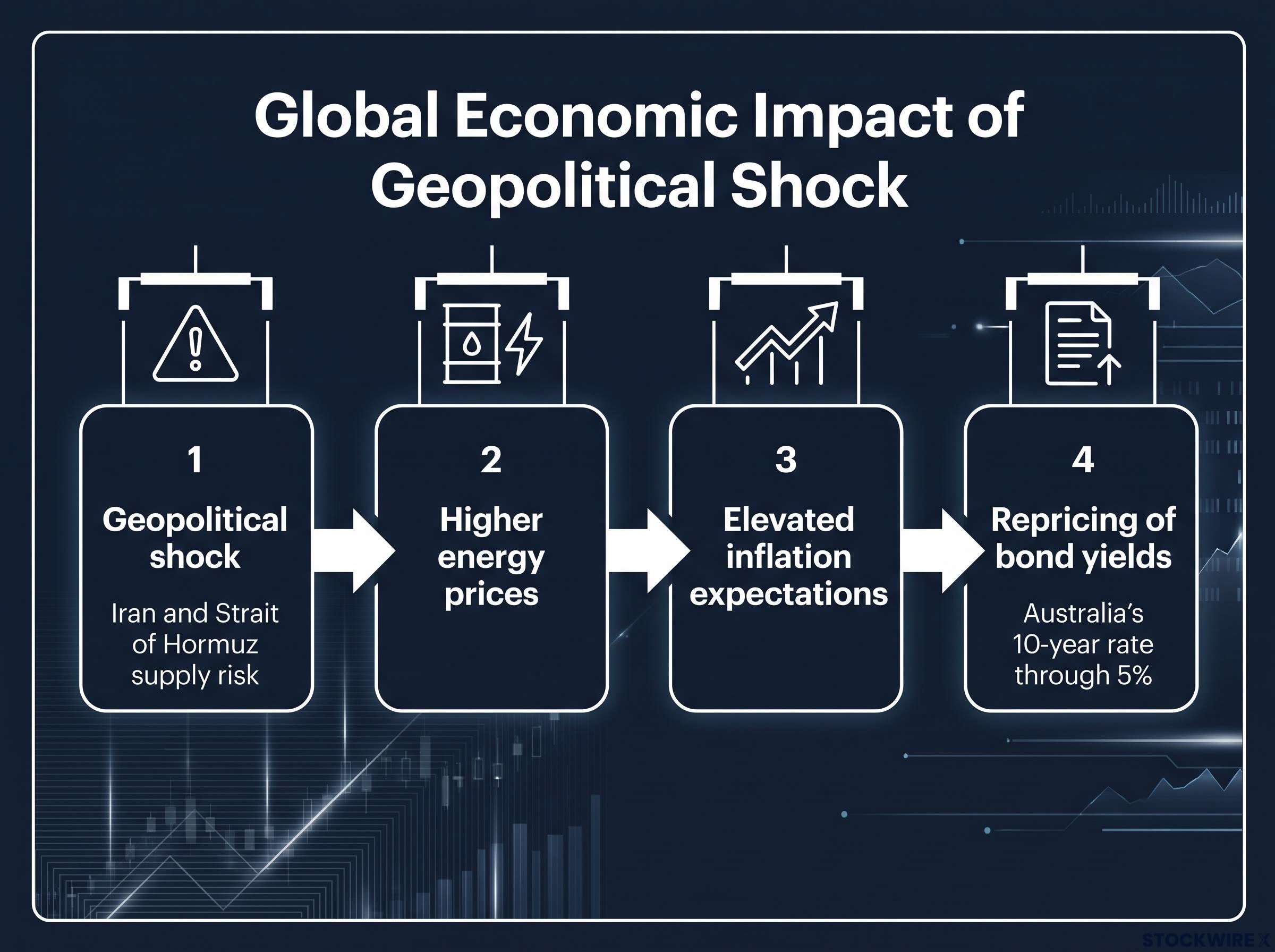
The connection between a geopolitical flashpoint in the Middle East and the yield on your Australian government bond follows a four-step chain reaction:
- Geopolitical shock to oil supply: Conflict involving Iran and disruption concerns around the Strait of Hormuz raised the risk of sustained supply disruption, pushing global oil prices sharply higher and sustaining that pressure over time.
- Higher and more uncertain energy prices: More expensive energy flows through to transport, manufacturing, and consumer prices, lifting both current inflation readings and near-term inflation expectations.
- Elevated inflation expectations: When investors expect more inflation, they demand higher nominal yields to compensate for the expected erosion of the real value of fixed coupon payments.
- Repricing of bond yields: As bond prices and yields move inversely (when yields rise, bond prices fall), the upward shift in required yields drove Australia’s 10-year rate through the 5% mark and pushed prices on existing bonds lower.
This mechanism is not unique to Australia. The same dynamic is visible across advanced economy sovereign markets where policymakers are holding or tightening while monitoring energy-driven inflation risk.
The Hormuz blockade repricing has not been confined to energy markets; ECB Chief Economist Philip Lane explicitly linked the Iran conflict-driven oil shock to potential rate hikes in May 2026, confirming that the transmission from geopolitical disruption to sovereign bond yields is a global phenomenon, not an Australian anomaly.
Inflation context: Headline CPI peaked at approximately 4.6% year-on-year in March 2026, eased to 4.2% in April, and reached 4.0% in May 2026. The trimmed mean measure stood at 3.6% year-on-year in May. Both remain well above the RBA’s 2-3% target band, with transport and fuel costs among the contributors.
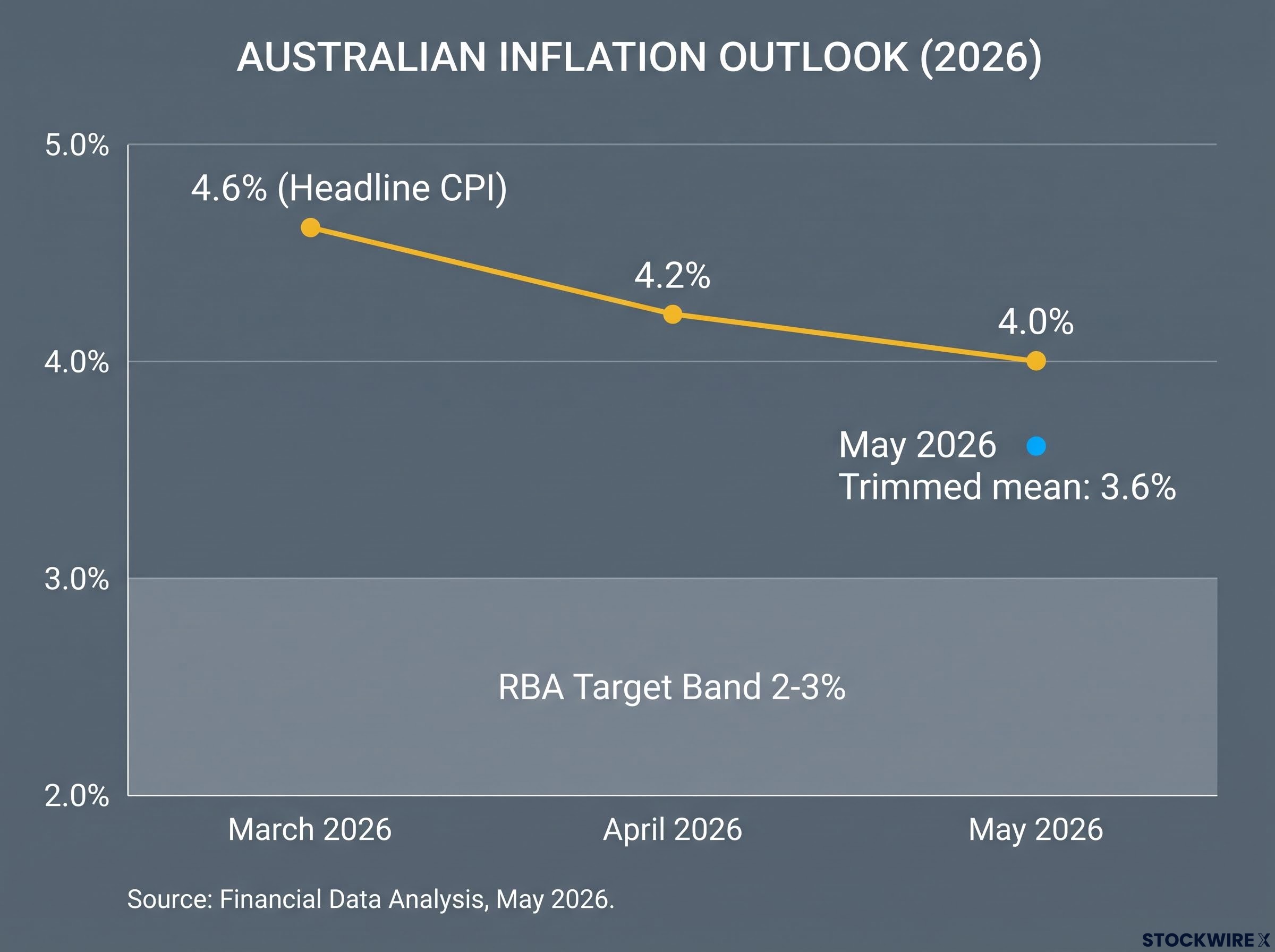
Understanding this chain means you can assess future yield moves yourself. When oil prices spike on geopolitical headlines, the question to ask is not “what will yields do today” but “does this change the inflation outlook durably enough to shift RBA policy expectations?”
What does a 5% government bond yield actually mean for investors?
The 5% figure is a single number, but it contains three distinct layers of value. Understanding all three is what separates an informed bond allocation decision from a reflexive one.
Contracted income from a low-credit-risk issuer
Australian government bonds carry very low credit risk, meaning a high probability that interest and principal will be paid as promised. Locking in approximately 5% per year for 10 years from this issuer is a fundamentally different proposition from 5% offered by a lower-quality corporate borrower, where default risk erodes the reliability of that income stream.
During the 2010s, 10-year yields of 1-2% often sat below prevailing inflation, leaving bondholders with little or no real income. That era is over.
The 5% level feels alarming partly because investors calibrated their expectations during a decade of QE-era suppression that held 10-year yields at 1.5-3% through unprecedented central bank intervention; a four-decade historical review shows current yields sitting comfortably within the range that prevailed before quantitative easing reshaped the fixed income landscape.
Real return arithmetic
With headline CPI at 4.0% (the most recent reading as of May 2026), the current real yield is modest. But if inflation converges toward the RBA’s 2-3% target band over the life of the bond, a 5% nominal yield implies a positive real return of roughly 2 percentage points per year.
That is the gap between what the bond pays you and what inflation takes away, and it is the number that matters most for preserving purchasing power.
Capital gain optionality
Because bond prices and yields move inversely, purchasing a bond at today’s elevated yield creates capital gain potential. If inflation recedes, geopolitical tensions ease, or growth slows and yields consequently fall, the market price of that bond will rise, adding capital gains on top of coupon income.
| Yield environment | Approximate 10-year yield | Approximate CPI | Implied real return |
|---|---|---|---|
| 2010s low-yield era | 1-2% | 2-3% | Negative to zero |
| Current environment (July 2026) | ~5% | 4.0% | ~1% |
| If inflation converges to RBA target | ~5% | 2-3% | ~2-3% |
The three-part value proposition, income, real return potential, and price optionality, is what makes today’s yield level worth serious attention.
How professional managers are treating today’s yield levels
Morningstar Investment Management lifted bond weightings incrementally across client portfolios in response to the late July yield move, adding exposure to both international and domestic Australian bonds. These adjustments were not driven by a view on where oil prices or geopolitical developments are headed next. The decisions were anchored in valuation: current prices relative to estimated long-run fair value.
Bryce Anderson, Senior Portfolio Manager, Morningstar Investment Management (28 July 2026): Portfolio adjustments are guided by the relationship between current prices and estimated long-term fair value, not attempts to time short-term geopolitical events.
The specific strategies in play illustrate the valuation-driven discipline:
- Incremental additions to quality fixed income: Adding to government and high-quality bonds to improve expected long-term portfolio returns without materially increasing credit risk
- Intermediate duration preference: Expanding exposure to 3-7 year maturities to capture higher yields with less rate sensitivity than 10-year bonds, while retaining short-duration holdings as a buffer if yields rise further
- Global diversification: Since energy-driven inflation risk is global, diversifying across regions and issuers rather than concentrating in a single sovereign market
The fact that a major professional manager is adding to bonds at these levels, using a valuation framework rather than a macro prediction, tells you something about the risk-reward calculus. Quality fixed income now offers a materially better return proposition than it did a year ago, and the professional response reflects measured, incremental commitment rather than aggressive concentration.
Australian bond market depth has expanded substantially, with $186 billion in new issuance in the first five months of 2026 absorbed without pricing dislocations despite active headwinds from Middle East conflict and global rate volatility, a sign that offshore demand at elevated yield levels is a structural feature rather than a temporary bid.
Practical considerations for Australian investors reassessing their bond exposure
Many Australian self-managed super funds (SMSFs) and retail investors have been structurally underweight bonds for years, and for good reason: yields were too low to compete meaningfully with equities and property. At 5% on 10-year government bonds, that calculus has changed.
Existing holders vs. new money
If you already hold long-duration bonds, you have experienced price drawdowns through the 2022-2026 tightening cycle. The relevant question for you is whether to hold for the income and potential price recovery, or rebalance your duration profile.
If you are deploying new money, a different framework applies. The relevant question is today’s entry point, not the path that brought yields here. Bonds purchased now have better expected returns than the same bonds bought a year ago, even though prior holders experienced price declines along the way.
| Bond type | Yield relative to cash rate | Key advantage now | Key risk now |
|---|---|---|---|
| Long-duration government bonds (10-year-plus) | Higher | Greatest income and capital gain potential if yields fall | Most sensitive to further rate rises |
| Intermediate government bonds (3-7 year) | Moderate premium | Balance of income and lower rate sensitivity | Less upside if yields fall sharply |
| Short-duration bonds / cash | Near cash rate | Capital stability and reinvestment optionality | Lower income, less upside |
| Inflation-linked bonds | Lower nominal, CPI-adjusted | Purchasing power protection if inflation stays elevated | Underperforms if inflation falls faster than expected |
| Investment-grade corporate bonds | Spread above government | Higher income than government bonds | Credit and downgrade risk if growth slows |
Inflation-linked bonds deserve specific attention as a hedge for the scenario where inflation remains elevated beyond the base case. Corporate bonds offer yield spreads over government bonds but introduce credit risk that could materialise if economic growth slows under tight monetary conditions.
This article is for informational purposes only and should not be considered financial advice. Investors should conduct their own research and consult with financial professionals before making investment decisions.
What changes at 5% and what the rate environment still leaves unresolved
For the first time since approximately 2011, Australian government bonds offer meaningful contracted income and positive real return potential. Fixed income’s role as both an income source and portfolio ballast against equity volatility has been restored after more than a decade where yields of 1-2% left the asset class unable to meaningfully compete.
That is the shift. But three variables remain genuinely unresolved:
- Inflation convergence timeline: Whether headline and trimmed mean CPI converge to the RBA’s 2-3% target on schedule, or whether energy-driven cost pressures keep inflation elevated longer than the base case
- RBA rate path: Whether the cash rate holds at 4.35% or moves toward the 4.60% implied by futures pricing, and what further tightening would do to bond prices
- Geopolitical trajectory: Whether Iran-linked tensions de-escalate or intensify, with direct consequences for oil prices and the inflation outlook
The 5% level does not resolve the uncertainty about future rates or inflation. But it does materially improve the starting point for fixed income returns. Those are two separate questions that require separate answers, and the investors who treat them separately will make better allocation decisions than those who conflate them.
For investors who hold existing long-duration bonds and are weighing whether to sell, shorten duration, or stay the course, our full explainer on bond investing strategy in rising yield environments walks through how starting yield historically predicts 5-10 year returns and why selling after yields have already risen locks in permanent capital losses.
Past performance does not guarantee future results. Financial projections are subject to market conditions and various risk factors.
—