Australia’s primary bond market has expanded by a factor of three to four since 2021. In raw terms, $186 billion in new issuance hit the market in the first five months of 2026 alone, a 29% jump on the same period a year earlier. The Australian dollar market has ascended to sit alongside the Canadian dollar and sterling markets in global standing, with only the US dollar and euro ranked above it. That is not a gradual creep upward. That is a reclassification.
What makes the 2026 number more than a cyclical headline is the environment it arrived in. Elevated global volatility, Middle East tensions, and higher oil prices have historically suppressed new bond issuance as both issuers and investors retreat to the sidelines. This year, the opposite happened. Deals kept coming, and they kept getting absorbed.
The question that data raises is a positioning one. After reading this, you will know whether the Australian bond market now warrants a strategic rather than peripheral allocation in your portfolio, and what the sustained foreign capital surge tells you about how global institutions have already answered that question for themselves.
From regional market to global tier: how fast the shift has been
The numbers tell the story more efficiently than any framing can. New issuance totalled $186 billion across the first five months of 2026, representing 29% growth compared with the same period a year prior. The market’s overall scale has roughly tripled or quadrupled relative to 2021 levels, based on figures drawn from Yarra Capital Management, Bloomberg, and Deutsche Bank.
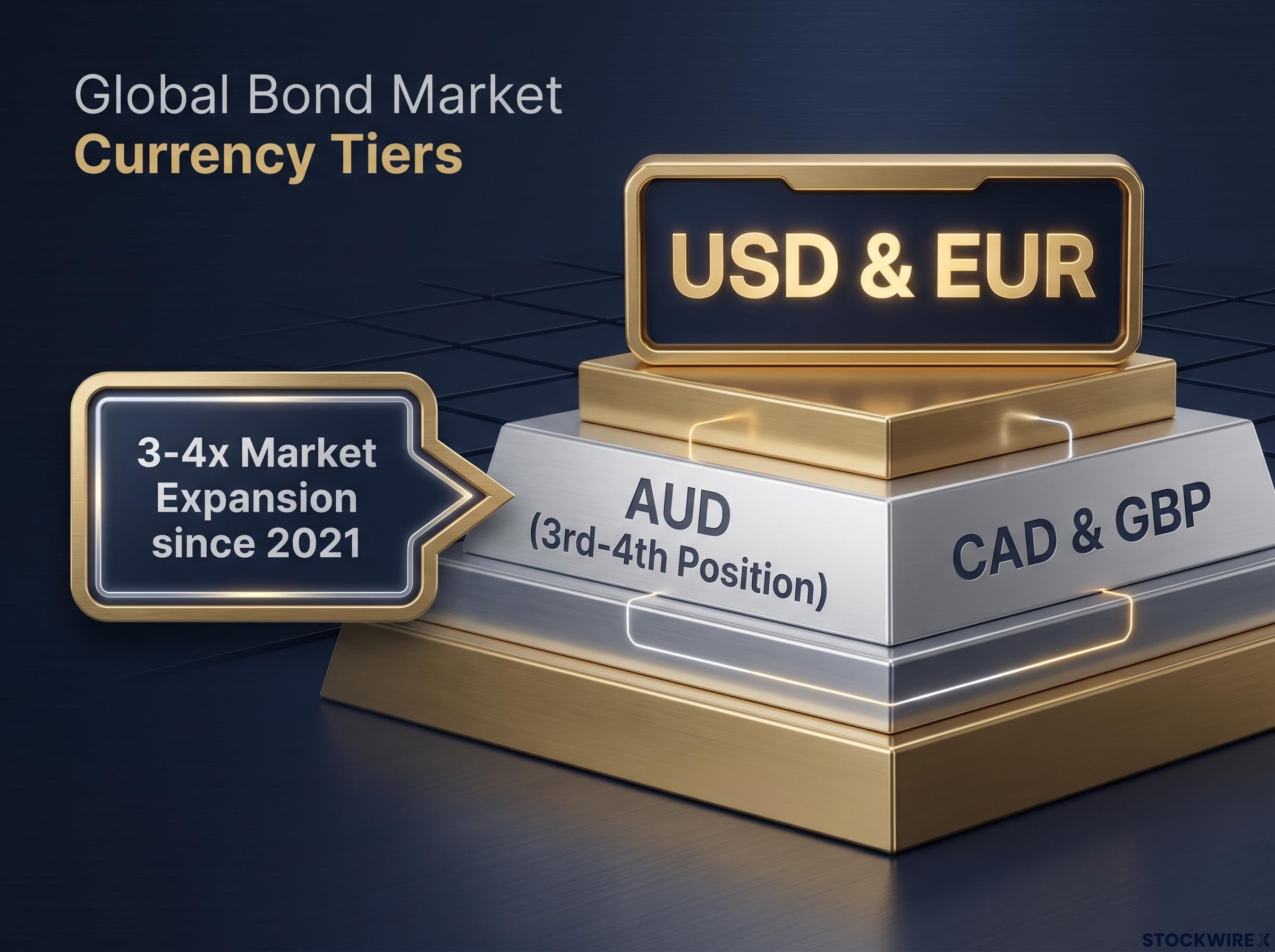
That expansion has moved the market into a different category. Among global bond markets ranked by size, the Australian dollar sits in third or fourth position, trailing only the USD and EUR, and now occupies the same tier as the Canadian dollar and sterling. For large institutions that require benchmark-scale markets with reliable secondary liquidity, Australia has crossed the threshold from peripheral allocation to core consideration.
AOFM annual report data on government securities issuance provides the official baseline for measuring how far primary market capacity has expanded since 2021, giving institutional allocators a verified reference point for the scale figures that now define Australia’s position in global bond market rankings.
| Metric | Figure | Period |
|---|---|---|
| Primary issuance | $186 billion | January-May 2026 |
| Year-on-year growth | 29% | Jan-May 2026 vs Jan-May 2025 |
| Growth since 2021 | ~3-4× expansion | 2021 to 2026 |
| Global ranking (AUD) | 3rd-4th | Behind USD and EUR |
| Foreign participation | 40-50% | Consistent, ongoing |
This is not a cyclical uptick. It is a structural reclassification of where Australian fixed income sits in global capital allocation hierarchies, and it determines which institutions can now treat it as a benchmark market rather than a niche diversifier.
When big ASX news breaks, our subscribers know first
Why foreign investors keep showing up at 40-50% of every new deal
Offshore investors have reliably accounted for 40-50% of new bond subscriptions in Australia, a share that has remained stable across varying market conditions and points to deliberate institutional positioning rather than short-term yield chasing.
That number should stop you mid-scroll. In most mid-sized bond markets, foreign participation fluctuates sharply with yield cycles and risk appetite. In Australia, it has remained structurally anchored. Two factors explain why.
- AAA sovereign rating accessibility. Australia holds AAA sovereign ratings from S&P, Moody’s, and Fitch as of 2026. That matters because the world’s most regulated balance sheets, pension funds, insurers, and sovereign wealth funds, operate under mandates with hard credit quality floors. AAA designation from all three agencies is the entry ticket for the most constrained allocators globally.
- Yield premium relative to AAA peers. Unlike most other AAA-rated economies, Australia offers comparatively higher yields. That gives offshore allocators something rare: a way to satisfy both credit quality constraints and income generation objectives in a single allocation.
The consistency of that 40-50% participation rate tells you something specific about the market’s pricing and liquidity dynamics. Offshore demand is not temporary support that could vanish in a risk-off episode. It is a structural feature, baked into how new deals are priced and how secondary markets function. For domestic investors making entry timing decisions, that distinction matters.
Sustained bond fund inflows across 56 consecutive weeks through late May 2026, with $30.5 billion drawn into fixed income in a single week, confirm at the global capital flow level what the Australian primary market data shows at the domestic level: institutional demand for bonds is not a short-term tactical position.
What AAA plus yield actually means in practice
What AAA means for institutional mandates
You probably know that AAA is the highest credit rating a sovereign borrower can receive. What you may not know is how few countries still hold it from all three major agencies, and why that scarcity matters mechanically.
Many institutional investors, particularly pension funds, insurers, and sovereign wealth funds, operate under mandates that restrict their holdings to investment-grade or specifically AAA-rated sovereign debt. These are not preferences. They are hard rules embedded in fund constitutions and regulatory frameworks. AAA designation from S&P, Moody’s, and Fitch simultaneously is the threshold that unlocks the most constrained pools of global capital.
Why the yield component changes the equation
AAA alone is not enough. Several AAA-rated markets, including Japan, Germany, and Switzerland, currently offer near-zero or negative real yields. They satisfy the quality mandate, but they do not generate income. For pension funds paying defined benefits or insurers matching liabilities, yield is not a preference; it is a portfolio necessity.
Australia’s combination is genuinely unusual: top-tier credit quality paired with positive, comparatively higher nominal yields. By mid-2026, Australian 3-year government bond yields had moved roughly 30 basis points higher than where they began the year. As Phil Strano at Yarra Capital Management has framed it, higher yields are functioning as the primary driver of fixed income returns in 2026.
The 30-basis-point move in Australian 3-year government bonds through mid-2026 is meaningful in context, but bond yield mechanics, specifically how auction pricing, inflation expectations, and central bank signals interact to produce the yield a market quotes, shape whether that move reads as an entry signal or a warning.
Three conditions make a bond market appealing to global institutional allocators:
- The credit quality floor is met (AAA from all three agencies)
- Yields sit above inflation in real terms, supporting income mandates
- Sufficient market liquidity and scale exist to absorb institutional-sized positions
Australia currently satisfies all three. For you as a domestic investor, the implication is direct: the same yield advantage attracting foreign capital is available to portfolios that may be underweight fixed income relative to where yields now sit.
Resilience under pressure: what the 2026 issuance pattern reveals about market depth
Historically, elevated global volatility suppresses primary bond issuance. Issuers wait for stable windows, investors retreat to secondary markets, and deal pipelines stall.
In 2026, that pattern broke. $186 billion was raised through May despite active headwinds that would normally have frozen the market:
- Ongoing conflict in the Middle East generating sustained geopolitical uncertainty across the first half of the year
- Oil price increases flowing through into broader inflation expectations
- Elevated global rate volatility as central banks recalibrated policy paths
The deals kept coming, and they were absorbed without notable pricing dislocations. Spreads held. Syndication processes completed. That absence of disruption is itself a data point.

A market that absorbs new issuance cleanly during stress is telling you something about its depth: the investor base is broad and diversified enough, and the infrastructure (bank syndicate desks, trading platforms, secondary market-makers) is mature enough, to handle volume when conditions are difficult.
For your portfolio, this matters beyond the primary market. A market that issues cleanly during stress is a market where secondary liquidity is also more likely to hold when conditions deteriorate. That directly affects the risk profile of holding Australian fixed income through a volatile macro period. If you needed to sell in a difficult environment, the 2026 issuance data suggests the exit would be more orderly than it would have been five years ago.
What the global convergence means for Australian investors managing domestic portfolios
The pricing and liquidity benefits for domestic portfolios
The 40-50% foreign participation rate is not just a headline. It is the mechanism behind measurable improvements in how Australian bonds are priced and traded.
As offshore capital anchors Australian bond spreads against global comparables, domestic investors benefit from tighter bid-offer spreads and more efficiently priced new issues. The “home market” premium that issuers once captured at investors’ expense has compressed. The three to four times expansion since 2021 has also driven structural liquidity improvement: more counterparties, deeper secondary markets, and the capacity for larger position sizes and more active portfolio management than were previously feasible.
The new risk transmission channels to monitor
Greater integration with global capital flows is not a free upgrade. As the Australian bond market converges with CAD and GBP peer markets in institutional allocations, Australian valuations will respond more quickly to developed-market repricing events than in the past. Risk-off episodes in global rates or credit will transmit into domestic pricing via foreign flows more directly than when the market was smaller and more domestically oriented.
US Treasury yield transmission into Australian government bond yields operates through several channels simultaneously: foreign capital reallocation, relative yield spread compression, and equity discount rate effects, meaning a sustained move above 5% in US long rates would reprice Australian fixed income even in the absence of any domestic policy change.
Variables to monitor as this integration deepens:
- Inflation trajectory and its effect on the yield differential that attracts foreign capital
- RBA policy path and how it diverges from or converges with other major central banks
- Global risk sentiment, particularly in developed-market rate markets
- Foreign flow data as a real-time signal of whether offshore allocations are expanding or contracting
The trade-off is clear. The same globalisation making Australian fixed income more liquid and efficiently priced also makes it more correlated to global rate moves. That belongs in any portfolio construction conversation about this asset class.
Where Australian fixed income sits in a strategic portfolio allocation now
The question for both offshore and domestic allocators is no longer whether Australian fixed income belongs in portfolios. It is how large and strategic that allocation should be.
That shift, from “whether” to “how much,” is the analytical conclusion the preceding evidence supports. The $186 billion issuance pace and 29% growth rate demonstrate a market functioning at global scale. Foreign participation at 40-50% of new subscriptions confirms that offshore institutions have already made the strategic allocation decision.
As Phil Strano at Yarra Capital Management has noted, higher yields are the primary return driver in fixed income in 2026. The current yield environment is unusually favourable for investment-grade fixed income relative to most of the past decade. An underweight position now carries a genuine opportunity cost.
Three forward-looking variables will signal whether the structural case remains intact:
- Yield differential persistence between Australian and other AAA-rated sovereign markets
- RBA policy trajectory and its implications for domestic rate levels
- Sustained foreign participation rates in new issuance as confirmation of ongoing institutional commitment
Investors who have not reviewed their Australian fixed income allocation since before the 2021 expansion are working with an outdated picture.
For investors wanting to translate the market-level analysis into specific product decisions, our deep-dive into Australian bond ETF duration risk examines why two funds with similar yield figures can produce opposite returns on the same day, using February 2026 price data across ALTB, IAF, and VAF as worked examples.
This article is for informational purposes only and should not be considered financial advice. Investors should conduct their own research and consult with financial professionals before making investment decisions. Past performance does not guarantee future results. Financial projections are subject to market conditions and various risk factors.
Reading the $186 billion signal correctly before making an allocation decision
The tripling or quadrupling of issuance since 2021, the sustained 40-50% foreign participation rate, and the resilience through 2026 volatility collectively represent a market that has reclassified itself in global fixed income. This is not a temporary surge. It is a structural shift in where Australia sits in the hierarchy of investable bond markets.
The honest trade-off for investors entering now is straightforward. The yield advantage is real and supported by durable global institutional demand. The AAA credit quality, combined with comparatively higher yields, is the logic that keeps foreign capital arriving. But greater integration with global capital flows introduces volatility transmission that was less present when the market was smaller and more domestically oriented.
If you have not reviewed your Australian fixed income allocation since before the 2021 expansion, you are working with an outdated picture of what this market is, how deep its liquidity runs, and how it behaves under stress. The $186 billion raised in five months is a clear prompt to update that picture before making your next allocation decision.