
When it comes to long-term investing returns, Australia consistently punches above its weight, and the explanation has little to do with superior stock selection. The country’s compulsory superannuation system quietly produces investor behaviour that most people spend years trying (and failing) to develop on their own. The secret is not superior fund management or better stock picks. It is a set of structural rules that prevent you from making the decisions that destroy long-term returns.
Outside of superannuation, every one of those protections disappears. Your non-super portfolio is fully exposed to panic selling, overtrading, irregular contributions, and impulsive withdrawals, the behaviours that superannuation’s architecture quietly suppresses without you ever noticing.
This article gives you a working blueprint for importing those structural advantages into any portfolio you manage directly. The tool is called an Investment Policy Statement (IPS), a personal governing document that turns your best long-term intentions into a system that runs whether you feel confident or terrified. Here is exactly what one looks like, what goes into each section, and how to build your own today.
How superannuation’s structural design produces better investor outcomes
Morningstar’s global Mind the Gap study makes a finding that surprises most investors when they first encounter it: favourable investment outcomes are more a function of sound process than of identifying superior investments. The divergence between what a fund returns and what its typical investor actually pockets is shaped primarily by behavioural choices around timing, not by the quality of the underlying product.
Australia’s compulsory superannuation system happens to engineer exactly the right behavioural process, almost by accident. The mandatory structure produces four distinct advantages:
- Consistent contributions across all market conditions. The Superannuation Guarantee channels money into the market every pay cycle, with no attempt to time entry or exit points.
- Minimal switching behaviour. Because most members are broadly disengaged from their super, they rarely move between investment options, which sidesteps the performance-chasing and panic-switching that chips away at returns over time.
- A structurally extended time horizon. Preservation age rules lock the money away until retirement, which removes the practical option of withdrawing funds when markets fall.
- Limited exposure to daily market noise. Because access is restricted, most members pay little attention to short-term price movements, and that inattention, counterintuitively, tends to produce better outcomes than frequent monitoring.
The reframing that matters here is this: these are not personality traits of disciplined investors. They are outputs of a well-designed system. Any investor can access the same advantage by building the right structure around their own portfolio, and that is what this guide shows you how to do.
For investors wanting to quantify exactly how much the superannuation tax wrapper contributes to the structural advantage described in this guide, our full explainer on the super vs shares tax gap works through the projected $230,000 wealth difference that emerges over 25 years from identical portfolios held inside and outside super.
When big ASX news breaks, our subscribers know first
Why your non-super portfolio is working against you right now
Step outside superannuation and every one of those structural protections vanishes. Your contributions become optional. Your time horizon becomes ambiguous. You can access the money whenever you want. And short-term market noise, headlines about crashes, rate decisions, geopolitical shocks, competes for your attention every time you open your phone.
The result is a well-documented urge to treat activity as progress, particularly when markets turn volatile and sitting still feels irresponsible. When prices fall, doing nothing feels irresponsible. So you trade. And that trading, according to Morningstar’s behavioural research, inflicts more damage than the market conditions that prompted it. The specific harms are predictable and well-documented:
The behavioural architecture that keeps investors in the market during drawdowns matters more than fund selection: research consistently finds that panic-selling at the worst moments, not poor asset choice, is the primary mechanism through which retail investors destroy long-run compounding.
- Crystallising a loss permanently by selling into a downturn rather than holding through a temporary decline
- Creating an avoidable tax liability by realising gains or losses outside your planned schedule
- Paying brokerage and transaction fees on trades that add no strategic value to the portfolio
- Sitting out the rebound by being in cash or underinvested precisely when the market’s strongest sessions occur
A well-diversified portfolio is built to weather a variety of conditions rather than to outperform in every single one. At any given point, some component will appear to be underperforming. That is the design working, not a signal to intervene.
Morningstar’s behavioural research finds that the investors who achieve the best long-term outcomes are those who lean on structured processes rather than personal willpower to keep emotion out of their decisions. The track record of Australia’s superannuation system is frequently held up as evidence that the right architecture can produce better investment discipline than self-control alone.
This tells you something important: willpower is not the answer. Designing friction and rules into your own portfolio is a legitimate, evidence-backed strategy, not an admission of weakness.
What an Investment Policy Statement is and why it works
A written Investment Policy Statement is a personal governing document in which you set out your investment goals, target asset allocation, contribution schedule, review intervals, rebalancing rules, and behavioural guardrails. If you have heard the term before, it was probably in the context of a corporate fund or a self-managed super fund (SMSF). But the concept works just as well, and arguably matters more, for your personal non-super portfolio.
Think of it as a contract between your calm, rational self today and your emotional self during the next market crash. Its purpose is to shift the question from “what should I do right now?” to “does my IPS tell me to do anything?” That single shift converts panic-driven improvisation into rule-based behaviour.
The IPS earns the majority of its value precisely during downturns, when you are most tempted to abandon strategy. This mirrors the role superannuation’s rules play: they remove the decision entirely. Your IPS does the same thing, except you wrote the rules yourself, before the crisis arrived. That is where its power comes from: you committed to the framework when you could think clearly, and the framework holds you to that commitment when you cannot.
A minimum-viable IPS covers these components:
- Objective and goals
- Time horizon
- Risk tolerance
- Asset allocation with tolerance bands
- Contribution schedule
- Monitoring and review rules
- Rebalancing rules
- Access rules and behavioural guardrails
Each of these is a clause you will write in your own words. The next section shows you exactly what each one looks like.
Building your IPS component by component
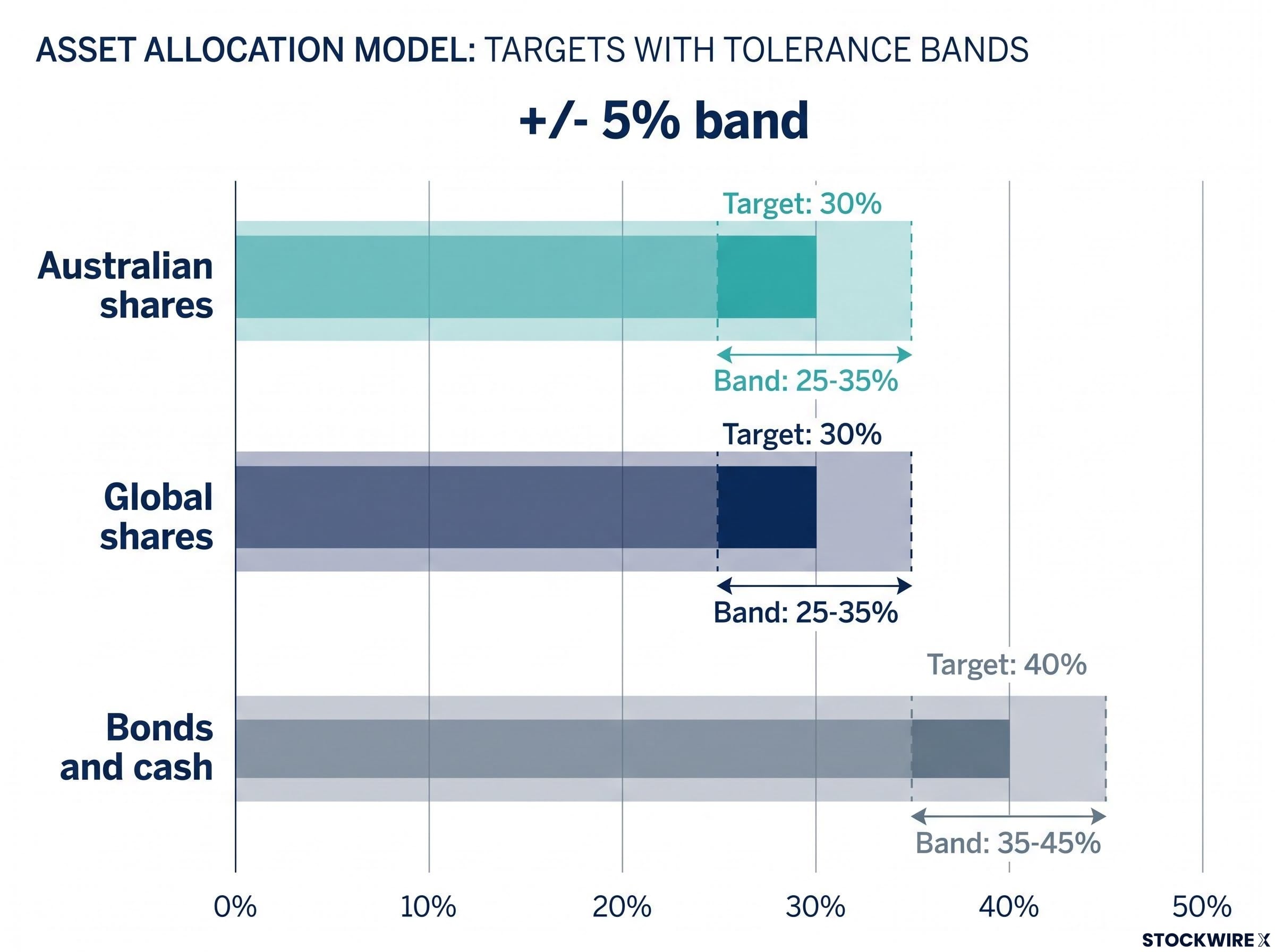
Your asset allocation is the structural core of the IPS. Setting a target with defined tolerance bands is what distinguishes a disciplined system from ad hoc portfolio management. You only act when a band is breached, not when a headline changes.
Here is an example base allocation with bands:
| Asset Class | Target Allocation | Band |
|---|---|---|
| Australian shares | 30% | 25-35% |
| Global shares | 30% | 25-35% |
| Bonds and cash | 40% | 35-45% |
The plus or minus 5% band around each target prevents unnecessary trading triggered by minor drift while ensuring genuine imbalances are corrected systematically.
When rebalancing is required, use this method in order of preference:
- Primary: redirect new contributions to underweight asset classes
- Secondary: sell portions of overweight asset classes to purchase underweight ones
Prioritising the contribution method minimises unnecessary tax events. The governing rule is simple: rebalancing is mechanical, not discretionary. Your feelings about recent performance are not part of the decision.
Tax-efficient rebalancing execution follows a strict priority order: directing new contributions to underweight asset classes first, dividend redirection second, and asset sales only as a last resort, a sequence that preserves the 50% CGT discount on assets held longer than 12 months.
Contribution schedule and automation
Hard-coding and automating your contribution schedule is the DIY equivalent of the Superannuation Guarantee. The power of the SG system is that contributions happen automatically; you never decide whether to contribute in a given month. Your IPS should work the same way.
“On the 1st of each month, $X is transferred from my bank account to my investment account and invested according to the target allocation.”
Set up a standing transfer from your salary or transaction account. If your platform supports automatic investment plans (regular ETF purchases, for example), use them. Once the schedule is set, the default is always to keep contributing, even and especially during downturns. Changing the contribution schedule should require a formal IPS review, not a bad week in markets.
Monitoring, review, and the low-engagement advantage
Superannuation members who rarely check their balances tend to trade less and retain more of their returns. You can deliberately recreate this benefit by setting defined monitoring limits.
Your IPS monitoring clause should look something like this: portfolio values checked quarterly, a full strategic review conducted annually (each July is a natural anchor), and no logging in to check values more than once a month. Your quarterly review checks allocations against bands and rebalances if any band has been breached. Your annual review reassesses objectives, time horizon, and any major life changes.
Include this explicit rule: short-term market moves, news headlines, and economic forecasts are not valid reasons to change strategy between scheduled reviews. This is not a restriction. It is the feature that recreates super’s accidental disengagement benefit by design.
Access rules and the 30-day cooling-off mechanism
Preservation age is one of superannuation’s most powerful behavioural features. You cannot fully replicate it outside super, but you can introduce meaningful friction. Start by maintaining your long-term investment accounts structurally separate from your day-to-day transaction accounts. The money should not be visible when you check your everyday banking.
For withdrawals, your IPS should specify: this portfolio is not to be used for spending before your target year or age, except in defined emergencies such as a medical crisis or job loss. Any withdrawal outside those circumstances requires a written note explaining why it is consistent with the IPS, reviewed after 30 days.
The psychology is straightforward. The act of writing the justification and then waiting introduces the delay that separates an emotional impulse from a considered decision. Most impulses do not survive 30 days of scrutiny.
Locking in the guardrails: behavioural rules for when markets get difficult
You have built the system. Now you need to understand how it holds up under pressure, specifically, the market conditions most likely to make you abandon it.
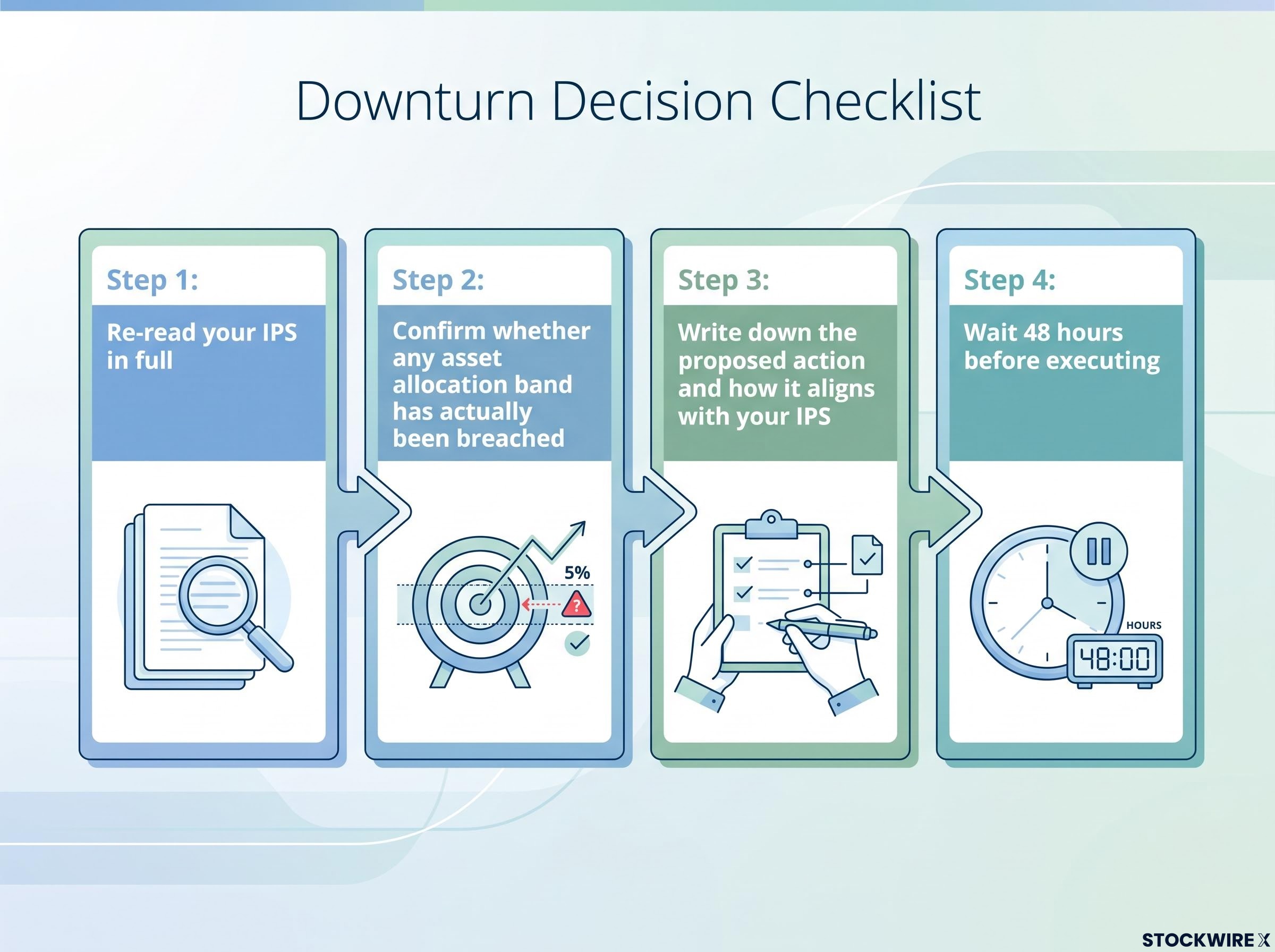
The first tool is a downturn decision checklist, a pre-committed procedure you follow before making any significant change during a market decline:
- Re-read your IPS in full
- Confirm whether any asset allocation band has actually been breached
- Write down the proposed action and how it aligns with your IPS
- Wait 48 hours before executing
The sequence matters. Step one forces you to re-engage with your long-term reasoning. Step two converts a feeling (“everything is falling”) into a fact-check (“has my allocation actually drifted outside its bands?”). Steps three and four introduce the friction that prevents an emotional reaction from becoming a permanent portfolio change.
Portfolio resilience during a crisis depends less on predicting the downturn than on having entered with a written allocation plan, a liquidity buffer, and pre-committed rules: research on the 2008 crash finds that investors with these structural foundations in place consistently outperformed those who relied on real-time judgement.
The second tool is a set of prohibited actions clauses, explicit rules written into your IPS about what you will not do:
- “I will not move the entire portfolio to cash in response to market falls.”
- “I will not change strategy based on a single year’s performance.”
Making these explicit removes the grey area that invites rationalisation under stress. When everything feels like it is falling apart, you are not deciding whether to sell. You already decided, months or years ago, that you would not.
Beyond the IPS itself, consider these optional structural reinforcements: disable push notifications for price movements; automate ETF purchases and dividend reinvestment to reduce the number of active decisions; and if you use a financial adviser, frame their role as behavioural coach rather than investment selector.
The adviser’s role in this system mirrors the role of a trustee in a superannuation fund: maintaining discipline on behalf of the member, not picking better investments.
These are not restrictions on your autonomy. They are the mechanism by which your considered, long-term judgement overrides your in-the-moment emotional state, which is the same thing superannuation’s rules do structurally.
What your portfolio looks like when the system is running
Here is what the finished document looks like. Your one-page IPS, adapted from the framework in this guide, covers seven components. The parameters below are illustrative; yours will reflect your own objectives, income, and timeline.
| Component | Example Clause |
|---|---|
| Objective | Investing to fund retirement at age 65. Horizon: 25 years. Target real return: 5% per year above inflation. |
| Asset allocation | 60% growth (30% Australian shares, 30% global shares), 40% defensive (20% bonds, 20% cash/term deposits). Bands: plus or minus 5% around each target. |
| Contributions | $2,000 per month on the 1st, automatically invested according to target allocation. |
| Monitoring and review | Portfolio values checked quarterly. Strategy reviewed annually each July. |
| Rebalancing | Rebalance when any asset leaves its band or at year-end, primarily via directing new contributions. |
| Access rules | No discretionary withdrawals before age 65, except for defined emergencies. |
| Behavioural rules | No wholesale move to cash. No strategy changes based on 12-month performance. All significant changes require a 48-hour cooling-off period and written rationale. |
Read that table from top to bottom and you will notice something: it is not a complex document. Seven clauses, most of them one sentence. But those seven clauses collectively convert a potentially infinite set of portfolio decisions into a small, defined set of rules, most of which run on autopilot.
That is the structural reframe this entire guide has been building toward. The four behavioural properties that make Australia’s compulsory superannuation system so effective at protecting investors, namely automatic contributions, infrequent trading, an extended time horizon, and minimal attention to short-term price movements, are now built into any portfolio you manage directly. The difference is that you built the system yourself, for any portfolio you manage directly.
Your IPS is a living document. The only clause that should change frequently is the annual review clause, which you revisit each July. Everything else is designed to stay fixed, especially when markets make you want to change it.
This article is for informational purposes only and should not be considered financial advice. Investors should conduct their own research and consult with financial professionals before making investment decisions.