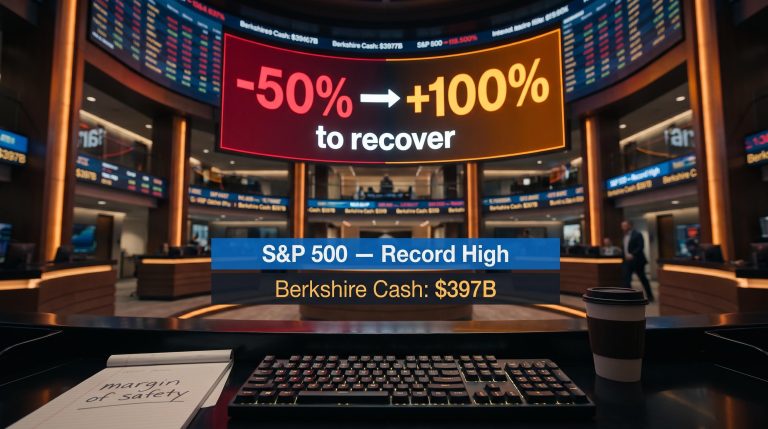
The market drops 5% in a week. Your portfolio screen turns red across every line. The urge arrives before the analysis does: sell now, ask questions later, protect what you have built.
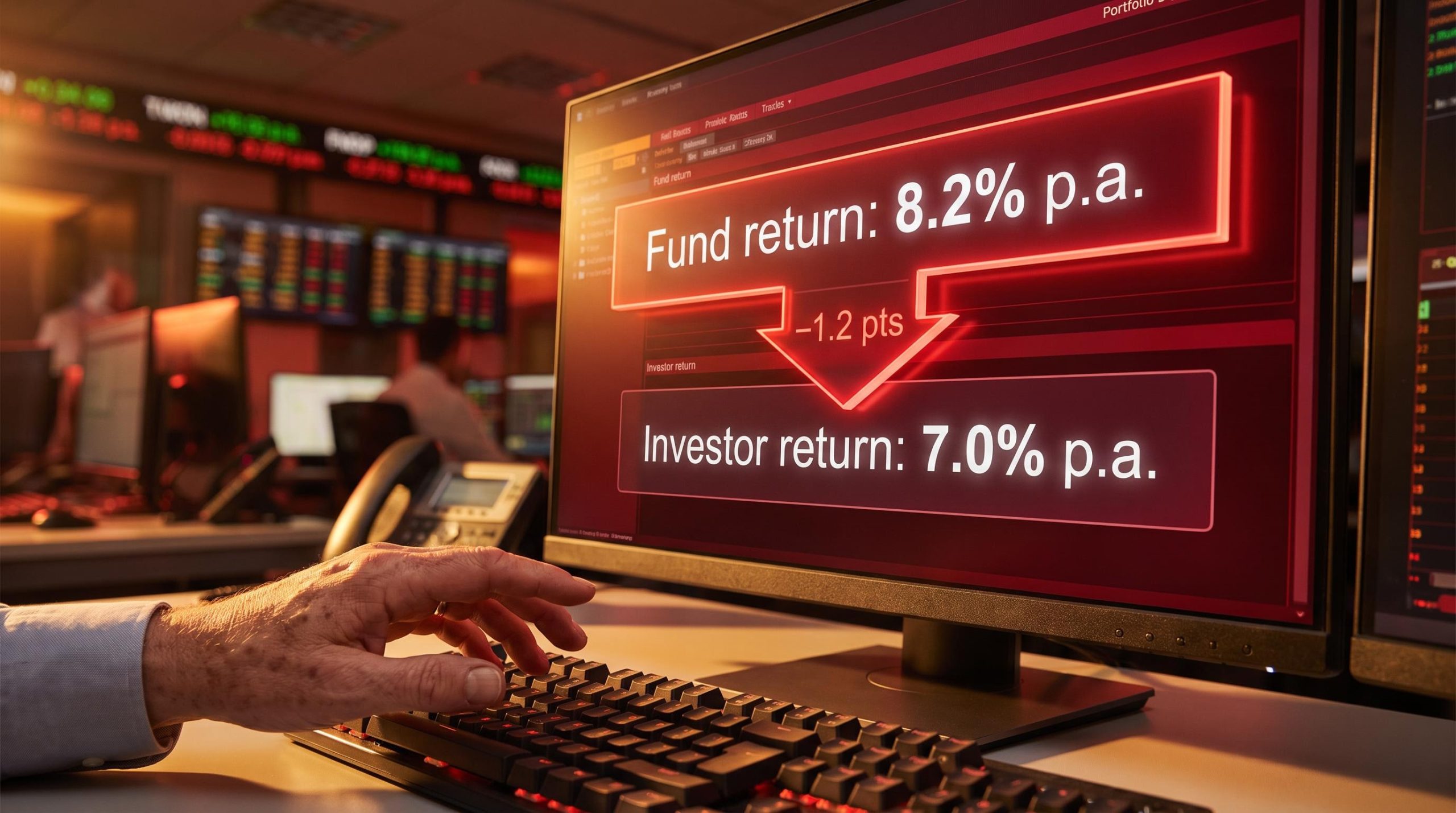
That impulse has a measurable cost. Morningstar’s Mind the Gap 2025 research found that over the 10 years ended 31 December 2024, the average dollar invested in US managed funds and ETFs earned 7.0% per year, while the funds themselves delivered 8.2%. The gap, 1.2 percentage points annually, did not stem from poor fund selection. It arose from the timing of purchases and sales, from entering after prices had climbed and exiting after they had fallen. Morningstar’s Australian commentary applies the same behavioural dynamics directly to superannuation.
Here is a concrete accounting of what that gap costs over a working life, why it happens, and what you can do about it before the next downturn forces the question.
How Morningstar measured the cost of investor timing decisions
The investor behaviour gap measures the divergence between two figures: the time-weighted total return a fund actually delivered over a given period, and the dollar-weighted return that investors in that fund genuinely received once every purchase and redemption is factored in. Put simply, it isolates what timing decisions cost in real money terms.
The distinction matters. The funds in Morningstar’s study averaged 8.2% per year. The investors who owned those same funds averaged 7.0%. The 1.2 percentage point shortfall was not a fee, not a product failure, and not a market crash. It was the aggregate result of millions of individual timing decisions, buying after prices had already risen and selling after they had already fallen.
Over the decade, that annual drag consumed approximately 15% of the funds’ total returns.
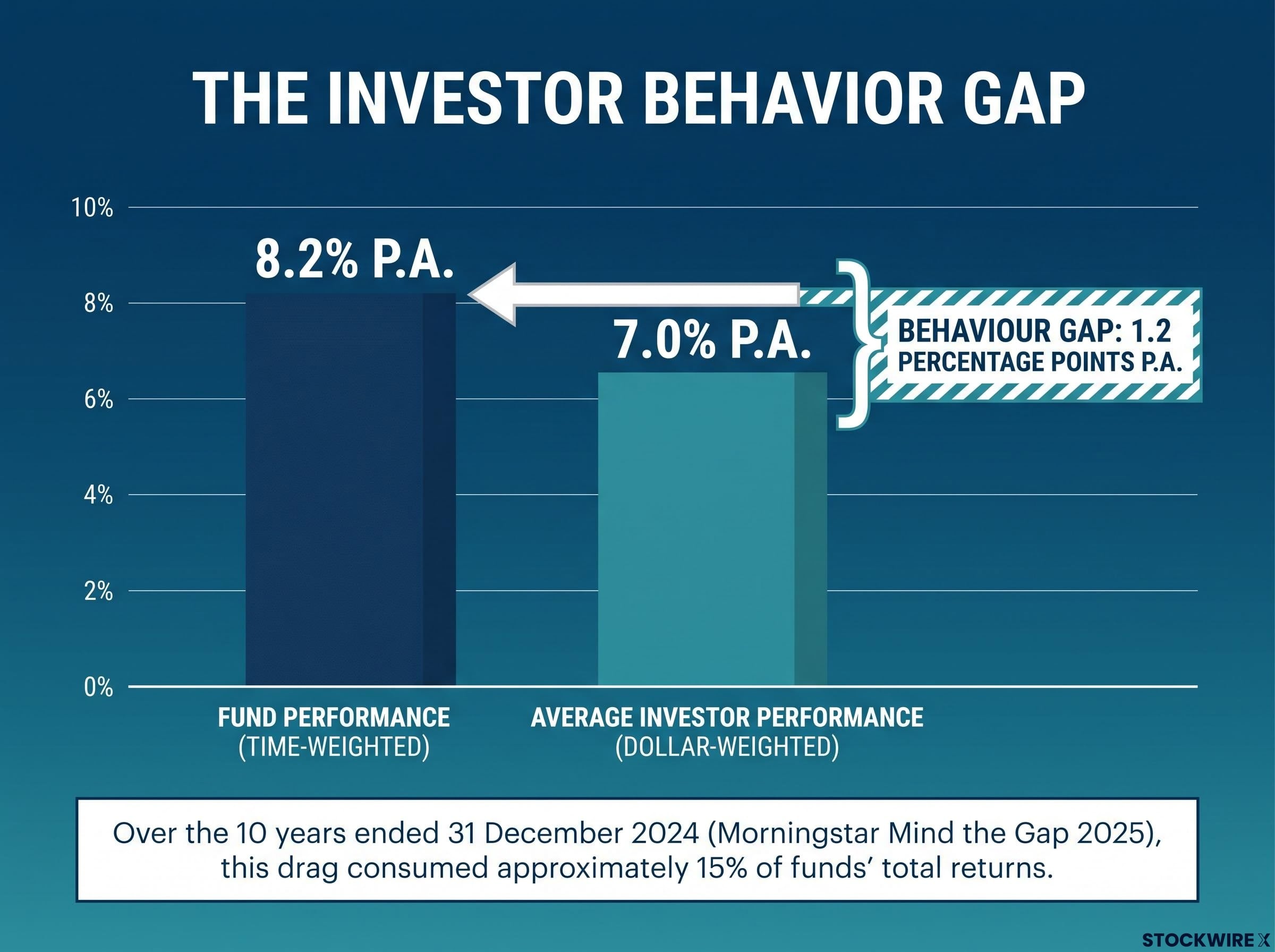
The investor return gap: 1.2 percentage points per year (Morningstar Mind the Gap 2025, 10 years ended 31 December 2024, US managed funds and ETFs). Morningstar’s Australian commentary applies equivalent behavioural analysis to the superannuation context.
| Return Type | Annualised Return | What It Represents |
|---|---|---|
| Fund performance (time-weighted) | 8.2% p.a. | What the fund delivered, assuming buy-and-hold |
| Average investor performance (dollar-weighted) | 7.0% p.a. | What the average invested dollar actually earned |
| Behaviour gap | 1.2 percentage points p.a. | Cost attributable to timing and cash flow decisions |
What that tells you is that behaviour is costing many investors roughly the same amount as their fund’s total expense ratio. You negotiate fees down by a fraction of a percent and feel disciplined. Meanwhile, the timing decisions you barely notice are extracting the same toll every year.
When big ASX news breaks, our subscribers know first
Why investors underperform their own funds
The pattern starts with what the screen does to your nervous system. Markets fall 3% in a day. The financial media runs crisis headlines. Your portfolio is suddenly worth less than it was a week ago, and every hour of inaction feels like a choice to lose more.
Loss aversion and the urge to act
The psychological architecture behind this is well established. Daniel Kahneman and Amos Tversky’s research on loss aversion demonstrated that losses feel roughly twice as painful as equivalent gains feel rewarding. A $10,000 paper loss hurts more than a $10,000 gain satisfies. That asymmetry creates an overwhelming bias toward action during declines, even when the rational response is to hold.
Performance chasing and the recovery miss
The second driver compounds the first. Once investors sell during a downturn, they tend to hold off re-entering until things appear more settled. The trouble is that the steepest part of any rebound typically plays out before that sense of calm arrives. This is the double cost of the timing trap: you realise the loss on the way down and miss the rebound on the way up.
The cost of missing the recovery is not evenly distributed across the calendar: seven of the 10 best single trading days in the 2004-2023 period occurred within two weeks of the 10 worst days, making it structurally near-impossible to exit during a crash without also sitting out the rebound.
Three behavioural drivers create the gap:
- Loss aversion: Losses feel psychologically larger than equivalent gains, intensifying the urge to act during declines
- Performance chasing: Buying after strong recent gains and selling after recent losses, systematically entering and exiting at the worst times
- Crowd effects and media amplification: Financial media coverage and peer behaviour reinforce emotional responses during volatility, triggering herd behaviour at precisely the wrong moment
The gap widens most during periods of heightened market stress, when emotional pressure peaks. The underlying problem is not a lack of knowledge or sophistication. Under sufficient pressure, the emotional circuitry overrides the rational one, and no amount of information reliably fixes that. The fix therefore has to be structural: rules and systems that reduce the number of high-stakes decisions you face in the heat of a sell-off. Knowing you should stay calm has never been the problem. Staying calm has.
What the gap actually costs over a working life
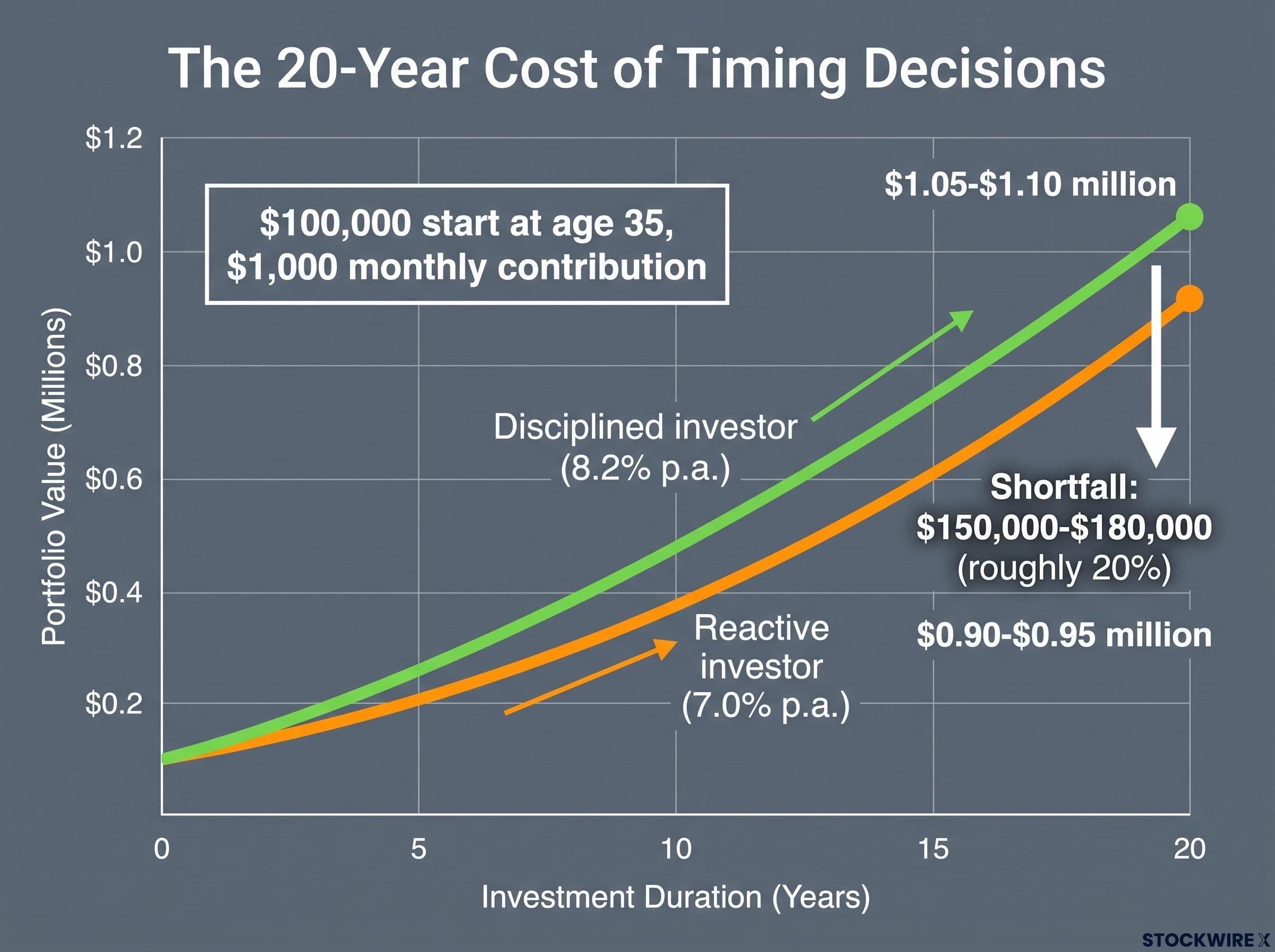
Start with a straightforward scenario. Consider someone who begins with $100,000 at age 35, contributes $1,000 per month, and stays invested for 20 years. The only variable is whether they earn the fund’s full return or the average investor’s return.
At 8.2% per year (the disciplined investor capturing the fund’s time-weighted return), that portfolio grows to approximately $1.05-$1.10 million after two decades.
At 7.0% per year (the reactive investor, earning the dollar-weighted average after timing decisions), the same contributions and starting balance produce approximately $0.90-$0.95 million.
The difference: approximately $150,000-$180,000.
Approximately $150,000-$180,000. That is the illustrative cost of timing decisions over 20 years, calculated using Morningstar’s reported return figures and standard compound interest methodology. It is not a Morningstar output, but a projection based on their data.
| Scenario | Annual Return | Approximate 20-Year Outcome |
|---|---|---|
| Disciplined investor (full fund return) | 8.2% p.a. | $1.05-$1.10 million |
| Reactive investor (average investor return) | 7.0% p.a. | $0.90-$0.95 million |
The shortfall represents roughly 20% or more of the reactive investor’s final balance. It did not come from a bad fund or excessive fees. It came from a series of timing decisions that felt, in each individual moment, like rational risk management: selling to stop the bleeding, waiting for clarity before buying back.
On a monthly statement, 1.2% per year is invisible. Over a career, the compounding makes it devastating. The gap does not announce itself. It accumulates in silence.
How Australian superannuation magnifies the risk
For most Australians reading this, superannuation is the largest financial asset they own. That changes the stakes of the behaviour gap from an investment performance observation to a retirement adequacy question.
Morningstar’s Australian commentary describes emotional timing decisions within super as a “fatal error with super.” The mechanism is specific: when markets fall sharply, a member moves their balance out of a growth option and into something more conservative or cash-based, often right around the point of maximum loss. That locks in damage that would otherwise have been temporary. When conditions stabilise and share prices begin climbing again, many members stay parked in the conservative option, reluctant to move back. The recovery runs its course largely without them.
Switching super to cash during a sharp drawdown is the most structurally damaging form of the behaviour gap for Australian members, because the mechanics of superannuation, including fund-level execution lags and contribution caps, make re-entry harder to execute cleanly than the equivalent decision in a direct share portfolio.
Three specific behavioural risk scenarios apply within superannuation:
- Switching to cash during downturns: Moving from growth to conservative or cash allocations near market lows, crystallising losses that would otherwise have been temporary
- Failing to re-enter for the recovery: Remaining in conservative options through the rebound, missing the period when staying invested matters most
- SMSF discretionary decisions during volatility: Self-managed super fund trustees have full control over investment decisions, which amplifies behavioural risk relative to members in industry or retail funds with default options
SMSF trustees: elevated exposure
SMSF trustees represent a distinct risk group. The same discretionary control that makes self-management appealing also removes the structural guardrails that default investment options provide. Every market decline presents a decision point, and every decision point is an opportunity for emotional architecture to override long-term strategy.
Mandatory Superannuation Guarantee (SG) contributions offer a limited built-in buffer against this. Because employer contributions arrive on a regular schedule irrespective of what markets are doing, they create a form of automatic dollar-cost averaging that operates independently of investor sentiment. But SG contributions cannot protect against discretionary switching decisions. You are still the one choosing whether to move to cash.
For the typical Australian, this means the behaviour gap is not a marginal performance drag. It is a potential retirement adequacy gap, playing out inside the single largest asset most people own.
Narrowing the gap: what the research says actually works
The most common advice for managing emotional responses to market volatility is some variation of “stay calm and invest for the long term.” The problem is that advice has never been actionable at the moment it matters. When markets are falling sharply, telling yourself to stay calm does not address the neurological reality that losses feel twice as painful as equivalent gains feel rewarding.
The Morningstar research points to a more effective approach: removing discretionary decision-making at moments of peak emotional pressure. The evidence suggests that the gap narrows when investors cannot easily act on impulse.
Morningstar’s research consistently finds that investors who build systematic processes, rather than relying on composure in the moment, tend to close more of the behaviour gap. The goal is to design an investment approach that limits the number of high-pressure, discretionary calls you are forced to make.
Three structural interventions address the specific mechanisms identified earlier in this article:
- Diversified, low-turnover strategy: Morningstar’s research found that diversified, low-turnover investment strategies tend to produce narrower investor return gaps. Lower volatility means fewer emotional triggers, which means fewer timing decisions to get wrong.
- Pre-committed investment rules: Setting out a formal investment policy, including target allocations and clear rebalancing triggers (for instance, acting when any single asset class shifts more than 5% from its intended weight), means the decision has already been made before the moment of stress arrives. The framework does the thinking so the investor does not have to.
- Leveraging automatic contribution discipline: The SG contribution structure already embeds one gap-narrowing mechanism, regular inflows regardless of conditions. Extending that logic to discretionary investments (automatic monthly contributions rather than lump-sum timing decisions) applies the same structural protection beyond super.
Each intervention addresses a named driver: loss aversion is blunted by lower volatility; performance chasing is blocked by pre-committed rules; and crowd effects lose their power when contributions are automatic rather than discretionary.
For investors who want to translate the structural interventions outlined above into a concrete personal framework, our full explainer on long-term investing discipline covers the three behavioural architecture choices, automated contributions, a maximum account-checking frequency, and a pre-written selling policy, that make a multi-decade strategy survivable under emotional pressure.
The cost that never appears on your statement
The behaviour gap does not show up on any fund report, platform summary, or annual super statement you will ever receive. No line item reads “cost of timing decisions: $7,500 this year.” The shortfall is invisible by design; it exists only in the difference between what you earned and what you would have earned if you had done nothing.
Fund fees and investor outcomes operate through a parallel compounding mechanism: Morningstar Australia data shows cheapest-quintile multisector growth funds achieve an 87% success rate against just 14% for the most expensive quintile, meaning the fee drag and the behaviour gap together represent two distinct but equally silent forces eroding retirement balances.
That is what makes it so persistent. Over the 10 years ended 31 December 2024, the gap consumed approximately 15% of aggregate fund returns across Morningstar’s dataset. Over a 20-year accumulation horizon, the illustrative cost compounds to roughly $150,000-$180,000 on a moderate portfolio. And the gap widens most during volatility, the precise moments when emotional pressure makes disciplined behaviour hardest.
The question worth answering before markets give you a reason to is specific: what will you do the next time your portfolio drops 10% in a month? If you do not have a pre-committed answer, the research says the cost of finding one in the moment is approximately 1.2% per year, compounding quietly against your retirement for every year it goes unaddressed.
This article is for informational purposes only and should not be considered financial advice. Investors should conduct their own research and consult with financial professionals before making investment decisions. The $150,000-$180,000 illustrative figure is a hypothetical calculation based on Morningstar’s reported return figures using standard compound interest methodology, not a guaranteed or predicted outcome. Past performance does not guarantee future results.