Most investors have watched a stock double or triple in days and assumed the company suddenly got much better. Sometimes it did. But sometimes the buying had almost nothing to do with the business, and everything to do with traders who were betting against it being forced to reverse course at the worst possible moment.
The term “short squeeze” entered mainstream vocabulary after GameStop’s extraordinary January 2021 run, but the mechanics behind it are older, more universal, and more relevant to everyday investing than most people realise. Understanding how a squeeze works protects you from two very different mistakes: misreading what is actually driving a price spike, and buying into one too late.
By the end of this piece, you will understand exactly why short squeezes happen, which signals suggest one may be building, and how to use that knowledge to make smarter decisions, whether you are considering a position or simply trying to make sense of a stock that seems to be defying gravity.
What short sellers are actually doing (and why it can go wrong so fast)
To understand a squeeze, you need to understand the position that makes it possible. Short selling is a three-step trade:
- Borrow shares from a broker.
- Sell those borrowed shares at the current market price.
- Buy them back later, ideally at a lower price, and return them to the lender. The difference is your profit.
The logic is straightforward: if you believe a stock is overvalued, you sell shares you do not own and repurchase them once the price falls. When it works, the gain is the gap between the selling price and the lower repurchase price. But the risk profile is deeply lopsided.
The asymmetry that defines the trade: A short seller’s maximum gain is capped at 100% of the position’s value (the stock drops to zero and you keep everything). Losses, however, are theoretically unlimited, because a stock price has no ceiling.
On top of that asymmetry, the clock is always running. Borrowed shares accrue interest costs over the holding period. If the company issues a dividend, the short seller must pay that dividend to the lender. And as the position moves against them, brokers can demand additional collateral or force the position closed entirely.
This is the single fact that makes short squeezes possible: unlike a long investor who can simply wait out a drawdown, a short seller faces mounting costs and margin pressure the longer a trade goes against them. Time and price both work against them simultaneously.
Borrow fees, margin requirements, and dividend obligations mean the short selling costs accumulate daily regardless of whether the trade is working, a structural drag that compounds timing errors into outsized losses even when the directional thesis eventually proves correct.
When big ASX news breaks, our subscribers know first
The feedback loop that turns rising prices into a self-reinforcing surge
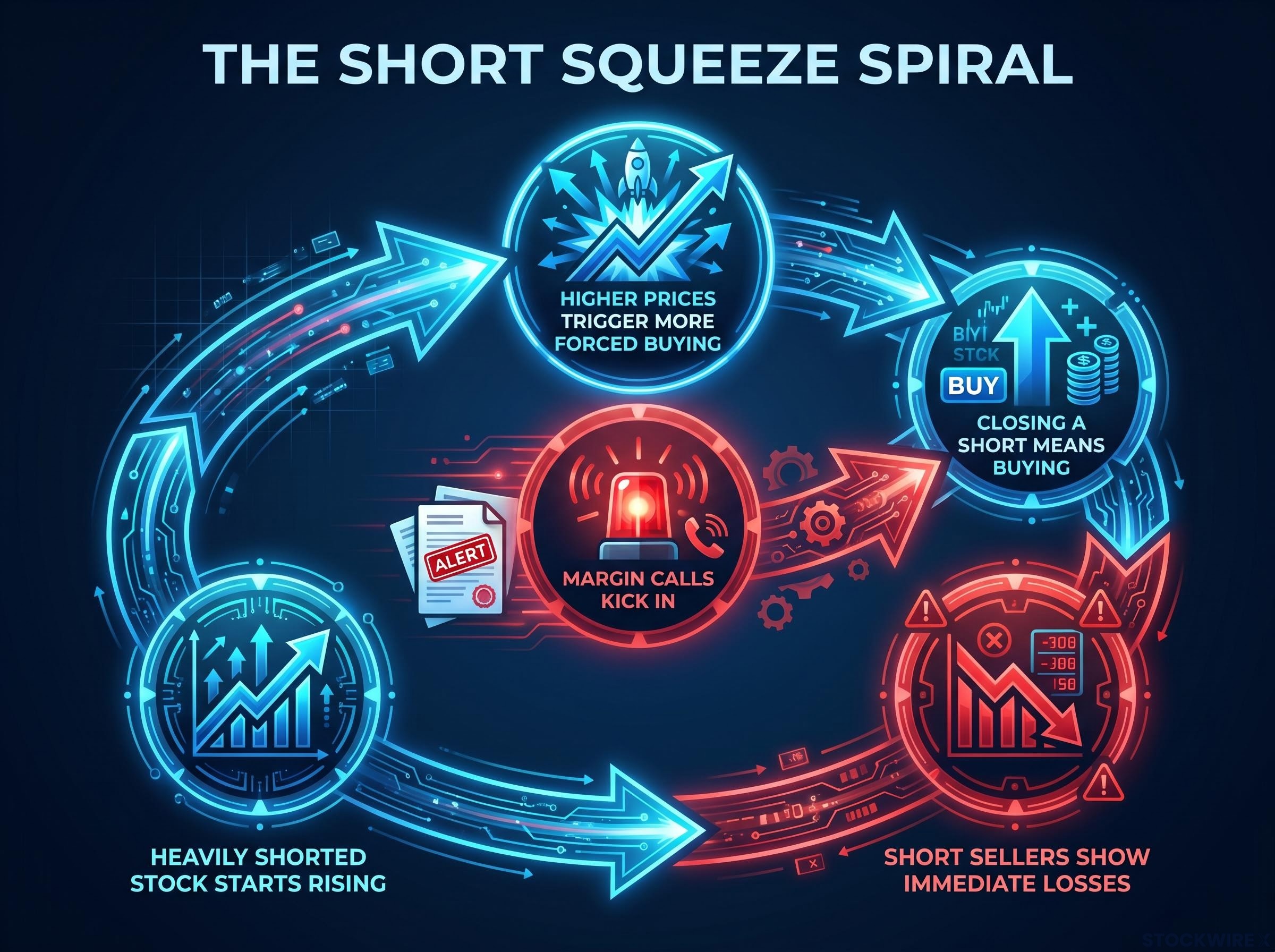
A squeeze is not one event. It is a sequence of cause and effect, and once you see the chain, the outcome starts to feel almost inevitable.
- A heavily shorted stock starts rising. A surprise catalyst, concentrated buying, or a shift in sentiment pushes the price up.
- Short sellers show immediate losses. Every dollar the stock rises is a dollar of unrealised loss per share for them.
- Margin calls kick in. As losses mount, brokers require more cash or equity. If the trader cannot post more, the broker forces the position closed.
- Closing a short means buying. To exit, short sellers must buy shares on the open market and return them to the lender. That buying pressure lifts the price further.
- Higher prices trigger more forced buying. The remaining shorts now face even larger losses, which triggers more margin calls, more covering, and more upward pressure. The cycle repeats until most shorts are flushed out or new sellers absorb the demand.
Each forced purchase adds buying pressure that pushes the price higher, which triggers additional short sellers to close. The spiral feeds itself.
How this differs from a normal price rally
A rally built on improving fundamentals tends to build gradually. Volume is elevated but not frenetic, and the gains hold because real business improvement underpins them.
A squeeze looks nothing like that. The price spikes over days, sometimes hours. Volume explodes to many multiples of normal levels. And when the forced buying exhausts itself, there is no fundamental reason for the price to stay elevated. The reversal can be as violent as the spike itself. Recognising that distinction is what prevents you from interpreting a parabolic price move as a signal of genuine business improvement, which is the mistake that draws late buyers into the worst entry points.
Six signals that suggest squeeze conditions are building
No single signal predicts a squeeze. These are conditions that raise the odds. Think of them as a cumulative probability framework: the more that stack together, the more elevated the risk for everyone involved.
- High short interest as a percentage of float. Float is the number of shares actually available to trade, excluding insider or restricted holdings. Short interest as a percentage of float tells you how many of those tradable shares have been sold short. Below 10% is generally not squeeze-sensitive. Above roughly 20% is frequently cited as a level suggesting meaningful vulnerability, particularly in smaller or less liquid names.
- Days to cover above 7-10. Days to cover equals total short interest divided by average daily volume. It tells you how many trading days, at normal volume, it would take all shorts to buy back their shares. Under 3 days is relatively easy to exit. Above approximately 10 days is commonly referenced as a threshold for elevated squeeze risk, because if everyone tried to exit at once, the buying pressure would be sustained over many sessions.
- Elevated and rising borrow costs. Short sellers pay a borrow fee to their broker. When demand to short is high and the supply of lendable shares is thinning, those fees climb. Very high and rising borrow costs tell you the trade is getting expensive to hold, which pressures shorts to exit sooner.
Where the real-time signals begin
The first three signals are structural. They tell you the conditions are present. The next three are dynamic; they tell you something may already be happening.
- A meaningful catalyst on the calendar. High short interest by itself is not enough. You need something to flip the narrative. Upcoming earnings releases, regulatory decisions, product launches, or even viral social-media campaigns are common ignition points. When evaluating a heavily shorted stock, note the dates that could change the story.
- Aggressive short-dated call options activity. This is the mechanism behind what is known as a gamma squeeze. When traders load up on short-dated call options, market makers who sold those calls hedge their exposure by buying shares. As the stock rises, those calls become more sensitive to price moves, forcing market makers to buy even more shares.
The gamma squeeze effect: Market makers who sold call options hedge by buying shares. As the stock rises, they must buy more. That dealer hedging adds a second layer of forced buying on top of short covering.
- A sudden volume spike several times above normal. Price breaking out on volume far above the stock’s historical average is one of the clearest real-time signals that a squeeze may already be underway.
Volume confirmation applies well beyond squeeze detection: a price breakout lacking strong volume participation carries a materially higher probability of failure and reversal, which is why traders treat volume as a primary sanity check on every price signal, not just the extreme moves that squeezes produce.
| Signal | Key threshold | Why it matters |
|---|---|---|
| Short interest (% of float) | Above ~20% | Large pool of traders who must eventually buy back shares |
| Days to cover | Above ~7-10 | Shorts cannot exit quickly at normal volume |
| Borrow costs | Elevated and rising | Holding the short position is increasingly expensive |
| Catalyst | Present or imminent | Provides the trigger that can ignite forced covering |
| Call options activity | Unusual volume in short-dated calls | Dealer hedging adds a second forced-buying layer |
| Volume | Several multiples above normal | Signals buying pressure may already be overwhelming supply |
When several of these signals stack together on the same stock, it tells you the conditions for a violent forced-buying event are present. That matters whether you own the stock, are considering it, or are simply trying to understand why a name is moving.
Where to find this data
Short interest (percentage of float and days to cover) is reported twice monthly through the Financial Industry Regulatory Authority (FINRA) and major exchanges, and is available on most retail brokerage platforms and financial data sites without requiring a premium subscription. The key limitation: because reporting occurs twice monthly, the publicly available data may be up to two weeks old. Treat it as directional context rather than a real-time snapshot. For a more current picture, combine reported short interest with real-time price action, volume, and options activity.
FINRA short interest reporting requires firms to submit positions twice monthly, with public data released on the seventh business day after settlement, which is why the figures available on retail platforms can lag real-world positioning by up to two weeks.
GameStop and Volkswagen: what the history actually shows
The mechanics above are not hypothetical. Two episodes, separated by more than a decade and driven by completely different forces, played out in almost identical fashion.
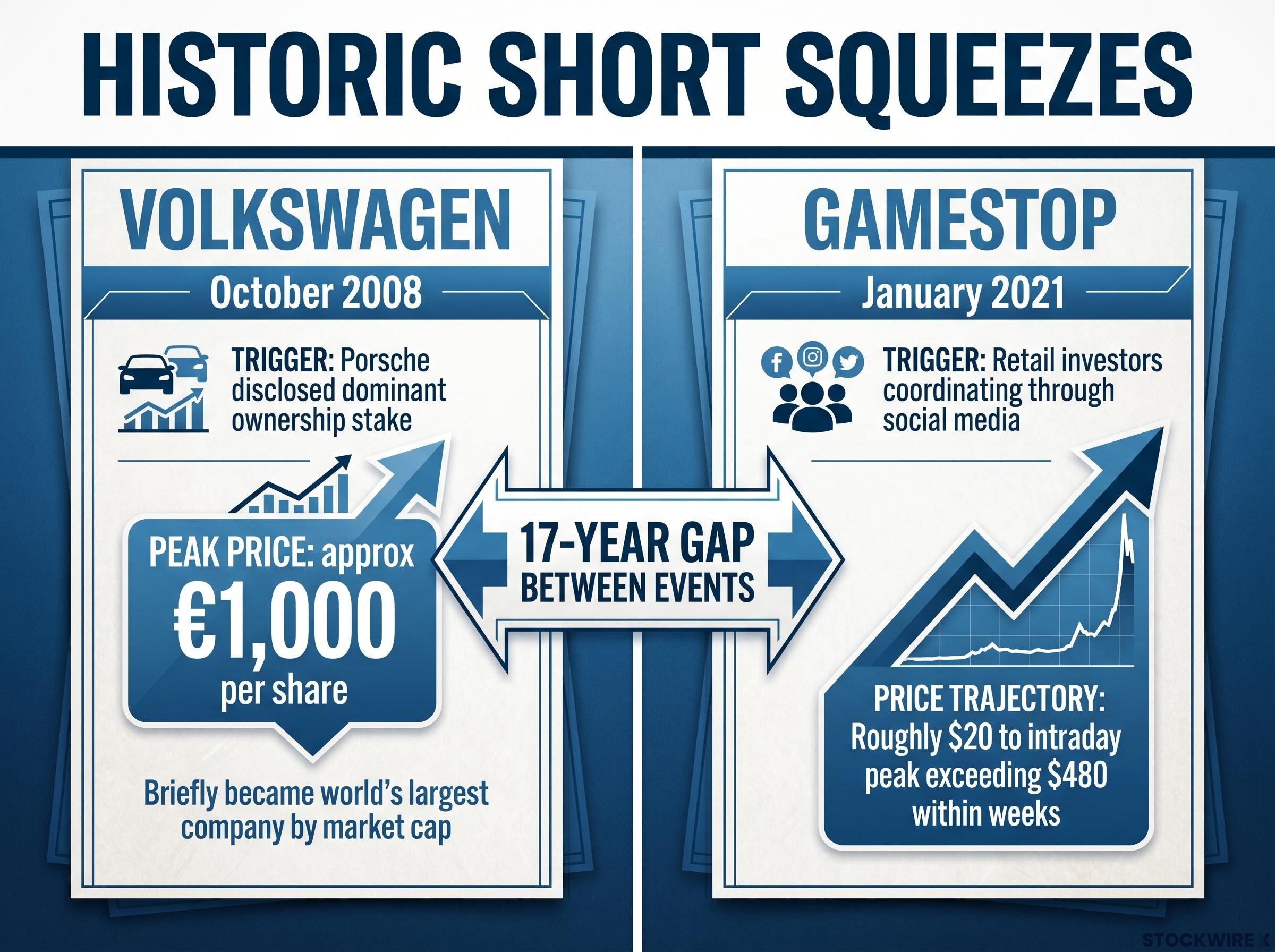
In October 2008, Porsche disclosed an undisclosed dominant ownership stake in Volkswagen, which suddenly left short sellers with very few available shares to purchase for covering. Volkswagen’s share price surged to approximately €1,000 per share before rapidly reversing. Volkswagen briefly became the world’s largest company by market capitalisation during the episode, a position that had nothing to do with its underlying business value and everything to do with the structural trap short sellers found themselves in.
In January 2021, GameStop shares climbed from roughly $20 at the start of the month to an intraday peak exceeding $480 within weeks. Retail investors, coordinating through social media platforms, piled into a stock where short interest was extraordinarily high. The episode demonstrated how options market dynamics (the gamma squeeze described above) could amplify a traditional short squeeze through forced dealer hedging, layering one wave of forced buying on top of another.
The shared structural pattern across both cases is worth noting:
- Extremely high short interest before the event.
- A triggering catalyst that changed the supply-demand balance for shares.
- A forced-buying spiral that drove prices far beyond any fundamental justification.
- A sharp reversal once the forced buying exhausted itself.
The 17-year gap between these two events, and the completely different contexts (institutional manoeuvring versus retail social media coordination), tells you this is a durable market structure phenomenon. It will happen again in some form. The mechanics are the same every time.
Why trying to trade a squeeze is harder than it looks
Understanding the pattern is one thing. Profiting from it is another. Six specific risks make squeeze trading genuinely dangerous:
- The squeeze may never happen. High short interest can persist for years in companies with serious fundamental problems. The short thesis may be correct. You might be buying a weak business purely for a move that never materialises.
- Timing is nearly impossible. Being early means tying up capital in a volatile name that can drift lower for months. You can be directionally right and still lose money before the squeeze occurs.
- You might be the exit liquidity. If you only notice the stock after it has already climbed 200-400%, the forced buying may be nearly exhausted. Retail investors entering late risk buying near the peak just as short sellers finish covering and professional traders begin selling.
- Intraday volatility can be extreme. Swings of 30-50% in a single session are not unusual during an active squeeze. Stop orders can trigger at terrible prices, and the conditions that make squeezes exciting are the same conditions that amplify emotional decision-making.
- Liquidity deteriorates fast. In highly shorted small-cap stocks, the quoted price may not reflect what you can realistically trade at size. Spreads widen dramatically during turbulence, making exits difficult precisely when you need them most.
- Regulatory scrutiny is increasing. Post-2021, coordinated retail buying activity around squeezes has attracted increased regulatory attention. Participating in mass campaigns carries legal and reputational risks beyond the market risk itself.
Post-earnings short strategies illustrate the timing problem from the opposite direction: institutional short sellers in several documented cases added to bearish positions immediately after 9-31% selloffs, using confirmed downgrade momentum as an entry signal rather than anticipating the decline, a discipline that sidesteps the carrying costs and margin pressure that punish positions held through earnings uncertainty.
The SEC staff report on 2021 meme stock market conditions examined the structural dynamics behind the GameStop episode in detail, including the interaction between short covering, options dealer hedging, and digital retail coordination, and identified areas of market structure that regulators considered examining further.
The exit liquidity problem: If you only notice the stock after it is already up 200-400%, you could be buying just as shorts are finishing their covering, with limited forced demand left behind.
The same signals that tell you a squeeze may be building also tell you the stock is in a high-risk zone for everyone involved, including buyers. Recognising conditions is not the same as having an edge over the people who created those conditions.
Squeeze awareness as a risk management tool, not a buy signal
The six signals covered earlier are most valuable not as a trading trigger, but as a risk-awareness framework. When several stack together on a single stock, it tells you the conditions for a violent forced-buying event are present, which means elevated risk for both shorts and longs.
Here is the practical checklist:
- Short interest at or above roughly 20% of float.
- Days to cover at or above 7-10.
- Borrow fees elevated and rising.
- Clear catalyst present or upcoming.
- Unusual short-dated call options activity.
- Price breaking out with volume several times above normal.
If multiple boxes are checked, the stock is in a high-squeeze-risk zone. For you, the value of knowing that depends on your position. If you already own a heavily shorted stock and the price suddenly spikes, recognising that a squeeze may be driving the move helps you make a more deliberate decision about whether to hold or exit, rather than assuming the business suddenly improved.
You can also use short interest data retroactively. If you see a dramatic price spike and, in the next reporting period, short interest has dropped sharply, that confirms short covering played a major role. The price move may not reflect genuine business improvement, and that distinction matters for any decision about whether to buy, hold, or stay away.
Institutional short positioning can also foreshadow price dislocations before they occur: published short interest data showed institutional bears lifting stakes in Lotus Resources to approximately 11% of shares in the weeks before the stock fell 34%, a timeline that illustrates how rising short interest sometimes functions as a leading indicator of stress rather than simply a coincident one.
Using this checklist as a lens rather than a signal means you are building better situational awareness of what is actually driving prices in any given stock. That is valuable regardless of whether you ever trade a squeeze directly.
The mechanics are knowable. The timing never is.
The core distinction worth carrying forward is this: understanding squeeze mechanics is genuinely useful. Predicting squeeze timing is not reliably achievable. Those are different skills, and only one of them is consistently available to you.
What you now hold is practical. You can read short interest data, interpret days to cover and borrow costs, watch for catalyst timing, spot unusual options activity, and distinguish a squeeze-driven spike from a fundamentally driven one. That is a meaningful upgrade to your ability to interpret price action.
Use it to size risk, avoid late entries into parabolic moves, and make sense of unusual price action. That is where the value lives, not in chasing the next squeeze candidate.
This article is for informational purposes only and should not be considered financial advice. Investors should conduct their own research and consult with financial professionals before making investment decisions.