
Palo Alto Networks ran a six-week AI-assisted scan of its own codebase earlier this year. The result: vulnerability findings that would have taken five to seven years to surface through conventional security testing. The token cost sat in the low millions of dollars. For a company that considers itself among the most rigorously tested in the cybersecurity sector, the implication was stark: if AI could compress years of discovery into weeks inside a best-in-class environment, the exposure across the broader enterprise software landscape is orders of magnitude larger.
This analysis examines what the offence-defence asymmetry in AI cybersecurity stocks means structurally for enterprise security buyers and investors, identifies the competitive moats that separate durable winners from hype-cycle casualties, and maps which parts of the AI cybersecurity narrative are operationally real today versus still ahead of deployment reality. IBM and Red Hat committing $5 billion to open-source vulnerability remediation on 28 May 2026 through Project Lightwell is one signal among several that the industry recognises the scale of the problem. The question for investors is which companies are positioned to solve it profitably.
What AI-accelerated vulnerability scanning reveals about enterprise security exposure
The Palo Alto Networks internal evaluation is worth examining in detail because it represents a controlled test with unusually high baseline rigour. CEO Nikesh Arora has framed the company as one of the highest-performing organisations in terms of code testing standards, which makes the six-week finding a lower bound rather than a typical outcome. Most enterprises writing software have significantly less mature testing programmes.
When AI operates in persistent reasoning mode, it does not simply flag individual weaknesses. It chains multiple vulnerabilities together, mapping novel attack pathways that no single finding would reveal on its own. Each discovered weakness amplifies the value of the others.
The cost-to-capability ratio is what reshapes the investment case. A spend in the low millions of dollars produced years of equivalent discovery. Any organisation that develops software is now exposed to a scanning capability it almost certainly cannot match with current internal resources.
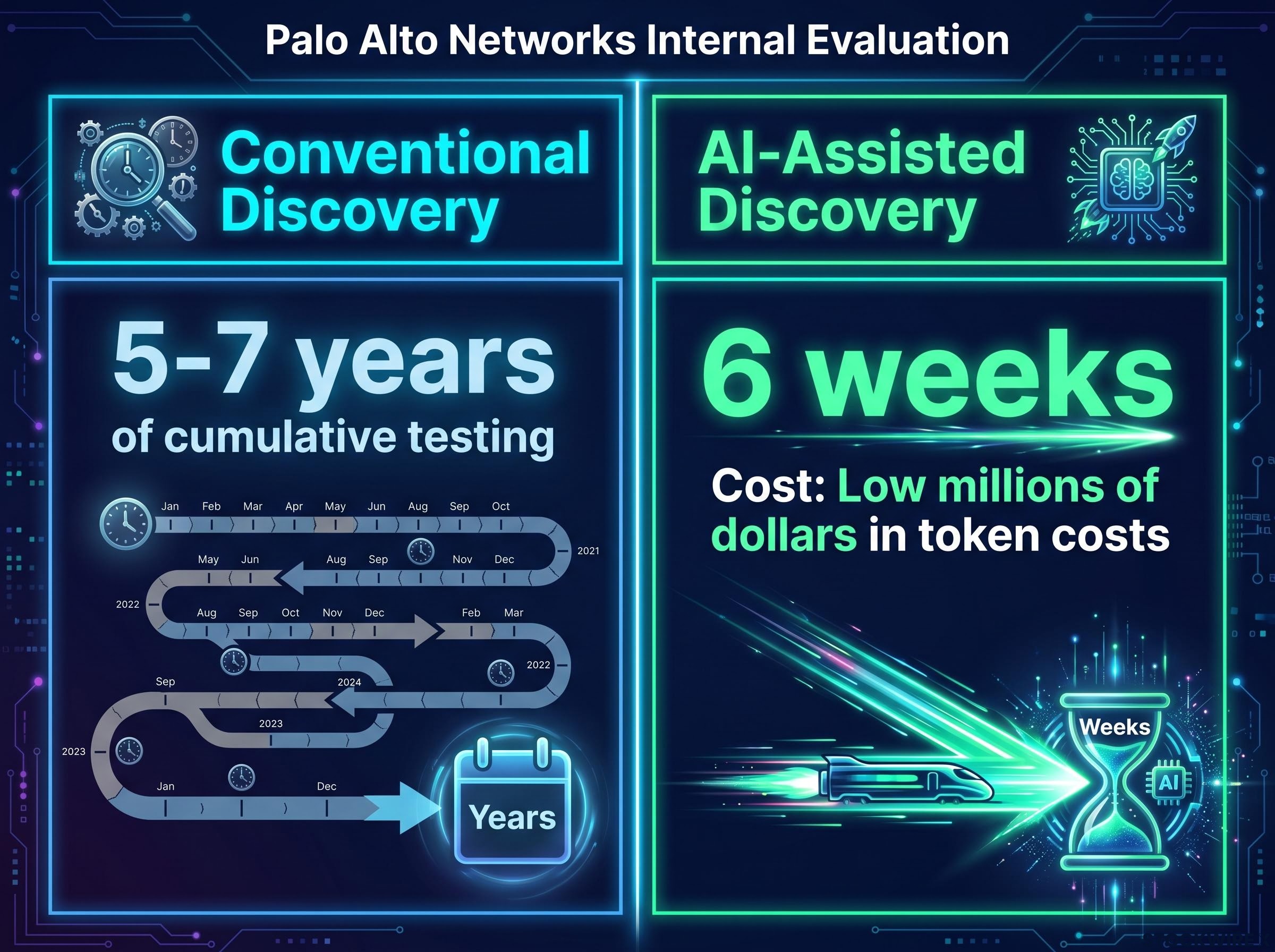
| Dimension | Conventional discovery | AI-assisted discovery |
|---|---|---|
| Time to discovery | 5-7 years of cumulative testing | 6 weeks |
| Cost per finding | High (sustained analyst headcount over years) | Low millions in token costs for equivalent output |
| Scale of coverage | Linear with analyst hours | Full codebase with vulnerability chaining |
IBM’s $5 billion bet on open-source remediation
Project Lightwell, announced on 28 May 2026, represents IBM and Red Hat’s response to the scale of open-source software vulnerability exposure. Open-source code underpins the majority of enterprise applications and is often poorly inventoried, making it disproportionately exposed to AI-accelerated scanning by attackers. The $5 billion commitment combines AI-driven approaches with a global engineering team, an acknowledgement that remediation at this scale cannot be managed through conventional patch cycles alone.
When big ASX news breaks, our subscribers know first
How the offence-defence imbalance in AI security tools became a structural problem
The asymmetry is not a temporary gap that better models will close. It is structural, and it operates at the level of how each side experiences the same tool’s limitations.
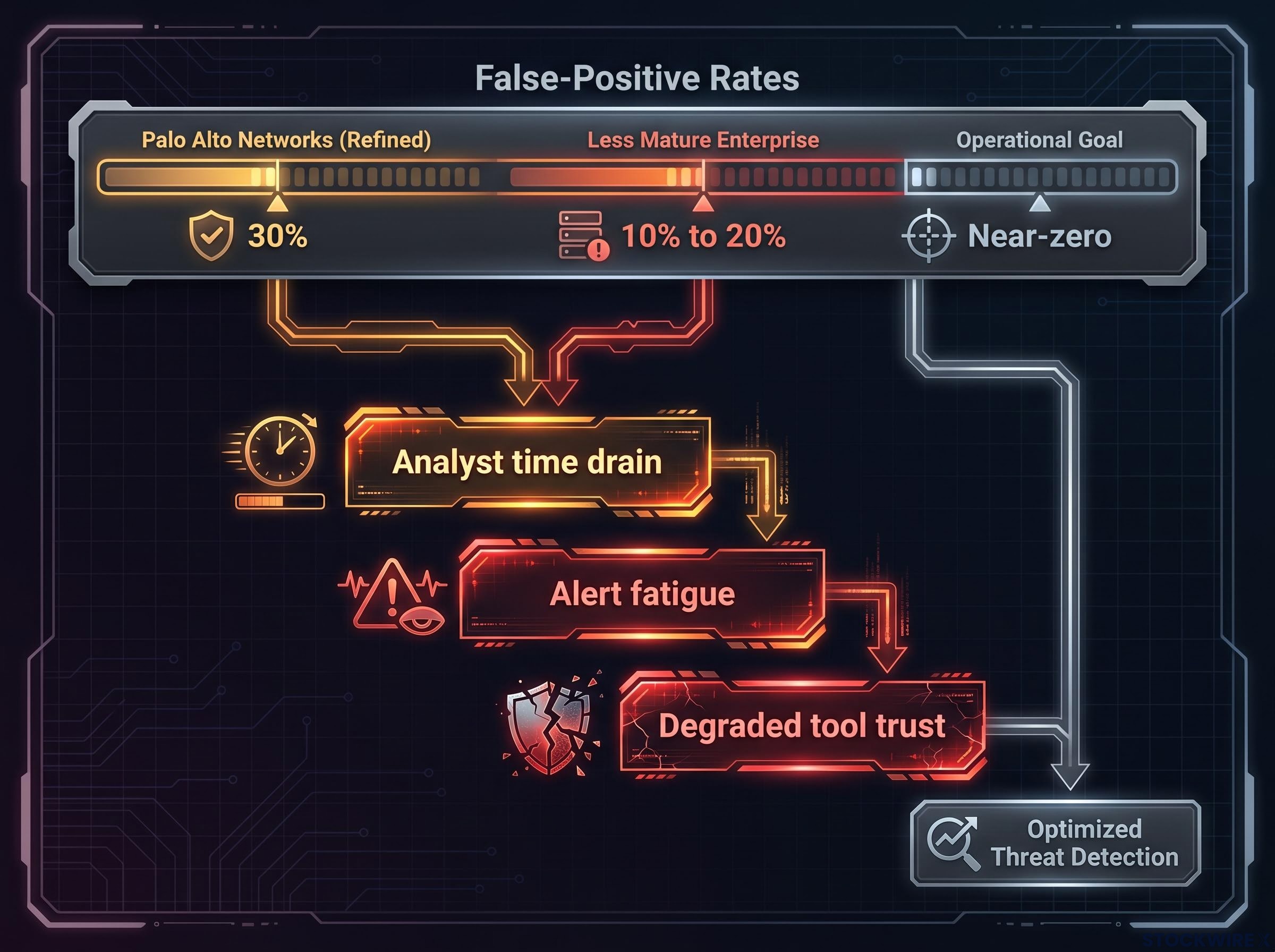
An offensive actor using AI vulnerability scanning can tolerate a high false-positive rate. The attacker tests what works, discards what does not, and iterates at near-zero cost. A defender faces the opposite constraint: every alert must be treated as potentially real. False positives consume scarce analyst time, degrade trust in tooling, and create a fatigue cycle that makes genuine threats harder to catch.
Palo Alto Networks verified a false-positive rate of approximately 30% in its own AI vulnerability testing, a figure Arora described as coming from one of the more refined deployments. Less mature enterprise implementations can run at 10% to 20% false-positive rates in production. The operational goal remains near-zero, and the distance between current performance and that target is measured in years of post-model engineering work.
Nikesh Arora compared the false-positive challenge to autonomous vehicle safety, arguing that a meaningful error rate would be unacceptable in safety-critical deployments. Applying insufficiently refined models to high-stakes processes could result in direct financial losses.
The operational consequences of high false-positive rates compound across three dimensions:
- Analyst time drain: Security operations centre (SOC) teams spend disproportionate hours triaging alerts that turn out to be noise
- Alert fatigue: AI anomaly detection systems generating thousands of alerts daily push beyond human triage capacity, causing genuine threats to be missed
- Degraded tool trust: Repeated false alarms erode confidence in AI-driven detections, leading teams to discount or ignore automated findings
For investors evaluating AI cybersecurity vendors, false-positive performance in production environments may be the single most informative underwriting criterion. Vendors that can demonstrate measurable reduction in analyst workload, rather than an increase in alert volume, hold a durable operational advantage.
What the cybersecurity arms race actually means for enterprise software buyers
The phrase “AI cybersecurity arms race” appears regularly in earnings calls and analyst reports. For readers encountering it without a security background, the mechanics are worth understanding clearly. AI lowers the cost of discovering and exploiting vulnerabilities while simultaneously offering defenders better detection tools. The two sides are not symmetrically positioned, however, because offensive use produces value at current accuracy levels while defensive use requires significantly higher precision to avoid doing more harm than good.
The dominant initial access vectors in most breaches are not exotic zero-day exploits. Credential theft and weak credentials remain the leading entry point across multiple industry breach reports. AI changes how effective and scalable these techniques become. Large language models significantly improve phishing quality and personalisation, lower the skill required for convincing spear-phishing attacks, and enable messages that mimic trusted contacts or organisational style.
The AI investment cycle has reached a scale that structurally guarantees a demand floor for security spending: combined hyperscaler CapEx commitments for 2026 sit in the $600-$805 billion range, and each dollar of infrastructure deployed expands the attack surface that security vendors are paid to defend.
Three specific attack vectors are amplified by AI:
- AI-enhanced phishing and credential attacks: More personalised, harder to detect by humans, and accessible to lower-skill attackers
- AI-accelerated vulnerability chaining in software: Persistent reasoning mode links individual weaknesses into exploitable attack pathways
- Legacy operational technology (OT) and open-source exposure: Older industrial control systems running legacy code cannot be patched easily but are increasingly connected to broader networks, and AI-accelerated discovery surfaces their flaws faster than remediation cycles can respond
The SMB exposure problem and systemic economic risk
Arora has expressed greater concern about economic disruption targeting small and mid-sized businesses than about attacks on large national security infrastructure. SMBs have limited security staff but are now reachable by sophisticated attacks at scale through AI-amplified tooling.
The Change Healthcare breach, involving parent company UnitedHealth Group, illustrated how disruption to a lower-profile part of the healthcare supply chain produced outsized systemic economic harm. That pattern of cascading impact through interconnected SMB-dependent supply chains is the scenario that AI-amplified attacks make more frequent and harder to contain.
The American Hospital Association’s Change Healthcare impact survey documented widespread financial disruption across hospitals and health systems, with a significant share reporting they could not pay staff or suppliers for weeks, giving concrete scale to the cascading supply-chain disruption that AI-amplified attacks on lower-profile infrastructure nodes can now replicate more frequently.
How quickly advanced offensive AI capability could reach the broader threat landscape
The window in which research-grade AI vulnerability detection remains limited to well-resourced actors is closing faster than many security product roadmaps assume.
Arora estimated that AI models with capabilities comparable to advanced research-grade systems could be accessible through open or foreign-developed models within approximately three months of his assessment. This is his scenario assessment rather than a firm empirical prediction, but the underlying diffusion dynamics are well documented.
Nikesh Arora estimated that AI models with research-grade vulnerability detection capability could become broadly accessible within approximately three months through open or foreign-developed models. (This represents the CEO’s scenario assessment based on observed capability diffusion patterns.)
Once model architectures and training techniques are published, capabilities propagate to smaller models through distillation and fine-tuning on a timeline measured in months. AI model weights for frontier systems can be compact enough for portable storage, enabling rapid replication. AI-amplified phishing-as-a-service and malware-as-a-service offerings are already lowering skill barriers for attackers across the broader threat landscape.
Open-source model commoditisation is one of the structural forces that makes offensive capability diffusion faster than most security product roadmaps assume, as model architectures and training techniques published for one purpose become available for fine-tuning across entirely different applications within months.
Carnegie Mellon research on autonomous LLM attack planning has demonstrated empirically that large language models can chain vulnerability discovery into full exploit sequences without human direction, providing peer-reviewed evidence for the capability diffusion dynamic that Arora’s three-month accessibility estimate describes at the market level.
For investors, the implication is directional and significant. Security vendors whose value proposition depends on staying ahead of attacker capability by years are structurally exposed. Vendors whose competitive position derives from data quality, workflow integration depth, and precision metrics are better positioned to maintain advantage regardless of how quickly offensive capabilities diffuse.
Where the durable competitive moats are in AI-era cybersecurity
The structural analysis above identifies where value accrues in the AI cybersecurity market. Three characteristics separate vendors with durable competitive positions from those riding narrative momentum.
Platform consolidation and telemetry richness form the first structural advantage. CISOs managing exploding vulnerability queues, open-source exposure, and connected legacy systems are consolidating onto integrated platforms with broad endpoint, network, identity, and cloud coverage. Vendors with high-quality telemetry spanning multiple security domains can natively integrate AI into end-to-end workflows, while point-solution AI features struggle to deliver equivalent correlation and context.
Platform consolidation pressure is already reshaping competitive dynamics at the vendor level, with Palo Alto’s broader enterprise footprint attracting contract wins that narrower zero-trust point solutions struggle to match on pricing and workflow depth alone.
False-positive reduction functions as a genuine competitive moat. Achieving near-zero false-positive rates in production requires high-quality labelled security data, deep SOC workflow expertise, and continuous feedback loops from real deployments. This combination cannot be replicated quickly, making validated precision a durable differentiator.
Identity, zero trust, and SOAR automation occupy structurally advantaged sub-verticals. AI-boosted phishing keeps identity squarely at the centre of the threat model, while security orchestration, automation, and response (SOAR) platforms address the bottleneck that emerges as discovery gets cheaper: triage and remediation become the constraint.
| Competitive moat | Vendor characteristic | Investor evidence metric |
|---|---|---|
| Platform consolidation | Broad telemetry across endpoint, network, identity, cloud | Customer platform adoption rate; multi-module attach metrics |
| False-positive reduction | High-quality labelled data, deep SOC workflow integration | Third-party-validated detection and false-positive rates in production |
| Remediation automation | SOAR, patch orchestration, SBOM generation | Case studies showing reduced analyst workload per incident |
Investors should watch for specific warning signs in vendor AI claims:
- AI “features” that have not yet shown measurable total cost of ownership reduction
- Detection metrics reported only in controlled lab environments, not production deployments
- Alert volume increases positioned as capability gains without corresponding workload reduction evidence
The offence-defence gap is widening, and the investment case is in the response infrastructure
The Palo Alto Networks experiment compresses the argument into a single data point: five to seven years of conventional vulnerability discovery, replicated in six weeks, for a cost in the low millions. AI has permanently reset the baseline cost of offensive vulnerability discovery, and the enterprise security industry is in an accelerated transition to managing that new cost structure.
The beneficiaries sort into two time horizons. In the short to medium term, platform consolidators, AI-native detection and remediation vendors, and identity and access management (IAM) providers are positioned to capture the structural spending increase. Longer-term optionality sits with companies betting on fully autonomous defence agents and large-scale open-source remediation infrastructure. Cyber insurance and regulatory tightening create a secondary structural tailwind for compliance-adjacent security vendors as both insurers and regulators respond to AI-accelerated threat frequency.
Investors wanting to translate the structural spending thesis into a specific portfolio position will find our dedicated guide to the cybersecurity ETF investment case, which examines global cybersecurity spending forecasts through 2028-2029, the non-discretionary regulatory demand floors that underpin sector resilience, and how key holdings including Zscaler and Check Point have performed across enterprise and consumer segments.
The due diligence questions that follow from this analysis are specific and answerable:
- What is the vendor’s false-positive rate in production environments, validated by third parties?
- Does the vendor’s AI integration reduce analyst workload per incident, or does it increase alert volume without corresponding efficiency gains?
- How deep is the vendor’s workflow integration across endpoint, identity, network, and cloud, and does telemetry breadth support meaningful correlation?
- What customer evidence exists showing measurable total cost of ownership reduction attributable to AI capabilities?
The AI cybersecurity narrative contains genuine structural signals alongside hype-cycle noise. The investor who can distinguish moat-backed positions from feature-layer marketing is the one positioned to benefit from the spending cycle ahead.
This article is for informational purposes only and should not be considered financial advice. Investors should conduct their own research and consult with financial professionals before making investment decisions. These forward-looking statements are speculative and subject to change based on market developments and company performance.