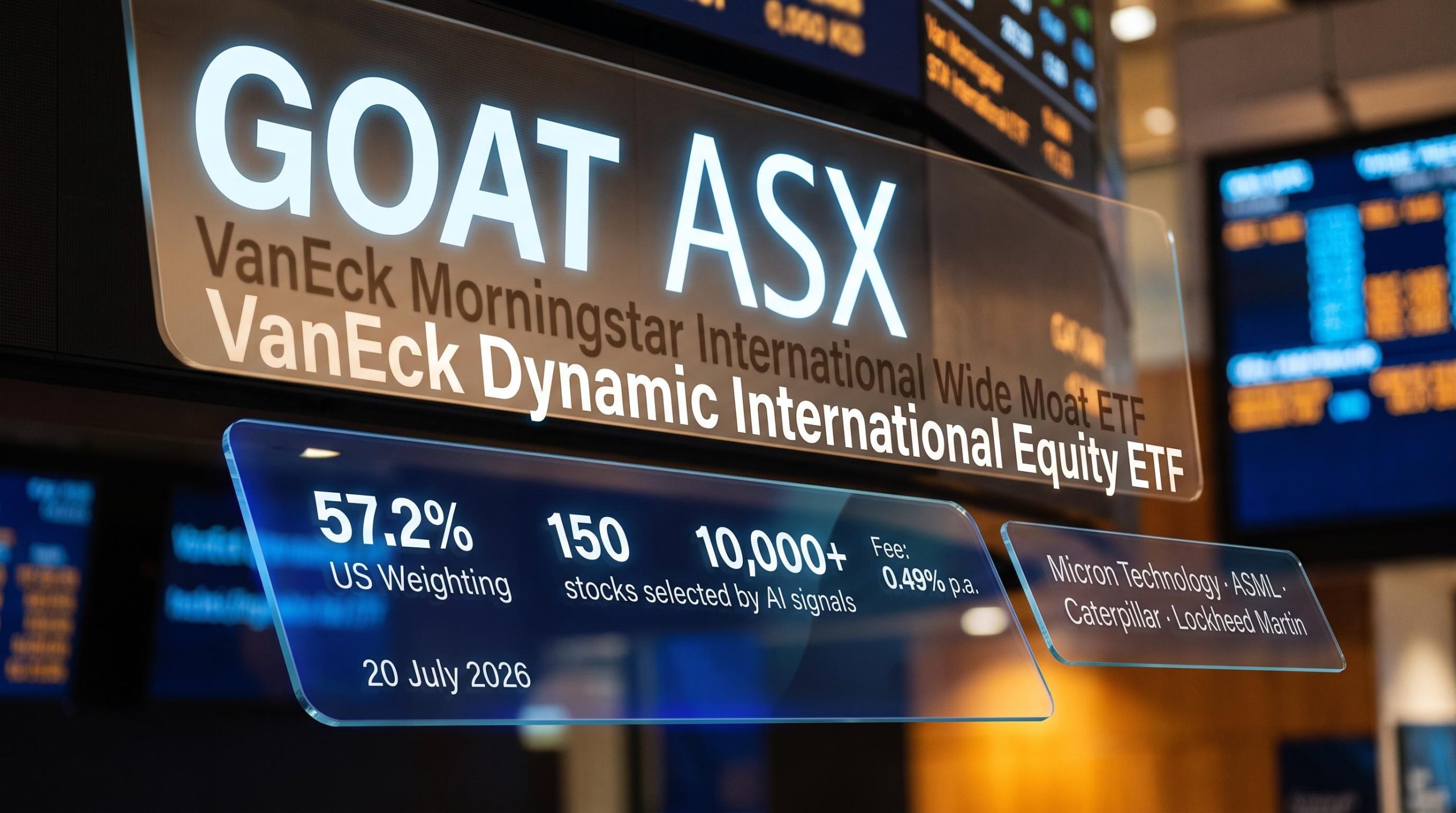
The GOAT ETF that traded on the ASX last month no longer exists. The ticker is the same. The fund inside it is not. On 20 July 2026, VanEck replaced its Morningstar-backed international wide-moat strategy with an AI-driven quantitative model, transforming what was a quality-and-value fund into something categorically different.
For investors who bought GOAT as an international companion to the wide-moat philosophy behind MOAT, the implications are immediate. An ETF can retain its ticker and listing history while delivering an entirely new product, and that is exactly what has happened here. If you last checked GOAT’s mandate six months ago, what you read no longer applies.
Here is what actually changed, how the new AI methodology selects stocks, what the portfolio holds right now, and what existing and prospective GOAT holders need to weigh before the next monthly rebalance.
Six years as a wide-moat fund, then everything changed
GOAT launched in September 2020 as the VanEck Morningstar International Wide Moat ETF. It was designed as the international companion to MOAT, extending the wide-moat philosophy beyond US markets to developed-market equities globally.
The mandate was built on Morningstar’s equity research. The fund held 50-100 developed-market companies selected from the Morningstar Developed Markets ex-Australia Wide Moat Focus Select Index, with a management fee of 0.55% p.a. The philosophy was Buffett-style: buy companies with durable competitive advantages trading below their estimated fair value.
To qualify for the portfolio, a company had to meet three criteria:
- Appear in the Morningstar Developed Markets ex-Australia parent index
- Hold a Wide Moat rating from Morningstar’s equity research team
- Have a Morningstar fair value estimate
That was a transparent, independently verifiable selection process. Investors who chose GOAT over other international equity options knew precisely what they were getting, and why. MOAT, the US-focused companion, remains unchanged on the ASX. GOAT’s former mandate does not.
MOAT ETF stock selection applies a two-stage screen requiring companies to hold a Morningstar wide-moat rating and trade below fair value, a dual discipline that remains unchanged on the ASX even as its former international companion has moved to an entirely different methodology.
When big ASX news breaks, our subscribers know first
What the rebrand actually means: a new name, ticker retained, strategy replaced
VanEck announced the changes in June 2026. The new strategy’s inception date was 17 July 2026, with the fund transitioning at market open on 20 July 2026. The before-and-after comparison makes the scale of change clear.
| Element | Before | After |
|---|---|---|
| Fund name | VanEck Morningstar International Wide Moat ETF | VanEck Dynamic International Equity ETF |
| Index | Morningstar Developed Markets ex-Australia Wide Moat Focus Select Index | Akros Enhanced World ex-Australia Index |
| Strategy type | Wide-moat, valuation-driven, Morningstar research-based | Rules-based, AI-driven, generative reinforcement learning |
| Management fee | 0.55% p.a. | 0.49% p.a. |
| Ticker | GOAT | GOAT (retained) |
The new index was created in partnership with Akros Technologies. According to VanEck, GOAT holds the distinction of being the first and only ETF on the Australian market to use an AI-driven approach for international equity selection.
The retained ticker is the mechanism that makes this kind of wholesale change possible inside an existing product. The GOAT you may have researched months ago is not the GOAT that trades today. ETF issuers can replace a fund’s entire strategy while preserving the wrapper, and investors cannot assume historical fund descriptions still apply.
How the AI actually picks the stocks
The marketing says “AI-driven.” The mechanics tell you more. The new strategy uses what VanEck describes as “generative reinforcement learning,” a form of machine learning where the model discovers and refines predictive signals rather than relying on a fixed set of human-defined factors.
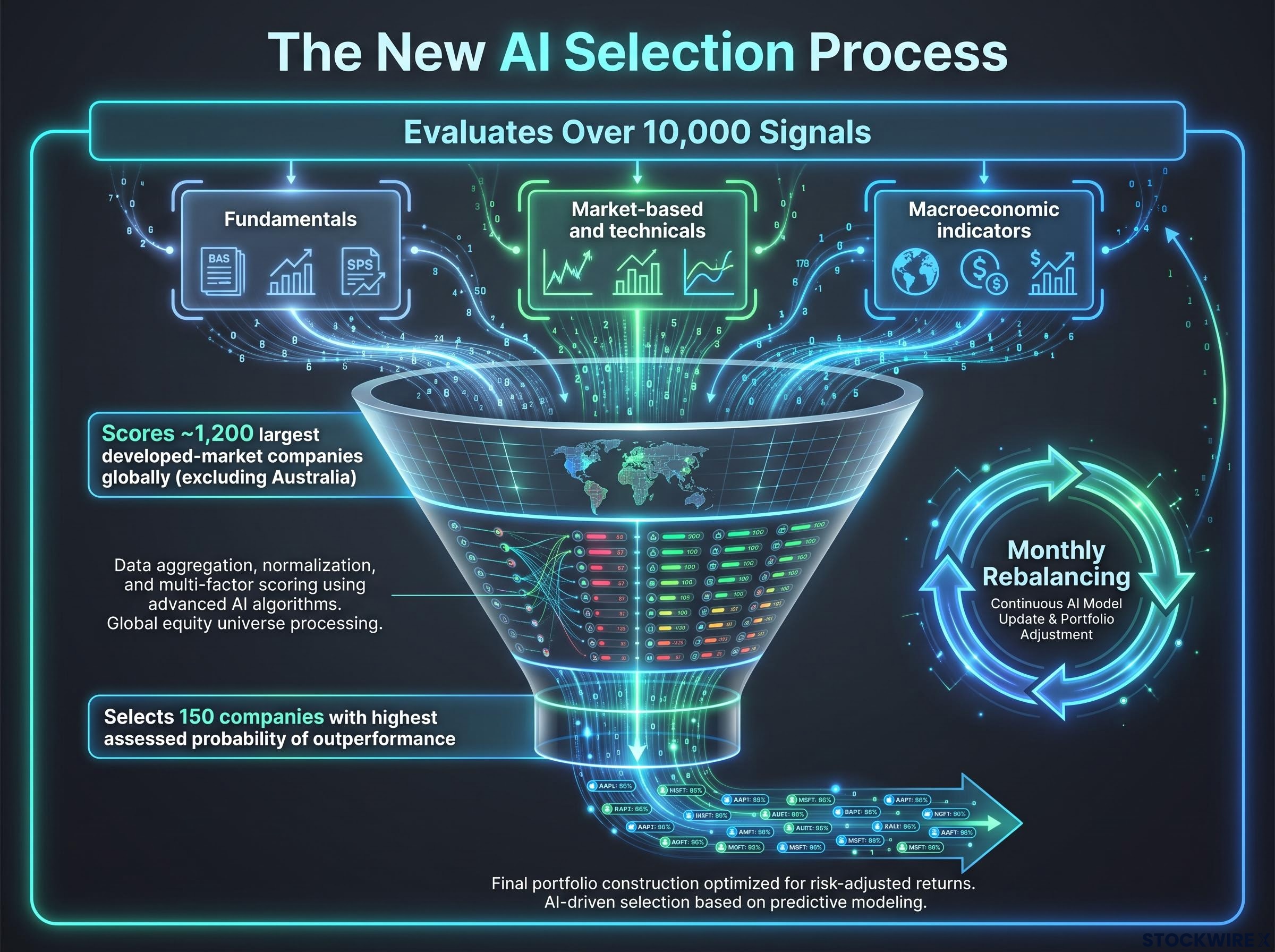
The AI evaluates over 10,000 signals across three categories:
- Fundamentals: profitability, balance sheet strength, valuations
- Market-based and technicals: price trends, volatility, liquidity, trading patterns
- Macroeconomic indicators: growth, inflation, interest rates, sector-level economic data
Each month, the model scores approximately 1,200 of the largest developed-market companies globally (excluding Australia) and selects the 150 with the highest assessed probability of outperformance. Signals that lose predictive power are retired. New signals can be added. The model is designed to adapt and recalibrate as market conditions change.
That adaptive framework means the portfolio can shift meaningfully in composition from one month to the next, a fundamentally different risk dynamic than a fund anchored to a stable quality-and-value philosophy.
AI trading systems that adapt their own behaviour from incoming data share a key characteristic with GOAT’s new methodology: their failure modes are less transparent and harder to anticipate than rule-based systems with fixed, human-defined criteria.
The transparency question
The high-level framework is publicly disclosed: universe size, signal categories, portfolio size, rebalancing frequency. The exact model parameters and specific signals are proprietary.
That opacity is common in quantitative strategies globally. But it represents a significant shift from GOAT’s former Morningstar criteria, which were clearly articulated and independently verifiable. Investors should factor this reduced transparency into their comfort level assessment when evaluating the new product.
What the current portfolio actually holds
The abstract methodology becomes concrete when you look at what the AI has actually selected.
Key geographic data point: As of approximately late July 2026, US stocks make up 57.2% of GOAT’s weighted portfolio. The index is “world ex-Australia,” not “ex-US,” and US stocks are explicitly within scope.
Beyond the United States, the portfolio draws from markets including Japan, Canada, Israel, Singapore, and the United Kingdom. The named holdings reported as of approximately late July 2026 give a clearer picture of the sector mix.
| Company | Sector |
|---|---|
| Micron Technology | Technology |
| ASML Holding | Technology |
| Caterpillar | Industrials |
| Lockheed Martin | Defence |
| Shell | Energy |
| General Motors | Cyclical |
A 57% US weighting alongside holdings in defence, industrials, and energy tells you this is a cyclically exposed, US-heavy portfolio today. But monthly rebalancing means that tilt can shift materially, which matters if you are managing overall portfolio construction. All current weights should be verified against VanEck’s latest portfolio disclosure before any investment decision.
Portfolio concentration risks are amplified in a monthly-rebalancing fund where sector and country tilts shift without investor intervention, particularly when a single geography already accounts for more than half the weighted exposure.
What existing GOAT holders and prospective investors need to weigh up
If you bought GOAT for its wide-moat mandate, you now own something categorically different. Four considerations should shape your reassessment:
- The mandate has changed entirely. The Buffett-style wide-moat, valuation-driven philosophy is gone. You now hold a quantitative, AI-driven strategy with different risk exposures and different return drivers. If you valued GOAT specifically for its Morningstar research foundation, that exposure no longer exists in this fund.
- The methodology is less transparent. The broad framework is disclosed, but the exact model mechanics are proprietary. That is standard in quantitative investing, but it is a meaningful step away from selection criteria that were clearly defined and independently verifiable.
- The portfolio is dynamic. Monthly rebalancing driven by AI-selected signals means sector and country tilts can shift materially from one month to the next. Investors with specific geographic or sector preferences need to monitor holdings regularly.
- There is no live track record. The simulated annualised return of approximately 12.5-12.6% p.a. since a July 2005 base date is illustrative only.
Peer-reviewed backtest overfitting research has demonstrated that high simulated returns can be constructed through data mining without producing equivalent out-of-sample performance, a finding that gives particular weight to the absence of any live track record for GOAT’s AI-driven methodology.
All performance figures for this strategy prior to July 2026 are simulated. Back-tests are constructed with hindsight and do not fully reflect real-world frictions, data gaps, or regime changes.
The absence of a live track record means every performance claim is hypothetical. You should weight that fact heavily when deciding how much of your portfolio to allocate to a methodology that has never been stress-tested in real market conditions under its own rules.
One additional gap to note: MOAT continues to provide US-focused wide-moat exposure on the ASX, but the international extension of that philosophy now has no ASX-listed ETF equivalent. If international wide-moat exposure was what you were buying, you will need to look beyond the ETF market to replicate it.
Existing holders should review the updated Product Disclosure Statement (PDS) and assess the new strategy against their own investment objectives and risk tolerance.
What GOAT’s transformation tells Australian ETF investors about portfolio maintenance
GOAT’s overhaul is a case study in a structural reality that extends well beyond one product. An ETF issuer made a wholesale strategy change inside an existing wrapper, kept the ticker and listing history, and delivered an effectively new product to unitholders. The ticker is not a guarantee of strategic continuity.
ETF structure on the ASX permits an issuer to change the underlying index and strategy while preserving the legal wrapper, the ticker, and the listing history, a feature of the unit trust architecture that investors rarely encounter until a product they hold is transformed.
Three practical habits protect against this:
- Check PDS update notices from your ETF issuers when they arrive, rather than filing them
- Review fund strategy descriptions annually against the reason you originally bought each position
- Cross-reference current holdings against the stated mandate, particularly for actively managed or rules-based funds
Whether GOAT’s AI-driven methodology proves to be a durable investment edge or a marketing differentiator will only be answerable once live performance data accumulates over multiple market cycles. VanEck positions GOAT as a pioneer in AI-driven ETFs on the ASX, and the strategy’s adaptive design means it is intended to evolve as markets change. That is both its stated advantage and a source of ongoing monitoring obligation.
For Australian ETF investors broadly, this case is a prompt to check that every fund in your portfolio still does what you bought it to do.
The information investors need before the next monthly rebalance
GOAT is now a categorically different product. Whether it belongs in your portfolio depends on your comfort with AI-driven methodology, your tolerance for reduced transparency relative to the former Morningstar criteria, and how much weight you place on a back-tested track record with no live performance history.
The first real performance data will emerge in the months ahead as the strategy operates through live market conditions. That makes this an appropriate moment to assess carefully rather than act impulsively in either direction.
This article is for informational purposes only and should not be considered financial advice. Investors should conduct their own research, review the VanEck PDS, and consult with financial professionals before making investment decisions. Past performance does not guarantee future results, and simulated performance figures are subject to material limitations.
—