
Macquarie Group has opened FY27 with a 14% jump in group net profit contribution to A$1,612 million for the three months ending 30 June 2026, with three of its four operating segments growing earnings year-over-year.
The figures were released today as part of Macquarie’s 2026 AGM update. For investors tracking one of the ASX’s most structurally diversified financial stocks, the quarterly breakdown reveals which parts of the business are accelerating, where margin pressure is emerging, and why the one segment that reported lower profit is less alarming than the headline suggests.
Here is a segment-by-segment picture of how Macquarie is tracking in the early stages of FY27, including the numbers that matter most and what they signal about the group’s trajectory.
A strong group-level result, but the detail is in the segments
A 14% lift in group net profit contribution is a strong headline. But for a business structured like Macquarie, the group number is a starting point rather than a conclusion.
Three of four segments grew profit year-over-year. One declined. The variation between them is where the real investment signal sits, because Macquarie’s four-segment model, spanning asset management, retail banking, commodities trading, and advisory, looks nothing like a traditional ASX bank. At CBA, Westpac, ANZ, or NAB, the group result largely tells the story. At Macquarie, you need to open it up.
The record FY26 result, which saw all four divisions post double-digit profit growth and group net profit after tax reach A$4,847 million, established the prior-year comparables that now shape how Q1 FY27 growth rates are read across each segment.
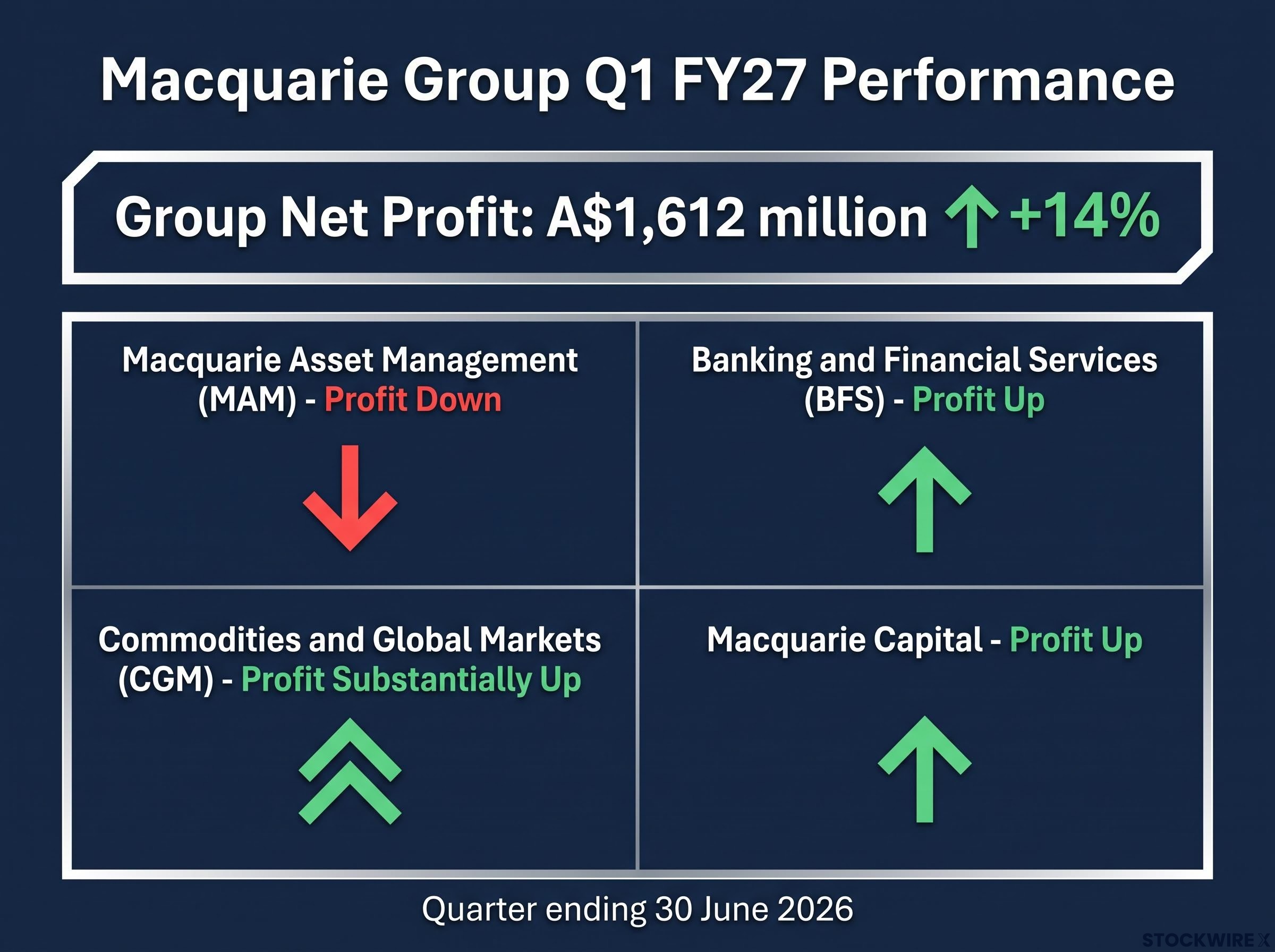
| Segment | YoY Profit Direction | Primary Driver |
|---|---|---|
| Macquarie Asset Management (MAM) | Down | Prior-year disposal of public investments business |
| Banking and Financial Services (BFS) | Up | Loan and deposit volume growth |
| Commodities and Global Markets (CGM) | Substantially up | Commodities income rebound; increased asset finance activity |
| Macquarie Capital | Up | Higher investment-related income and brokerage activity |
When big ASX news breaks, our subscribers know first
Commodities and Global Markets bounces back from a difficult prior year
CGM delivered what Macquarie described as “substantially higher” net profit year-over-year. That sounds dramatic, and it is, but the context matters.
Q1 FY26 was a weak period for commodities markets. The prior-year base was low, which means the year-over-year comparison flatters the current quarter’s result. Two factors drove the recovery: higher commodities income and increased asset finance activity, both reflecting a more supportive trading and financing environment than the same period last year.
The CGM rebound is real, but it needs to be read alongside the context: conditions a year ago were notably subdued, and that soft prior-year base makes the current quarter’s gain look larger than the underlying improvement alone would suggest.
CGM is Macquarie’s most volatile segment. When commodities conditions are favourable, it can deliver outsized returns. When they are not, it can drag group earnings. That cyclicality is the reason investors should treat this quarter’s strength as a signal that current market conditions are supportive, not as a reliable baseline for the remaining three quarters of FY27.
Commodities market conditions shifted materially between Q1 FY27’s close and the time of this update, with Brent crude collapsing 38% from its March 2026 peak as the Strait of Hormuz reopened and the US dollar reached a 13-month high, a development that investors should weigh when assessing whether CGM’s Q1 rebound will carry into Q2.
What is Macquarie Asset Management and why did its profit fall?
MAM is Macquarie’s funds management arm. It manages money across alternative assets (investments outside of traditional shares and bonds), infrastructure, and private credit on behalf of institutional and retail clients globally. It is one of the world’s larger managers of infrastructure assets.
The year-over-year profit decline in MAM is a product of deliberate portfolio reshaping rather than any weakening in the business itself. During the second half of FY26, Macquarie sold off its North American and European public investments operations, and with that comes a lower earnings base against which the current quarter is measured. The division is not performing worse operationally; the comparison is simply harder because that revenue line no longer exists.
The more forward-looking metric tells a different story:
- AUM: approximately A$748 billion, up 4% quarter-over-quarter
- QoQ AUM growth: 4%, reflecting continued investor inflows
- Profit direction: lower year-over-year, driven by the H2 FY26 disposal
AUM rising 4% in a single quarter to A$748 billion tells you that investor demand for Macquarie’s alternative asset products remains strong. The profit dip is an accounting artefact of last year’s strategic decision, not a warning sign about the business itself.
Banking and Financial Services: volume growth doing the heavy lifting
BFS is the segment most directly comparable to a traditional Australian bank, and the volume trajectory in Q1 suggests Macquarie is winning ground in competitive lending and deposit markets.
The growth came across all three core product lines:
- Home loans: A$191.5 billion, up 6% quarter-over-quarter
- Deposits: A$223.3 billion, up 4% quarter-over-quarter
- Business banking loans: A$18.7 billion, up 3% quarter-over-quarter
Home loans at A$191.5 billion, up 6% in a single quarter, signal that Macquarie is actively taking mortgage market share from the major banks.
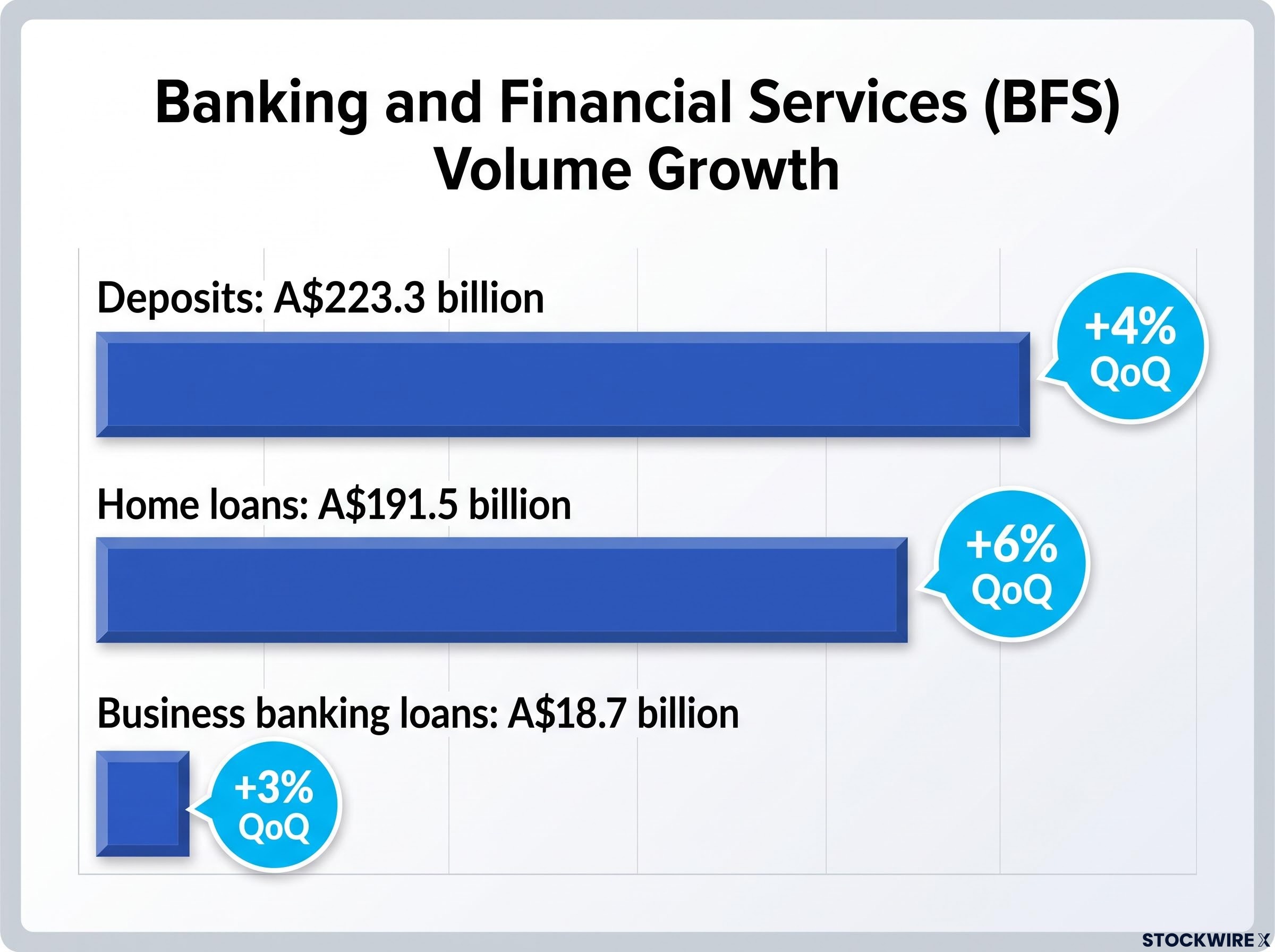
That breadth matters. It is not a single product driving the segment; home loans, deposits, and business lending are all expanding simultaneously, which gives BFS a broader base of earnings support heading into the rest of FY27.
Margin compression: the offset to watch
Volume growth alone does not tell the full story. BFS reported that lower margins, driven by portfolio mix changes and competitive pricing pressure on both lending and deposits, partially offset the volume gains. In practical terms, this means Macquarie is competing aggressively on price to win market share, and the net interest margin (the difference between what the bank earns on loans and what it pays on deposits) is narrowing.
Net interest margin pressure has been the defining earnings headwind for Australian banking names in 2026, with the Big Four collectively experiencing margin compression from both mortgage refinancing activity and intense deposit competition, a backdrop that contextualises why Macquarie’s BFS volume gains are being partially absorbed by price concessions.
Volume growth more than compensated in Q1. But if margin compression accelerates while volume growth moderates, the earnings quality of BFS could come under scrutiny in later quarters.
Macquarie Capital grows despite a tough comparison period
Macquarie Capital is the group’s advisory and investing arm. It advises on mergers and acquisitions, arranges capital markets transactions, makes principal investments alongside clients, and generates brokerage income from equity market activity.
Profit for the segment came in ahead of the prior corresponding period, which is a more meaningful outcome than it might initially appear given that Q1 FY26 was itself a solid quarter for the division. Growing earnings against a strong rather than a soft comparable speaks to genuine momentum in the business. The two contributors to that outcome were, first, a lift in income from investment-related activity, pointing to positive returns from principal positions and asset realisations, and second, a pickup in brokerage, consistent with active equity market conditions through the June quarter.
Growing profit against a strong prior-year base suggests deal-making and equity market activity remained favourable. For investors tracking M&A and capital markets conditions more broadly, this is a constructive data point, not just about Macquarie specifically, but about the environment advisory businesses are operating in.
What the Q1 FY27 scorecard means for Macquarie investors heading into FY27
Taken together, the Q1 result shows a group where structural diversification is doing exactly what it is designed to do. CGM rebounded, BFS grew volumes, and Macquarie Capital proved resilient against a strong prior-year base. MAM’s profit decline, the only negative in the scorecard, is a mechanical consequence of last year’s disposal rather than a signal of operational weakness.
That is how Macquarie posts 14% group profit growth to A$1,612 million even when one segment faces a year-over-year headwind.
Macquarie’s valuation premium over the Big Four, which traded at roughly 18.96x trailing earnings and 2.54x book value before the Q1 FY27 update, is anchored in large part on the recurring fee streams generated by MAM’s infrastructure AUM base, making the 4% quarter-over-quarter AUM growth reported today a direct input into how analysts will reassess that multiple.
Three variables are worth monitoring across the rest of FY27:
- MAM profit trajectory: with the disposal now fully cycled, how quickly does underlying growth in a A$748 billion AUM base translate back into profit improvement?
- BFS margins versus volume: can Macquarie sustain market share gains without further margin compression eroding the quality of the growth?
- CGM sustainability: will commodities conditions remain supportive, or will the segment’s historical volatility reassert itself?
The Q1 result provides a constructive but not unconditional signal. The diversification is delivering, but margin and segment mix dynamics deserve continued attention as Macquarie progresses through FY27.
This article is for informational purposes only and should not be considered financial advice. Investors should conduct their own research and consult with financial professionals before making investment decisions.