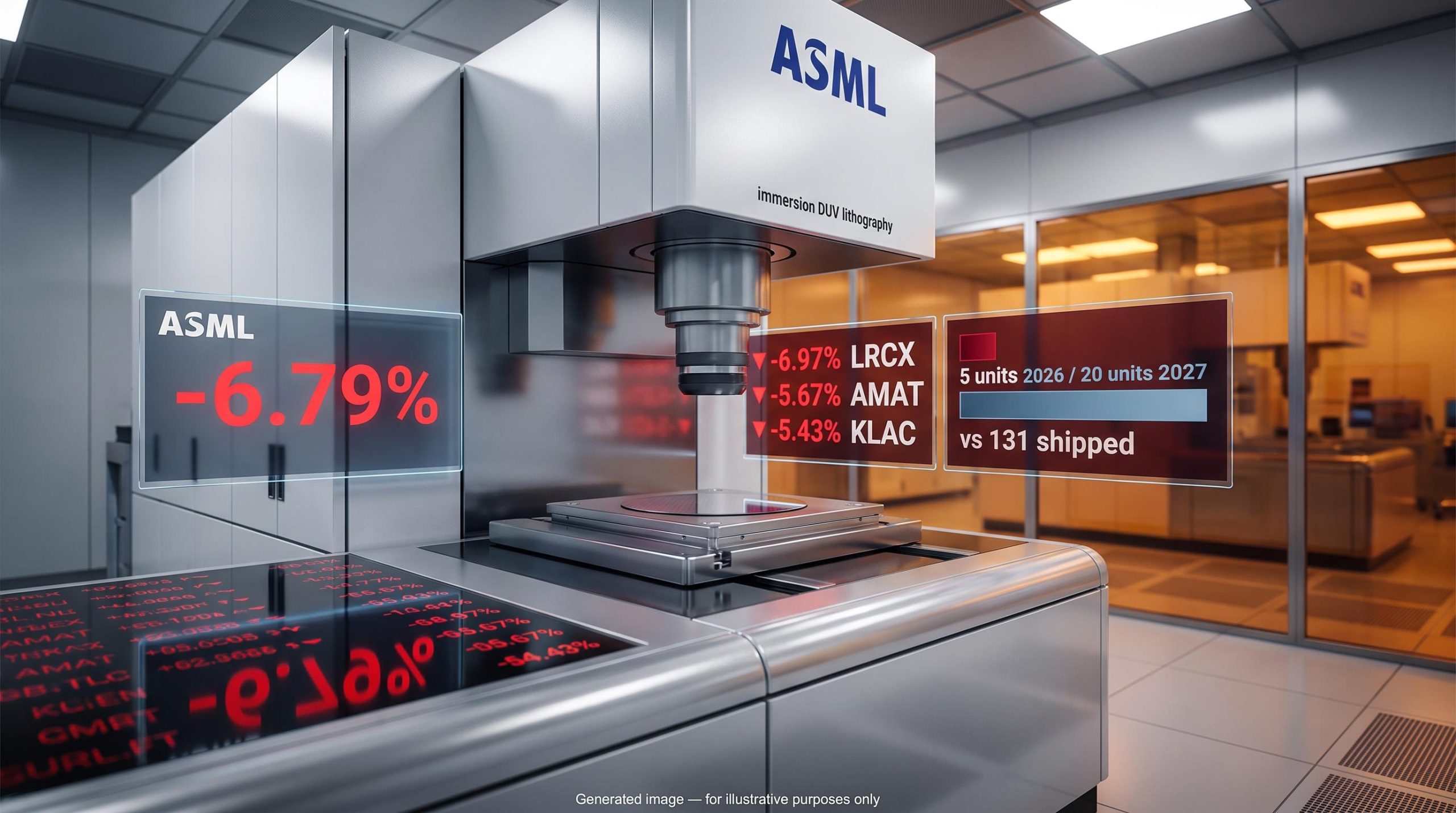
Semiconductor equipment stocks had been building gains in pre-market trading on 27 July 2026, with the sector carried higher by a combination of reduced geopolitical tension and news of a reported $250 billion infrastructure financing arrangement linking Nvidia and OpenAI. A single report alleging that a Shanghai factory had produced its own immersion DUV lithography tools erased all of that momentum, pulling ASML down roughly 6.79% and dragging Applied Materials, Lam Research, and KLA Corp sharply lower alongside it.
The reaction was sharp because the report struck the precise vulnerability the market understood best. With export controls having shut off Chinese access to EUV technology, Chinese fabs had pivoted to purchasing immersion DUV systems from ASML as the highest-capability lithography equipment still available to them. That pivot concentrated ASML’s remaining China exposure squarely within the DUV product line. Any viable homegrown substitute, however early-stage, placed that concentrated revenue stream directly at risk.
This piece breaks down both the direct mechanism (why ASML specifically) and the contagion logic (why Applied Materials, Lam Research, and KLA fell despite making none of the threatened equipment). The distinction that matters most: what the market is pricing versus what has actually changed in the near term.
What China has reportedly built, and what it has not
The strongest version of the claim is significant. According to reports published on 27 July 2026, a state-supported manufacturer based in Shanghai commenced initial production runs of domestically engineered immersion DUV lithography systems, with early units intended for SMIC, Hua Hong Semiconductor, and CXMT. Given that lithography represents arguably the most technically demanding discipline in the entire chip fabrication process, even incremental domestic progress in this area commands significant attention.
Now for the narrowing. Here is what has actually been confirmed or reported:
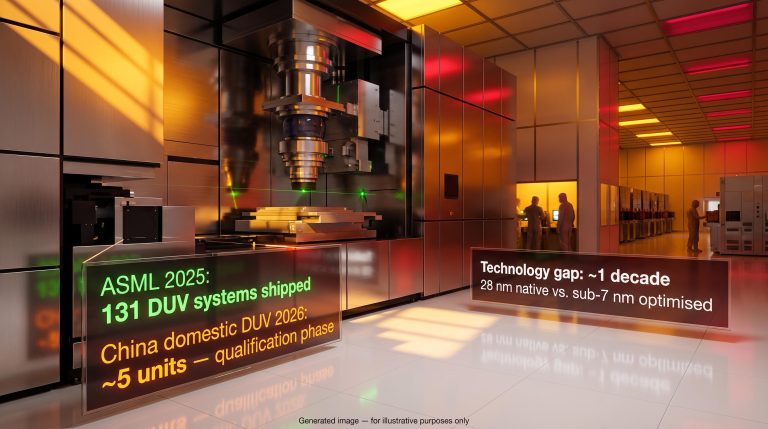
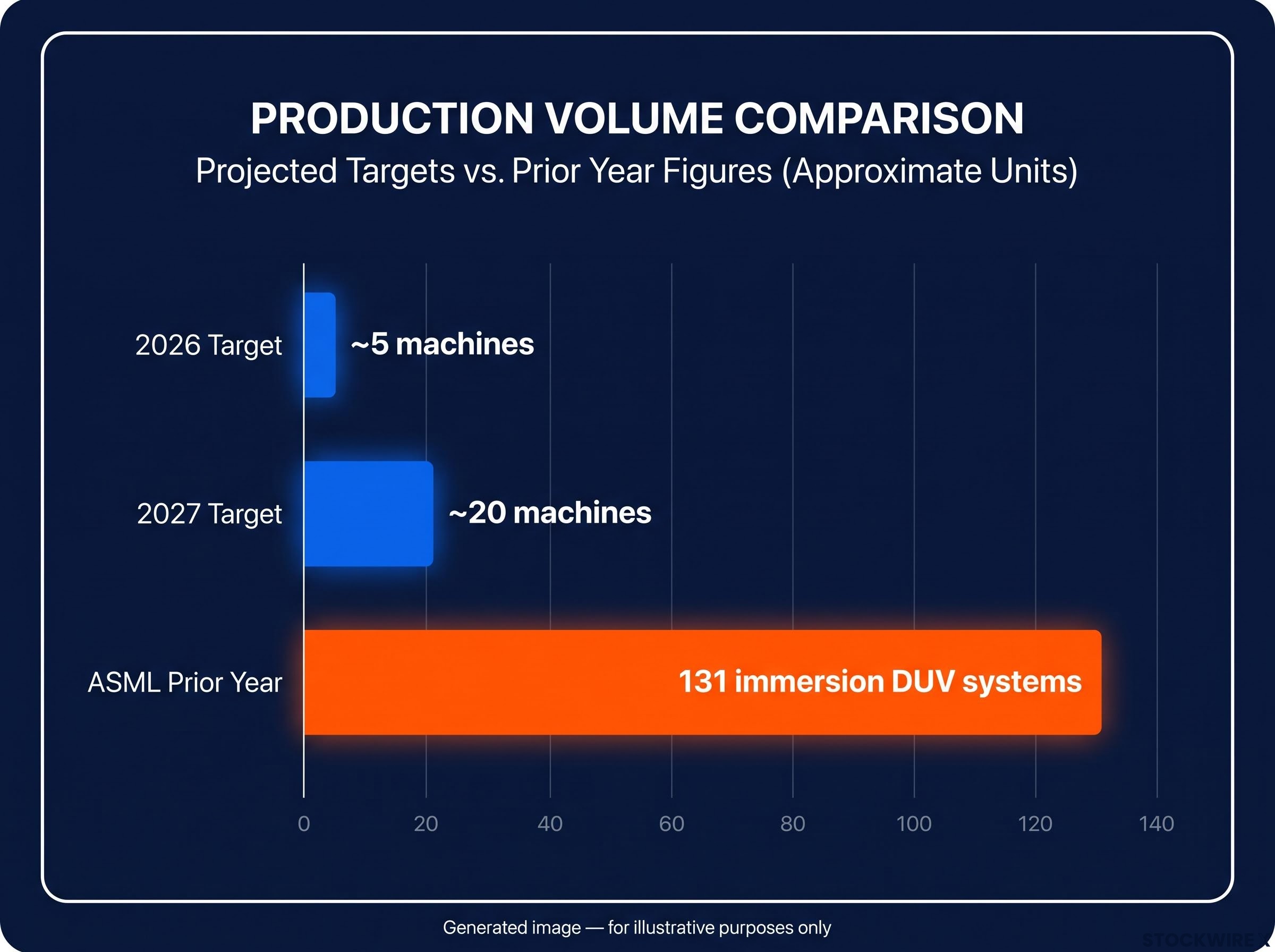
- Production targets: approximately 5 machines in 2026, roughly 20 in 2027
- ASML shipped 131 immersion DUV systems in the prior year
- SMIC has been evaluating an immersion DUV tool from Shanghai Yuliangsheng Technology since late 2025, targeting 28 nm initially
- Most components are locally sourced, but some critical parts still come from Japan, and supply constraints have already limited output
- No major fab has confirmed these tools are qualified for high-volume production
The manufacturer remains unnamed in public reports. The story originates from The Information, citing unnamed industry sources, and has not been corroborated by ASML, the Chinese manufacturer, or formal fab disclosures.
The scale gap between 5-20 machines and ASML’s 131-unit annual run rate tells you this is a proof-of-concept milestone, not a commercial displacement event. That distinction matters enormously for interpreting what the market actually priced on this session.
When big ASX news breaks, our subscribers know first
What this signals about the long-run China equipment market
The selloff was not a reaction to confirmed near-term revenue loss. Current orders from SMIC, Hua Hong, and CXMT are not yet threatened by machines that have not passed qualification testing. What the market repriced was a forward-looking probability: the chance that China eventually builds a largely self-sufficient semiconductor equipment ecosystem.
There is a paradox embedded in the export control strategy. Restrictions were designed to slow China’s chip capability. But by forcing domestic R&D and channelling massive state capital allocation toward equipment development, those same controls have created the conditions that make a domestic equipment stack more likely over a longer horizon.
The structural durability of export controls is a recurring variable that shapes how investors should interpret each new China semiconductor headline; controls grounded in national-security law with bipartisan Congressional backing are not subject to trade negotiators and are unlikely to be unwound regardless of diplomatic progress at any given summit.
The erosion path, if it materialises, runs in two phases:
- Incremental growth loss: China stops placing new expansion orders with Western suppliers as domestic tools fill greenfield capacity at mature nodes
- Replacement order loss: As domestic tools mature and demonstrate competitive yields, replacement and expansion orders at existing fabs shift to local manufacturers
That trajectory, if it plays out over the next 3-10 years, would remove one of the semiconductor equipment sector’s largest growth markets permanently. But the operative words are “if” and “years.”
Near-term buffers that protect Western equipment revenues
Chinese tools still need months, likely years, of qualification testing. No domestic DUV system has demonstrated competitive yields, uptime, or overlay accuracy (the precision with which successive chip layers align) against ASML’s systems in a volume production environment.
The engineering complexity underlying those capability claims is substantial; SPIE multi-patterning analysis covering double-patterning at 22 nm half-pitch identifies layout splitting constraints, stitching tolerances, and process variation sensitivity as the primary yield barriers that any domestic immersion tool must clear before qualifying for volume production.
The component dependency has not been resolved either. Reliance on Japanese parts for some critical components means full supply independence has not been achieved, and those constraints have already limited output volumes.
And the scale context bears repeating: roughly 20 projected units in 2027 against China’s enormous installed base and ongoing fab expansion programme. The near-term commercial buffer remains substantial.
Why immersion DUV became ASML’s most exposed revenue line
ASML holds an uncontested global position as the only company producing EUV lithography systems, which represent the frontier of chip patterning technology. A series of export control measures, introduced from roughly 2019-2020 and progressively tightened, brought EUV shipments to China to a complete halt. With that category closed off, the highest-value segment of ASML’s potential China business disappeared from the addressable market.
ASML’s structural position as the sole global EUV supplier is insulated from the DUV threat in the near and medium term; its High NA EUV monopoly operates in a technology category where no domestic Chinese alternative exists even at prototype stage, and where the surrounding resist, mask, and metrology ecosystem is co-developed entirely around ASML’s roadmap.
In response to losing access to EUV equipment, Chinese chipmakers accumulated large volumes of immersion DUV tools, buying as many units as possible while that category remained available for purchase. As a result, DUV orders grew into the primary driver of ASML’s China revenue, with the company’s regional exposure narrowing into a single product line.
DUV’s role in China’s current manufacturing ambitions
Immersion DUV uses 193 nm wavelength light with water immersion to achieve resolution fine enough to support chip manufacturing at the following specifications:
- Wavelength: 193 nm
- Immersion medium: Purified water
- Node capability: Down to approximately 7 nm via multi-patterning, a technique where chips are exposed to the light source multiple times per layer to achieve finer resolution than a single pass would allow
That range covers the advanced-but-not-cutting-edge nodes that Chinese fabs are aggressively expanding: 28 nm through 7 nm. Multi-patterning techniques allow DUV to punch well below its nominal wavelength limit, extending the tool’s relevance further than its basic specification implies.
For investors, this sequence means ASML’s China exposure is now structurally concentrated in exactly the one lithography category where a domestic alternative is being built. That concentration is not an accident of competition; it is a direct consequence of the export control regime itself. A domestic Chinese EUV tool reportedly exists at prototype stage, but it remains years from practical chip production.
Ecosystem spillover: why Applied Materials, Lam Research, and KLA declined in parallel
Here is the critical distinction the market blurred in a single session. ASML makes the equipment directly threatened by the Chinese DUV report. Applied Materials, Lam Research, and KLA do not make lithography tools at all.
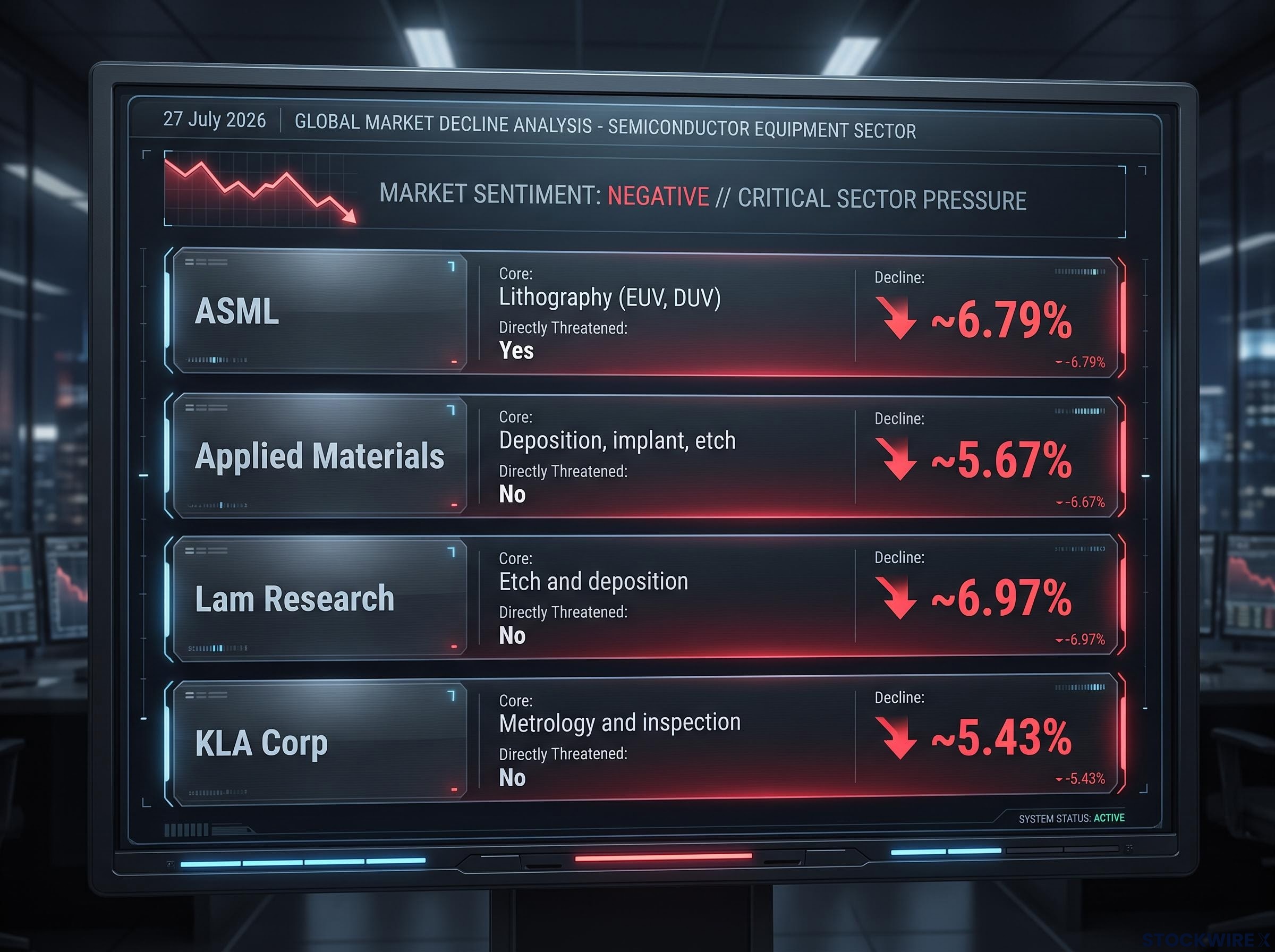
| Company | Core equipment focus | Directly threatened by DUV breakthrough | Session decline 27 July 2026 |
|---|---|---|---|
| ASML | Lithography (EUV, DUV) | Yes (DUV segment) | ~6.79% |
| Applied Materials | Deposition, implant, etch | No | ~5.67% |
| Lam Research | Etch and deposition | No | ~6.97% |
| KLA Corp | Metrology and inspection | No | ~5.43% |
Prior to the report’s publication, the sector had been advancing in pre-market trading, supported by a reduction in Iran-related geopolitical risk and the reported $250 billion Nvidia-OpenAI financing arrangement. The session saw the full journey from positive momentum to significant losses compressed into a matter of hours.
The reasoning behind the broader selloff runs as follows: patterning circuits onto silicon via lithography is the most technically formidable challenge in chip manufacturing. If China has made genuine inroads there, even at an early stage, the inference drawn by the market is that adjacent process steps, including deposition (layering materials onto wafers), etch (cutting patterns into those layers), and inspection (measuring defects at microscopic scale), become progressively more achievable over time. That inference, in turn, lifts the probability that China redirects its substantial equipment spending toward domestic suppliers across multiple categories.
But here is what that logic obscures. ASML’s decline has a direct, identifiable mechanism: a reported domestic competitor for a specific product line. The declines in AMAT, LRCX, and KLAC are speculative ecosystem trades based on extrapolated probability. The critical question for investors evaluating these contagion declines is whether China can replicate deposition, etch, and inspection capability at the same pace as lithography, a timeline that could span many years if it happens at all.
Semiconductor equipment cycle positioning matters as much as any single geopolitical event when evaluating names like Applied Materials, Lam Research, and KLA; with global revenues projected at $975 billion in 2026 and a locked-in supply wave arriving in 2027-2029, the cyclical backdrop shapes how much tolerance investors have for near-term contagion declines in equipment names.
How to evaluate claims like this before repricing a position
China’s semiconductor localisation push will generate many similar reports in the years ahead. Each one will move stocks. A repeatable framework for assessing them is more valuable than a verdict on any single claim.
- Existence versus qualification: A machine being assembled and shipped is not the same as passing yield and uptime qualification at a leading fab’s volume production line. Watch for SMIC, Hua Hong, or CXMT publicly confirming that domestic tools are running in volume lines with competitive yields.
- Confirmation hierarchy: Unnamed-source reports carry the least evidentiary weight. Subsequent confirmation from fab disclosures, ASML management commentary, or published technical specifications from the manufacturer carries substantially more.
- Volume context test: Place any production target against current Western shipment volumes and China’s total installed base before concluding a displacement threat is commercially meaningful. Today, that means 5-20 units against ASML’s 131-unit annual benchmark.
Today’s report rests entirely on unnamed sources. The appropriate investor response is calibrated attention, not a confirmed position change.
Investors who apply this framework avoid both overcorrecting on unverified reports and dismissing genuine strategic shifts that are still early in their confirmation arc.
What the correction changes, and what it does not
Something has genuinely changed. The probability that China eventually builds a largely self-sufficient semiconductor equipment stack has increased, and that is a legitimate reason for long-duration investors in Western equipment names to update their assumptions about the terminal value of China-facing revenue.
What has not changed is nearer. ASML’s current DUV revenue in China is not yet threatened by machines that have not cleared qualification. The contagion declines in Applied Materials, Lam Research, and KLA reflect scenario repricing, not confirmed revenue displacement. And ASML’s structural position as the sole global EUV supplier remains entirely unthreatened in the near and medium term; no domestic Chinese EUV alternative is close to production readiness.
The most useful frame is not whether today’s selloff was justified, but which specific data points in the next 12-18 months will tell you whether the strategic risk is accelerating or stalling. Two matter most:
- Formal fab qualification announcements: Watch for SMIC, Hua Hong, or CXMT publicly confirming domestic DUV tools are running in volume production with competitive yields
- The 2027 production ramp: Whether the manufacturer hits the roughly 20-unit target will reveal whether this is a scalable programme or a symbolic demonstration
Those are the signals that separate a structural shift from a headline. Until they arrive, this remains a story where the direction is plausible but the timeline is unproven.
For investors evaluating how China’s semiconductor localisation push interacts with broader portfolio exposure, our deep-dive into Taiwan semiconductor supply risk examines the concentration of leading-edge fabrication capacity and the timeline implications for portfolios that carry technology, automotive, or industrial holdings.
This article is for informational purposes only and should not be considered financial advice. Investors should conduct their own research and consult with financial professionals before making investment decisions. These forward-looking statements about China’s semiconductor equipment capability are speculative and subject to change based on technological developments, policy shifts, and company performance.