How Listed Property Funds Managers Actually Make Money
5 mins ago


Morningstar has revised its rating on one of Australia’s most widely held global equity ETFs, but the trigger was not what most investors would expect. The iShares Global 100 ETF (ASX: IOO) was downgraded from Bronze to Neutral in a Medalist Rating update published on 9 June 2026. The fund itself has not changed. Its index, its manager, and its investment process remain exactly as they were. What changed was the measurement system: an April 2026 methodology update placed greater weight on fee competitiveness, particularly for passive funds, and IOO’s cost position no longer clears the revised threshold for a Bronze conviction rating. What follows explains the mechanism behind the downgrade, what a Neutral designation actually signals, and how both existing holders and prospective buyers should interpret the news.
The downgrade was authored by Simonelle Mody, Associate Investment Specialist at Morningstar Australia, and published on 9 June 2026. IOO moved from Bronze to Neutral in a single step.
Nothing inside the fund prompted the revision. IOO continues to track the same index. It retains the same manager. Morningstar still rates the fund positively on its People and Process dimensions.
The three things that did not change in IOO:
The change was external. Morningstar’s April 2026 methodology update increased the weighting of the Price component in the Medalist Rating calculation for passive funds. IOO charges a management fee of 0.40% per annum, well below the 0.85% category median, and carries a Price Score of 1.34 on a scale of -2.5 to +2.5. Under the old model, that positioning supported a Bronze rating. Under the new one, it does not.
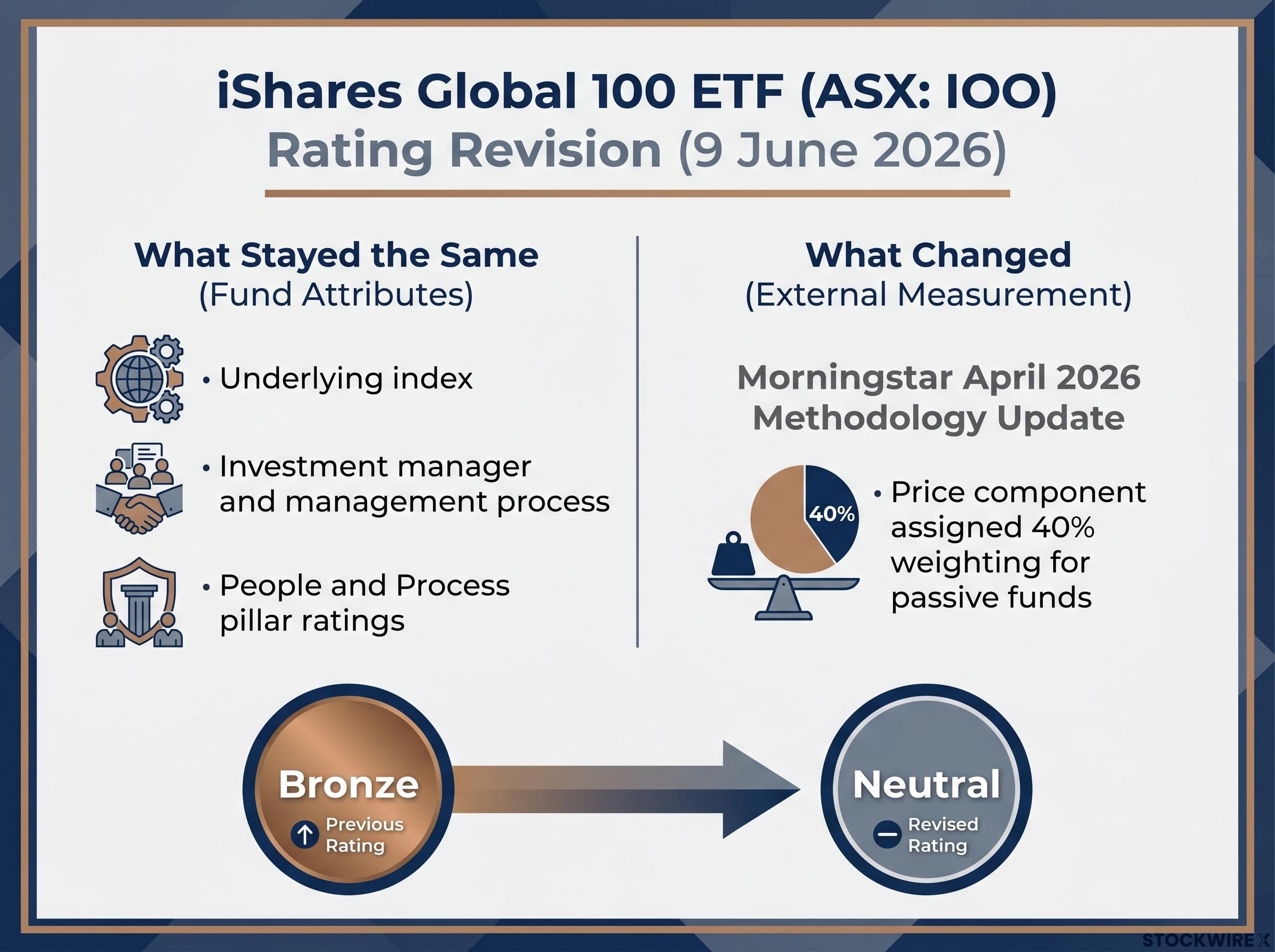
The bar moved up, not the fund down. IOO’s downgrade reflects a stricter methodology, not a deterioration in the fund’s quality or process.
Morningstar’s Medalist Ratings are forward-looking assessments of expected performance net of fees over a full market cycle. They are probabilistic forecasts with specific inputs, not pass/fail stamps.
The system evaluates funds across four pillars: People, Process, Parent, and Price. For passive index-tracking funds, the April 2026 update assigned the Price component a 40% weighting in the overall calculation, reflecting Morningstar’s view that cost is the primary determinant of outcomes when two funds track similar benchmarks.
Morningstar’s April 2026 Medalist Rating methodology update confirmed that for passive index-tracking funds, the Price component carries a 40% weighting in the overall rating calculation, reflecting the firm’s position that cost is the primary performance differentiator when funds track similar benchmarks.
The rating tiers correspond to specific performance expectations:
| Rating | What It Predicts | What It Does Not Mean |
|---|---|---|
| Gold / Silver / Bronze | Expected to outperform category benchmark after fees, with varying conviction | Not a guarantee of positive returns |
| Neutral | Expected to roughly match category benchmark after fees | Not a sell signal or criticism of fund quality |
| Negative | Expected to underperform category benchmark after fees | Reserved for funds Morningstar considers genuinely problematic |
A Neutral rating predicts benchmark-matching performance. It does not signal fund failure.
For passive funds tracking similar indices, fee differences are not a secondary consideration. They are the primary variable that separates outcomes. When two ETFs replicate the same benchmark, the cheaper one systematically captures more of the return after costs. That is not an opinion; it is arithmetic.
IOO’s 0.40% annual fee places it in the second-cheapest quintile of the Morningstar Australia Fund Equity World Large Blend category, comfortably below the 0.85% median. In absolute terms, the fee is competitive. Under the revised methodology, however, the comparison point is not the median. It is the very cheapest alternatives in the category.
ETF management fees are deducted daily from a fund’s net asset value and never appear as a separate charge on a brokerage statement, which is why a 0.40% annual cost can feel abstract until it is modelled against a longer compounding horizon.
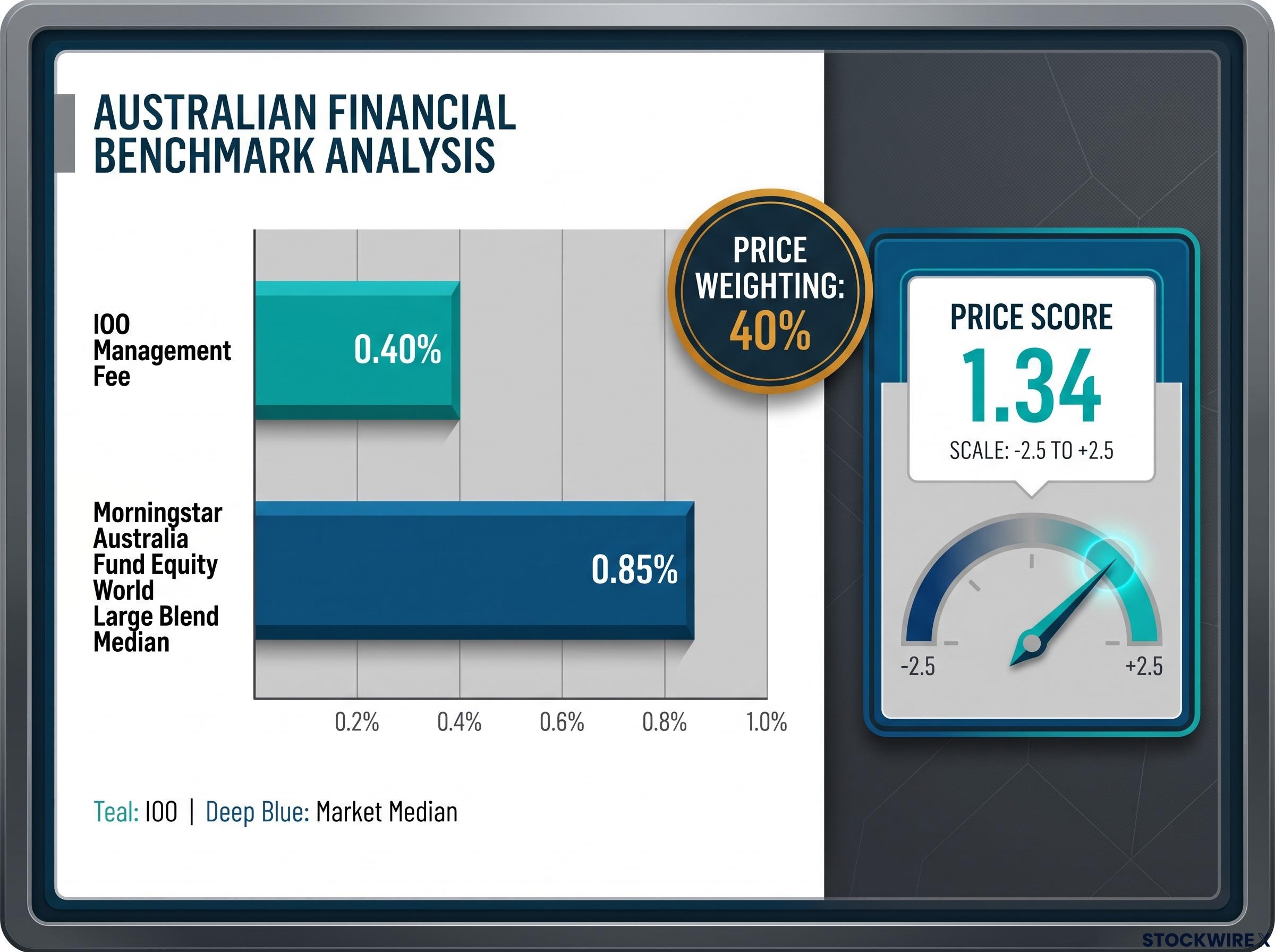
With the Price Score carrying 40% of the overall Medalist Rating for passive funds, IOO’s cost position, competitive but not category-leading, is no longer sufficient to sustain a Bronze conviction rating.
This is a structural feature of the April 2026 update, not a one-off judgment on IOO. Morningstar’s own announcement indicated the methodology was expected to produce more Gold and Silver ratings and fewer Bronze ratings overall, meaning some Bronze-to-Neutral movements were an anticipated outcome of the recalibration.
A Neutral rating is not a sell recommendation. Morningstar explicitly frames its ratings as analysis tools, not trading signals, and this distinction matters most when the driver is a methodology change rather than a deterioration in fund quality.
For Australian investors who have held IOO and accrued capital gains, switching to a marginally cheaper alternative introduces costs that the rating revision does not account for. Three factors should inform any switching decision:
Portfolio role clarity matters more than rating tier when assessing whether to retain a holding: an ETF that was selected to deliver broad global large-cap exposure continues to serve that function regardless of whether its Medalist Rating sits at Bronze or Neutral, provided the allocation decision was sound to begin with.
The capital gains tax changes from 1 July 2027 add a further dimension to the switching calculation for existing holders: the 50% CGT discount will be replaced by a CPI indexation model with a 30% minimum effective rate, meaning investors who delay a potential switch past that date may face a materially different tax outcome on the same accrued gain.
Morningstar reserves the Negative rating for funds it genuinely considers problematic. A Neutral designation is not that.
The proportionate response is to note the change, confirm the fund still serves its intended portfolio role, and weigh any potential switch against the real, quantifiable costs of acting.
For new money, the calculus is different. The friction costs that restrain existing holders, capital gains tax, transaction costs from unwinding a position, do not apply to fresh capital. A Neutral rating and IOO’s relative fee position carry more decision weight when there is no embedded cost of switching.
Morningstar’s own research consistently identifies fee differences as one of the most reliable predictors of relative performance among similar index funds over time. For investors deploying fresh capital into global equities, three evaluation dimensions provide a structured comparison framework:
With hundreds of ETF products available on the Australian market, a structured evaluation before committing new capital is increasingly valuable.
Investors deploying fresh capital into global equities will find our comprehensive walkthrough of global ETF comparisons for ASX investors covers all 12 of the largest global share ETFs on the ASX, including IOO, side by side across fees, liquidity, index breadth, and five-year return data, providing a structured basis for evaluating which option fits a specific portfolio objective.
The distinction between a methodology-driven downgrade and a quality-driven downgrade is the single most useful takeaway from IOO’s rating revision. IOO continues to track the same index, retains its positive People and Process ratings, and remains a credible vehicle for global large-cap exposure in Morningstar’s assessment.
Morningstar’s April 2026 update was designed to raise the analytical bar on fees, and IOO’s movement from Bronze to Neutral is consistent with that directional intent. The overall effect of the recalibration was expected to produce more top-tier ratings and fewer mid-tier ratings, meaning some Bronze downgrades to Neutral were an anticipated, structural outcome.
The next time any fund in a portfolio receives a rating revision, the first question should not be “should I sell?” It should be: did the fund change, or did the measurement change?
Review the change, contextualise the driver, and respond proportionately. A methodology revision warrants attention, not reaction.
This article is for informational purposes only and should not be considered financial advice. Investors should conduct their own research and consult with financial professionals before making investment decisions.
—
The Morningstar Medalist Rating is a forward-looking assessment of a fund's expected performance net of fees over a full market cycle. A Neutral rating means the fund is expected to roughly match its category benchmark after fees; it is not a sell signal or a criticism of fund quality.
IOO was downgraded from Bronze to Neutral in June 2026 because Morningstar's April 2026 methodology update increased the weighting of the Price component to 40% for passive funds, and IOO's 0.40% fee, while below the 0.85% category median, was no longer competitive enough to meet the revised Bronze threshold.
A Neutral rating is not a sell recommendation; Morningstar frames its ratings as analysis tools, not trading signals. Existing holders with accrued capital gains should weigh the tax liability of switching against any potential fee savings from a cheaper alternative before taking action.
ETF management fees are deducted daily from a fund's net asset value and never appear as a separate charge on a brokerage statement, meaning even a 0.40% annual cost compounds into a material drag on returns over longer investment horizons.
Yes, the distinction matters significantly. Existing holders face capital gains tax and transaction costs if they switch, which can outweigh fee savings, while investors deploying fresh capital face none of those friction costs and can evaluate alternatives purely on fees, index breadth, and Morningstar rating tier.