An 81% overall response rate across six cancer subtypes in heavily pre-treated patients is the kind of headline number that moves biotech stocks. Whether it should is a more complicated question.
Imugene presented Phase 1b expansion cohort data for its allogeneic CAR-T candidate azer-cel (azercabtagene zapreleucel) at ASCO 2026 on 9 June 2026, the same day the company announced two new FDA Fast Track Designations for relapsed/refractory chronic lymphocytic leukaemia (CLL) and marginal zone lymphoma (MZL). For Australian investors tracking the ASX-listed company, the confluence of a major oncology conference readout and fresh regulatory designations in a single news cycle warrants careful unpacking.
This article breaks down the ASCO data, explains what the FDA designations actually confer, and maps out the clinical and commercial questions that will determine whether yesterday’s milestones translate into long-term value.
What the ASCO 2026 data actually shows
The headline figure is genuinely striking. Across 19 evaluable patients in the ASCO 2026 Abstract 7012 dataset, azer-cel delivered an overall response rate (ORR) of 81%, with a complete response (CR) rate of 31%.
81% overall response rate at Day 28 across six relapsed/refractory B-cell malignancy subtypes in heavily pre-treated, CAR-T-naïve patients (ASCO 2026 Abstract 7012, 19 evaluable patients).
The responses spanned all six B-cell malignancy subtypes enrolled: diffuse large B-cell lymphoma (DLBCL), MZL, CLL, primary central nervous system lymphoma (PCNSL), follicular lymphoma (FL), and Waldenström’s macroglobulinaemia (WM). Some 21% of enrolled patients had received more than four prior lines of therapy before entering the study.
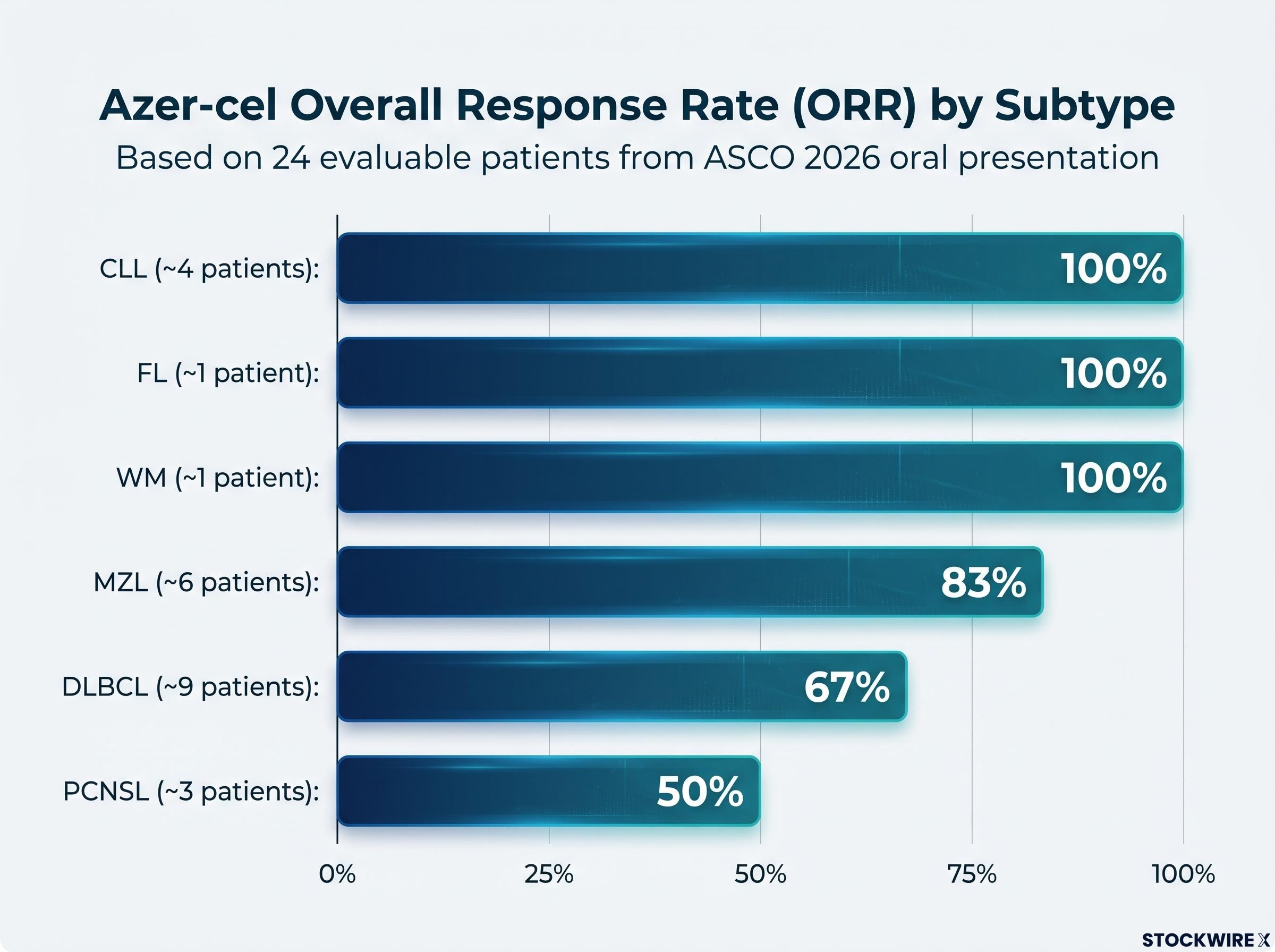
An updated oral presentation dataset, reflecting 24 evaluable patients out of 25 treated, provided the following subtype-level response rates:
| Cancer Subtype | Approximate Patient Count | ORR |
|---|---|---|
| DLBCL | ~9 | 67% |
| MZL | ~6 | 83% |
| CLL | ~4 | 100% |
| PCNSL | ~3 | 50% |
| FL | ~1 | 100% |
| WM | ~1 | 100% |
The difference between the 19-patient abstract and the 24-patient oral presentation reflects more recent enrolment data captured after the abstract submission deadline. The primary disease assessment was conducted at Day 28 post-infusion, meaning durability data is still maturing. With subgroup sizes in the single digits for several subtypes, a handful of additional patients could shift these figures substantially. The signal is encouraging; the sample size demands caution.
A pre-ASCO interim readout published in late May 2026 captured the 16-patient dataset that preceded both the abstract and oral presentation figures, providing a third data snapshot that illustrates how quickly the trial has been enrolling across its six B-cell malignancy subtypes.
When big ASX news breaks, our subscribers know first
Why “off-the-shelf” CAR-T matters for this programme
CAR-T therapy works by engineering immune cells to recognise and attack cancer. The distinction that matters for azer-cel is how those cells are sourced.
- Autologous CAR-T: Uses the patient’s own cells, requiring individualised manufacturing for each person. This process can take several weeks and limits scalability.
- Allogeneic CAR-T (off-the-shelf): Uses donor-derived cells manufactured at scale, potentially available for immediate administration to multiple patients from a single production batch.
Azer-cel is an allogeneic, off-the-shelf therapy targeting CD19-positive B-cell malignancies, administered in combination with low-dose IL-2. The trial includes both CAR-T-naïve patients and those who had relapsed after prior autologous CAR-T therapy, a population with very limited treatment options.
The format carries potential advantages in manufacturing speed, access, and cost if the clinical profile holds at scale. It also enters a space where approved autologous CD19 CAR-T products already exist in DLBCL, alongside emerging allogeneic competitors. Whether azer-cel is solving a genuine access problem or offering incremental differentiation in a crowded field is not yet clear, but it is the right question for investors to track.
The competitive landscape for allogeneic CAR-T development was on display at ASCO 2026 more broadly, with Chimeric Therapeutics reporting an 82% disease control rate for its CDH17 CAR-T programme across 11 evaluable patients, a result that highlights both the sector’s collective momentum and the difficulty of drawing direct efficacy comparisons across trials with different target antigens, patient populations, and disease contexts.
The safety data investors should not overlook
Efficacy numbers attract attention. Safety data determines whether a therapy survives the transition from a small trial to a registrational programme.
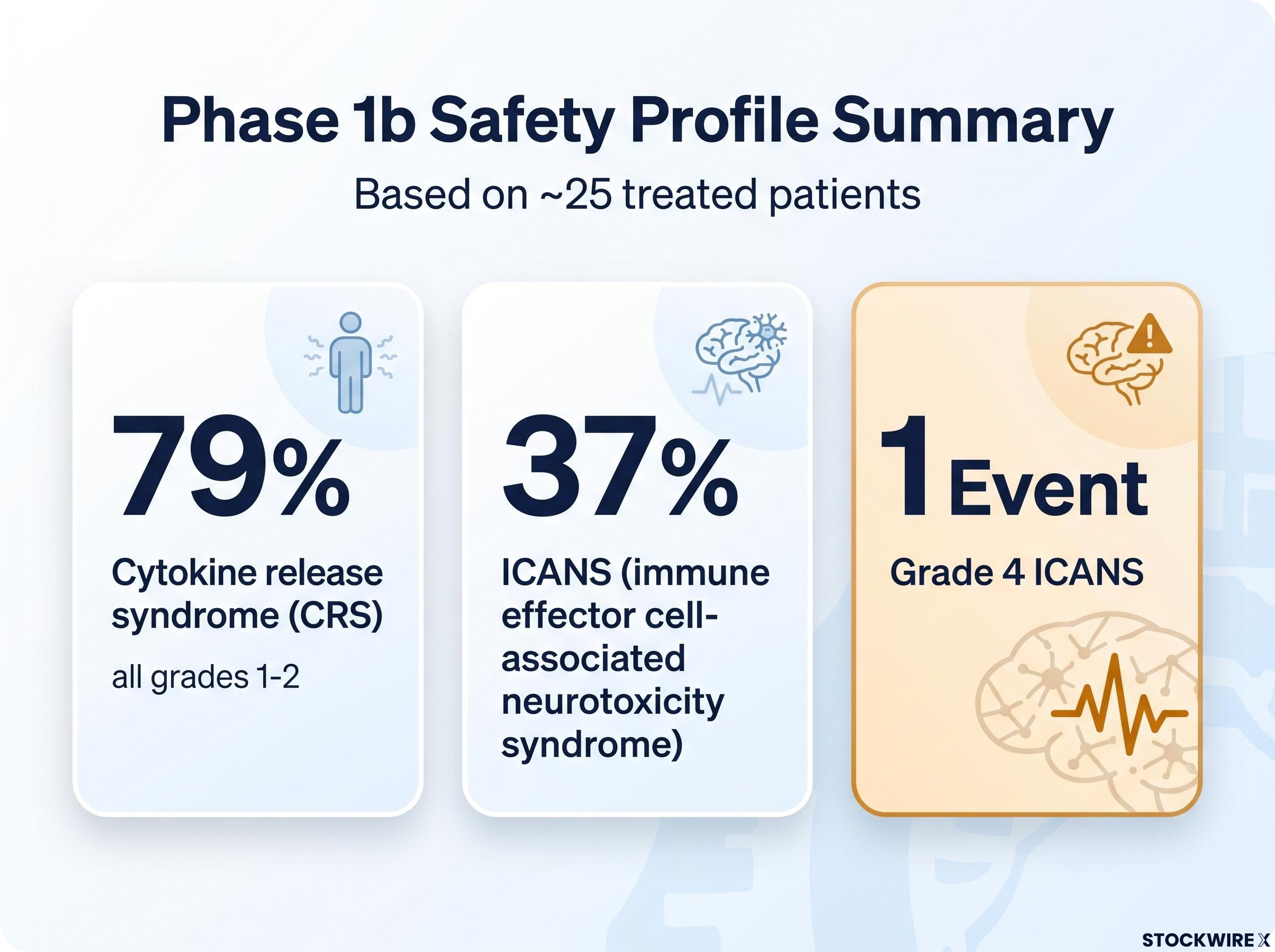
The key safety metrics from the Phase 1b dataset:
- Cytokine release syndrome (CRS): Observed in 79% of patients, all grades 1-2. CRS is an inflammatory response triggered when CAR-T cells activate against cancer; grades 1-2 are generally considered manageable with standard monitoring protocols.
- ICANS (immune effector cell-associated neurotoxicity syndrome): Reported in 37% of patients overall.
- Grade 4 ICANS: One event, the only high-grade adverse event in the dataset to date.
The ASTCT consensus grading for CRS and ICANS establishes the uniform criteria by which grades 1-2 CRS is classified as manageable and grade 3-4 events are flagged as requiring escalated intervention, the same framework regulators apply when evaluating whether a CAR-T programme’s toxicity profile is acceptable for advancement to a larger pivotal population.
One Grade 4 ICANS event has been observed across approximately 25 treated patients, the sole high-grade safety signal in the current dataset.
A single high-grade neurotoxicity event in roughly 25 patients is not alarming in isolation. The company has described the overall safety profile as consistent with the broader CAR-T class. The question is whether ICANS frequency and severity remain stable as patient numbers increase. Phase 1b-to-pivotal transition risk concentrates here: what appears manageable in 25 patients may look different in 250.
What the FDA Fast Track Designations do (and do not) deliver
Imugene now holds three FDA Fast Track Designations for azer-cel. The DLBCL designation was granted in March 2025. Two additional designations, for CLL and MZL, were reported by Imugene in an ASX announcement on 9 June 2026, though these have not been independently verified in publicly indexed sources at the time of writing.
What Fast Track provides in practice
- More frequent meetings and written communications with the FDA during the development process.
- Eligibility for rolling review, which allows sections of a future marketing application to be submitted as they are completed rather than requiring the entire package at once.
- Ongoing regulatory alignment on trial design, reducing the risk that a pivotal trial fails on procedural grounds rather than clinical ones.
What it does not change
- Fast Track designation is not a product approval.
- It does not confirm therapeutic efficacy or safety.
- It does not lower the evidentiary standard required for approval; the same clinical bar applies regardless of designation status.
Rolling review eligibility is among the more commercially significant benefits, allowing Imugene to submit completed sections of a future Biologics License Application as clinical data packages are finalised rather than waiting until the full programme is complete, a mechanism that can compress the pre-approval timeline by several months.
For an ASX-listed biotech targeting a pivotal trial, Fast Track carries real operational value. It is not, however, a commercial outcome.
The BTKi combination cohort and the road to a pivotal trial
The forward-looking catalyst sequence for Imugene centres on three threads, each at a different stage of maturity.
- Phase 1b durability data: Longer-term follow-up at 6-12 months for the CAR-T-naïve cohort, which will determine whether Day 28 responses translate into durable remissions.
- Pivotal trial initiation: Targeted for 2026, partially funded by a $22.5 million institutional placement completed earlier this year. Additional financing requirements are anticipated.
- BTKi combination cohort (Cohort 3) early readouts: The first patient was dosed at Baylor University in May 2026, according to an Imugene ASX announcement dated 28 May 2026. The patient had BTKi-refractory mantle cell lymphoma.
Scientific rationale: Pre-clinical and translational data, attributed to Dr. Blunt at ASCO 2026, suggest that prior BTK inhibitor exposure may shift T-cell phenotype toward a central memory profile, which could enhance CAR-T cell persistence. This hypothesis has not yet been confirmed in clinical data.
The BTKi cohort represents a medium- to longer-term optionality thread. Its relevance is contingent on the monotherapy data first demonstrating durable efficacy and acceptable safety at larger scale.
A milestone session that raises the right questions for investors
The ASCO 2026 presentation and the concurrent FDA designations advance the azer-cel programme meaningfully. They do not, on their own, resolve the questions that sit between a Phase 1b signal and a regulatory approval.
The outstanding variables investors should monitor:
- Durability data: Complete response rate persistence and progression-free survival beyond Day 28, the metrics that regulators will weigh most heavily.
- Pivotal trial design: Whether Imugene pursues a single-indication approach (likely DLBCL) or a broader basket strategy, and whether the FDA accepts a single-arm design or requires randomisation.
- ICANS characterisation at scale: Whether high-grade neurotoxicity remains rare as patient numbers grow from tens to hundreds.
- Capital requirements: The $22.5 million placement covers only a portion of anticipated pivotal trial costs; further raises are likely.
- Cohort 3 safety and early efficacy readouts from the BTKi combination arm.
The step-change from approximately 25 Phase 1b patients to a pivotal trial population in the hundreds represents a substantial increase in cost, complexity, and execution risk. Investors who understand which metrics to track are better positioned than those reacting to any single data point. The session at ASCO 2026 gives them a clearer map; the destination remains years away.
Binary catalyst risk of this kind, where a single trial outcome can either validate years of development spending or eliminate most of the stock’s value, is a category of investment risk that demands pre-defined position sizing and exit conditions rather than reactive decision-making at the moment of readout.
This article is for informational purposes only and should not be considered financial advice. Investors should conduct their own research and consult with financial professionals before making investment decisions. Forward-looking statements regarding clinical trial outcomes, regulatory timelines, and commercial prospects are speculative and subject to change based on market developments and company performance.