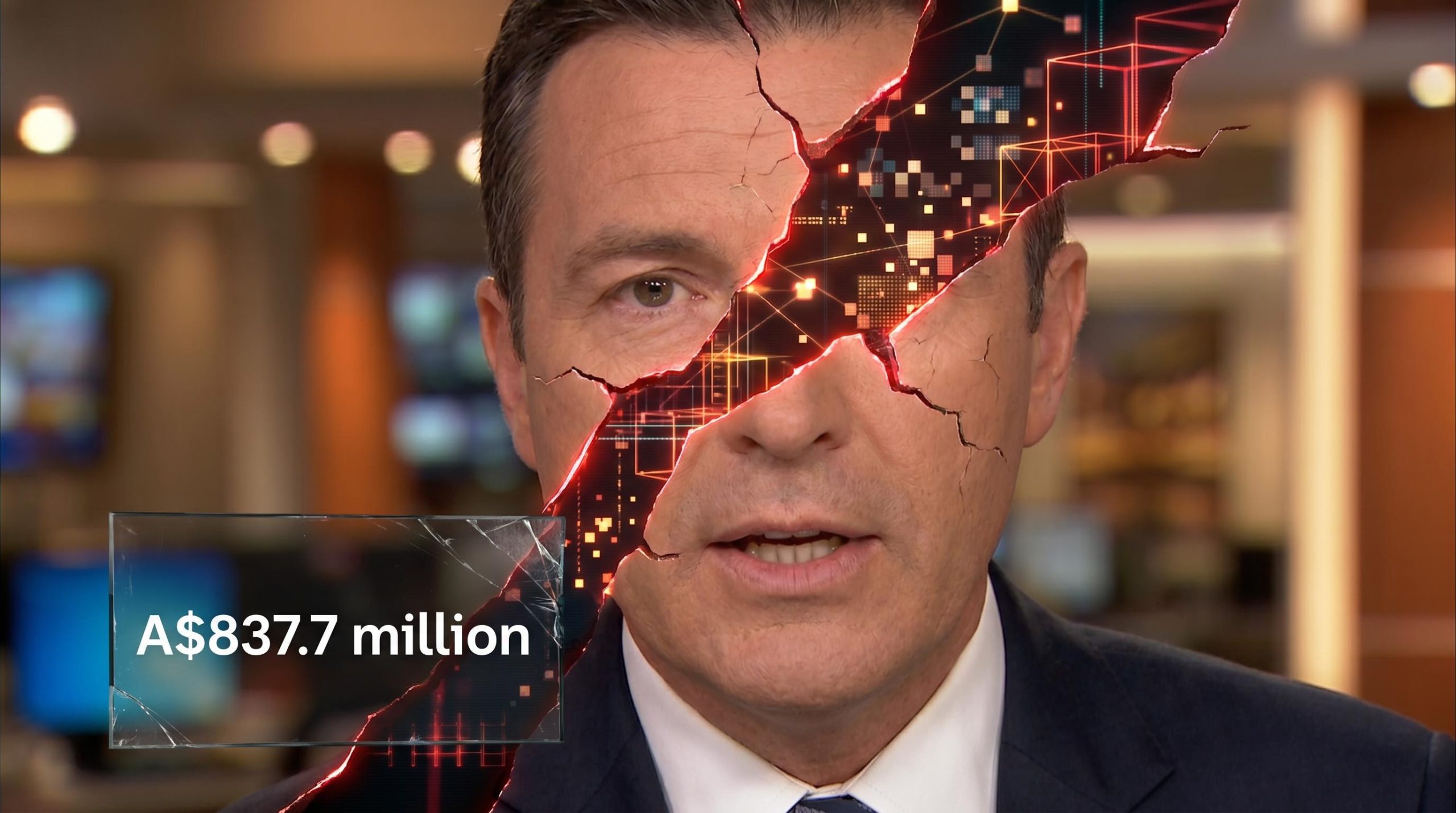
In 2025, a deepfake video of Western Australian Premier Roger Cook circulated across social media in investment scam advertisements. To many viewers, it was indistinguishable from a genuine endorsement. It was one of thousands of AI-generated scam assets the Australian Securities and Investments Commission (ASIC) identified that year.
Investment scams are no longer crude, easy-to-spot operations. Artificial intelligence has given fraudsters the tools to produce polished videos, fabricated licensing documents, and hyper-targeted advertising at industrial scale. Australian investors lost A$837.7 million to investment scams in 2025 alone, the largest single loss category in national scam data. The tactics are becoming harder to detect with each passing year. This guide explains how AI is being used to deceive Australian investors, what the specific warning signs look like, how regulators are responding, and what concrete steps readers can take before committing money to any investment opportunity.
Why AI has made investment scams far more convincing
Investment scams used to announce themselves. Poor grammar, pixelated logos, implausible claims typed in broken English: these were the cues Australian consumers were trained to spot. That training is now outdated.
AI tools have not simply increased the volume of scam content. They have changed its quality. Fraudsters can now produce professionally filmed video endorsements, polished landing pages, and personalised advertising copy that mirrors the tone and visual standards of legitimate financial services firms. The traditional tell-tale signs, the ones consumer protection campaigns spent years teaching Australians to recognise, are largely absent from the latest generation of AI-generated scam material.
The combination of scalable AI production and targeted social media distribution has created a new threat environment. ASIC removed more than 1,100 online investment scam advertisements during 2025. CyberCX has noted that the financial services sector faces rising risk from well-researched scam activity, financial disinformation, and exploitation of human vulnerabilities.
The boundary between AI-generated content and regulated financial advice is a recurring source of confusion for Australian investors, and the gap between what AI tools can produce and what they are legally permitted to deliver under Australian financial law remains unresolved as of mid-2026.
ASIC removed 11,964 phishing and investment scam websites in 2025, a 90% increase from 6,270 the prior year.
The scale of takedown activity alone signals how rapidly scam infrastructure is being built. For Australian retail investors researching opportunities online, understanding that the threat has qualitatively changed is the necessary starting point.
When big ASX news breaks, our subscribers know first
The specific AI tactics fraudsters are using right now
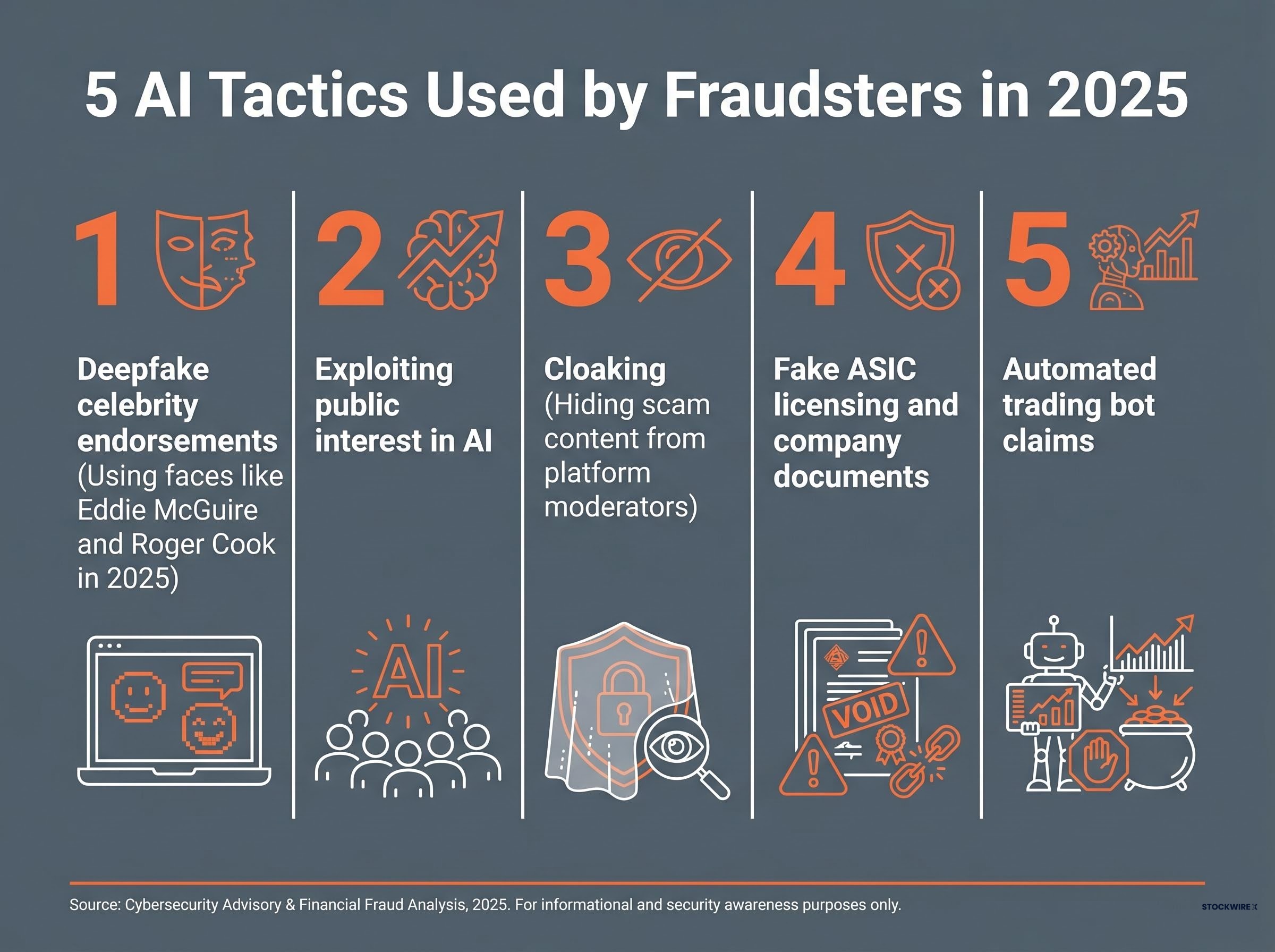
No single red flag check is sufficient any longer. The fraud works because it layers multiple AI-generated elements together, each designed to survive a different type of scrutiny. The following tactics have all been documented in Australia in 2025.
Deepfakes and fabricated endorsements
- Deepfake celebrity endorsements. AI-generated video content places the faces and voices of prominent Australians into fabricated investment advertisements. A March 2025 deepfake video of Eddie McGuire appeared in investment scam promotions. In November 2025, a deepfake of Western Australian Premier Roger Cook followed the same pattern. These videos are distributed through social media advertising, where they reach audiences already primed to trust recognisable public figures.
- Exploiting public interest in AI itself. Scam promotions frequently capitalise on growing curiosity about artificial intelligence by making misleading claims about the ease and speed of generating AI-powered investment returns. The technology is simultaneously the tool and the sales pitch.
Cloaking, fake licences, and bot claims
- Cloaking. This is a technique where scam advertisements display different content depending on who is viewing them. Platform moderators reviewing the ad may see compliant content, while targeted users in specific locations or on specific devices see the scam promotion. In plain terms, cloaking lets fraudulent ads survive the review process that is supposed to catch them.
- Fake ASIC licensing and company documents. Some scams falsely assert they are certified or licensed by ASIC. Fraudsters produce fabricated company registration certificates citing Australian company numbers that belong to unrelated entities. These documents exploit the trust consumers place in regulator branding.
- Automated trading bot claims. Scam promotions frequently assert that AI-powered trading bots can reliably generate passive income with minimal effort.
ASIC has stated that automated trading bots generating reliable passive income as advertised are very unlikely to exist.
AI-powered trading bots are a recurring feature in scam promotions precisely because retail investors have limited visibility into how legitimate algorithmic trading systems actually behave; the opacity that makes real AI trading tools difficult to audit is the same property fraudsters exploit when making performance claims that cannot be independently tested.
Each tactic is designed to address a different objection a cautious investor might raise. Together, they form a layered deception that can withstand surface-level due diligence.
What Australian investors have lost, and who is most at risk
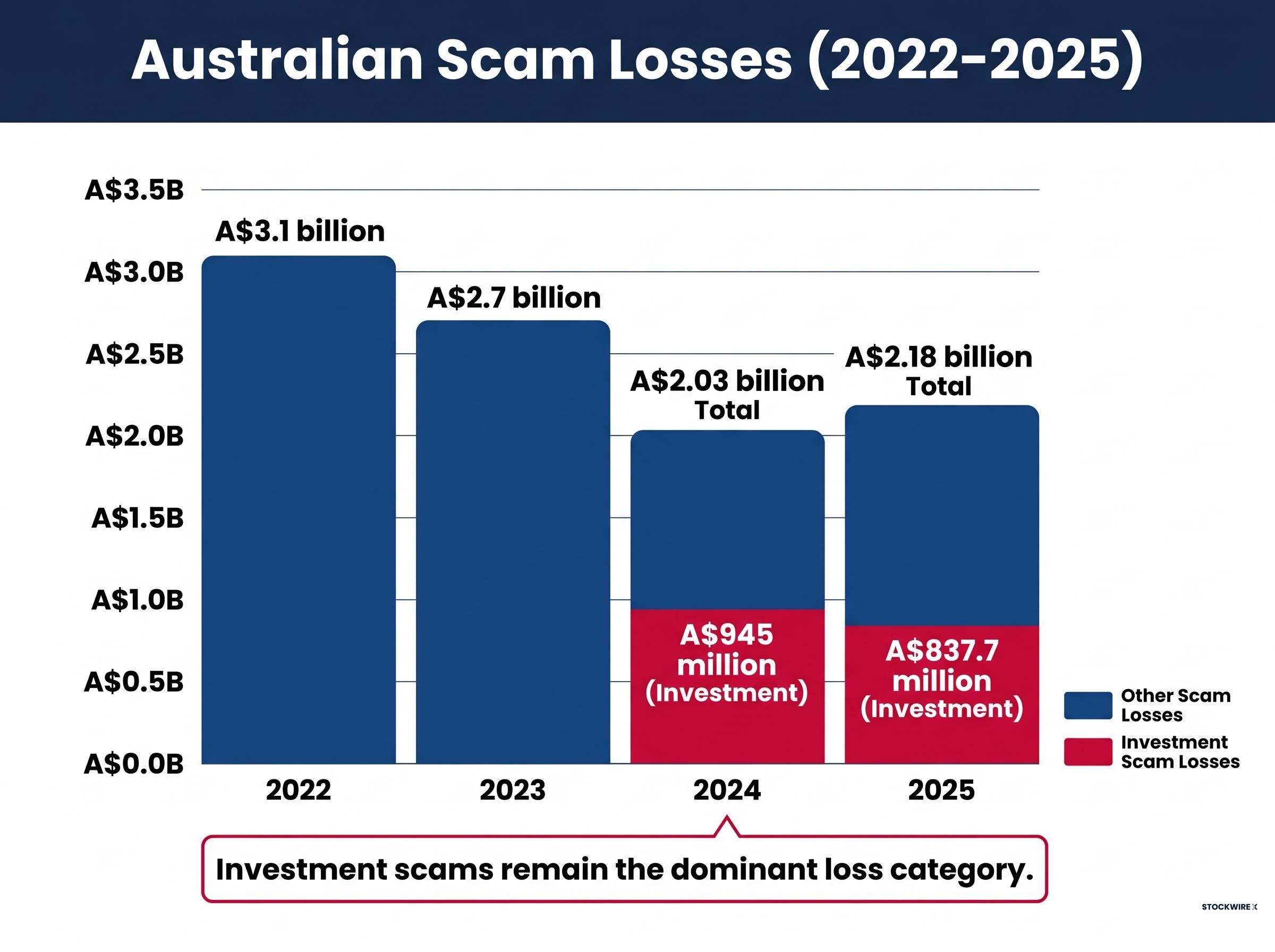
The financial scale of this problem is not abstract. National scam loss data across 2022-2025 shows both the magnitude and the trajectory.
| Year | Total Scam Losses | Investment Scam Losses | Year-on-Year Change (Total) |
|---|---|---|---|
| 2022 | A$3.1 billion | — | Peak year |
| 2023 | A$2.7 billion | — | Decline |
| 2024 | A$2.03 billion | A$945 million | -25.9% |
| 2025 | A$2.18 billion | A$837.7 million | +7.8% |
Investment scams remained the largest single loss category in every reporting year. These figures draw from combined data across Scamwatch, ReportCyber, IDCARE, AFCX, and ASIC.
Behind the aggregate numbers, a significant proportion of these losses involve retirement savings, according to reporting from the National Anti-Scam Centre. Funds lost to these schemes frequently move to criminal networks operating overseas, making recovery extremely unlikely once money is transferred. The trajectory reversed in 2025, with total scam losses rising 7.8% after two years of decline. Investment scams, despite a nominal decrease from 2024, remain the dominant loss category by a wide margin.
How to tell a legitimate investment from an AI-generated scam
Recognising the threat is the first step. The second is knowing exactly what to check before committing any funds. The following verification steps are concrete actions available to any Australian investor today.
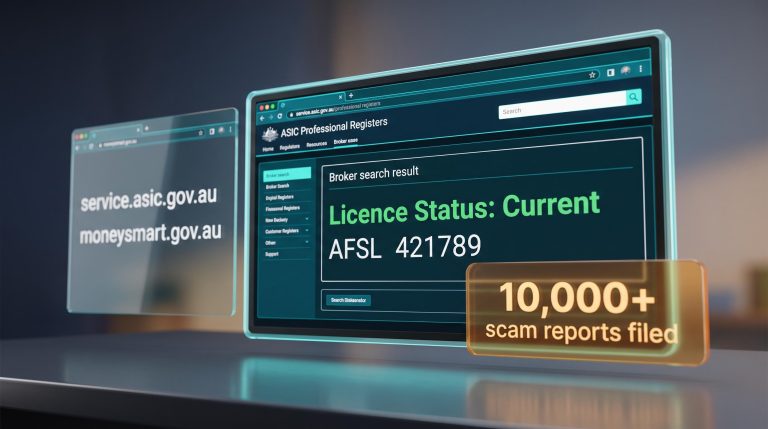
- Verify the Australian Financial Services (AFS) licence. This is the single most important protective action. Visit the ASIC website directly and search for the provider’s AFS licence number. Do not rely on licence numbers displayed on the provider’s own website or social media profiles. These can be fabricated or copied from unrelated entities.
AFS licence verification through ASIC’s register is the most reliable protective step available to retail investors, but the register also reflects ongoing maintenance activity: ASIC cancelled or suspended 215 AFS licences in FY2024-25, meaning a licence number that appears valid today may reflect an entity that has since ceased operating or had its authorisation removed.
- Check the Moneysmart investor alert list. ASIC’s Moneysmart website maintains a list of investments suspected of being fraudulent, unlicensed, or scam-related. This is a free, underused resource that gives Australians a direct way to check whether a specific opportunity has already been flagged.
ASIC’s Moneysmart investor alert list is a free, regularly updated resource that allows Australian investors to check whether a specific opportunity has already been flagged as suspected fraud, fabricated, or operating without a valid licence.
- Independently search the promoter. Search for the company name, the individuals named, and the specific product being offered using a general search engine. Look for independent coverage, regulatory actions, or consumer warnings. Do not rely solely on the materials provided by the promoter.
- Assess urgency and pressure tactics. Scammers deliberately create time pressure, such as limited-time offers, exclusive access windows, or claims that returns will diminish if the investor does not act immediately. These are friction-removal tools designed specifically to prevent the verification steps above from being completed.
ASIC urges consumers not to provide personal or financial details to any provider encountered through social media unless that provider’s AFS licence has been independently verified.
One additional point warrants emphasis. Company registration is available to check for free through ASIC, but registration alone does not constitute ASIC endorsement or a guarantee of quality. A registered company can still operate fraudulently.
What ASIC and Australia’s regulators are doing about it
Regulators have escalated their response to AI-enabled investment fraud, and the scale of that escalation is genuine. Whether it is sufficient is a separate question.
- ASIC removed 11,964 phishing and investment scam websites in 2025, a 90% increase from the prior year
- ASIC removed more than 1,100 online investment scam advertisements during the same period
- The 2025 Scams Prevention Framework legislation established broader anti-scam obligations across industry, representing the most significant structural legislative change in this area
- On 8 May 2026, ASIC issued an open letter to financial services firms calling for immediate strengthening of cyber resilience against frontier AI threats
ASIC Commissioner Alan Kirkland has noted that frontier AI increases the scale and speed of attacks on the financial services sector. The May 2026 open letter urged firms not to wait for clearer regulation and to act immediately on their existing obligations.
These measures represent meaningful institutional action. At the same time, no regulatory measure has been identified that specifically classifies or targets AI-generated investment fraud as a separate category. Cloaking and other evasion techniques mean some scam content continues to survive platform moderation, even after the significant increase in takedown activity. The speed of AI-enabled fraud creation continues to outpace the speed of institutional response, which is precisely why individual verification remains the most reliable first line of defence.
What to do if you think you have already encountered one
If an investment opportunity now looks suspicious, or if financial details or funds have already been shared, speed matters more than certainty. The following steps should be taken in order.
- Contact your bank immediately. If financial information has been shared or funds transferred, call the bank’s fraud line without delay. Fund recovery windows close quickly once transfers are processed, and early contact maximises the chance of intervention.
- Report to Scamwatch. File a report at scamwatch.gov.au. This is not just an administrative step. Each report contributes to the data that helps regulators identify and shut down active scam operations, protecting other Australians.
- Check the Moneysmart investor alert list. For anyone still uncertain whether a contact was legitimate, ASIC’s Moneysmart alert list provides information on investments already flagged as suspected fraud.
- Contact IDCARE for identity support. If personal identity documents or details were shared, IDCARE provides free, national identity and cyber support services to help manage the risk of identity misuse.
One point bears emphasis. Scammers deliberately build trust and rapport over time. Having engaged with a scam does not reflect financial naivety; it reflects the effectiveness of professionally crafted deception. Hesitating to seek help only extends the window in which further losses can occur.
Protecting your money in an era where scams look real
AI has removed the visual and textual cues that once allowed consumers to spot scams at a glance. A polished website, a convincing video endorsement, and a plausible licensing document no longer provide any assurance. Verification processes are now non-optional, not precautionary.
The protective mindset reduces to two commitments: independently verify before acting on any investment opportunity, and report if something feels wrong, even if certainty is lacking.
ASIC’s escalating enforcement and the 2025 Scams Prevention Framework legislation represent meaningful progress. The 90% increase in scam website takedowns and the May 2026 open letter to financial services firms signal genuine institutional urgency. But the pace of AI development means that new scam content is generated faster than regulators can remove it. Individual vigilance remains the most reliable first line of defence.
The two most practical next steps: visit ASIC’s Moneysmart website to verify any opportunity and check the investor alert list, and report suspicious activity to Scamwatch at scamwatch.gov.au. Consider sharing these warning signs with family members who may be less familiar with how convincing these scams now appear.
For investors who want to stress-test their broader decision-making habits alongside scam awareness, our dedicated guide to common investing mistakes in Australia examines six documented error patterns including how social media tips function as exit signals for earlier participants, why leveraged products produce net losses for 68% of retail CFD clients, and where free regulator-endorsed educational resources sit relative to paid courses.
This article is for informational purposes only and should not be considered financial advice. Investors should conduct their own research and consult with financial professionals before making investment decisions.