
When investors think about AI disrupting established platforms, the usual script involves nimble start-ups outflanking slow-moving incumbents. REA Group is not following that script. The company behind realestate.com.au has turned inward, training 90% of its Australian workforce on AI, tripling the searchable surface area of its property listings in six months, and feeding a 30-year proprietary dataset into tools that no competitor can easily replicate.
The result is a company that looks less like an incumbent bracing for disruption and more like the one doing the disrupting, from within its own walls.
Here is a structured assessment of whether REA Group’s AI capabilities amount to a durable competitive advantage or a well-packaged capability announcement. The evidence covers five distinct domains, from internal culture to mortgage broking, and the goal is to give you a framework for evaluating the substance behind the strategy.
From property portal to AI-native organisation
REA has declared a clear strategic goal of making AI central to everything it does. Rather than treating AI as a product feature confined to an innovation team, the company has positioned it as fundamental to how the organisation operates across all functions.
The numbers behind that ambition are worth separating into three layers:
- Training penetration: 90% of Australian staff have been trained to use AI at a foundational level, establishing fluency as a baseline competency rather than a specialist skill.
- Internal AI assistant: Around 90% of employees globally use the company’s internal AI assistant on a regular basis, suggesting the tools have cleared the adoption friction that stalls most enterprise programmes.
- The “zombie hunt”: An internal initiative where staff nominate routine, repetitive tasks from their day-to-day workflows to be automated by AI and removed from their workload. A recent round saw the tax team take out the top prize.
The distinction between training and usage matters here. Plenty of large organisations can report high training completion rates. The 90% regular usage figure for the internal assistant is the more meaningful signal, because it tells you REA has moved past the deployment stage and into sustained behavioural change. For investors, that reduces one of the most common failure modes in technology transformation: expensive tooling that the workforce does not actually use.
Enterprise AI deployment at Australian incumbents is following a consistent pattern: a shared platform anchored by a major cloud partnership, cross-divisional rollout prioritising highest-volume workflows first, and commercial payoff measured over a multi-year horizon rather than a single reporting period, a cadence visible in Wesfarmers’ programme as much as REA’s.
McKinsey’s 2025 State of AI survey found that 88% of organisations use AI in at least one business function, but sustained workforce-level adoption at the rate REA reports remains markedly less common, making the internal usage figures a meaningful signal rather than a routine benchmark.
When big ASX news breaks, our subscribers know first
Tripling the search index: how conversational AI is changing property discovery
REA used AI to make images, text, and agent-provided attributes fully searchable, tripling the size of its search index in six months.
That expansion is not a minor product update. It represents a structural change in what a property portal’s inventory actually is. The traditional approach to property search relied on structured fields: price bands, bedroom counts, geographic boundaries. That checkbox-driven model indexed only a slice of the information contained within any given listing, leaving the majority of a property’s attributes invisible to search.
REA’s AI now makes the rest searchable. Architectural style visible in photos. Layout details mentioned in agent descriptions. Neighbourhood attributes. The platform moved from indexing structured data to indexing meaning, and the shift happened in six months.
The company ran a 12-month trial of natural-language querying before broader rollout, allowing users to describe what they want in conversation rather than clicking through filters. The conversational AI draws exclusively on REA’s own data, not general web sources. That constraint doubles as a competitive defence: the quality of the search experience is directly proportional to the depth of REA’s proprietary dataset, creating a self-reinforcing loop that is hard for a competitor to replicate without comparable data.
Separately, REA launched a ChatGPT app that lets logged-in users search realestate.com.au listings inside the ChatGPT interface. The feature set includes:
- Map-based results with up to seven photos per listing
- Pricing, agent details, and listing descriptions
- Iterative conversational refinement of search criteria
- Save and click-through actions to the full listing
That is a deliberate bet on meeting users wherever they search, not just on REA’s own platform.
What AI actually does inside a mortgage brokerage
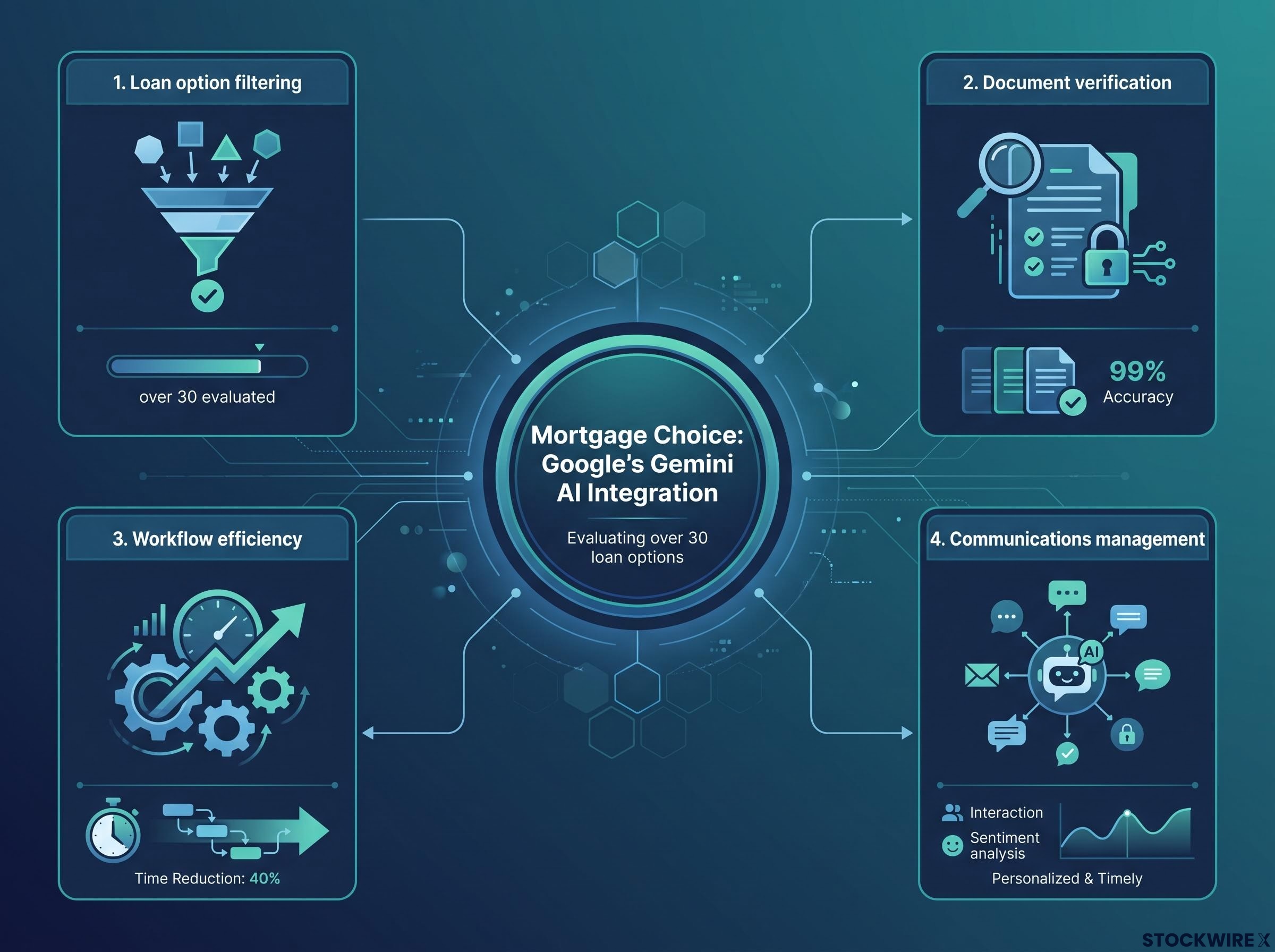
A mortgage broker assessing a borrower’s options faces a specific kind of information overload. Mortgage Choice, REA’s broking arm, presents brokers with over 30 loan options to evaluate for any given borrower. Working through those options, each carrying different lender policies and eligibility conditions, across an entire client base represents a significant burden on broker time and attention.
Google’s Gemini agentic AI is now deployed within Mortgage Choice to address those specific pain points. The AI’s roles within the brokerage workflow include:
- Loan option filtering: Using borrower circumstances to identify which of the 30-plus products are actually worth considering
- Document verification: Reviewing submitted paperwork to confirm it meets lender requirements before submission
- Workflow efficiency: Streamlining repetitive administrative processes
- Communications management: Handling routine correspondence and data entry
For readers thinking about REA’s revenue opportunity, AI-assisted broking is not purely a cost-reduction play. It is about enabling each broker to handle a larger client base without a drop in service quality, which directly affects Mortgage Choice’s throughput and REA’s share of the financial services leg of the property transaction. Embedding AI into this workflow ties REA more deeply into the transaction that follows most property decisions, widening revenue surface beyond listing fees and advertising.
The 30-year data advantage that makes REA’s AI harder to replicate
To understand why REA’s AI programme may prove durable, you need to understand what a proprietary data moat means in an AI context. A data moat is a dataset that a competitor cannot access, purchase, or reconstruct in a reasonable timeframe, and that improves the quality of AI models trained on it. The important word is “proprietary”: publicly available data, no matter how large, does not create a moat because anyone can train on it.
Proprietary data moats are the defining characteristic separating durable AI winners from companies whose advantage evaporates when a better-funded rival deploys a larger model, a distinction that applies directly to why REA’s 30-year dataset matters more than any specific model it runs on top of that data.
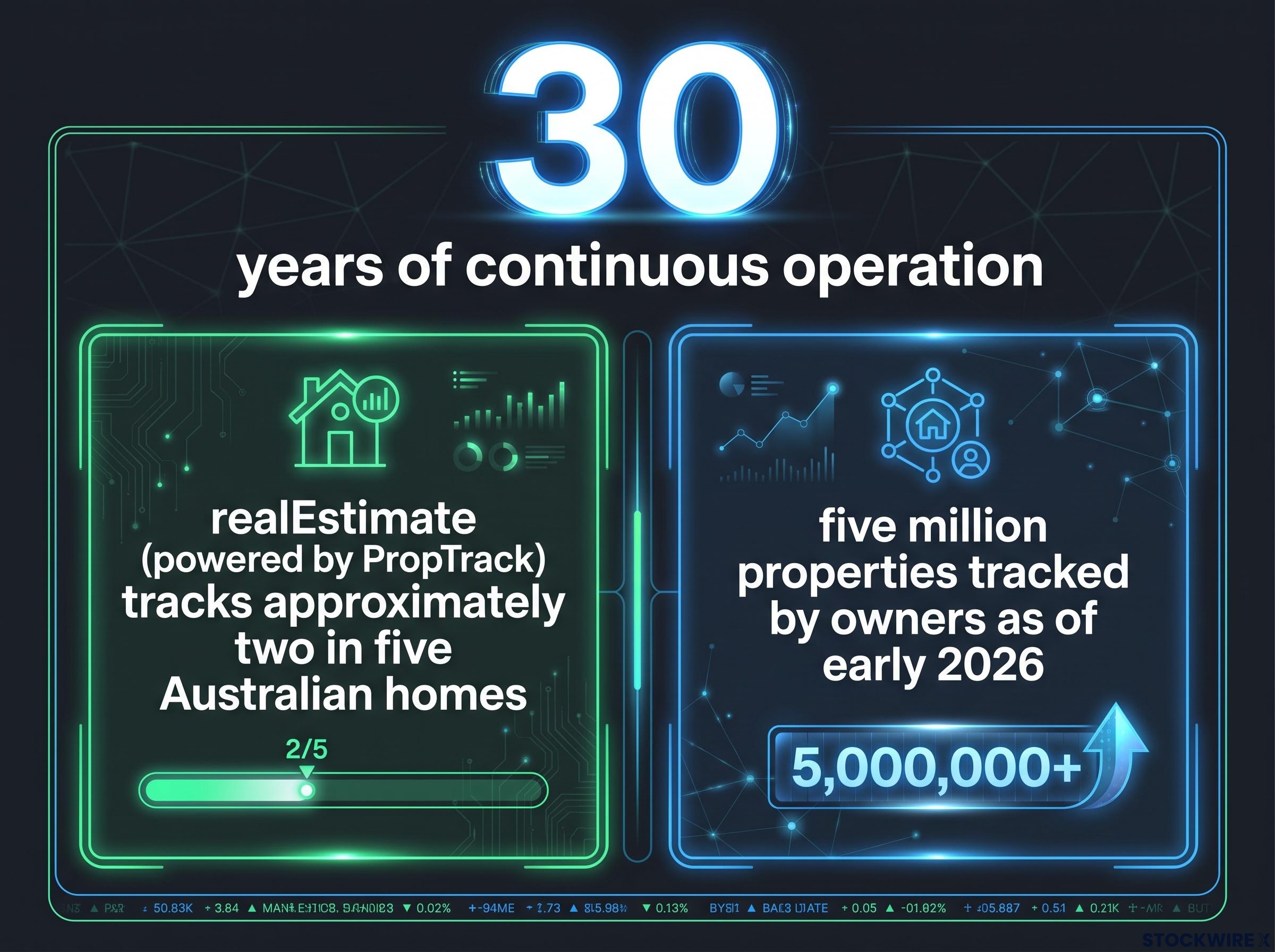
REA’s dataset is built on three decades of continuous operation within a single domain, making it both highly concentrated and extraordinarily granular in its coverage of Australian property. It spans approximately 30 years of continuous operation in a single domain, covering:
- Property content (listings, descriptions, agent-provided attributes)
- Consumer behaviour (search patterns, saved properties, engagement signals)
- Valuations (the realEstimate automated valuation model, powered by PropTrack)
- Imagery (photos, floor plans, visual attributes tagged by AI)
- Lifestyle context (neighbourhood characteristics, social dimensions)
The scale of coverage is substantial. realEstimate tracks approximately two in five Australian homes, with five million properties tracked by owners on realestate.com.au as of early 2026. That longitudinal view of property values, demand patterns, and owner behaviour is not something a new entrant can assemble quickly.
REA has also invested deliberately to extend this data advantage beyond organic growth:
| Company | Domain | Stake/Status | Strategic Rationale |
|---|---|---|---|
| Jitty | UK AI property portal (LLMs, computer vision, natural language search) | 10% stake | Accelerate AI search capabilities |
| Planitar (iGuide) | AI-driven 3D floorplan visualisation | 61.5% majority stake | Enhanced property imagery and immersive visual experiences |
| Neighbourlytics | Lifestyle and neighbourhood data | Acquired outright, late 2025 | Deepen contextual and lifestyle data layer |
| Arealytics | Commercial real estate data | Investment (unverified) | Extend coverage to commercial property segment |
Because REA’s 30-year dataset sits entirely outside the public domain, it cannot be reproduced by a new entrant or a well-funded rival within any practical timeframe. That inaccessibility is the quality that gives the data its competitive weight: AI trained on information a competitor cannot obtain improves with each advance in model capability, compounding the gap rather than closing it.
Why REA’s AI strategy reinforces its market position rather than reinventing it
Step back from the individual capabilities and the strategic pattern becomes clear: every AI initiative REA has deployed connects to a pre-existing strength. Conversational search amplifies an already dominant audience. AI-powered valuations deepen an already unmatched dataset. Broker AI augments an already established financial services arm. Internal automation compounds the productivity of an already AI-literate workforce.
The cumulative effect is a set of advantages that are mutually reinforcing rather than independently fragile. Three loops are doing the work:
- Audience feeds data: Dominant consumer traffic and listing coverage generate the behavioural and content data that trains better AI models.
- Data feeds experience: Richer proprietary data enables more accurate search, better valuations, and more personalised recommendations.
- Experience feeds audience: Superior AI-powered experiences deepen user engagement and strengthen REA’s value proposition to agents, which attracts more listings and more traffic.
This reinforcing loop logic matters because it means REA’s AI advantage is not a point-in-time technology lead that a better-funded competitor can close with a larger model spend. It is a compounding structural advantage tied to proprietary data and audience scale that takes years to replicate, if it can be replicated at all.
REA Group’s valuation has attracted significant debate among covering brokers, with eight of twelve rating the stock a Buy even as the share price sits well below its 52-week high, a divergence that reflects macro multiple compression rather than any deterioration in the underlying business fundamentals this AI programme is designed to strengthen.
That said, the strategy has blind spots. A competitor with materially deeper pockets could attempt to replicate the search product without comparable data depth. Shifts in consumer behaviour that bypass portals entirely, such as social-media-driven property discovery or agent-direct platforms, would undercut the audience leg of the loop. The reinforcing logic holds only as long as all three legs remain strong.
How far REA has come, and what remains to be proven
REA’s AI programme has cleared several high bars that most enterprise AI strategies never reach. Organisational adoption at scale is demonstrated, not aspirational. The search index expansion is measurable. The external investments in data and visualisation are committed capital, not letters of intent.
What remains emerging is the commercial payoff. The long-term impact of conversational search on consumer behaviour is still being measured. The full revenue contribution of AI-assisted broking through Mortgage Choice has not yet been proven at scale. The distinction matters: AI as a capability embedded in operations is largely evident from the evidence; AI as a monetisation engine is a forward bet on conversion and engagement that has not been fully demonstrated.
Xero’s AI-driven revenue model offers a comparable case study in how Australian technology companies are attempting to convert AI capabilities into measurable ARPC expansion, with XeroForce’s usage-based pricing tier representing a direct monetisation mechanism that REA has not yet replicated within its own AI product suite.
Three variables are worth monitoring to assess whether the strategy is delivering on its promise:
- Conversational search engagement: Time on site, query depth, and conversion rates from natural-language search versus traditional filter-based search
- Mortgage Choice conversion capacity: Whether AI-assisted broking translates into measurably more borrowers served per broker and higher completion rates
- realEstimate coverage expansion: The pace at which tracked properties grow beyond the current two-in-five benchmark, and whether AI improves valuation accuracy alongside scale
This is a strategically coherent programme with a credible data foundation. The financial payoff, however, is being built over a medium-to-long horizon. For investors, the right frame is not whether REA has an AI strategy, but whether the evidence of execution continues to accumulate in the quarters ahead.
This article is for informational purposes only and should not be considered financial advice. Investors should conduct their own research and consult with financial professionals before making investment decisions. Forward-looking statements regarding REA Group’s AI capabilities and their potential commercial impact are subject to change based on market developments and company performance.
—