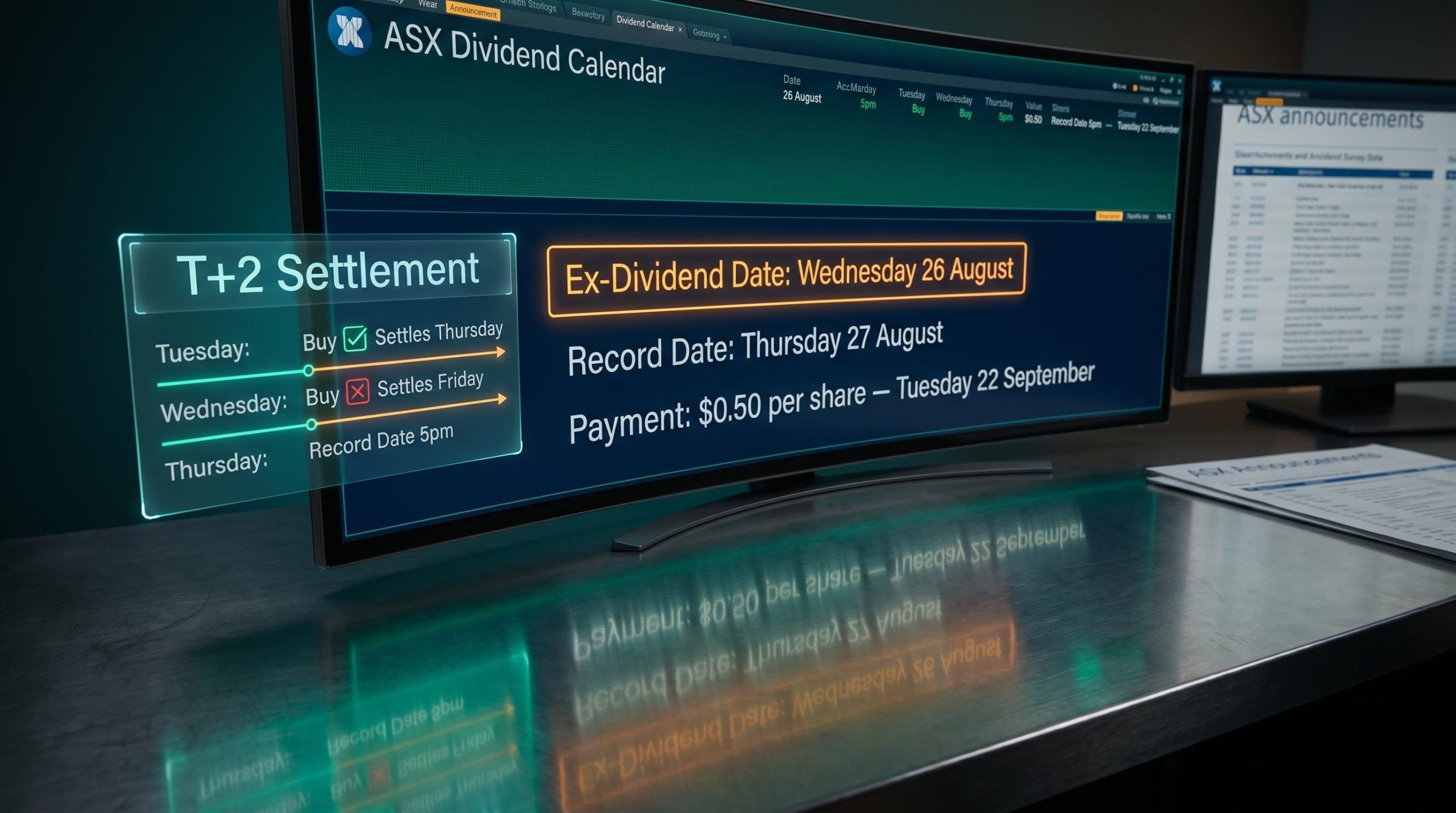
You buy shares in an ASX-listed company on the ex-dividend date, confident the next payment is weeks away and your timing is fine. Then the distribution lands, and your account shows nothing. The entitlement belonged to the seller, not you, and the difference between qualifying and missing out was a single trading day.
The confusion is not carelessness. The gap between the ex-dividend date and the record date is exactly one business day, and without understanding how ASX T+2 settlement works, the logic behind that gap is invisible. This is a mechanics problem, and it has a mechanical solution.
Here is the framework that makes ASX dividend dates permanently clear. After reading this, you will be able to find any ex-dividend date on a broker platform or the ASX announcements page, identify whether a planned trade qualifies you for the next payment, and make that call with certainty every time.
How an ASX dividend payment progresses through four distinct dates
Every ASX dividend moves through four dates in sequence. Each one exists because the previous one set something in motion, and the next one cannot happen without it. Here is what each date does:
- Declaration date: The board sets out the dividend, its size, and the three subsequent dates. This is informational only; owning shares on this date does not determine your entitlement.
- Ex-dividend date: The practical cut-off. From this date onward, shares change hands without the right to the upcoming dividend. If you buy before it, you qualify. If you buy on it or after, you do not.
- Record date: The company locks its share register (typically at 5pm) to establish who holds shares as a matter of record. This is the administrative checkpoint, one business day after the ex-dividend date.
- Payment date: The dividend reaches your account. This typically arrives 2-4 weeks after the ex-dividend date, though it can be up to one month after the record date.
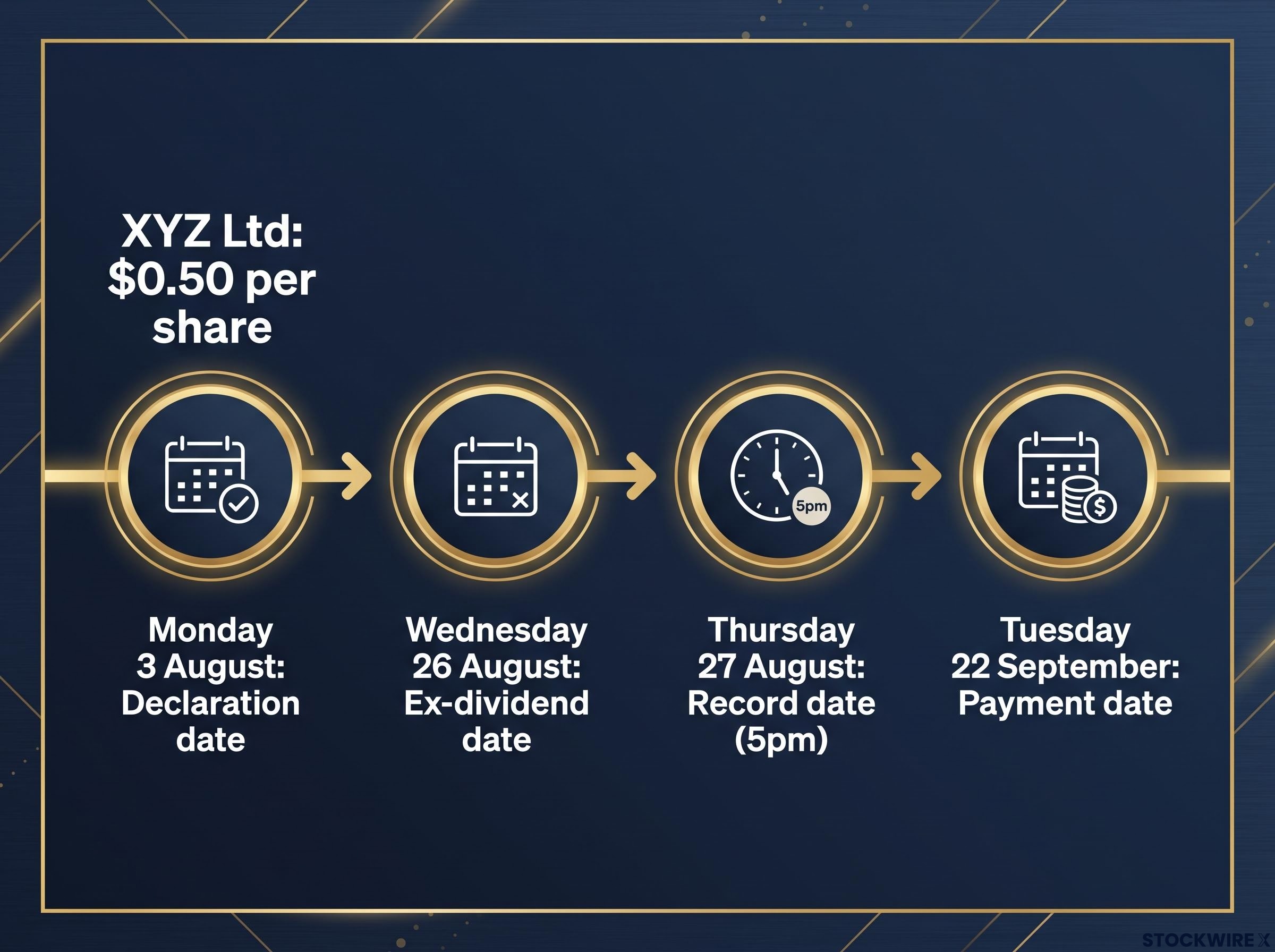
Here is how these dates look in practice for a hypothetical company, XYZ Ltd, paying a $0.50 per share dividend:
| Date | Event |
|---|---|
| Monday 3 August | Declaration date: dividend of $0.50 per share announced |
| Wednesday 26 August | Ex-dividend date: shares begin trading without the dividend |
| Thursday 27 August | Record date: shareholder register finalised at 5pm |
| Tuesday 22 September | Payment date: eligible shareholders receive $0.50 per share |
All four dates exist to answer one practical question: who legally owns the shares at the moment the register closes? The ex-dividend date is the only one you need to act on before that moment arrives. The record and payment dates are downstream consequences of that single cut-off.
When big ASX news breaks, our subscribers know first
The T+2 settlement rule that keeps the ex-dividend date and record date one business day apart
If the ex-dividend date is the cut-off and the record date is when ownership is confirmed, why are they not the same day?
The answer sits in how ASX trades actually settle. T+2 settlement means that when you buy shares, ownership is not formally transferred to you until two business days after the trade date. The day you click “buy” is not the day the company recognises you as a shareholder. Your name appears on the register only once settlement completes.
This creates a structural problem. Matching the ex-dividend date and the record date would mean any purchase made that morning had not yet cleared. Those buyers would be absent from the register at the moment it closed. The one-business-day gap is structured so that the final eligible purchaser, someone who buys the day before the ex-dividend date, completes settlement precisely on the record date.
| Day | Event | Settlement outcome |
|---|---|---|
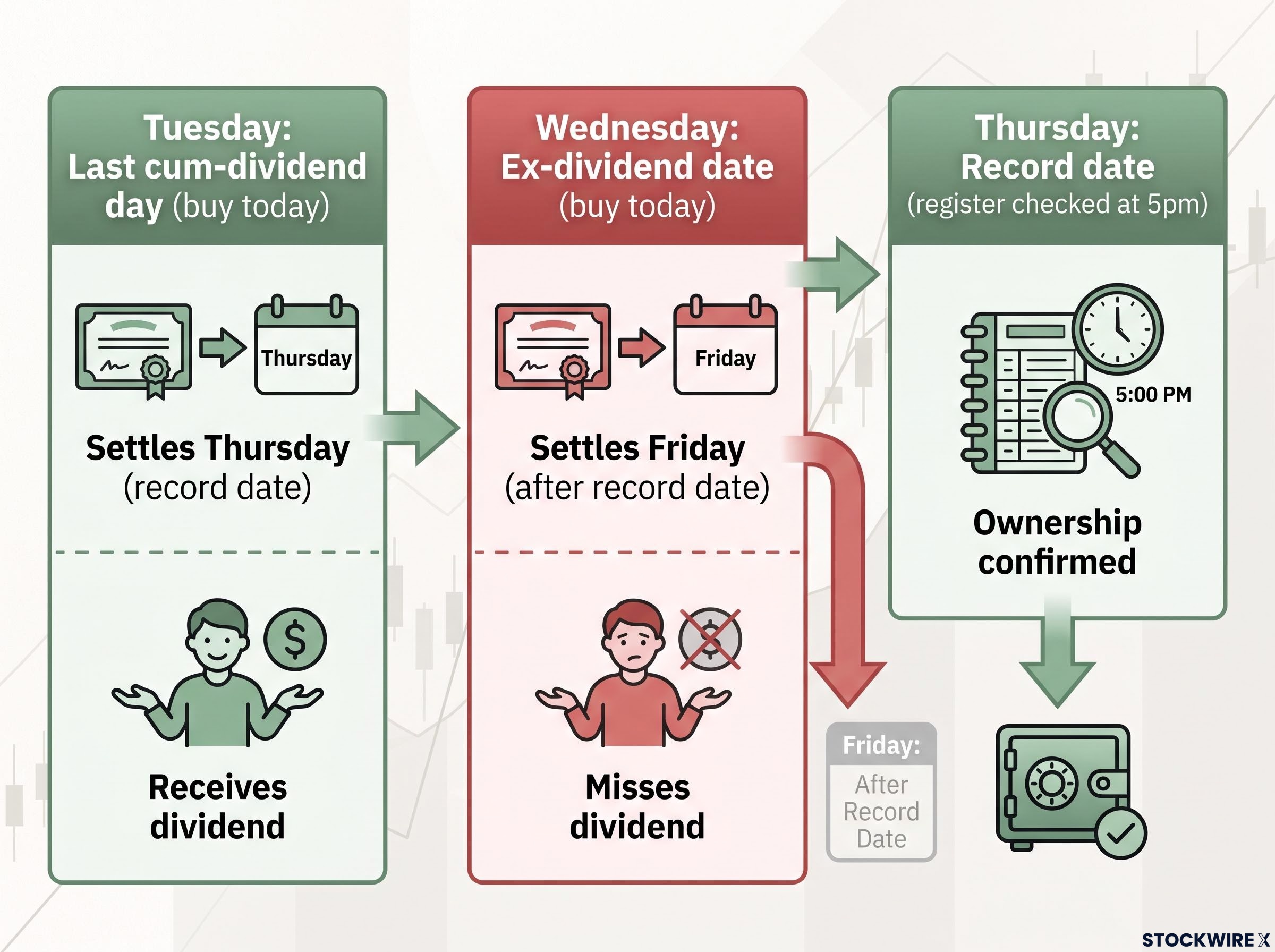
| Tuesday | Last cum-dividend day (buy today) | Settles Thursday (record date) ✅ Receives dividend |
| Wednesday | Ex-dividend date (buy today) | Settles Friday (after record date) ❌ Misses dividend |
| Thursday | Record date (register checked at 5pm) | Ownership confirmed for eligible holders |
The last day you can buy shares and still receive the dividend is the trading day before the ex-dividend date. That trade settles two business days later, landing on the record date, which is exactly when the company checks its register.
One note on older resources: some educational material describes the record date as falling two days after the ex-dividend date, reflecting previous settlement conventions. Current ASX timetables show a one-business-day gap. If you encounter a two-day reference, it is outdated. Certain overseas exchanges, the US and India among them, have moved to T+1 settlement, and that faster cycle produces dividend date conventions that differ somewhat from those used on the ASX.
For you, T+2 means one thing: the day you place a trade is not the day you become a shareholder of record. The business day before the ex-dividend date is your actual deadline.
What actually determines your entitlement: buy and sell scenarios
The mechanics make sense in theory. Here is how they play out in the four situations you are most likely to face:
- You buy before the ex-dividend date: you receive the dividend. Your trade settles two business days later, landing on or before the record date. Your name appears on the register, and you qualify for the payment.
- You buy on or after the ex-dividend date: you do not receive the dividend. Settlement occurs after the record date. The company does not recognise you as a shareholder for this dividend cycle, regardless of when the payment date falls.
- You sell before the ex-dividend date: you lose the dividend. The buyer’s settlement puts them on the register by the record date. Your entitlement transfers with the shares.
- You sell on or after the ex-dividend date: you still receive the dividend. This is the scenario that catches investors off guard. Your entitlement was locked in the moment the shares went ex-dividend. Even if you sell on that day, weeks before the payment date, the dividend still arrives in your account.
The counterintuitive rule: You can sell shares on the ex-dividend date and still receive the payment. Your entitlement is a snapshot taken at a specific moment in time, not something that tracks dynamically as your holding changes afterward.
That snapshot logic is what matters. Your entitlement is not determined by whether you still hold the shares on the record date or the payment date. It is determined by whether you held them before the ex-dividend date. Once that moment passes, the outcome is locked.
How ASX-listed ETFs handle distributions (and where the same rules apply)
If you hold ASX-listed ETFs alongside direct shares, the framework you have just learned applies identically. The terminology shifts, but the mechanics do not.
ETFs use “distributions” rather than “dividends” and “ex-distribution date” rather than “ex-dividend date.” All four stages run in the same sequence: declaration, ex-distribution, record, and payment. The same T+2 settlement rule governs the one-business-day gap between the ex-distribution date and the record date.
The three differences worth noting between ETF distributions and direct share dividends:
- Terminology: “Distributions” and “ex-distribution date” replace “dividends” and “ex-dividend date.”
- Distribution composition: ETF distributions draw from the income generated across the fund’s underlying assets, which may include company dividends, interest receipts, and realised capital gains from portfolio activity. Direct share dividends are simpler, coming from company profits.
- Franking credit pass-through: Many Australian equity ETFs pass through franking credits from the underlying companies they hold, reflecting corporate tax already paid on those profits.
Do franking credits work the same way in ETFs?
Franking credits are passed on to ETF investors, but the way they interact with personal tax returns is sufficiently complex that ASIC’s Moneysmart resource or a registered tax agent is the appropriate place to seek guidance. The mechanics of entitlement (buy before the ex-distribution date, settle by the record date) are identical. The tax implications are where professional advice adds genuine value.
For your income portfolio, the practical takeaway is consistent: one rule applies across all ASX-listed holdings, whether shares or ETFs. The ex-date is the date that counts.
Where to find ASX dividend dates and how to read a dividend calendar
Understanding the framework is half the task. Knowing where to find the dates makes it immediately useful.
Your three primary sources:
- ASX announcements platform: The official source. When a company declares a dividend, the announcement includes the ex-dividend date, record date, and payment date. All publicly listed on the ASX website.
- Broker ex-dividend calendar tools: Most broker platforms maintain calendars of upcoming ex-dividend dates for ASX stocks and ETFs. Platforms such as Selfwealth display dividend and distribution information alongside your holdings once the details have been officially published.
- Financial data services: Third-party financial data providers aggregate upcoming ex-dividend dates across the market, often with filtering and alert features.
You do not need to calculate dates manually. Once the ex-dividend date is published, T+2 logic gives you everything else. The record date is one business day later. The last day to buy and qualify is one business day before the ex-dividend date.
Know the ex-dividend date. Everything else follows from T+2.
That makes dividend calendar literacy a one-variable skill. Find the ex-dividend date, count back one trading day to identify your buy deadline, and the decision is made.
What the settlement mechanics mean for how you plan around income
Now that you understand the full framework, it is worth addressing the question it naturally raises: can you use this knowledge to time trades around dividend payments?
The short answer is that dividend capture strategies (buying just before the ex-dividend date and selling shortly after) rarely deliver a net benefit. Here is why:
- Price adjustment: When a share goes ex-dividend, its price tends to decline by roughly the value of the dividend, with the actual movement shaped by tax considerations and broader market activity. Any income received is therefore substantially cancelled out by the reduction in share price.
- Brokerage costs: Transaction fees on the buy and the sell eat into whatever theoretical gain remains.
- Bid-ask spreads: The difference between buy and sell prices adds a further layer of friction that erodes returns.
Research and broker education material consistently frame dividends as a component of long-term total return rather than a short-term timing opportunity. Keeping a regular investment cadence, holding shares via CHESS sponsorship so your ownership is accurately reflected on the register, and treating dividend yield as one element of total return rather than a target to chase will serve you better than engineering trades around the ex-dividend date.
The real value of understanding ASX dividend dates is defensive. You now know how to avoid accidentally missing an entitlement because you bought one day too late, or panicking about selling on the ex-dividend date and wondering whether you forfeited the payment. The framework protects your income stream by removing timing errors from the equation.
This article is for informational purposes only and should not be considered financial advice. Investors should conduct their own research and consult with financial professionals before making investment decisions.