Three ASX-listed thematic ETFs give Australian investors direct exposure to cybersecurity, robotics and AI, and gaming, three sectors projected to expand regardless of which individual companies dominate them. Their recent returns, however, tell very different stories.
Retail investor flows into HACK and RBTZ doubled in 2025 amid AI-driven enthusiasm, according to the Australian Financial Review (February 2026). Australian investors are actively weighing whether thematic ETFs belong alongside broad-market core holdings like A200 or VGS. The investment case for thematic funds rests on structural rather than cyclical demand, but the performance data reveals meaningful divergence across each theme.
What follows is a breakdown of three ASX-listed thematic ETFs, HACK, RBTZ, and ESPO, by investment thesis, holdings, recent performance, fees, and portfolio fit. The aim: a concrete, side-by-side comparison to support an informed allocation decision.
Why thematic ETFs work differently from broad-market funds
Thematic ETFs concentrate exposure in a single sector or megatrend rather than spreading across the whole market. That concentration amplifies both upside and downside relative to broad index funds, and it changes the role these products play in a portfolio.
The distinction that underpins each fund’s investment case is structural versus cyclical demand. Cybersecurity spending grows because digital infrastructure requires constant defence. Robotics adoption accelerates because labour shortages are permanent. These are not short-term economic tailwinds; they are fundamental shifts in how industries operate.
Three characteristics define thematic ETFs:
- Concentrated exposure to a single sector or megatrend
- Structural demand thesis driven by long-term shifts, not economic cycles
- Higher volatility relative to diversified index funds
According to Firstlinks (April 2026), thematic ETFs carry a standard deviation of approximately 25%, compared with approximately 15% for broad-market equivalents.
Australian financial media, including Livewire Markets (March 2026), consistently frames thematic ETFs as satellite holdings of 5-10% of a portfolio. They sit alongside core positions, not in place of them. That framing matters for how the fund-by-fund analysis below should be read.
When big ASX news breaks, our subscribers know first
HACK: owning the companies that defend the internet
Cybersecurity has shifted from optional IT expenditure to non-negotiable business infrastructure. Cloud migration, digital payment reliance, and regulatory mandates are driving demand. The EU’s Cyber Resilience Act, enforced in January 2026, mandates software security standards across European markets, with IDC (March 2026) estimating a 20% year-on-year increase in compliance spending.
HACK holds approximately 40-50 companies, heavily concentrated in the United States (90.8%), with smaller allocations to Israel (2.6%), Canada (2.0%), France (1.9%), and India (1.6%). Key holdings include CrowdStrike, Palo Alto Networks, Cisco, Okta, and Fortinet. The fund tracks the Nasdaq CTA Cybersecurity Index and pays semi-annual distributions (69.37 cents per unit in H1 2026, unfranked).
| Metric | HACK |
|---|---|
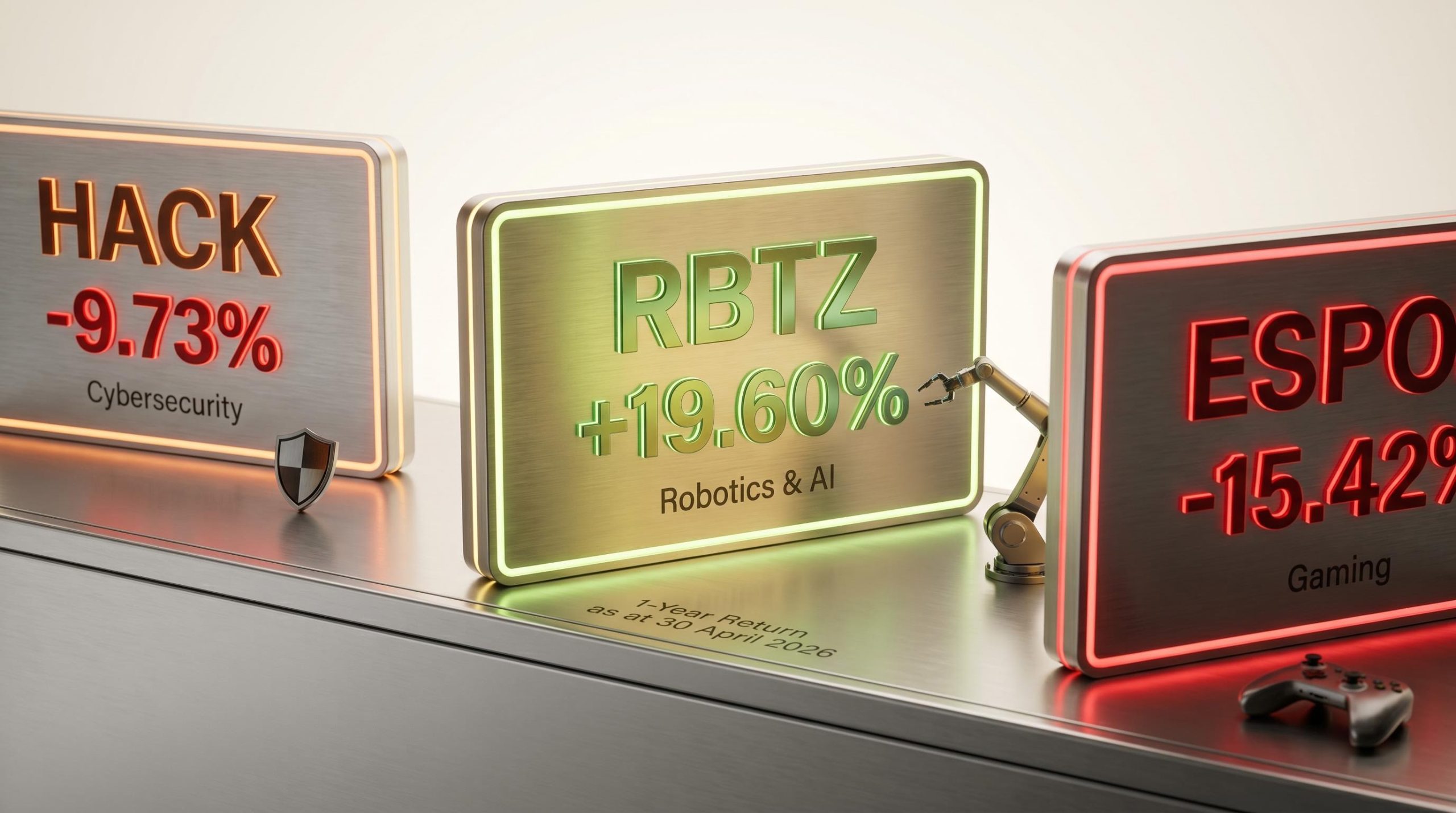
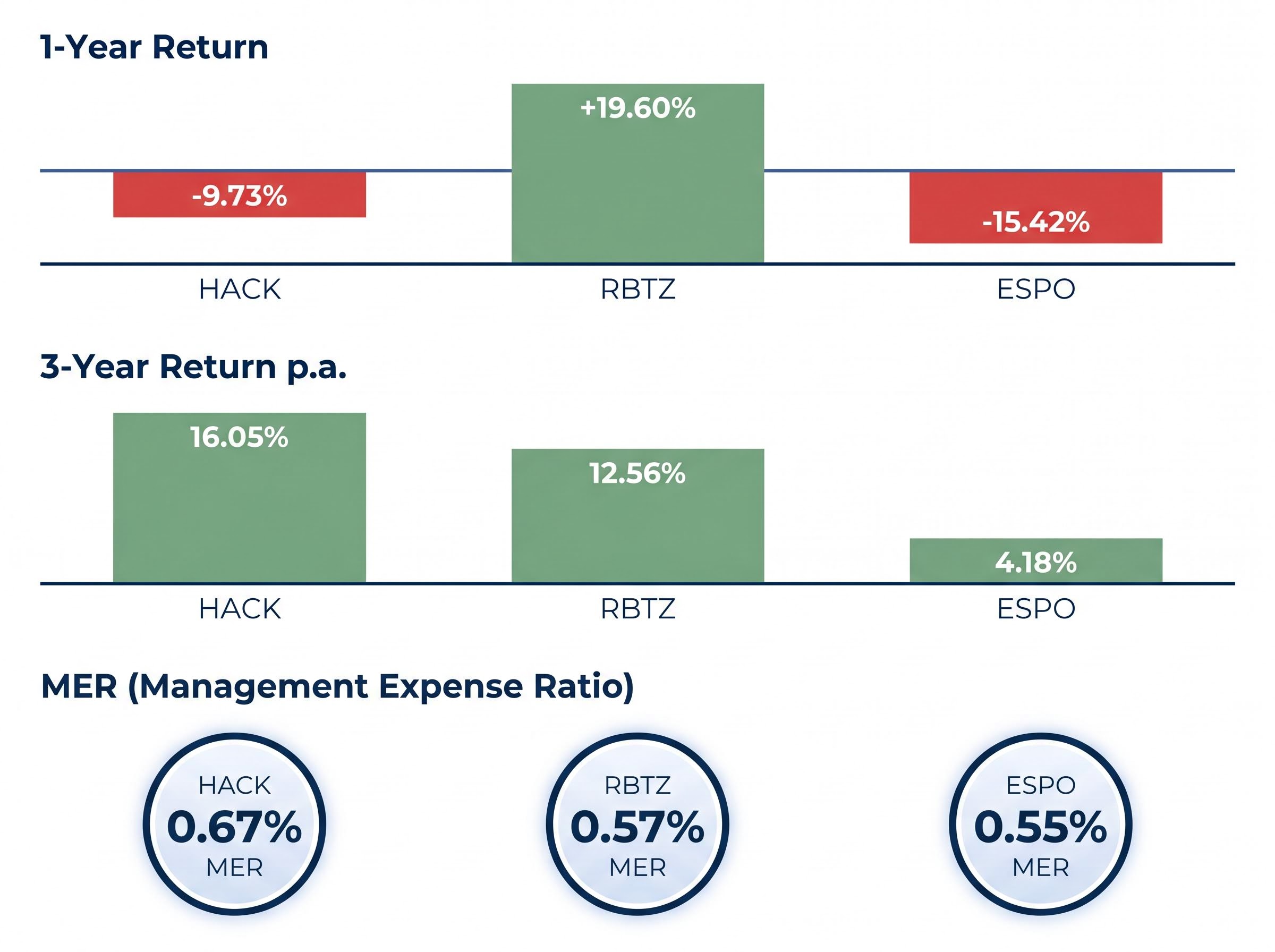
| 1-year return | -9.73% |
| 3-year return p.a. | 16.05% |
| Since-inception return p.a. | 14.85% |
| MER | 0.67% p.a. |
| Top geography | United States (90.8%) |
The one-year return of -9.73% (as of 30 April 2026) reflects broader tech sector pressure rather than a deterioration in the cybersecurity spending thesis. Set that figure against the fund’s track record since inception in August 2016: 14.85% annualised over nearly a decade.
HACK’s since-inception return of 14.85% p.a. over almost ten years remains the strongest long-term compounding record of the three funds profiled here.
That tension, a difficult recent year against a decade of compounding, is the honest picture. The structural demand for cybersecurity has not weakened. The short-term return reflects sector rotation, not a broken thesis.
RBTZ: betting on the machines taking over
RBTZ delivered a one-year return of +19.60% as of 30 April 2026, the strongest short-term result of the three funds. The thesis is broad: automation spreading across manufacturing, healthcare, logistics, and AI-driven decision-making, driven by labour shortages, cost pressure, and efficiency demands.
Industrial robotics installations reached approximately 542,000 units in 2024, more than double the figure from a decade prior, according to the IFR World Robotics Report (2025). AI integration is now present in approximately 45% of manufacturing operations, per McKinsey (Q1 2026). BetaShares (April 2026) noted that structural tailwinds from generative AI continue to underpin the fund’s thesis.
The fund holds up to 100 companies across the robotics and AI supply chain, including Intuitive Surgical, Keyence, and ABB. Its four core sectors illustrate the breadth of the theme:
AI theme stock selection carries the same fundamental problem that defined the dot-com era: being correct about a transformative technology does not mean correctly identifying which companies capture the majority of the value, a distinction that explains why diversified robotics and AI ETFs like RBTZ are structured to own the whole supply chain rather than bet on individual winners.
- Industrial robotics
- Surgical robotics
- AI hardware
- Autonomous systems
The MER sits at 0.57% p.a., and the three-year annualised return is 12.56%.
Understanding RBTZ’s geographic risk profile
What separates RBTZ from most ASX-listed tech ETFs is its geographic composition. The United States accounts for 29.4%, Japan for 29.3%, China for 22.0%, and Switzerland for 9.3%. Japan plus China alone represent over 50% of the fund.
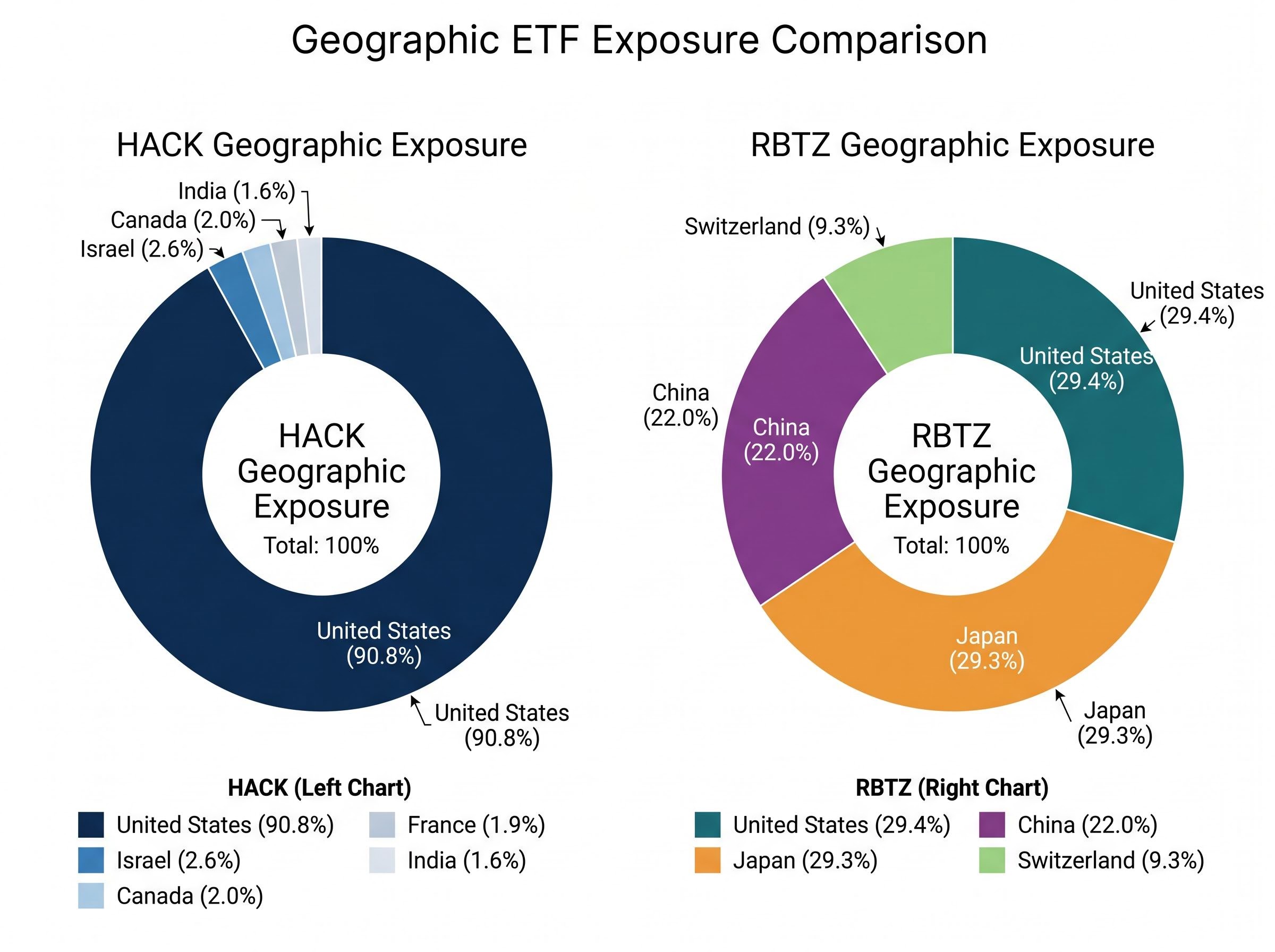
That Asia-heavy weighting is both a diversification advantage and a concentration risk. Currency exposure spans the US dollar, Japanese yen, Chinese yuan, and Swiss franc simultaneously. All three funds profiled here are unhedged, but RBTZ’s multi-currency sensitivity is materially more complex than HACK’s near-total US dollar exposure.
China’s 22% weighting introduces geopolitical risk that Australian investors should factor into position sizing, particularly given ongoing US-China trade tensions. The fund’s outperformance is real, but it comes with a geographic complexity that broad-market ETFs do not carry.
ESPO: the gaming thesis with the hardest recent record to defend
Gaming is one of the world’s largest entertainment sectors by revenue. Structural growth drivers remain intact: live-service model adoption, esports viewership expansion (approximately 700 million viewers globally), and IP monetisation across film, merchandise, and streaming. Mobile and live-service games drove approximately 55% of total gaming revenue in 2025.
ESPO holds pure-play gaming names including Nintendo, Electronic Arts, and Tencent. Its benchmark, the MVIS Global Video Gaming and eSports Index, requires companies to derive more than 50% of revenue from gaming or esports, filtering out diversified tech conglomerates. The MER is 0.55% p.a., the lowest of the three funds.
The performance data is where the case becomes harder to make. A one-year return of -15.42% (as of 13 May 2026) and a three-year annualised return of 4.18% make ESPO the weakest performer across both timeframes. Approximately 10,000 studio-level layoffs across the gaming industry in 2025 weighed on sentiment and valuations. The AUD-denominated version has also underperformed the USD-listed ESPO due to dollar strength, amplifying losses for Australian holders.
ESPO’s 52-week range: A$15.11 to A$22.35. The fund currently trades at A$15.87, near the bottom of that range, reflecting the sector’s difficult year.
| ETF | 1-year return | 3-year return p.a. | MER | Benchmark |
|---|---|---|---|---|
| HACK | -9.73% | 16.05% | 0.67% | Nasdaq CTA Cybersecurity Index |
| RBTZ | +19.60% | 12.56% | 0.57% | Indxx Global Robotics & AI Thematic Index |
| ESPO | -15.42% | 4.18% | 0.55% | MVIS Global Video Gaming and eSports Index |
ESPO’s lowest fee and genuine long-term growth story may still appeal to investors with a multi-year horizon. But the three-year return of 4.18% p.a. demands an honest assessment of whether gaming’s structural drivers have stalled or are merely delayed.
How to fit thematic ETFs into an Australian portfolio
The fund-by-fund data is only useful if it translates into an allocation decision. Australian financial media and fund providers consistently position thematic ETFs as satellite holdings, sitting alongside broad-market core positions like A200, VAS, or VGS rather than replacing them. Both VanEck and BetaShares advised this approach in commentary reported by the AFR (February 2026).
Building a core ASX ETF portfolio with low-cost positions in A200 or VGS before adding satellite thematic exposure is the approach consistently advocated by both fund providers and financial media, because broad-market diversification limits the downside when any single theme underperforms.
Three steps before allocating to a thematic ETF:
- Define existing core holdings and confirm broad-market diversification is in place
- Determine a satellite budget as a percentage of the total portfolio (Livewire Markets recommends 5-10%)
- Assess overlap with any existing tech ETF exposure, particularly if already holding NDQ, to avoid inadvertent concentration in US large-cap technology names
An investor holding HACK, RBTZ, and ESPO alongside a broad tech ETF may find significant duplication in US technology names, concentrating rather than diversifying the portfolio.
Tax and distribution considerations for Australian investors
All three ETFs are eligible for the 50% CGT discount when held for more than 12 months, per ATO guidance (October 2024). Distributions are generally unfranked given the international nature of holdings. Unlike franked dividends from Australian equity ETFs, unfranked distributions are fully taxable at the investor’s marginal rate.
The ATO CGT discount rules confirm that Australian resident investors who hold an ETF for more than 12 months are entitled to reduce their assessable capital gain by 50%, making the holding period a material factor in net-return calculations for thematic positions.
Unhedged currency exposure means AUD/USD movements affect both capital returns and distribution amounts. This is particularly relevant for HACK, given its 90.8% US exposure, but applies across all three funds.
Structural growth themes outlast short-term noise, but only if you choose the right one
The divergence across these three funds is the story. RBTZ has delivered the strongest recent performance at +19.60% over one year. HACK carries the strongest long-term compounding record at 14.85% p.a. since inception. ESPO trails on both measures, reflecting a sector weighed down by studio layoffs and rotation headwinds rather than broken structural demand.
Not all tech themes compound equally. Thematic ETFs reward investors who correctly identify durable structural demand rather than cyclical enthusiasm. The gap between RBTZ and ESPO over the past year illustrates that distinction clearly.
Investors exploring why reported fund returns and actual investor-experienced returns diverge so sharply in thematic products will find our deep-dive into the thematic ETF behaviour gap, which examines the ARKK case study, Morningstar’s $13.4 billion value destruction estimate, and the timing-risk framework most relevant to Australian retail investors holding HACK, RBTZ, and ESPO.
Australian investors considering these funds should treat them as long-term satellite positions, assess overlap with existing holdings, and review performance data directly at the provider level (BetaShares for HACK and RBTZ, VanEck for ESPO) before allocating capital.
This article is for informational purposes only and should not be considered financial advice. Investors should conduct their own research and consult with financial professionals before making investment decisions. Past performance does not guarantee future results.