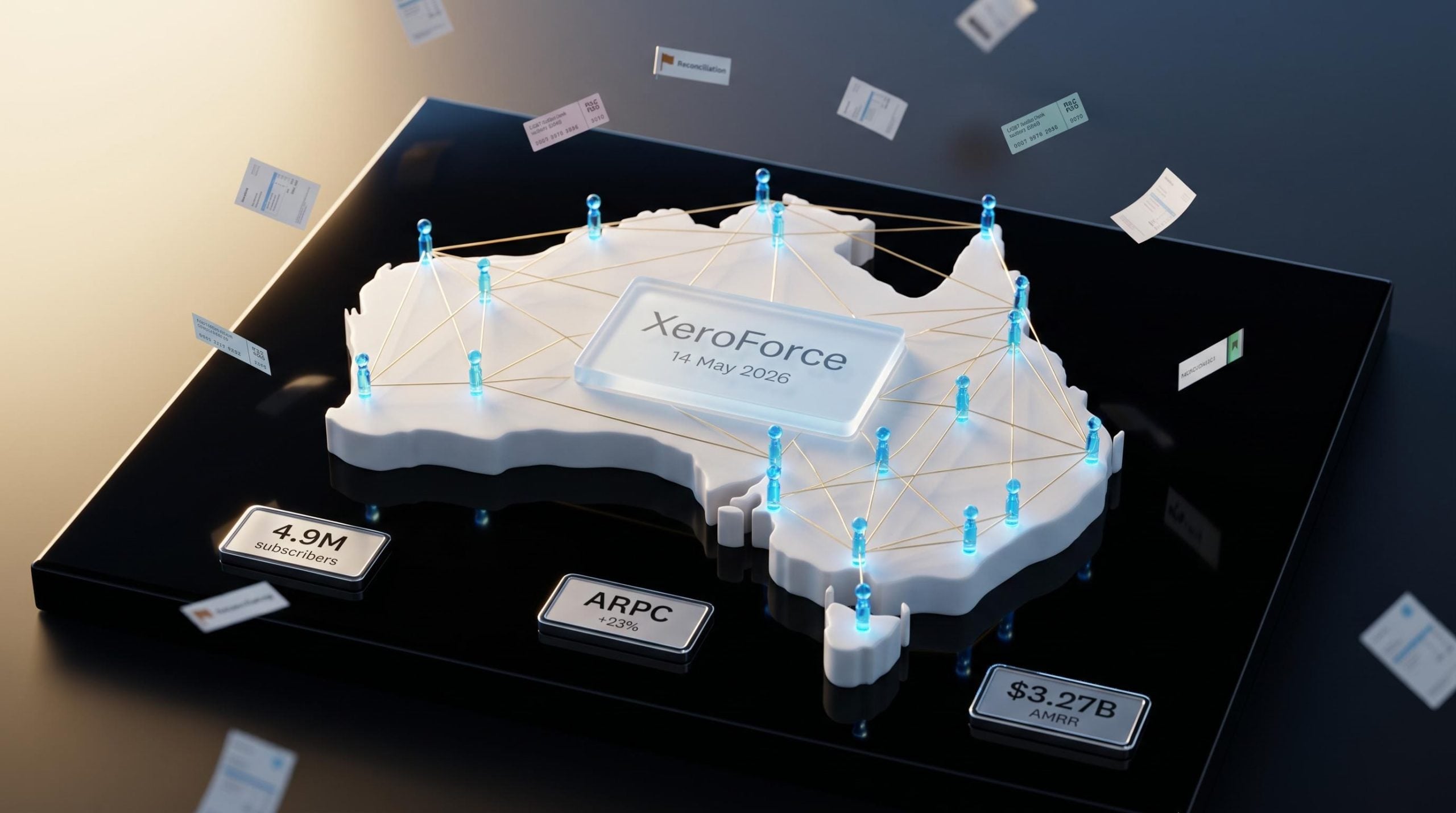
Australian accountants and bookkeepers spend hours each week on workflow tasks that follow identical rules every time: chasing overdue invoices, coding supplier transactions to the same accounts, flagging reconciliation exceptions. Xero believes a natural-language agent builder can eliminate most of that friction without requiring a single line of code. On 14 May 2026, the company announced XeroForce, an invite-only alpha product that lets users describe a recurring workflow in plain English and deploy an AI agent to execute it automatically.
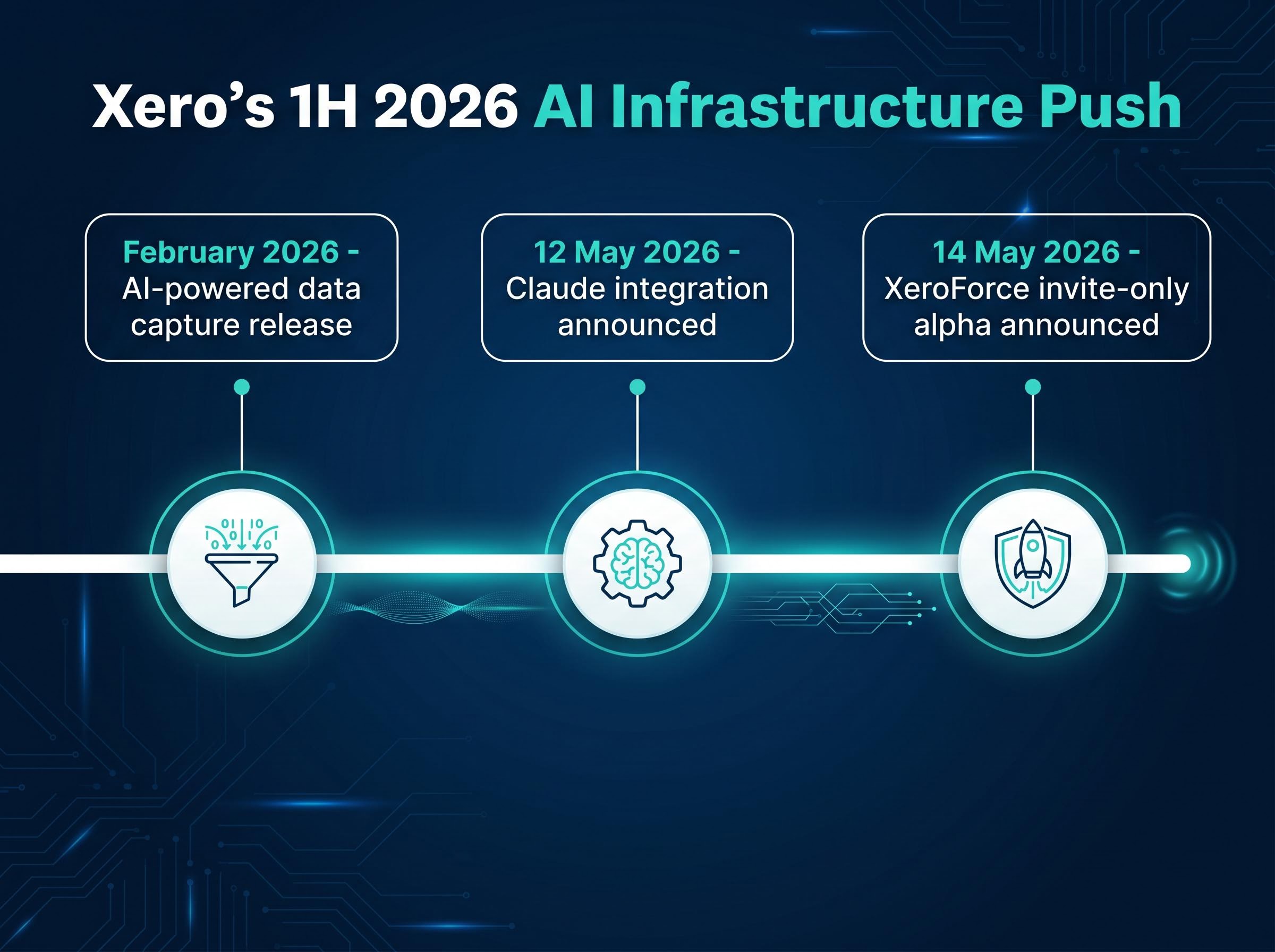
The announcement is not a standalone feature drop. It follows Xero’s February 2026 AI-powered data capture release and a Claude integration announced on 12 May 2026, forming a deliberate, sequenced infrastructure push across the first half of 2026. This article explains what XeroForce actually does and how it differs from conventional AI add-ons, what Xero’s three-part commercial AI model signals for subscription costs, how XeroForce compares to MYOB and other local competitors, and why Australian compliance realities will shape whether this strategy succeeds or stalls.
What XeroForce actually does, and why “agent builder” is different from “AI feature”
A user opens XeroForce, types a natural-language instruction describing a recurring workflow, and the platform builds and deploys an agent to execute it. No code. No IT resources. The agent runs persistently, handling the task each time its trigger conditions are met.
Concrete examples of workflows a user might automate include:
- Sending overdue invoice reminders every Friday for balances exceeding a set threshold
- Coding all transactions from a specific supplier to a designated account
- Flagging reconciliation exceptions that exceed a defined variance
- Triggering cash-flow alerts when balances drop below a configured minimum
The distinction worth understanding is architectural. An embedded AI assistant answers questions or surfaces insights when prompted. XeroForce is a builder: it constructs persistent, cross-app workflow automations that run without ongoing user input, operating across both Xero’s own platform and third-party applications already embedded in Australian accounting stacks.
Xero’s stated design principle is that XeroForce requires no technical expertise or IT resources to configure. The company has also confirmed that no customer data is used for model training, and financial data access is session-limited.
That accessibility claim is central to the product’s value proposition. If XeroForce works as described, it functions as a workflow infrastructure layer rather than a smarter search function, and that changes the calculus for practitioners evaluating whether to invest time in configuring it.
When big ASX news breaks, our subscribers know first
Understanding Xero’s AI Pricing Strategy: Bundled, Premium, and Usage-Based Tiers
Xero has outlined a three-pronged commercial framework for its AI capabilities, and the structure tells a story about where cost pressure is likely to build.
| Tier | What it includes | Pricing structure |
|---|---|---|
| Bundled AI features | Core AI capabilities integrated into existing subscription plans | Included in current subscription pricing |
| Premium AI add-ons | Advanced automation and intelligence capabilities beyond the base tier | Standalone paid add-on |
| Usage-based AI | Agent actions executed at scale (volume-linked) | Per-action or volume-based pricing |
The usage-based tier is the most structurally significant element. It means the more value a firm extracts from AI automation, the higher its Xero bill becomes. That is a fundamentally different cost structure from flat subscription pricing, and it cuts both ways: it lowers the barrier to trial but raises the ceiling on cost at scale.
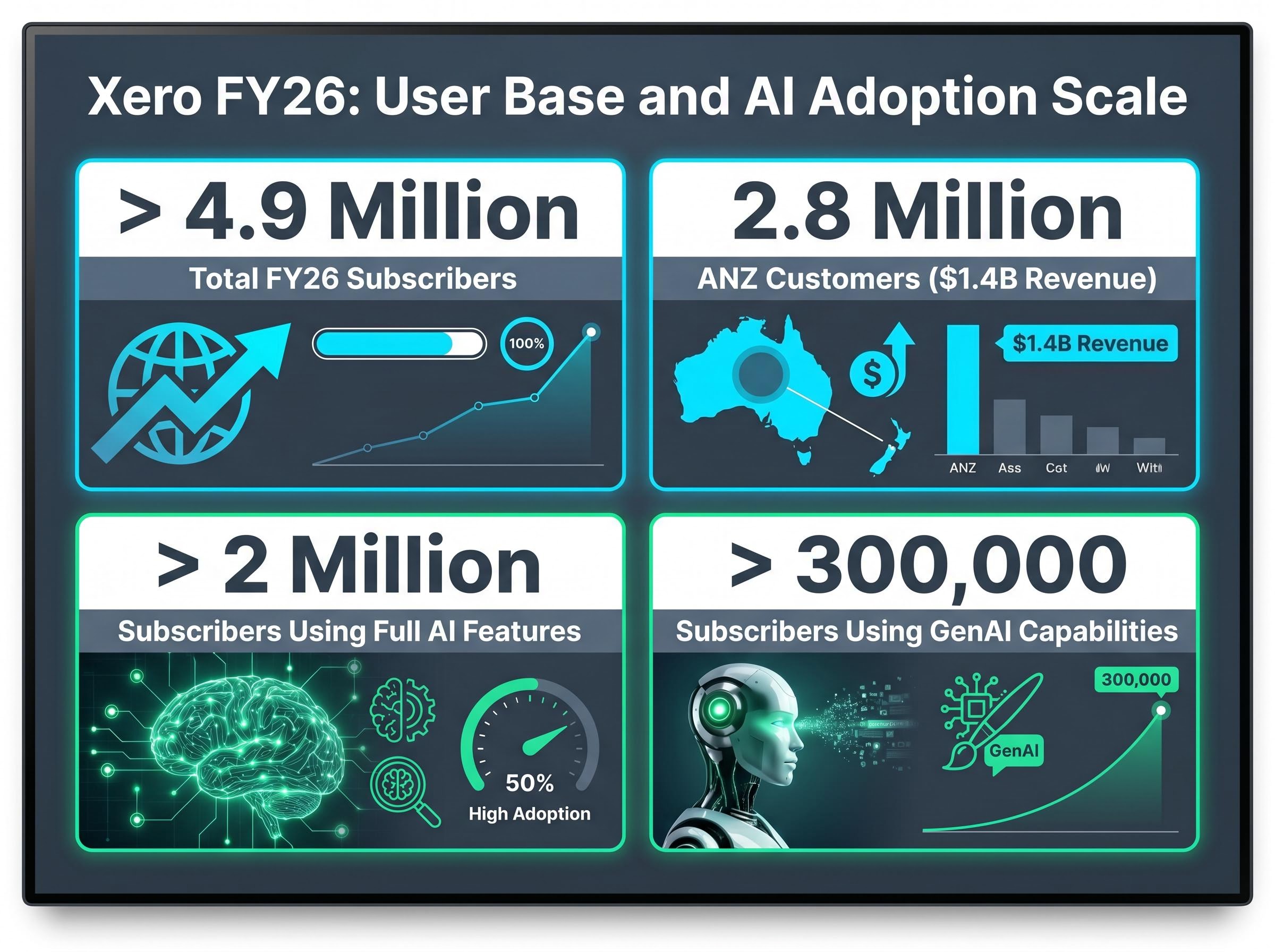
The numbers suggest Xero is building toward meaningful AI-driven revenue expansion. Total subscribers exceeded 4.9 million in FY26, with average revenue per customer (ARPC) rising 23% to $55.44. More than 2 million subscribers already benefit from full AI features, and over 300,000 are using newer GenAI capabilities. FY27 revenue guidance of $3.62 billion to $3.73 billion, combined with annualised monthly recurring revenue (AMRR) growth of 37% to $3.27 billion in FY26, signals that AI premium pricing is likely factored into the forward growth model.
Xero’s AI monetisation roadmap, including the JAX platform engagement metrics and the H2 FY28 Melio breakeven timeline, situates XeroForce within a broader commercial architecture that is already producing measurable ARPC expansion well before the agent builder reaches general availability.
What alpha status means for pricing certainty
XeroForce’s invite-only alpha phase means no public pricing has been confirmed for the agent builder specifically. The three-tier framework should be treated as the structural template, not a confirmed price sheet. Firms evaluating XeroForce would benefit from monitoring general availability announcements for actual pricing confirmation before budgeting for usage-based costs.
What AI agents are and why the accounting profession is a natural fit
An AI agent is a software process that perceives an input (a due date arriving, an account balance crossing a threshold, a transaction flagged for review), makes a decision based on configured rules or learned patterns, and executes an action (sends a reminder, categorises a transaction, triggers an approval request) without waiting for a human to initiate each step. It is not a chatbot. It acts, rather than answers.
Accounting workflows are structurally well-matched to this kind of automation because they are high-frequency, rule-based, data-rich, and repetitive. An agent can follow the same logic a human bookkeeper would, without the fatigue or inconsistency that accumulates across hundreds of identical tasks per week.
The five workflow categories where AI agents have the clearest return on investment are:
- Receipt and document capture
- Transaction coding and categorisation
- Overdue invoice and payment reminders
- Cash-flow threshold alerts
- Reconciliation exception flagging
Techaisle has framed Xero’s AI roadmap as moving from reactive queries toward proactive, strategic nudges and an “autonomous financial OS,” positioning XeroForce as one step toward that longer-term vision.
The boundary condition matters as much as the capability. Agents work well on well-defined, bounded tasks and become unreliable on judgment-intensive, context-dependent, or exception-heavy work. That is why industry consensus is forming around mandatory review and approval gates before agent actions execute, full audit trails, and granular permissioning. The technology handles the repetition; the human handles the judgment.
How XeroForce compares to MYOB, QuickBooks, and Sage in the ANZ market
The competitive comparison that matters for Australian accountants is architectural, not feature-based. Each major vendor is building AI capability, but the underlying approach differs in ways that shape what practitioners can actually do with each platform.
| Vendor | AI positioning | Architectural approach | ANZ market strength |
|---|---|---|---|
| Xero (XeroForce) | Natural-language agent builder for custom workflow automation | Builder (user-constructed cross-app agents) | Strong: 2.8M ANZ customers |
| MYOB | Compliance-led embedded automation for ANZ payroll and tax | Embedded automation | Strong: deep local compliance footprint |
| Intuit / QuickBooks | AI assistant within large proprietary finance ecosystem | Assistant (conversational, in-platform) | Moderate: less ANZ density |
| Sage | Workflow automation and insights across SMB and mid-market | ERP-adjacent agentic features | Limited: less central in ANZ SMB |
MYOB is the most credible local competitor. Its compliance and payroll footprint gives it strong brand familiarity with Australian bookkeepers, and its AI strategy is oriented around the specific regulatory complexity of ANZ payroll and tax. XeroForce’s cross-app orchestration ambition appears more expansive than MYOB’s current SMB bookkeeping AI scope, but the comparison is premature until XeroForce exits alpha.
Xero’s ANZ segment generated $1.4 billion in revenue from 2.8 million customers in FY26, with ARPC up 17%. That installed base is a structural advantage for XeroForce rollout. No Australian competitor has yet announced a natural-language custom agent builder product comparable to XeroForce.
Why Australian compliance requirements will shape XeroForce’s product design more than global AI trends will
The ATO’s ongoing digitisation and data-matching requirements raise the stakes for automated bookkeeping. An AI agent that mis-codes a transaction or executes an action without a clear audit trail creates genuine tax compliance exposure, not just an operational inconvenience. Clean, auditable automation is not optional in this market; it is the baseline.
AI governance gaps in Australian financial services have attracted direct APRA supervisory attention, with the regulator’s April 2026 letter explicitly citing insufficient board-level AI literacy and dangerous vendor concentration risk as priorities enforceable under existing prudential standards, a regulatory posture that frames the compliance stakes for any automated workflow tool operating in this environment.
Single Touch Payroll (STP), the ATO’s real-time payroll reporting system, is a domain where AI agent automation carries particular risk. STP is rules-heavy, error-sensitive, and driven by lodgement deadlines. An agent that misclassifies an employee or triggers a lodgement with incorrect data creates compliance liability. Xero’s stated posture of mandatory human review gates before any agent action executes is especially relevant here.
The ATO’s Single Touch Payroll reporting obligations require employers to transmit payroll data to the ATO at each pay event in real time, meaning any agent-triggered lodgement error cannot be corrected quietly after the fact but creates an immediate compliance record that must be amended through a formal process.
Xero’s four stated AI data and compliance design principles are:
- No training on customer data
- Session-limited financial data usage
- Human review and approval gates before agent actions are finalised
- Full audit trail support
These principles, consistent across the February 2026 data capture announcement, the Claude integration, and XeroForce, establish a pattern: automation with controls. Australian Privacy Act obligations add a further design constraint on data handling architecture.
The OAIC guidance on AI products and privacy obligations clarifies that Australian Privacy Principles apply in full when personal information is processed by third-party AI systems, placing the burden on the deploying business to verify that vendor data handling architecture meets those requirements before agents are activated in production.
Where e-invoicing creates the clearest automation opportunity
E-invoicing is the domain where compliance requirements and AI agent capability align most cleanly. The data is structured, the workflow is bounded, and the ATO’s own digitisation agenda is pulling in the same direction. Invoice routing, exception flagging, and approval triggering are precisely the high-frequency, rule-based tasks that AI agents handle most reliably. For Australian practices, this is likely the first domain where XeroForce agents could deliver measurable efficiency gains with manageable compliance risk.
XeroForce is a directional bet, not a finished product, and that distinction matters
XeroForce is in invite-only alpha as of May 2026. No public third-party case studies have been published. No practitioner adoption data is available. Neither CPA Australia, CA ANZ, nor the Institute of Certified Bookkeepers has issued commentary or guidance. Editorial framing should reflect this status.
What the evidence does support is a coherent, sequenced AI infrastructure strategy from Xero spanning February through May 2026, a genuine architectural distinction from conventional AI feature add-ons, and a product concept well-aligned with Australian practitioners’ expressed desire for time-saving automation in bounded, repeatable tasks. The sequence from vendor-led coverage through partner commentary, conference mentions, and case study publication typically spans 12 to 24 months for invite-only alpha products in the accounting software market.
Practitioner sentiment, while early-stage, is instructive:
- Positive signals: time savings on repetitive tasks, ability to scale without headcount, improved real-time cash-flow visibility for clients
- Cautious signals: accuracy concerns for compliance-critical work, liability ambiguity when AI produces errors, data sovereignty questions, risk of junior staff skill erosion
AI accuracy limitations in Australian financial contexts extend well beyond accounting workflows: documented error rates on Australian financial queries, the absence of licensing frameworks for AI-generated recommendations, and the particular risk concentration in SMSF and superannuation content all illustrate why the practitioner instinct to require human review before any automated action is finalised reflects genuine liability exposure, not overcaution.
“Accountants and bookkeepers broadly welcome automation that reduces manual data entry and improves client service, but they remain sensitive to accuracy, liability, and the need for human review before any automated action is finalised.”
Xero’s AI readiness white paper for the Australian market signals the company is in an “educate and de-risk” phase, which typically precedes broader customer adoption. Over 300,000 subscribers already using newer GenAI features provide a ready pilot audience for XeroForce when broader access follows.
XeroForce and the slow, necessary work of earning accounting professionals’ trust
XeroForce represents a genuine architectural shift in how accounting software delivers value, moving from reactive query tools to proactive workflow infrastructure. Its commercial success in Australia depends on closing the trust gap between vendor capability claims and practitioner confidence in AI accuracy and auditability.
Three concrete adoption signals are worth monitoring:
- First independent case studies from Australian accounting firms using XeroForce agents in production workflows
- Commentary or guidance from CPA Australia or CA ANZ on agentic AI tools in accounting practice
- General availability pricing confirmation, particularly whether the usage-based tier applies to XeroForce agent actions
Xero’s FY27 revenue guidance of $3.62 billion to $3.73 billion, and its medium-term target to double FY25 revenue by FY28 on an organic basis, indicate that AI-driven ARPC expansion is central to the growth model. The vendor that builds the most trusted, compliance-safe agentic layer in ANZ, whether Xero or a competitor, will gain a durable platform advantage that is difficult to replicate. Trust in accounting automation is earned through demonstrated accuracy over time, not announced at a product launch.
For investors reading this analysis who want to weigh XeroForce’s commercial potential against Xero’s current market pricing, our deep-dive into XRO’s current valuation discount examines the 53% compression in price-to-sales ratio against the five-year historical average, the RBA rate sensitivity embedded in that gap, and the analyst target range spanning $87.67 to $245.49 that reflects genuine uncertainty about the AI monetisation timeline.
This article is for informational purposes only and should not be considered financial advice. Investors should conduct their own research and consult with financial professionals before making investment decisions. Forward-looking statements regarding Xero’s product roadmap, pricing, and revenue targets are subject to change based on market developments and company performance.